
AI UGC vs Real UGC: The Evidence, Costs & When Each Wins
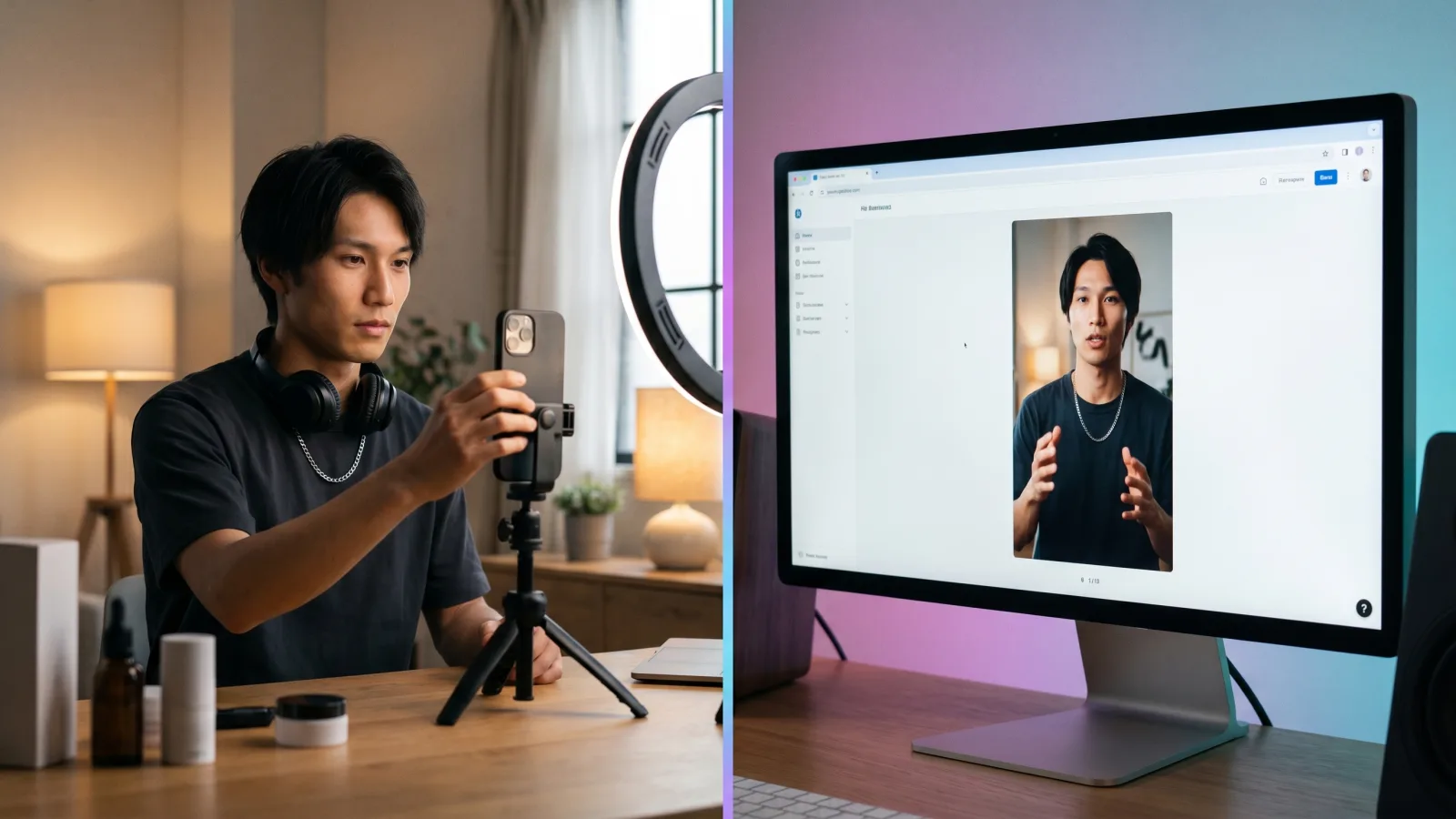
Neither format wins outright in the AI UGC vs real UGC fight. AI UGC wins the volume war — cost per tested hook, speed, languages — with one AI actor holding 100% character consistency across every variant on the Playcut Actor Engine. Real UGC wins the trust war: lived experience, creator reach, and the categories where authenticity is the product. The teams that win run both — AI for breadth, humans for depth.
The cleanest split test on record backs that split verdict. Across $100K of Meta spend and 220 creatives, human UGC won click-through — 2.4% vs 1.9% — while AI creative won ROAS, 2.8× vs 2.3×, on production economics (aubado). Our AI UGC guide covers what AI UGC is and how it’s made; this page is the promised head-to-head — evidence, cost math, rights, and routing.
Table of Contents
- AI UGC vs real UGC: the verdict at a glance
- What the performance data actually shows
- The real cost math: creator rates vs AI generation
- Speed, scale, and the fatigue clock
- Rights, licensing, and disclosure
- When real UGC wins
- When AI UGC wins
- The hybrid playbook: how teams actually run it
- Where Playcut fits
- Frequently asked questions
- Conclusion: run both, on purpose
AI UGC vs real UGC: the verdict at a glance
AI UGC is AI-generated video built to read like creator-filmed content; real UGC is the version a human creator actually films. That one-sentence definition is all this page re-teaches. Everything below compares synthetic UGC vs real creator content as ad formats: performance evidence, verified costs, speed, rights, and routing.
| Dimension | AI UGC | Real creator UGC |
|---|---|---|
| Same face across variants / creative control | One saved AI actor holds 100% character consistency across every hook, language, and aspect-ratio variant | Consistent within one creator; multi-creator batches vary with who you book |
| Cost per finished video | $5.51 measured voiced 10s clip; ≈ $16.53 voiced 30s (three 10-second scenes) | ~$197 cleared-market average; rate cards $150–$3,500+ by tier |
| Cost per tested hook | $0.97 per still | $25–$100 marketplace floor |
| Turnaround | ~21 seconds per still, minutes per clip (measured) | 10-day marketplace video SLA; 1–4 weeks hired end to end |
| Scale and variants | A 50-variant batch is a budget line; 30+ lip-synced languages | One creator typically delivers 1–2 ads per campaign cycle |
| Trust evidence | IAB: only 45% of consumers feel positive about AI ads; YouGov: 32% would trust a brand less | Wins perceived trust across surveys; won CTR 2.4% vs 1.9% in the $100K split test |
| Rights and licensing | Outputs owned under Playcut’s Terms, commercial license on every tier, no renewal clock | Licensed by scope and clock — paid-ad rights add 20–100%+ of base and renew |
| Disclosure duty | AI-content labels: FTC endorsement rules, EU AI Act Article 50, platform auto-labels | #ad and material-connection disclosure under 16 CFR 255 |
| Audience and reach | None of its own — you buy the media | Creator’s handle and audience, rentable via whitelisting and Spark Ads |
| Best for | Hook testing, variant volume, localization, always-on iteration | Testimonials, authenticity-critical categories, deep funnel, community |
Every number in that table is sourced in the sections below, and the cost rows are production-cost comparisons, not performance claims. The verdict deepens the one our pillar already shipped: AI UGC wins volume metrics — reach, variant count, cost per asset, speed of testing — while real UGC wins quality metrics — trust, authenticity, and influence on big-ticket buys.
What the performance data actually shows
Does AI UGC work? Yes — for specific jobs, and the honest evidence names them. This section tiers every number — peer-reviewed first, then platform-reported, then vendor-attributed — because in the AI UGC effectiveness debate, the most-quoted numbers are the least reliable.
The short version: AI UGC reaches click-through parity for cold-audience ad testing, and humans keep the edge as purchase intent deepens. Beyond the first-party tests below, no independent head-to-head benchmark exists; vendor numbers are self-reported.
The $100K split test both sides should read
The most useful single datapoint comes from advertiser aubado, which split $100K of Meta spend across 220 video creatives — 134 AI-generated, 86 human UGC — over three months. Human UGC won click-through, 2.4% vs 1.9%. AI creative won return on ad spend, 2.8× vs 2.3×.
The author’s own caveat ships with the result: “AI’s higher ROAS is driven by production economics, not by superior ad performance.” The same test found hybrid cycles surfaced 5–7 winning creatives per cycle versus 2–3 for either lane alone. Tier it honestly: first-party data from a single advertiser with no method appendix — the strongest number on this question, not a peer-reviewed one.
The case for AI UGC
The strongest evidence is peer-reviewed, and it’s about AI video broadly rather than an AI-vs-human head-to-head. A field experiment with over 21,000 consumers found AI-personalized video ads lifted click-through by roughly 6 to 9 percent over personalized image ads and generic video — 9.4% higher than the personalized image ads and 6.5% higher than the generic videos, per the summary (Kapoor & Kumar, Marketing Science; MIT IDE summary).
The platform tier points the same direction, with caveats attached. Meta reports a 22% ROAS lift from its Advantage+ AI ad system (Meta Engineering) — a real figure, but platform-reported and tied to the whole Advantage+ system, not AI-generated video alone. And adoption is mainstream: the IAB reports 86% of advertisers expect to use generative AI to build video ads (IAB).
On the direct ai vs real ugc ads question, the vendor tier is all anyone has. Agency and tool studies suggest AI UGC can reach roughly 85–110% of real UGC’s click-through rate for cold-audience ad testing while cutting production cost sharply (Superscale, inBeat). Treat every one of those figures as directional, not measured fact — both publishers sell AI UGC services.
The case for real UGC
The human side’s evidence is mostly about trust, and it is consistent. An IAB study of 505 US Gen Z and Millennial consumers found only 45% feel positive about AI ads, while 82% of ad executives assumed consumers did — a 37-point perception gap (IAB). Gen Z is the most skeptical, with 39% feeling negative versus 20% of Millennials. Our AI video ads guide unpacks that trust-gap dataset in full.
The largest consumer survey on record agrees. Polling nearly 10,000 people across seven global markets, YouGov found 32% of consumers say they would trust a brand less if they knew its content was AI-generated, versus only a small minority — 15% — saying it would increase trust; an overwhelming majority say it’s important that brands clearly disclose AI content (YouGov via Meltwater).
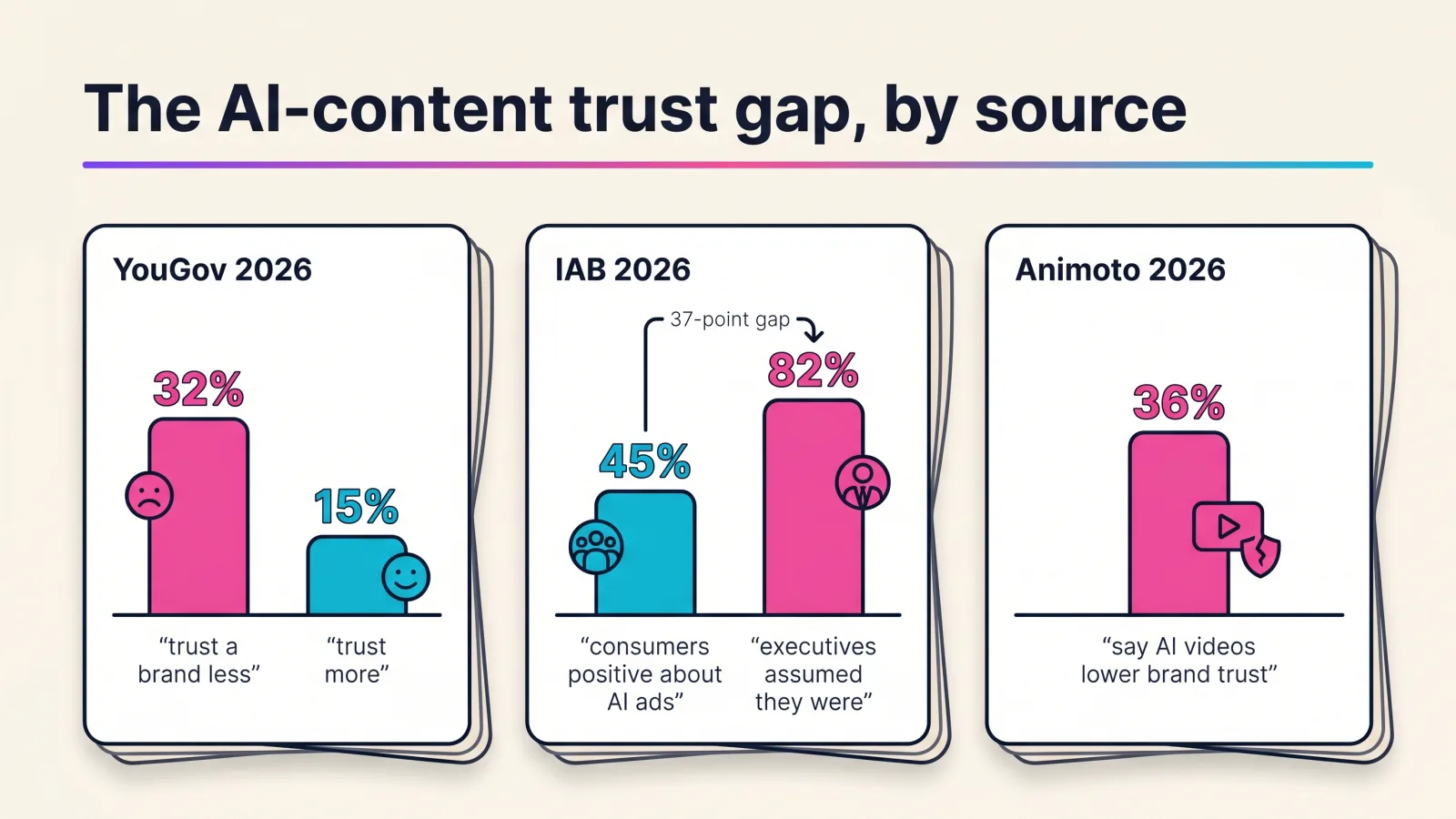
Consumers also believe they’re spotting it. In Animoto’s 2026 State of Video report, nearly 83% of consumers say they’ve watched a video they suspected was AI-generated, and 36% say seeing AI videos lowers their trust in a brand — the tells they report are robotic gestures (67%), unnatural voices (55%), and lack of emotional tone (51%). Caveats: it’s a vendor survey of 450+ US consumers and marketers, and self-reported suspicion is not verified detection.
And the $100K split test above puts a performance number on the same pattern: human UGC won the click, 2.4% vs 1.9%. The credible synthesis is the one our pillar shipped — real UGC still scores higher on perceived trust and wins more high-consideration, deep-funnel purchases.
The register effect: why UGC style wins either way
One stat family gets misused in this debate, so file it correctly. Creator-style ads earn +70% higher CTR and +159% higher engagement than brand-only ads at the same CPM — TikTok internal data, “The Creator Advantage,” Nov 2025, sample size undisclosed (TikTok).
That is a register comparison — casual, direct-to-camera UGC style versus polished brand creative — not an AI-vs-human result. It explains why both lanes of this comparison exist at all: the UGC format outperforms polish, whoever produces it.
The real cost math: creator rates vs AI generation
A real-creator video clears just under $197 on average; a measured voiced 10-second AI clip costs $5.51 — roughly 35× apart on production cost per asset, or 12–24× normalized per finished second. Usage rights then stack only on the human side. Here is every number with its source.
What real creators cost
| Creator tier | Per video (15–30s) | Source |
|---|---|---|
| First paid work (cleared floor) | $75–$300 | Marketplace and gig clearing data |
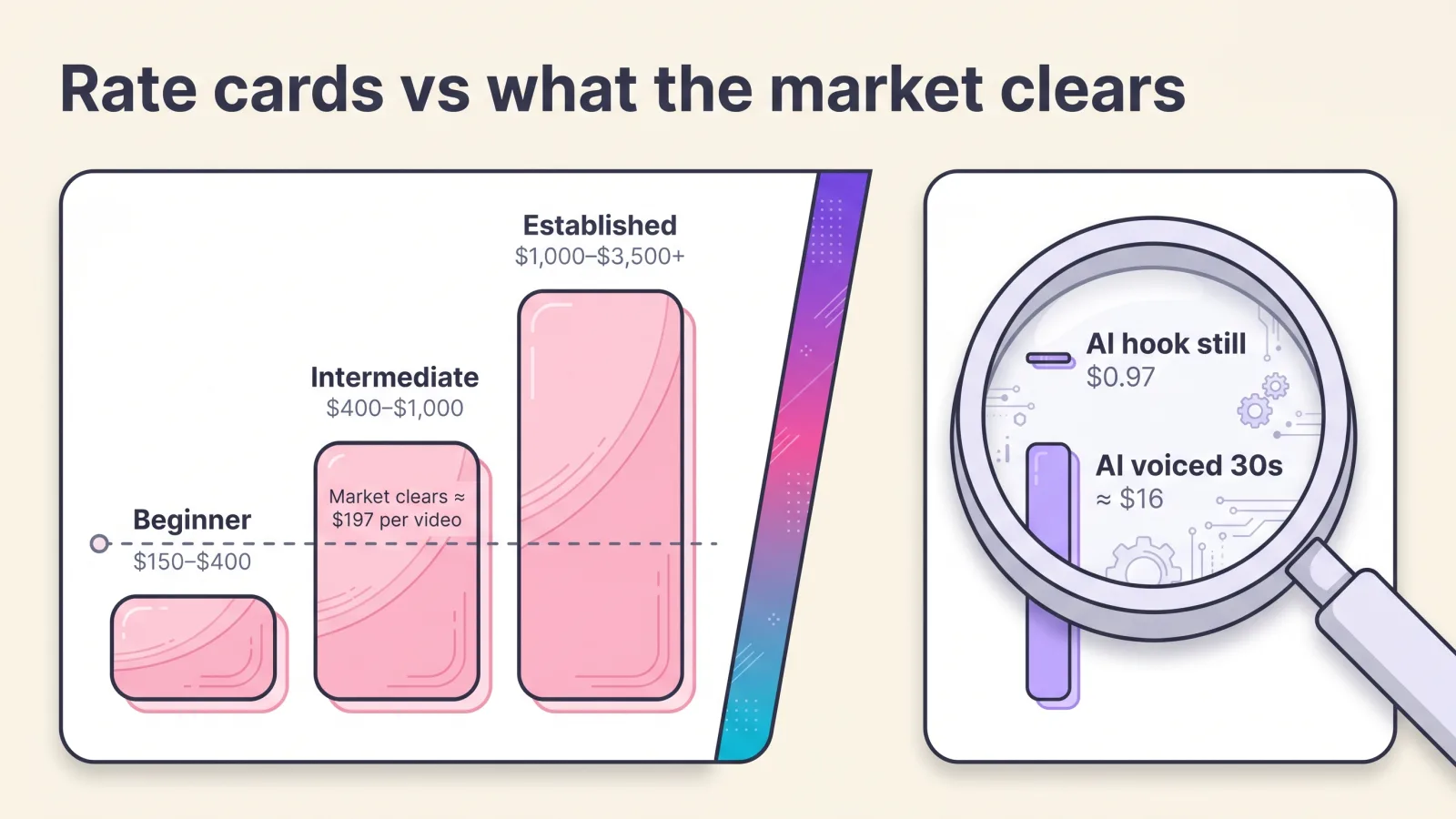
| Beginner ask (0–2 yrs) | $150–$400 | InfluenceFlow 2026 rate card |
| Intermediate ask (2–5 yrs) | $400–$1,000 | InfluenceFlow |
| Established ask (5+ yrs) | $1,000–$3,500+ | InfluenceFlow |
Rate cards are asks; the market clears lower. The 2026 average paid per UGC video sits just under $197 across 21,000+ collaborations in Collabstr’s 2026 report, and DesignRevision’s independent dataset lands within a dollar, at $198. Roughly 80% of collaborations close under $300–$500, and self-serve marketplace jobs floor at $25 per video (JoinBrands).
Usage rights stack on top of every band, and they renew — paid-ad usage alone adds 20–30% of base per month (PitchBrand) to 50–100% (InfluenceFlow). The full add-on math, packaged into seller-side rates, is in our pricing guide’s per-deliverable bands; the structural comparison is in the rights section below.
What AI generation costs (measured, not quoted)
The AI side uses our own measured numbers — generated on Playcut, billed to the credit, June 2026 — not vendor marketing ranges. We timed the whole run end to end in the step-by-step AI UGC production walkthrough, where each of these costs is logged per step.
| AI unit (Playcut, Pro rate) | Credits | Cost |
|---|---|---|
| Actor hook still (any aspect ratio) | 67 | $0.97 |
| Voiced 10s vertical clip — measured | 380 | $5.51 ($0.55/finished second) |
| Complete ad (hook still + voiced clip) | 447 | ≈ $6.48 |
| Voiced 15s (two 10s scenes) | 585 | $8.48 |
| Voiced 30s (three 10-second scenes) | 1,140 | ≈ $16.53 |
The voiced 10-second clip’s 380 credits matched the billing formula to the credit when we ran it. One generation maxes out at 10 seconds, so 15- and 30-second deliverables are multi-scene builds — call a voiced 30-second ad about $16 (three 10-second scenes). The full per-clip credit ladder across eight tools lives in our AI actor video cost breakdown.
The 30-clip program math
Assumptions, stated: the real lane prices a 15–30-second short-form video at the verified anchors above; the AI lane prices the measured voiced 10-second clip, with a 15-second build shown because a 10-second AI ad and a 30-second creator video are not perfectly matched deliverables. Cash uses real purchasable SKUs — a Pro plan plus never-expiring credit packs — and script, brief, and ad-ops labor is excluded on both lanes.
| 30 clips per month | Monthly cost | Per clip |
|---|---|---|
| All real — cleared average ($197–198) | $5,910–$5,940 | ~$197 |
| All real + monthly paid-ad usage rights | $7,092–$11,820 | rights renew each period |
| All AI — measured 10s clips (Pro + 2 Large packs) | $159 | $5.30 |
| All AI — length-matched 15s builds | $233 | $7.77 |
| Hybrid — 10 real + 20 AI | $2,073–$2,139 | ≈ $69–$71 blended |
At the cleared average, the all-AI program runs at about 3–4% of the all-real cost, and the hybrid keeps ten real-creator clips while cutting the bill roughly 64–65%. Normalized per finished second — which defuses the length mismatch — measured AI runs $0.55/s versus $6.57–$13.13/s for the cleared-average human video, a 12–24× gap.
Two framing rules keep this honest. Vendor audits peg AI UGC as about 70–90% cheaper than traditional UGC (Superscale’s figure); our program math is a different scope — measured units against verified market anchors — so cite them separately, never averaged. And all of it is production cost and iteration speed only: cheaper does not mean better-performing, as the split test above showed.
If you sell UGC content as a service, those deltas are the business model — the margin math walks through it from the seller’s side.
Speed, scale, and the fatigue clock
Real-creator UGC is measured in days to weeks. JoinBrands publishes delivery SLAs of 5 days for images and 10 days for videos, entry rate cards include about one revision round, and a hired-creator cycle runs 1–4 weeks end to end once scheduling, shooting, and revisions are counted.
AI UGC is measured in seconds to minutes. In our June 2026 lab runs, an actor still averaged ~20.5 seconds to generate (n=8) and a fully voiced 10-second clip rendered in about three and a half minutes — self-run point observations on our own platform, not guaranteed rates.
The reason that gap matters is creative fatigue. TikTok’s own Smart Creative documentation describes fatigue detection and automatic refresh kicking in within the first 3–5 days of delivery (TikTok) — the ad system is engineered around a days-scale creative lifespan — and its campaign formats presuppose batches, with minimums of 3 creatives for Smart Performance Campaigns and 4–6 for Smart+.
Creative volume is also where the sales leverage is. Across ~450 CPG campaigns, NCSolutions’ independent meta-study found creative drives ~49% of incremental sales impact — the single biggest lever, ahead of brand, reach, targeting, and recency (NCSolutions).
Put together: a weekly batch of fresh hooks is a $10–$30 line item on the AI side and a roster-scheduling problem on the human side. That is an argument about iteration economics, not ad quality — the routing question stays open until the rights and trust sections below.
Rights, licensing, and disclosure
The rights asymmetry is the part of this comparison almost nobody prices in. A hired creator’s invoice is a license, metered by scope and clock; an AI output from a studio with a commercial license is bought once. Both lanes still carry disclosure duties — different ones.
License vs ownership
A creator’s base fee typically buys creation plus about 3–6 months of organic use (PitchBrand). Paid-ad rights, whitelisting from the creator’s handle, and exclusivity are each paid add-ons that renew — the multipliers in the cost section — and a perpetual buyout runs +100–200%, which PitchBrand calls “incredibly rare and incredibly expensive.” Your best-performing ad keeps invoicing you.
That isn’t a scam; it’s the market pricing a genuinely scarce asset — a real person’s face and reputation. The fee is how exclusivity of a human being is rented, and it buys things AI can’t synthesize: the creator’s own audience and a real product experience.
Playcut inverts the structure: outputs are owned, not metered. The Terms state “you retain ownership of prompts, reference inputs, and generations you create,” and the pricing page lists a commercial license on every tier — no paid-usage line, no renewal clock, no model release to chase. Exclusivity is structural too: a custom actor is private to your workspace and cannot front a competitor’s campaign by construction.
Two caveats keep that paragraph honest. Playcut’s Terms note that generations are processed by third-party model providers whose content policies pass through to outputs — so it’s ownership under the Terms, not unconditional rights. And owning the asset does not waive a single disclosure duty, which is where the evidence gets interesting.
The disclosure triangle
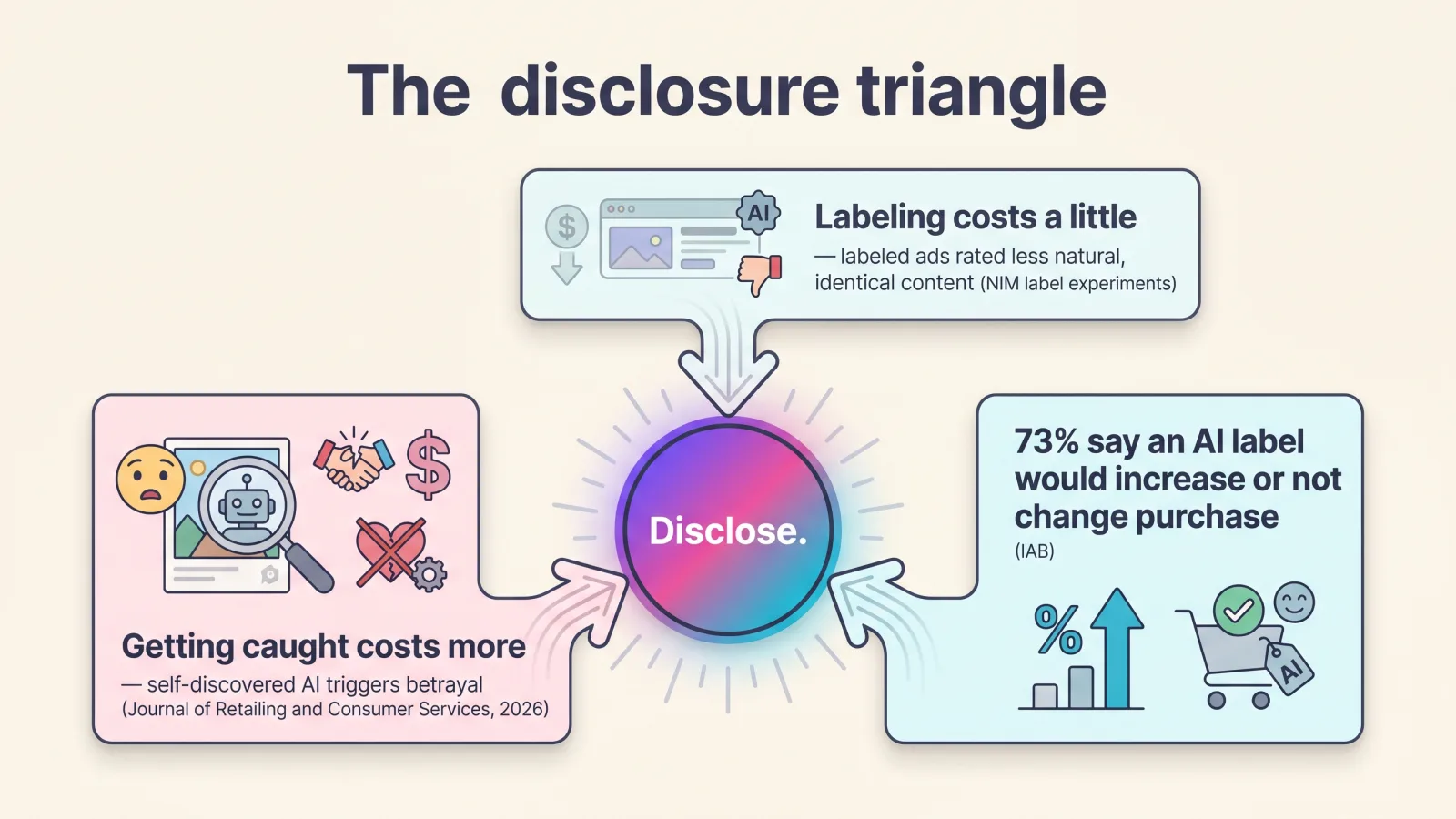
Three findings, read together, settle the disclosure question better than any one stat.
Labeling costs a little. The Nuremberg Institute for Market Decisions ran labeling experiments on 1,000-person samples in each of the US, UK, and Germany: labeling an ad as AI-generated led to a more critical evaluation — consumers tended to see the ads as less natural and less useful, even though the content was identical (NIM).
Getting caught costs much more. A peer-reviewed deepfake-UGC ad experiment by Yang & Lee in the Journal of Retailing and Consumer Services (2026) found that natural recognition — the viewer catching it themselves — triggers a stronger negative expectancy violation and sense of betrayal than proactive disclosure, and predicts undisclosed AI UGC’s effectiveness will fall as awareness rises (study record).
And most consumers say the label won’t stop the purchase. In the same IAB study cited above, 73% said knowing an ad was AI-made would increase or not change their purchase likelihood — labeling mitigates backlash rather than worsening it.
Disclosure also isn’t optional. The FTC’s endorsement rules cover any party that “could be or appear to be an individual” (16 CFR 255.0), the EU AI Act’s Article 50 requires deepfake disclosure from 2 August 2026, and Meta already auto-labels AI content. Human creators carry their own duty — #ad, material-connection disclosure — so neither lane is disclosure-free.
So: disclose. The label costs you a point of polish; the screenshot of an undisclosed synthetic “customer” costs you the brand. Every rule, penalty, and platform label is mapped in is AI UGC legal?.
The fake-testimonial line
One rule is absolute. The FTC’s Consumer Review Rule (16 CFR Part 465, effective October 21, 2024) bans reviews and testimonials attributed to a person who doesn’t exist or didn’t use the product — with civil penalties up to $53,088 per violation as of 2026 (up from $51,744 at the 2024 announcement).
The practical line: an AI actor reading a scripted ad is standard advertising; an AI actor presented as a real customer’s experience is a violation. No production-cost delta is worth $53,088 a screenshot.
When real UGC wins
These five lanes are concessions with teeth, not hedges — routing them to AI is either weaker on the evidence or illegal.
-
Lived-experience testimony. A real customer’s testimonial is the one format AI categorically cannot replace, because the fake-testimonial rule above makes it a legal line, not a taste call. If the pitch is “this worked for me,” the “me” must exist and have used the product.
-
Authenticity-critical categories. Health and wellness, finance, supplements, and results-driven beauty and skincare — audiences in these categories are primed to distrust a synthetic spokesperson, because embodied proof is the pitch itself.
-
Creator reach and whitelisting. Spark Ads and whitelisted campaigns run from the creator’s own handle to the creator’s own audience — distribution a synthetic persona simply doesn’t have. You’re buying the messenger, not just the message.
-
Deep-funnel, high-consideration buys. The trust evidence consistently favors humans — IAB’s 45% positive, YouGov’s 32% trust-less, the split test’s 2.4% vs 1.9% CTR — so concentrate human creative where purchase intent is high and the decision is considered.
-
Trend-native, community-embedded content. Reactive trend-riding, duets, and comment-section presence remain human jobs; they depend on being inside the conversation, not on production capacity.

A working rule for the ai ugc vs human ugc budget: brands buy authenticity from creators and volume from AI — the winners buy both, deliberately.
When AI UGC wins
The AI lane’s wins are volume-shaped, and they compound.
- Hook and concept testing at volume. A tested hook still costs $0.97 against a $25–$100 marketplace floor per human variant — roughly 200× cheaper per tested idea, production cost only.
- Speed. ~21 seconds per still and minutes per voiced clip versus 10-day SLAs; a losing concept costs you an afternoon, not a booking.
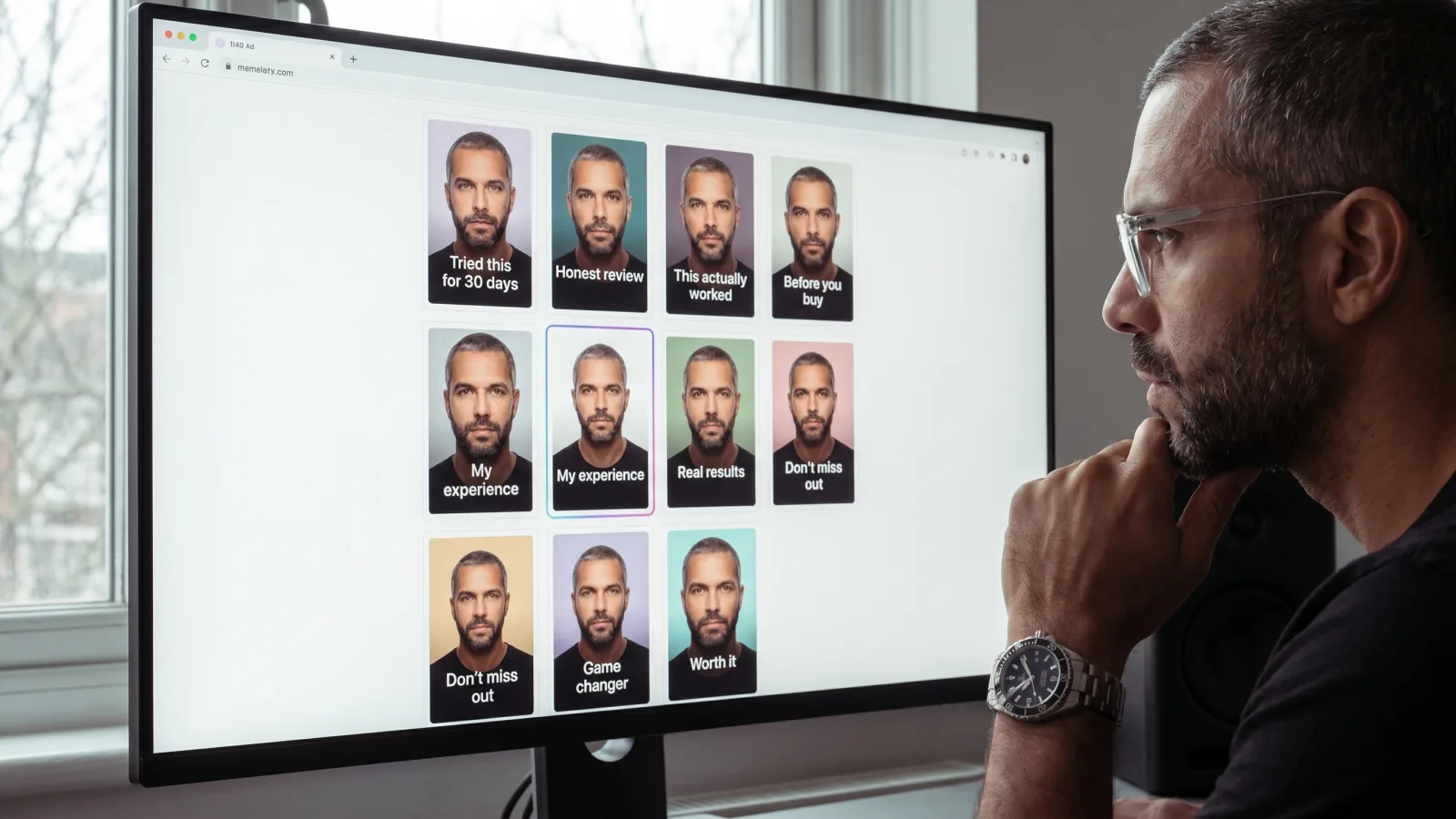
- Consistency and control. The same face fronts all 50 variants — a saved AI actor holds identity across hooks, languages, and aspect ratios, where multi-creator batches reset recognition with every new face.
- Localization. The Playcut Voice Engine ships 30+ lip-synced languages, so one winning concept becomes a multilingual campaign without re-casting.
- Iteration against the fatigue clock. Days-scale creative lifespans reward weekly refresh batches, which only one lane can produce at a sane cost.
- Rights simplicity. Owned outputs, commercial license included, no usage renewals, no model releases — the structural inversion from the rights section.
- Always-on cadence. Testing never waits on scheduling, shipping products to creators, or revision rounds.
The hybrid playbook: how teams actually run it
The realistic answer to this comparison is a split, and most teams already run one. The much-quoted 70/30 rule — roughly 70% of UGC volume from AI, 30% from real creators — is an agency rule of thumb, not a measured optimum; treat it as a starting allocation, not physics.
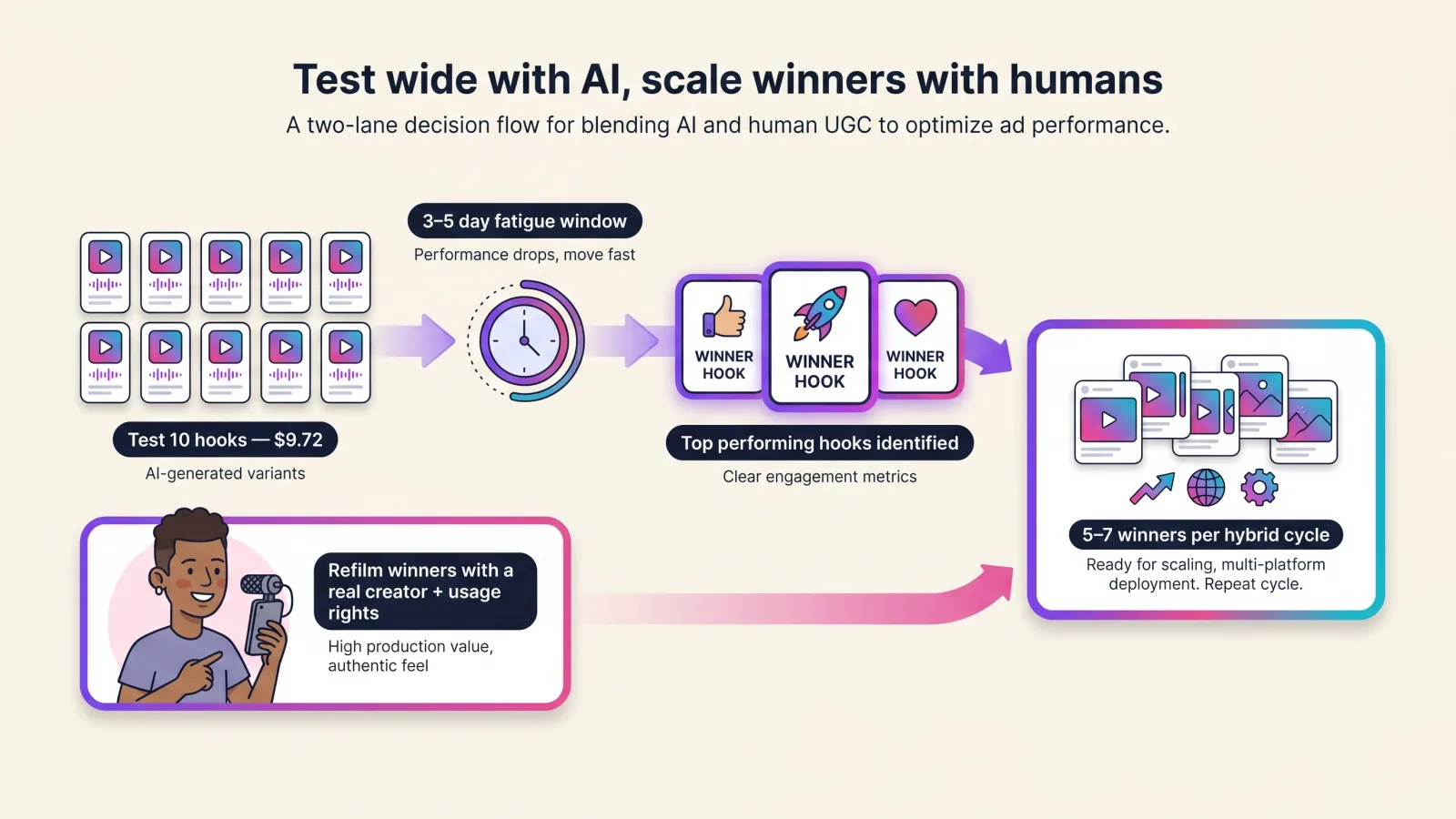
The operational version is a two-stage ladder with measured costs. Test ten hooks as actor stills for $9.72 total; animate the two or three winners as voiced 10-second clips at $5.51 each — about $26 of total discovery spend before the first creator dollar. Then refilm the proven winners with a real creator, buying proper usage rights for the scale placements.
The split test’s hybrid finding is the why: cycles mixing both lanes surfaced 5–7 winners per cycle versus 2–3 for either lane alone. AI breadth finds concepts; human depth scales the ones that deserve it.
Cadence and budget follow the same logic. Run AI as the always-on testing layer — weekly batches sized to the 3–5-day fatigue window — and spend human budget on proven hooks and the five lanes above. The hook anatomy and batch workflow live in our AI UGC ads guide, the operator’s version in how to start an AI UGC agency, and the production side in Playcut’s UGC ads workspace.
Where Playcut fits
Playcut’s lane in this comparison is the volume side, and its lead argument is consistency. The Playcut Actor Engine keeps one saved actor’s face, voice, and wardrobe identical across every still, clip, language, and aspect-ratio variant in a batch — so a 50-variant test reads as one campaign, not 50 strangers.
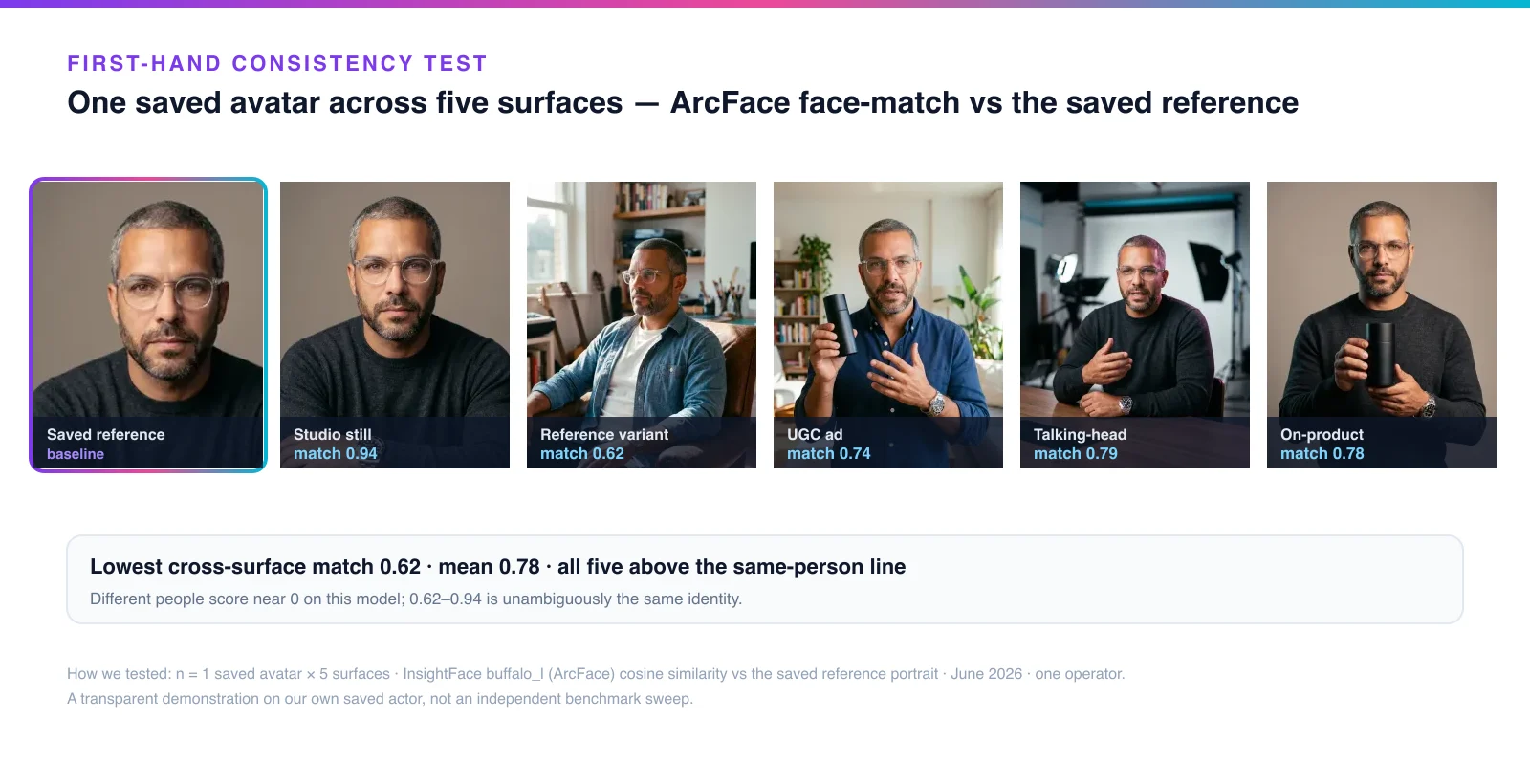
We publish first-hand numbers on that claim. Our five-surface consistency benchmark scored one saved actor at a 0.78 mean ArcFace match across five output surfaces (range 0.62–0.94; n=1 actor, June 2026, self-run). It measures Playcut self-consistency across formats; it is not a cross-tool benchmark.
The June 2026 end-to-end lab run behind this article’s cost figures held identity through video too: the face you cast in the thumbnail is verifiably the face talking in the ad — 0.57 ArcFace cosine still-to-video, 0.90 frame-to-frame (n=1 clip, one actor, self-run).
That whole run was one person, one chat session, zero filming: a scroll-stopping hook still in 21 seconds for $0.97, then a fully voiced, lipsynced 10-second vertical UGC ad in three and a half minutes for $5.51 — $6.48 total.
Full disclosure from that run: our one failed attempt was a parameter error — a 15-second request over the 10-second scene cap — and it still billed its $0.44 scene fee. Single runs on our own platform are point observations, not guarantees.
The rest of the volume stack: the Playcut Voice Engine’s 30+ lip-synced languages, multi-brand brand kits, and team workspaces. Pricing is flat — Hobby $9 fits one complete AI ad a month, Pro $29 covers about five voiced 10-second clips or 29 hook stills, and Pro’s $29 buys ten reusable custom actors at $2.90 each; Studio $79 and Agency $149/seat scale from there on the UGC ads page.
And the lane-honest close: when the brief calls for a real customer’s story, creator reach, or a high-trust category, hire the human — that work is theirs. Playcut covers the volume side of the split.
Frequently asked questions
Does AI UGC perform as well as real UGC?
For cold-audience ad testing, vendor data puts AI UGC at roughly 85–110% of real UGC’s click-through — directional, not measured fact. The cleanest first-party test (220 creatives, $100K on Meta) saw human UGC win CTR 2.4% vs 1.9% while AI won ROAS 2.8× vs 2.3×. Humans keep the edge as purchase intent deepens.
Is AI UGC cheaper than hiring a UGC creator?
On production cost, dramatically: a tested hook still runs $0.97 and a voiced 30-second AI ad about $16 (three 10-second scenes), versus a ~$197 cleared-market average and $150–$400 beginner rate cards per creator video — before usage-rights add-ons. That’s a production-cost comparison only, not a performance-parity claim.
Do consumers trust AI UGC less?
Survey evidence says yes, by a margin: 32% of consumers told YouGov they would trust a brand less knowing its content was AI-generated (15% more), and the IAB found only 45% of consumers feel positive about AI ads while 82% of executives assumed they did. The gap matters least in cold-audience testing, where AI UGC earns its keep.
Does disclosing AI UGC hurt performance?
Less than not disclosing. Label experiments found identical content rated less natural once marked AI-made, but peer-reviewed work shows viewers who catch undisclosed AI themselves feel measurably more betrayed than those told upfront. And 73% told the IAB an AI label would increase or not change purchase likelihood. Disclosure is also legally required either way.
Can AI UGC be used for testimonials or reviews?
No. The FTC’s Consumer Review Rule (16 CFR Part 465) bans testimonials from people who don’t exist or never used the product, with civil penalties up to $53,088 per violation. An AI actor reading a scripted ad is standard advertising; an AI actor presented as a real customer’s experience is a violation.
When should you still hire real UGC creators?
Five lanes: genuine lived-experience testimonials (the lane AI legally can’t enter), authenticity-critical categories like health, finance, and results-driven skincare, creator reach via whitelisting and Spark Ads, deep-funnel high-consideration purchases where the trust data favors humans, and trend-native community content. Route human budget there; let AI carry the testing volume.
What is the 70/30 rule for AI and human UGC?
An agency heuristic — not a measured optimum — that allocates roughly 70% of UGC volume to AI for testing breadth and 30% to real creators for trust depth. The operational version is a two-stage ladder: test hooks as $0.97 AI stills, animate winners with one consistent actor, then refilm proven concepts with a creator plus proper usage rights.
Will AI replace UGC creators?
The demand data says no: in Influencer Marketing Hub’s 2026 survey, 50% of brands plan to grow UGC-creator work and 0% plan to cut it, even as 86% of advertisers expect to build ads with generative AI. The job shifts toward hybrid delivery — our guide to becoming a UGC creator covers that pivot.
Conclusion: run both, on purpose
The AI UGC vs real UGC question doesn’t have a winner; it has a routing table. AI UGC owns the volume war — $0.97 tested hooks, $5.51 measured voiced clips, weekly refresh batches, 30+ languages, one consistent face across all of it. Real UGC owns the trust war — testimony, reach, authenticity-critical categories, and the deep funnel, with the survey data and the split test’s CTR on its side.
The teams that win stop treating it as a versus at all: AI for breadth, humans for depth, disclosure everywhere. If you’re choosing the AI half of that stack, our ranked AI UGC generator guide covers the tools — or start the two-stage ladder today at app.playcut.ai and put your first ten tested hooks on the board for under $10.