
The 8 Best AI UGC Generators of 2026 (Ranked & Compared)
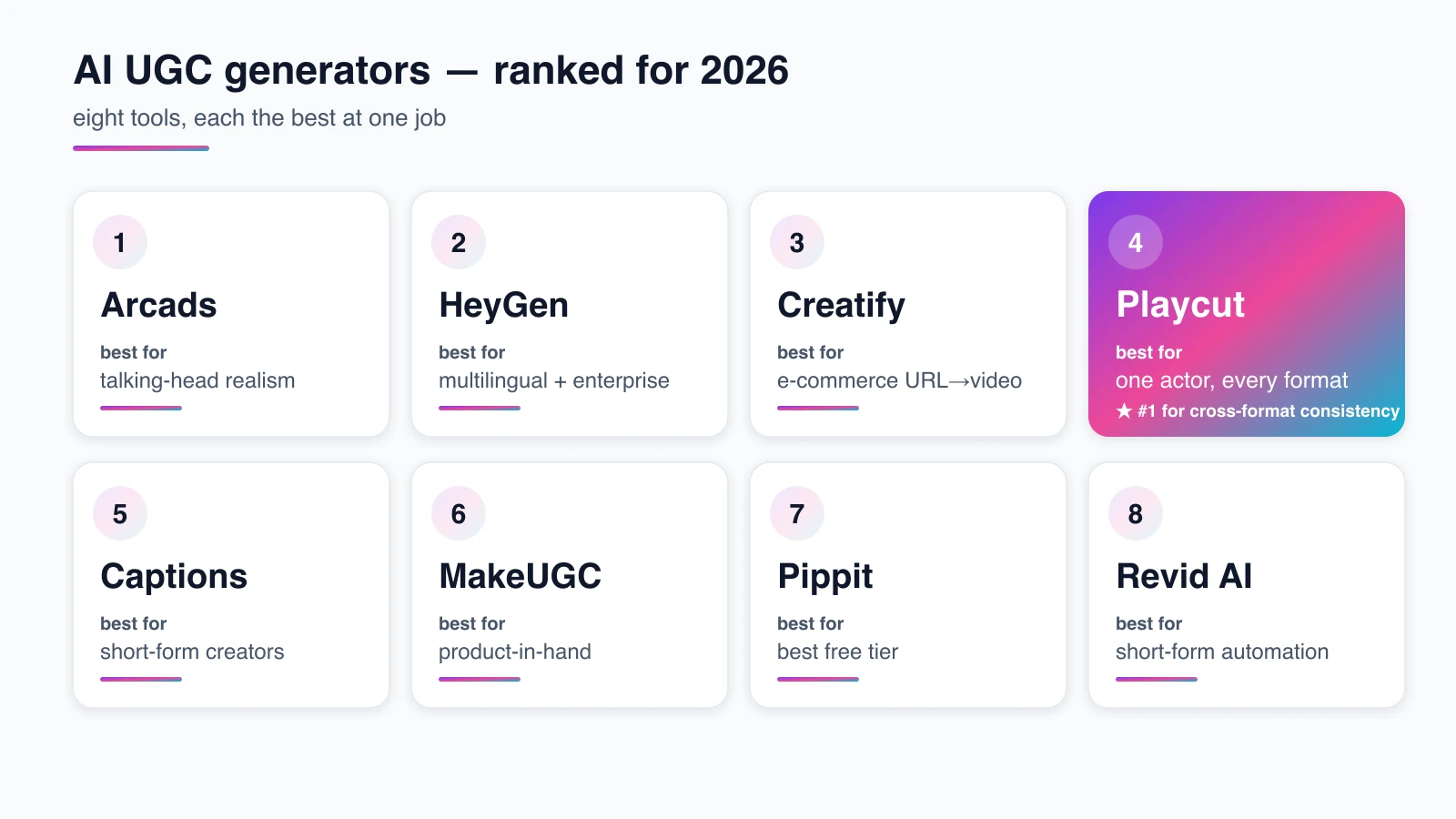
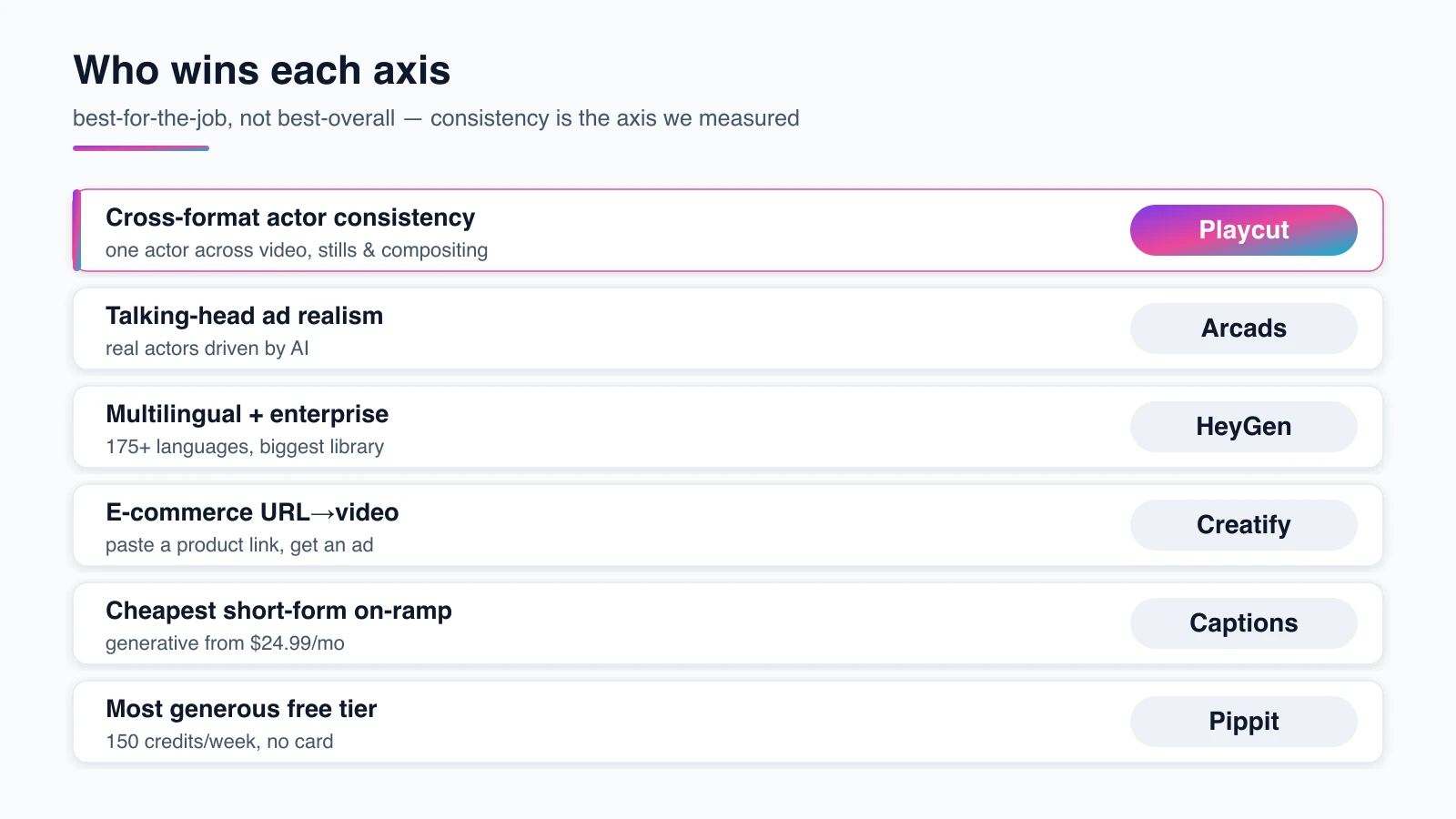
The best AI UGC generator depends on the job. Arcads is the most-cited for talking-head ad delivery, Creatify wins e-commerce URL-to-video, HeyGen on multilingual and enterprise localization, Captions on cheap short-form, and Playcut on keeping one AI actor consistent across video, stills, and compositing. There is no single winner — there’s a best tool for each use case.
This is a ranked, compared breakdown of the best AI UGC video generator tools in 2026, scored on a transparent rubric with pricing verified to each vendor’s own page. It’s for marketers, founders, and creators choosing one tool to make UGC-style ads at volume.
Playcut publishes this page — we make one of the tools below. We rank ourselves number one only for the single thing we can defend with a measurement (cross-format actor consistency) and name the tool that wins every other use case. Last updated: June 5, 2026.
Table of contents
- Best AI UGC generators at a glance
- How we ranked these tools
- The 8 best AI UGC generators, ranked
- How to choose the right AI UGC generator
- Our verdict
- Frequently asked questions
Best AI UGC generators at a glance
The table below ranks eight real AI UGC generators on entry price (verified to each vendor’s pricing page on June 5, 2026), free access, library depth, and whether the tool offers more than one generation model. Use it as the quick answer; the full reviews follow.
| # | Tool | Best for | Entry price | Free tier | Multi-model |
|---|---|---|---|---|---|
| 1 | Arcads | Talking-head ad realism | about $110/mo (unverified) | No | No |
| 2 | HeyGen | Multilingual + enterprise | $29/mo Creator | Yes (3 videos/mo) | No |
| 3 | Creatify | E-commerce URL→video | $33/mo Starter | Yes (10 cr, watermark) | No |
| 4 | Playcut | One actor across formats | $9 Hobby / $29 Pro | 7-day trial | Yes |
| 5 | Captions | Short-form creators | $24.99/mo Max | Basic only (no gen-AI) | No |
| 6 | MakeUGC | UGC-specific, product-in-hand | $49/mo Startup | No (refund only) | No |
| 7 | Pippit | The most generous free tier | Free / $24.17/mo | Yes (150 cr/week) | No |
| 8 | Revid AI | Credit-flexible short-form | $39/mo (promo) | Tool only | No |
Best for each job:
- Most-cited for talking-head ad delivery → Arcads
- Multilingual + enterprise localization → HeyGen
- E-commerce, URL-to-video at scale → Creatify
- One consistent AI actor across formats → Playcut
- Cheapest short-form on-ramp → Captions
- Product-in-hand UGC → MakeUGC
- Most generous free tier → Pippit
- Pay-per-action short-form automation → Revid AI
How we ranked these tools
We ranked these eight tools by use case, not by a single leaderboard score, because the right pick genuinely changes with the job. Every price and feature here is verified against the vendor’s own pricing or docs page on June 5, 2026; anything we could not confirm to a primary source is flagged as unverified. Avatar-library and language totals are each vendor’s own advertised figures.
The one number we measured ourselves is a Playcut cross-format consistency score. Every other tool is assessed from its verified specs and published demos, not from a head-to-head test we ran — so this page makes zero quantified cross-tool consistency claims. That honesty is deliberate: most “best UGC” lists crown the tool their authors sell and show no method at all.
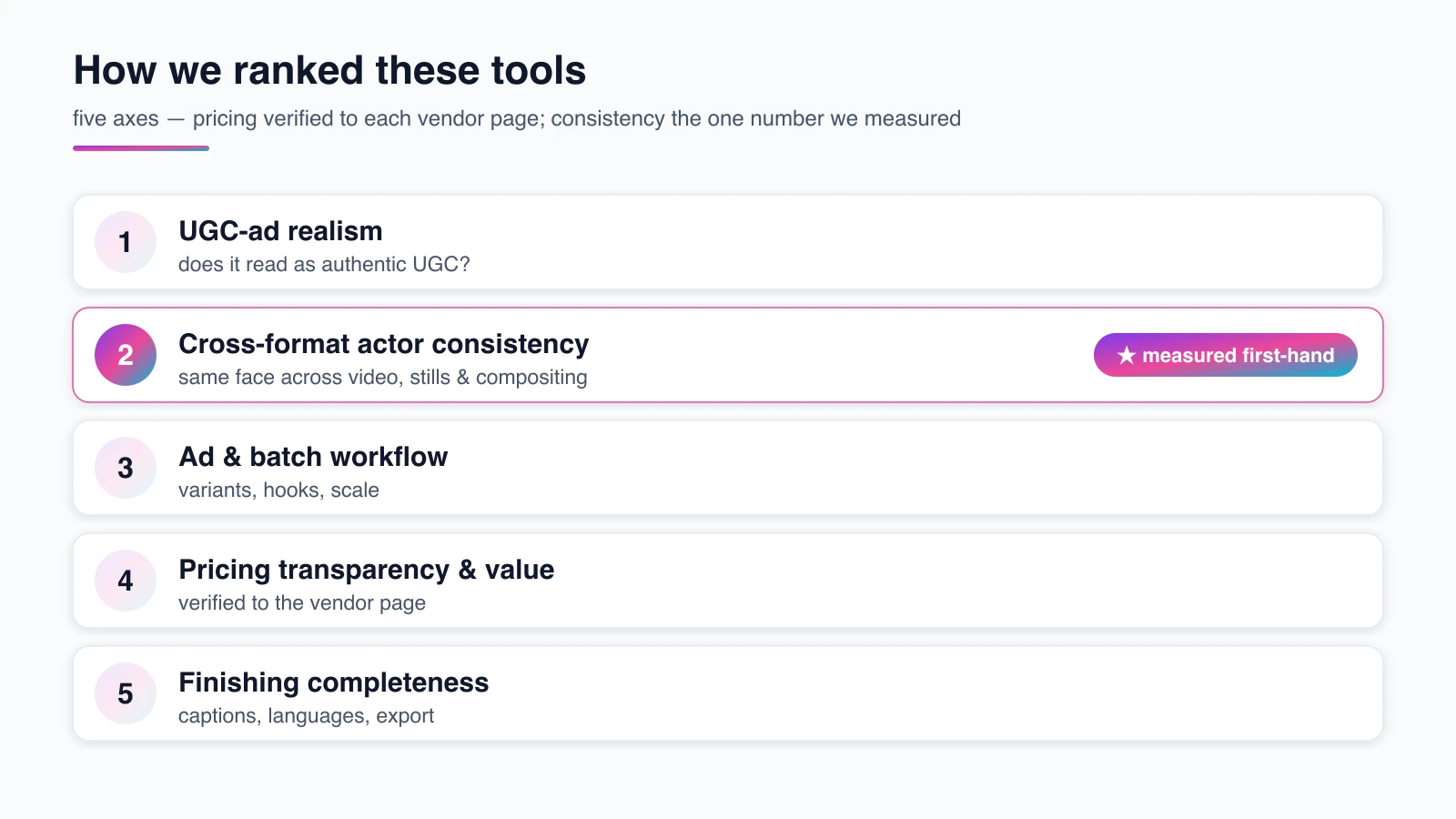
The rubric. We scored each tool on five axes: UGC-ad realism, cross-format actor consistency, ad and batch workflow, pricing transparency and value, and finishing completeness (captions, languages, export). Cross-format consistency is the axis no competing list scores, and it’s the one we measured.
The one consistency number we own. In an InsightFace ArcFace test (the buffalo_l model), a single Playcut AI actor held a 0.78 mean face-match cosine across five output surfaces — a still, a talking-head clip, an on-product shot, a UGC read, and a reference variant (n = 5 surfaces, one actor, run June 5, 2026). That measures Playcut self-consistency across formats; it is not a cross-tool benchmark.
For scale, HeyGen self-reports a 0.840 Face Similarity for its Avatar V model on its own 70-case benchmark — a different metric on a different dataset, so treat it as a sense of what “strong” looks like, not a head-to-head with our number.
Conflict of interest. Playcut publishes this page. We rank it number one only for cross-format actor consistency — the one thing we can back with a measurement — and we name the competitor that wins each other category.
The 8 best AI UGC generators, ranked
The ranking runs best-for-use-case, not best-overall. Each tool leads its own category; pick by the job you’re hiring it for.
1. Arcads — best for natural talking-head ad delivery
Arcads turns a script into a UGC-style talking-head video performed by a licensed AI actor, with full emotion control. It’s the most-cited pick in 2026 roundups for sub-60-second ad delivery and built for performance marketers who test creative in volume.
Overview. The core loop is script in, ad out: write hooks, pick actors, generate many variations, A/B test on paid social. Reviewers say most viewers can’t tell the output from real UGC, because it captures real-performer expressions and micro-movements.
Key features. Emotion control (you write the intended emotion and the actor performs it); product, app, and clothing integration; batch workflows like 10 hooks × 5 actors × 3 CTAs; speech-to-speech voice transfer with ElevenLabs voices on Pro. B-roll and one-click captions are still marked “coming soon.”
Pricing. Arcads does not publish public pricing — arcads.ai/pricing returns a 404 and plans sit behind a login. Third-party trackers consistently report Starter at about $110/mo for 10 videos (about $11 each) and Creator at about $220 for 20, with no free trial and no annual discount. Treat the figure as unverified to the primary source until you see it in-app.
Pros and cons. Best-in-class talking-head realism with pre-licensed actors and a real batch-variation workflow. Against it: the highest floor here (no free trial), a single format, and a non-exclusive output license — a competitor could surface a near-identical creative.
Best for: performance marketers who want the most believable talking-head ads and will pay for it.
2. HeyGen — best for multilingual and enterprise localization
HeyGen is the avatar and translation heavyweight, with the largest library and the deepest language coverage in this roster. Its honest best-for is localized spokesperson video and enterprise teams, with a dedicated UGC-avatar mode on top.
Overview. Pick or create an avatar, type a script, choose a language, and render an ad-ready talking-head clip. A dedicated AI UGC mode positions its avatars as creator-style “talking product video” actors for TikTok-style testimonials.
Key features. 1,100+ avatars by HeyGen’s count (the largest here); 175+ languages and dialects on paid plans; Avatar IV that turns one image into a full clip with lip-sync and hand gestures; a strong, citable consent-and-compensation ethics posture (it pays actors per video and doesn’t train on user data).
Pricing. Free tier (3 videos/month, ≤1 minute, watermarked), Creator $29/mo (600 credits), Pro $49/mo (1,000 credits, 4K), and Business $149/mo plus $20/seat (heygen.com/pricing, verified June 5, 2026). The hidden cost is credit burn: premium Avatar IV runs 20 credits per minute, so Creator’s 600 credits is roughly 30 minutes of premium video.
Pros and cons. Unmatched localization, a huge library, and a clear ethics stance, with a $29 entry that undercuts Arcads. Against it: credit burn makes heavy use far pricier than the sticker, and the corporate-clean register can feel too polished for scrappy UGC.
Best for: teams localizing spokesperson video across many languages, or enterprises needing SSO and API.
3. Creatify — best for e-commerce URL-to-video at scale
Creatify converts a product URL into UGC-style and product video ads, then layers ad-operations tooling on top. It targets the full “ad creation to ad buying” workflow, not just generation. An AI Media Buyer and a Competitor Ad Tracker push it past pure generation into running the ads, which sets it apart from the talking-head specialists.
Overview. Paste a product link and Creatify builds a finished video ad with an AI avatar; from there an AI Media Buyer and a Competitor Ad Tracker extend it into ad ops that pure generators lack.
Key features. URL-to-Ad maker; 1,500+ AI avatars plus 3 custom avatars on Pro; batch mode for 10+ variations at once; 75+ languages; AI scriptwriter and multi-aspect-ratio export; up-to-10-minute video on Pro.
Pricing. Free ($0, 10 credits, watermarked), Starter $33/mo (100 credits, watermark removed), Pro $49/mo (300 credits, 1,500 avatars, AI Media Buyer) (creatify.ai/pricing, verified June 5, 2026). A video costs 2–20 credits depending on length and model, so plan for roughly $3–$7 per usable video; credits don’t roll over.
Pros and cons. The lowest real entry with a genuine free tier, URL-to-ad automation, and an ad-ops layer competitors don’t have. Against it: avatar realism and lip-sync trail premium talking-head tools, and the 2–20 credit range makes true cost-per-approved-ad hard to predict.
Best for: DTC and e-commerce teams turning product pages into ad variants at scale.
4. Playcut — best for one consistent AI actor across formats
Playcut is the only tool here that pairs a multi-model picker with one custom AI actor that holds across formats — UGC video, product stills, and on-product compositing — rather than being a single-model talking-head generator. We make it, and we rank it number one only on that one axis.
Overview. A chat-driven studio puts a model behind every shot (Google Veo 3.1 and Seedance 2.0 for motion, Nano Banana Pro for stills, xAI Grok Imagine for fast surreal scenes) and pairs that with a library of custom AI actors you build yourself.
Key features. Unlimited custom AI actors (yours, not a stock library) that persist across stills, motion, UGC, and compositing; UGC ads in any language you script, performed natively by the video model; 9:16 ad-native output; multi-brand brand kits that lock palette and voice; team workspaces.
Pricing. Hobby $9/mo (500 credits), Pro $29/mo (2,000 credits), Studio $79/mo (6,000 credits, 4 seats), Agency $149/seat (10,000 credits/seat), with a 7-day trial on Hobby and never-expiring credit packs. The consistent-actor entry ($9–$29) undercuts every Tier-A rival’s entry tier.
Pros and cons. The only tool here that pairs a multi-model picker with a custom actor that persists across formats, at a $9–$29 entry that undercuts every Tier-A rival.
Against it: it’s not the talking-head realism leader (Arcads is) or the URL-to-video e-commerce machine (Creatify is); the actor library is what you build, not a 1,000+ stock roster like HeyGen’s; and beyond our own 0.78 self-consistency test, we publish no cross-tool benchmark.
Best for: brands and creators who need one actor to stay identical across video, stills, and on-product shots, across multiple models.

One saved Playcut actor across two surfaces. In our InsightFace ArcFace test, a Playcut actor held a mean 0.78 same-face cosine across five output surfaces (per-surface scores rounded). This measures self-consistency across formats, not a cross-tool score.
5. Captions — best for short-form creators
Captions is a caption-first video editor that grows into a full AI-UGC and AI-ad generator, and it’s the cheapest credible on-ramp into the generative tier. Its best-for is solo creators and small teams who want pro caption styling plus optional generative UGC in one app.
Overview. The DNA is best-in-class subtitle styling (100+ templates); higher tiers add an AI Twin, AI actors, text-to-video, and dedicated AI UGC and AI Ad generators.
Key features. Dedicated AI UGC generator (script to finished clip with built-in captions and translation); AI Twin to put a face to customer quotes; AI Ad generator that drafts UGC-style scripts; 100+ caption languages; generous credit rollover (up to a 3× banked cap).
Pricing. Free (basic editing, watermark, no generative AI), Pro $9.99/mo (removes the watermark, still no generative AI), Max $24.99/mo (500 credits — the real generative-UGC tier with AI Twin, AI actors, and text-to-video) (captions.ai/pricing, verified June 5, 2026). Watch the trap: the headline $9.99 has zero generative AI; UGC generation starts at Max $24.99.
Pros and cons. Cheapest generative on-ramp, the best caption styling here, and a lot of tools in one app. Against it: the $9.99 sticker is misleading (generative is $24.99), and the avatar-library count isn’t publicly disclosed.
Best for: short-form creators who want caption polish plus light generative UGC without a big spend.
6. MakeUGC — best UGC-specific budget pipeline
MakeUGC is purpose-built for the UGC-ad workflow — script, pick an avatar, generate — with a genuine product-in-hand feature that talking-head-only tools lack. It leans budget but gates its best features to the top tier.
Overview. The whole product is the UGC pipeline rather than a general editor, with a content library of proven ad formats to recreate and a video agent that rebuilds an ad’s structure from a reference clip.
Key features. 1,000+ AI creators; Product-in-Hand so the avatar physically holds the product (Pro+); B-roll and AI hook videos; batch mode; full motion control to replay the same movements across renders; 50+ languages.
Pricing. Startup $49/mo (5 videos), Growth $69/mo (10 videos), Pro $119/mo (20 videos, plus Product-in-Hand, custom avatar, and the video agent) (makeugc.ai/pricing, verified June 5, 2026). There’s no free trial — MakeUGC instead refunds unused credits — and credits don’t roll over.
Pros and cons. A real UGC-specific pipeline, product-in-hand, a large actor count, and clean perpetual ownership of your creatives. Against it: no free trial, low monthly video counts, and product-in-hand locked to the $119 Pro tier.
Best for: teams that want a dedicated UGC pipeline with product-in-hand and can live with low video counts.
7. Pippit — best free tier
Pippit, powered by CapCut and owned by ByteDance, has the most generous free tier in this roster and native publishing inside the TikTok ecosystem. It’s the entry point for e-commerce and TikTok-Shop sellers. Native CapCut editing and built-in scheduling mean you can make, edit, and publish a TikTok-Shop video without leaving the app.
Overview. Paste a link to make a video, use AI avatars, then edit with native CapCut tools and publish and schedule across platforms — much of it available on the free plan.
Key features. Link-to-video and AI avatars on the free tier; a UGC Maker (added January 2026) for organic-style ad videos; image studio and poster generators; multi-platform publishing, scheduling, and analytics.
Pricing. Free ($0, no card, 150 credits/week that refresh weekly — about two minutes of video), and Starter at $24.17/mo billed annually ($289.98/year, ~21,600 credits/year) (pippit.ai/pricing, verified June 5, 2026). It’s the cheapest paid entry and the standout free tier.
Pros and cons. A genuinely generous no-card free tier, native CapCut editing, and built-in TikTok publishing and analytics. Against it: a shallow reusable-actor system compared with Arcads or Playcut, credits that expire, and an annual-only discount.
Best for: e-commerce and TikTok-Shop sellers who want a strong free tier and native publishing.
8. Revid AI — best credit-flexible short-form
Revid AI is a credit-flexible short-form and faceless-video tool with a free UGC-ad generator as its entry point. It’s broad rather than UGC-specialized, with automation for hands-off posting. Auto-Mode Workers generate and post to TikTok, Instagram, and YouTube on their own, which is its real differentiator over single-output tools.
Overview. Create from text, links, or recordings; remix from a 3M+ viral-video library; and run Auto-Mode Workers that generate and publish to TikTok, Instagram, and YouTube on their own.
Key features. AI avatars, face swaps, and voice cloning; script and hook generation; 70+ voiceover languages; 3, 5, or 10 Auto-Mode posting Workers by tier; transparent per-action credit costs.
Pricing. Growth $39/mo (2,000 credits) — advertised down from a $99 list price, so quote both — with Elite $89/mo (5,000 credits) and Ultra $199/mo above it (revid.ai/pricing, verified June 5, 2026). Avatar lip-sync burns credits fast at 40 per 500 characters, roughly four times a plain voiceover.
Pros and cons. A cheap promo entry, a huge remix library, automated posting, and 100% content ownership. Against it: it’s a general short-form engine rather than a UGC specialist, lip-sync is credit-expensive, and the $39 is a promo off $99.
Best for: creators who want pay-per-action credit flexibility and automated short-form posting.
Also considered (not ranked)
Icon is excluded on purpose: it’s a human-creator UGC service, not an AI generator. It delivers six real human-filmed ads plus ad-ops software from $399/mo and brands itself “100% real, not AI,” so ranking it among AI tools would be a category error.
If you want real humans over AI avatars, it’s worth a look. Synthesia and Colossyan are enterprise training-video avatar tools rather than UGC-ad generators; for those, see our Synthesia alternatives breakdown.
How to choose the right AI UGC generator
The right tool follows the job, so match the pick to your primary use case rather than chasing an overall winner.
If you run paid social ads with talking-head hooks, Arcads is the most-cited for believable delivery, and Creatify gives the cheapest path to many variants. Both are built for testing creative in volume; Creatify wins price and automation. If those ads also need matching stills and product shots, that’s Playcut’s lane.
If you sell on Shopify or e-commerce, Creatify’s URL-to-video turns product pages into ads fastest, and MakeUGC’s product-in-hand puts the item in an avatar’s hands. Pair either with AI product photography for the stills.
If you need one actor across many formats, Playcut is the only tool here that keeps a single AI actor identical across video, stills, and on-product shots while giving you a model picker on every shot. For the mechanics of why faces drift between tools, see the AI actor generators compared breakdown.
If you’re on a tight budget or want a free tier, Pippit’s 150-credits-a-week free plan is the most generous, Captions starts generating at $24.99, and Playcut Hobby is $9. Most free tiers watermark, so confirm before you ship a client ad.
Our verdict
Start from the job, not the brand. If realism on a talking-head ad is everything, Arcads wins; if you’re localizing across markets, HeyGen; if you live in Shopify, Creatify; and if budget rules, Captions or Pippit’s free tier. The decision criterion, not a single overall score, picks the tool. Whether AI UGC beats hiring creators at all is the prior question — the AI UGC vs real UGC comparison answers it on the evidence.
Playcut is our pick for one job only: keeping a single AI actor consistent across UGC video, product stills, and compositing while you pick the model per shot. We build it, and we rank it number one only there — for everything else, the tool named above wins.
Whichever you choose, the workflow is the same idea: pick the model for the job, keep your actor and product consistent, and test variants cheaply. To understand the format itself before you buy, start with our AI UGC guide; to ship ad variants, see AI UGC ads and the AI UGC ad generator. To build with one consistent actor across formats, try Playcut’s AI actors free.
Frequently asked questions
What is the best AI UGC generator in 2026?
There’s no single best — it depends on the job. Arcads is the most-cited for talking-head ad delivery, Creatify wins e-commerce URL-to-video, HeyGen on multilingual and enterprise, Captions on cheap short-form, and Playcut on keeping one AI actor consistent across video, stills, and compositing. The comparison table above has the full ranked breakdown.
What’s the difference between this ranking and the AI UGC guide?
This page ranks and compares the best AI UGC generator tools to help you pick one. Our AI UGC guide is the explainer — what AI UGC is, whether it works, and how the workflow runs. Use the guide to understand AI UGC; use this page to choose a tool.
What is the best AI UGC video generator?
For UGC ad video specifically, Arcads is the most-cited for talking-head delivery and Creatify wins URL-to-video at scale. If you need one actor across video and stills, Playcut is the pick. Most tools here output 9:16 vertical video built for TikTok, Reels, and Meta.
Which AI UGC tool makes the most realistic videos?
Arcads is the most-cited pick in 2026 roundups for sub-60-second talking-head delivery — it films real actors and drives them with AI. The field has closed that gap fast: no independent head-to-head benchmark exists, and engine upgrades across 2026 (Playcut’s cinema-grade Actor Engine included) make ‘most realistic’ a vendor claim, not a measured fact.
What is the best free AI UGC generator?
Pippit, from CapCut and ByteDance, has the most generous free tier — 150 credits a week with no card required. Creatify’s free plan gives 10 credits and about two watermarked videos a month; HeyGen’s free tier allows three short videos a month. Most free tiers watermark, so check before you ship.
Is Playcut the best AI UGC generator?
Playcut is the best for the job that compounds: keeping a single AI actor consistent — same face and outfit — across a UGC video, a product still, and on-product compositing, rendered by a cinema-grade engine. For e-commerce URL-to-video at volume, Creatify is the specialist pick. We make Playcut and rank it honestly.
How much does an AI UGC generator cost?
Entry tiers run from about $9.99 to $110 a month, and the effective cost per video is roughly $2 to $20 depending on the tool and credits. The cheapest credible entry points are Captions at $9.99 and Playcut Hobby at $9. Arcads is the priciest at around $11 per video with no free trial, and its public pricing is unverified.
Are AI UGC ads legal, and do I have to disclose AI?
Yes, they’re legal, but disclosure increasingly matters. TikTok, Meta, and YouTube ask you to label AI-generated or AI-altered people, and the FTC treats a synthetic endorser like a human one — a fabricated ‘real customer’ claim it can’t support is a violation. Use the platform’s AI-content label and keep claims truthful.