
UGC With AI Actors: Why One Face Beats a Thousand Strangers
UGC with AI actors works best when one saved custom actor fronts the whole program: batch-test hooks as stills for about a dollar each, animate only the winners, and let the same face compound recognition while the hooks rotate. That takes an actor system built for reuse — the Playcut Actor Engine holds 100% character consistency across stills, video, UGC ads, and on-product shots, so every variant is unmistakably the same person.
Stock avatar libraries rent you a new stranger per ad. A saved custom actor is a brand asset you own. The whole strategy reduces to one sentence: hooks fatigue in days; faces compound for years — rotate the hook, keep the actor.
This guide is the program design, not a tool pitch: why rotating stock faces resets your brand to zero, the five-step actor-led program, what a ten-hook batch costs (metered on our own platform in June 2026), and the marketing science on familiar faces — including where that evidence is genuinely mixed.
Table of Contents
- The rotating-stranger problem with stock avatar UGC
- How to run UGC with AI actors: the 5-step actor-led program
- What a 10-hook batch with one actor costs
- Why the same face sells: familiarity and brand recall
- Frequently asked questions
- One actor, one program: where to start
The rotating-stranger problem with stock avatar UGC
Almost every tool ranking for UGC with AI actors sells the same model: a shared library of presenter faces licensed non-exclusively to every subscriber. The pitch is choice — hundreds or thousands of faces. The structural problem is that a shared face can front any subscriber’s brand, including a competitor’s, and rotating through the library means your audience never meets the same person twice.
The library sizes below are the vendors’ own marketing claims, pulled from their pages in June 2026. Treat them as self-reported counts, not audits.
| Vendor | Stock library size, by the vendor’s own count |
|---|---|
| Arcads | ”1,000+ Captivating AI Actors” (homepage) |
| HeyGen | ”more than 1,100 avatars” (UGC landing page) |
| MakeUGC | ”1000+ realistic AI actors” |
| Vidnoz | 1,800+ avatars advertised on the free tier |
| Akool | ”1000+ AI Avatars” — alongside self-published claims of 10M+ users and 73K+ companies |
| Synthesia | 240+ stock avatars |
Now run the arithmetic those pages invite. Akool, by its own count, advertises roughly 1,000 faces against a customer base it describes as 73,000+ companies. Every license is non-exclusive, so the face you cast from a shared library can be presenting someone else’s product next week — possibly a direct rival’s — and neither of you will know until both ads are live.
None of that is an accusation; shared libraries are a legitimate model and fine for one-off explainers or internal video. The failure mode is specific: using a rented, non-exclusive face as your brand’s recurring spokesperson. Even HeyGen’s UGC page — the only ranking page that sells reuse at all — sells stock reuse: the avatars “never disappear,” for you and for every other subscriber who picked the same face.
Full disclosure, because the argument cuts both ways: Playcut also ships a template library — 10,000+ stock actors on every tier. The differentiator is not library absence. It’s that every plan includes private custom actors — 3 on Hobby ($9/mo), 10 on Pro ($29/mo), 25 on Studio ($79/mo), unlimited per seat on Agency ($149/seat/mo) — built once in the Playcut Actor Engine and exclusive to your workspace. A custom actor cannot appear in a competitor’s ad by construction.
The deeper architecture argument — why a saved identity beats a re-prompted or rented face at a mechanical level — is covered in our AI actor guide, and ranked tool verdicts live in the best AI UGC generators roundup. This page stays on the program: what you do with one face once you own it.
How to run UGC with AI actors: the 5-step actor-led program
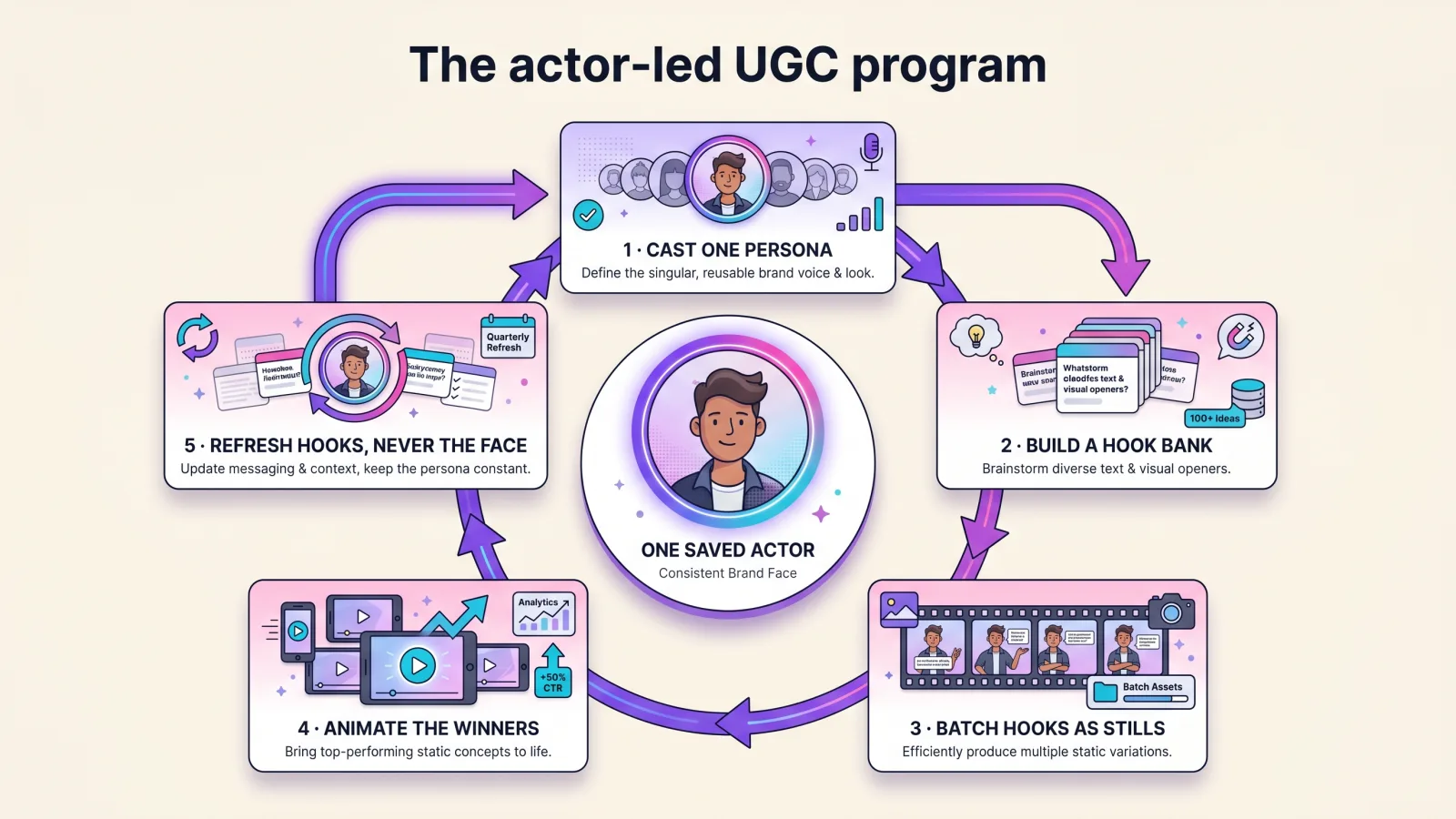
An actor-led program inverts the usual UGC workflow. Instead of casting a new face per ad, you cast once and rotate everything else around that constant: one actor, ten hooks, a few animated winners, per-placement variants, refreshed on a cadence. The five steps:
- Cast one persona per brand — build the actor once; save appearance, voice, and outfits as one identity.
- Build a hook bank, not a script — ten hooks per concept, so the batch tests the hook.
- Batch the hooks as stills first — $0.97 a still; find the winners for $9.72.
- Animate the winners and ship per placement — voiced clips only for hooks that earned it.
- Refresh hooks, never the face — the actor persists as the distinctive asset.
Step 1: Cast one persona per brand
Cast deliberately: one persona per brand, or one per product line — an audience-matched character with a defined age, register, and wardrobe, not a generic presenter. Build it once as a custom actor and save appearance, voice, and outfit variants as a single identity. The build mechanics are in the AI actor guide; the custom-actor allowance per plan is on the AI actors page.
Resist the urge to cast several interchangeable faces. The program’s compounding effect depends on one face per brand absorbing every impression — three rotating personas split the recognition three ways.
One scope note: this is the synthetic-actor path. If you’re the human creator selling UGC to brands, that career has its own playbook in how to become a UGC creator.
Step 2: Build a hook bank, not a script
Write a hook bank: ten openings per concept — a problem call-out, a results claim, a direct question, a demo tease, a contrarian take, a specific number, and so on. The body of the script barely changes between variants; the first one to three seconds change every time. Hook-writing structure and the script-to-render production loop are the pillar’s territory — see step 2 of the AI UGC guide.
The bank matters because of what the platform’s algorithm does with it. When every variant is unmistakably the same creator, the algorithm is testing the hook, not a new face each time — a clean experiment instead of a confounded one.
Step 3: Batch the hooks as stills first
Render all ten hooks as stills of your saved actor before animating anything. In our metered June 2026 runs, a 1K actor still costs 67 credits — $0.97 at Pro rates — so the full ten-still batch is 670 credits, or $9.72. We verified that figure two ways: per-task metering and an eight-task workspace reconciliation that balanced to the credit.
A sequential ten-still batch lands in roughly 10–12 minutes (extrapolated from our measured three-still runs, which finished in about 3–3.5 minutes each including polling — pure generation is 18–21 seconds a still). Run the stills as image ads or thumbnails with a small budget, and let spend data surface the two or three hooks that earn animation.
Plan note: the batch does not fit Hobby’s 500 monthly credits — seven stills is the ceiling there without a $9 credit pack. Batch workflows start at Pro.
Step 4: Animate the winners and ship per placement
Animate only the winners. A voiced 10-second actor clip — scene, animation, voice, and lip-sync as one generation — measured 380 credits, or $5.51, in our June 2026 lab; how to make AI UGC logs that render step by step. Note the duration ceiling we hit: a single actor-video generation caps at 10 seconds, so write winner scripts to roughly 25 words. By the same formula, a 6-second cutdown of the same hook runs 240 credits ($3.48).
Then ship each winner per placement: same actor, new aspect ratios and wardrobe — 4:5 for feed, 9:16 for Reels and TikTok. This is exactly the workflow the UGC ads page automates: hook variants on one consistent face, re-rendered per placement.
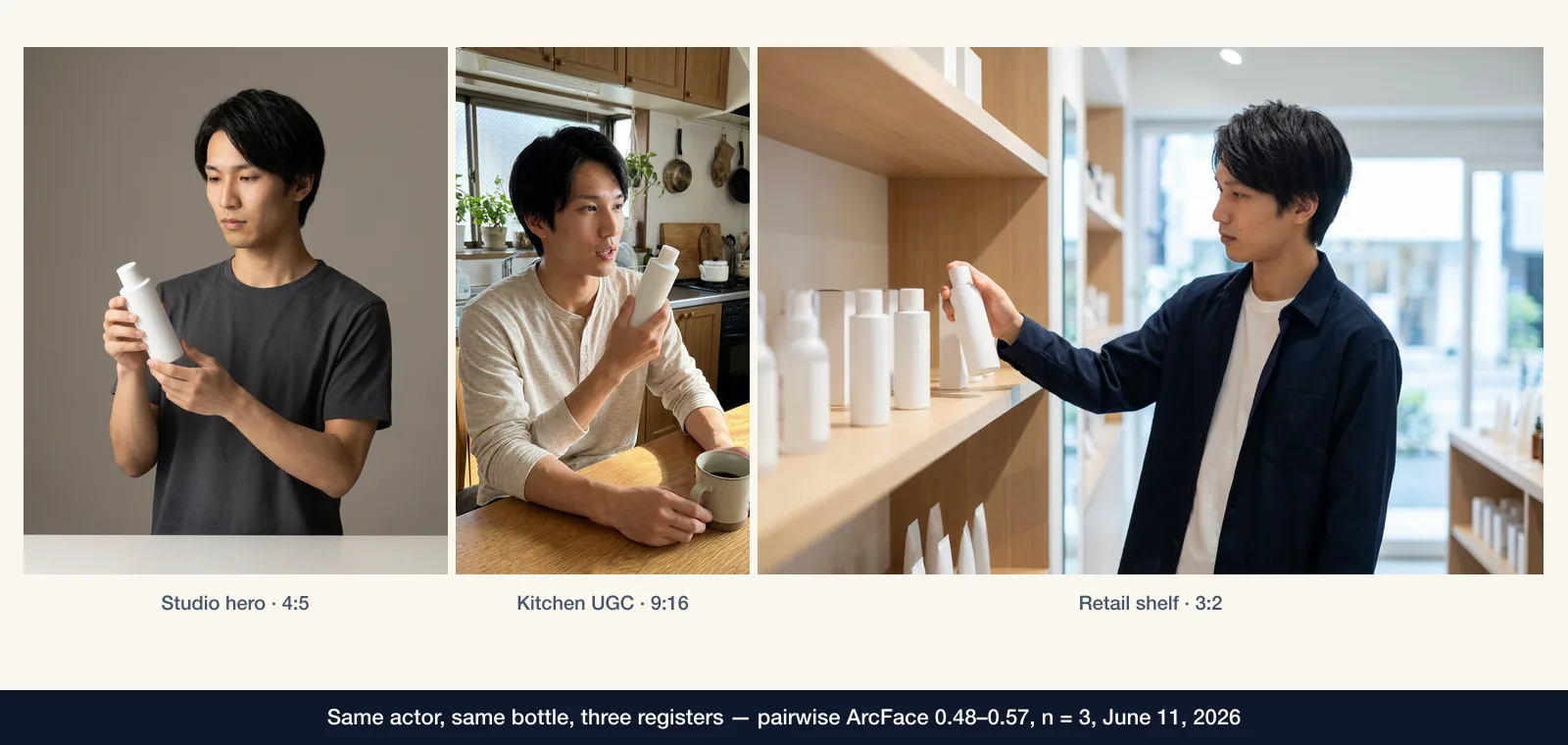
The cross-placement claim is measurable, so we measured it. In our June 11, 2026 product lab, one saved actor with the same unbranded bottle held pairwise ArcFace face-match scores of 0.48–0.57 across studio, kitchen-UGC, and shelf registers (n = 3 stills, self-run). For calibration: InsightFace scores of 0.30–0.40 verify the same person, and 0.5+ is a strong match even between two real photos of one face.
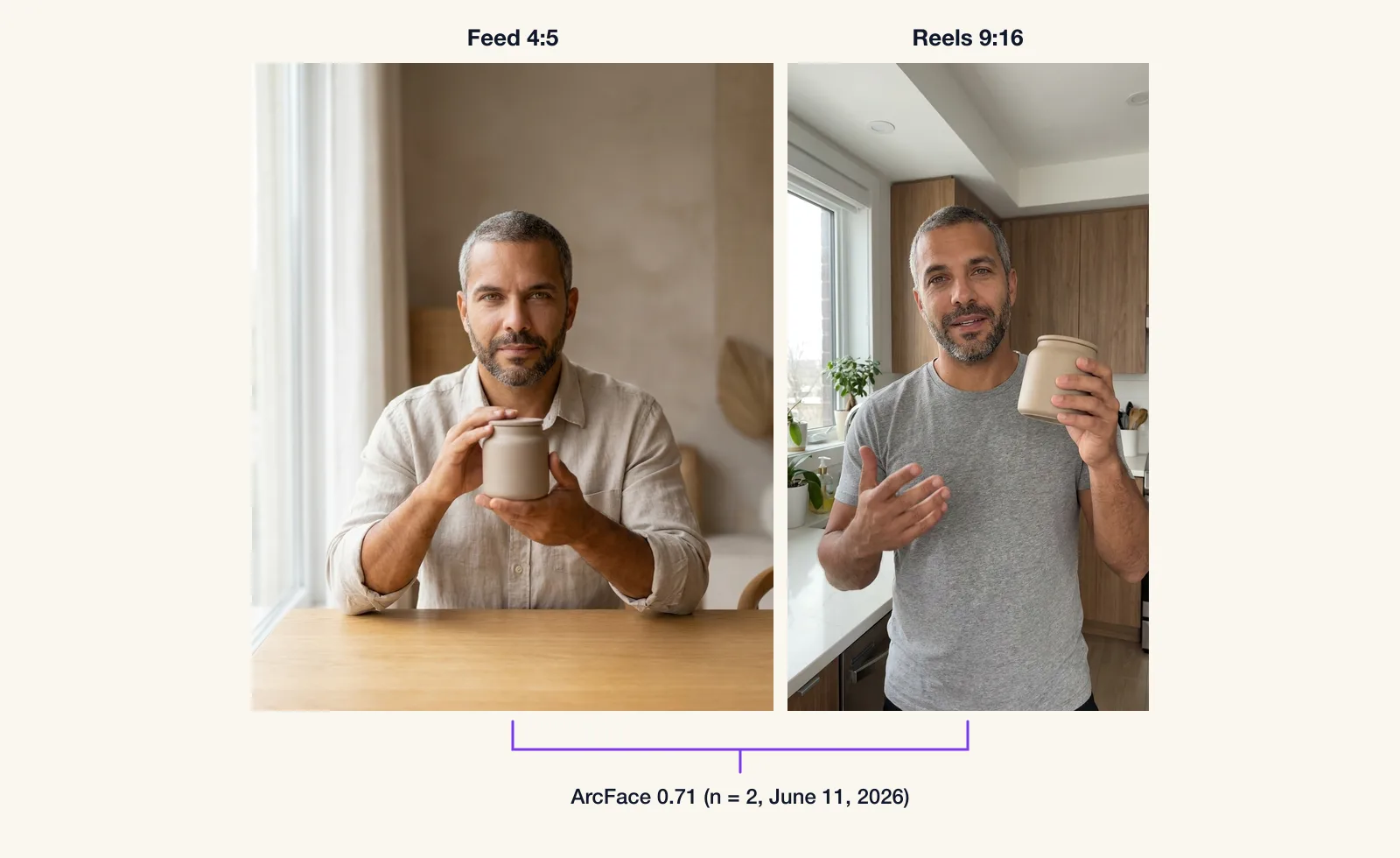
The same day, a second actor held 0.71 across the two Meta placements — feed 4:5 and Reels 9:16 — with wardrobe, scene, and lighting all changed (n = 2).
The hold extends from stills into motion. In the June 2026 end-to-end lab, the hook still matched the finished voiced clip’s frames at a 0.57 mean ArcFace score, and the clip held 0.90 frame-to-frame (n = 1 production run). The face you cast in the thumbnail is verifiably the face talking in the ad.
Step 5: Refresh hooks, never the face
TikTok’s own ad system is engineered around a days-scale creative lifespan. Its Smart Creative feature runs “ad group fatigue detection and auto-refresh strategies,” pausing videos that “show signs of fatigue within the first 3-5 days” and swapping replacements in. That 3–5 days is the system’s own observation window, not a refresh-every-N-days rule for advertisers — but it tells you which half of the ad dies first: the hook, not the face.
Meta’s Ads Manager help materials likewise document creative-fatigue statuses and advise fresh creative as the same people see an ad repeatedly. The platforms’ minimum-creative recommendations presuppose variant batches.
So the cadence is asymmetric by design: keep feeding new hooks from the bank into the account, and never recast the face. Wardrobe and outfit variants on the saved actor make the constant identity feel new without resetting it.
One face, every market: hooks in 30+ languages
Language is just another variant axis on the same identity. The Playcut Voice Engine delivers 30+ lip-synced languages from one saved actor, so the German, Spanish, and Japanese versions of a winning hook are fronted by the same spokesperson — no per-market recasting, no second library face. The lip-sync mechanics live in step 3 of the AI UGC guide.
Programmatically, that means a three-market brand runs one hook bank and one face, not three of each. Localize the wardrobe and scene per market if you want; the identity — and the recognition it accrues — stays whole.
What a 10-hook batch with one actor costs
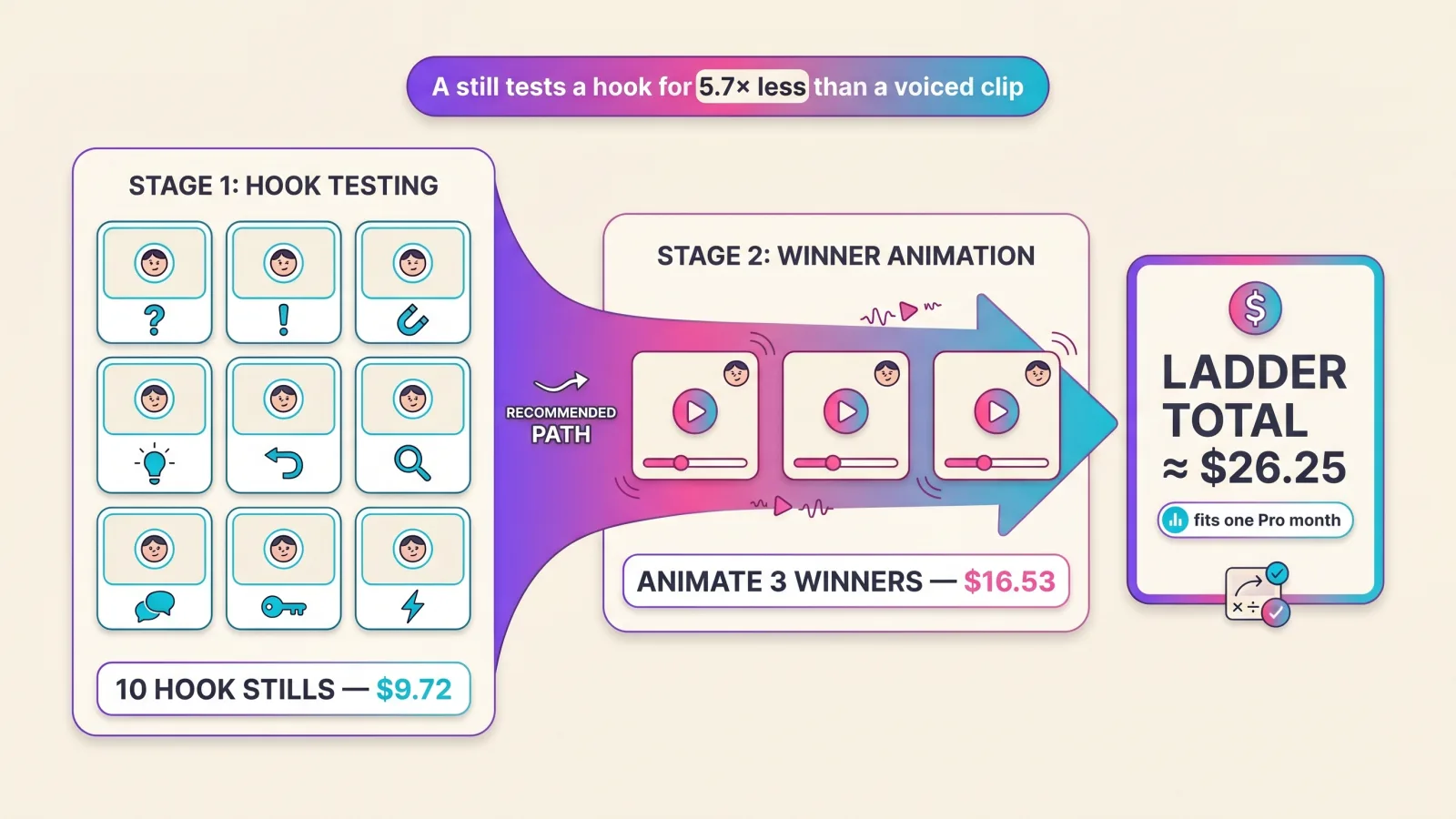
The still-first ladder is the economically honest way to run the program: $0.97 per hook still, $9.72 for the ten-still test batch, $5.51 per voiced 10-second winner — about $26.25 for the full ladder, which fits inside a single Pro month. Every figure is from our own metered June 2026 lab runs at Pro’s credit rate ($29 / 2,000 credits = $0.0145 per credit), reconciled against workspace balances to the credit.
| Stage | Credits | Cost at Pro rates |
|---|---|---|
| 10 hook stills (67 cr each) | 670 | $9.72 |
| Animate 3 winners as voiced 10s clips (380 cr each) | 1,140 | $16.53 |
| Two-stage ladder total | 1,810 | ≈ $26.25 |
| (Contrast) animating all 10 hooks as voiced clips | 3,800 | $55.10 |
The ladder works because a still tests a hook for 5.7× less than a voiced clip ($0.97 vs $5.51). Skipping the still stage and animating all ten hooks costs $55.10 — more than double the ladder — to learn the same thing: which two or three hooks deserve budget.
A few measured details worth planning around. A complete ad — hook still plus voiced 10-second clip — came to $6.48 in our end-to-end run, with the voiced clip itself costing $0.55 per finished second and rendering in about three and a half minutes. Per-clip pricing across durations, platforms, and the agency margin math is the Playcut Act cost guide’s territory.
Plan fit, stated plainly: Hobby’s 500 credits cover one voiced 10-second clip a month but not the ten-still batch, so batch workflows start at Pro. Pro runs the full ladder with 190 credits to spare; Studio’s 6,000 credits fit three ladders a month; Agency adds 10,000 per seat. The actor side is even simpler — Pro’s $29 includes ten reusable custom actors, $2.90 each.
For contrast, the human-creator baseline on our UGC ads page is $300–$1,500 per ad, with creator sourcing and scheduling measured in weeks. That is a production-cost and iteration-speed comparison only — it says nothing about how a given human creator performs against a given AI actor, which the AI UGC vs real UGC comparison weighs on the evidence, and which you should test, not assume.
Why the same face sells: familiarity and brand recall
The economics explain why you batch hooks; the marketing science explains why the face should not rotate. Recognition only compounds if the stimulus repeats — and the evidence runs from mere exposure through spokes-character research to distinctive-asset theory.
The mechanism is old and well-replicated: Robert Zajonc’s 1968 mere-exposure studies showed that repeated exposure to the same stimulus increases liking of it. A spokesperson your audience has seen five times starts every ad with that accumulated familiarity; a stranger starts at zero.
The spokes-character evidence is more specific. Garretson and Niedrich’s 2004 Journal of Advertising study found that spokes-character trust significantly drives positive brand attitudes — and that characters are most influential for shoppers unfamiliar with the brand. That nuance matters in both directions: cold paid-social audiences are exactly the brand-unfamiliar shoppers the effect is strongest for, and the same study found the effect weakest on people who already know you.
Jenni Romaniuk’s Building Distinctive Brand Assets (Oxford University Press, 2018) and the Ehrenberg-Bass Institute supply the strategic frame: faces and characters are distinctive brand assets — memory links built by consistent use over time, and reset by chopping and changing. A saved actor is a distinctive-asset investment; a rotating stock library is perpetual square one.
The creator-style format itself has platform-published numbers behind it. TikTok’s Creator Advantage analysis reports creator-style ads earning +70% click-through and +159% engagement versus non-creator ads at the same CPM. And NCSolutions’ analysis of roughly 450 campaigns attributes 49% of incremental sales to creative quality — the strongest single argument for investing in the creative system rather than only the media budget.
Set against all of that is the fatigue evidence from step 5: the hooks themselves decay on a days-to-weeks scale by the platforms’ own telling. Which is the thesis again, now with its citations attached: hooks fatigue, faces compound — rotate the hook, keep the actor.
An honesty note before the measured data: the familiarity evidence is mixed and context-dependent — the Garretson and Niedrich effect concentrates on brand-unfamiliar shoppers, and no public study yet measures familiarity effects for AI actors specifically; the research base is human spokespeople and fictional spokes-characters. What we can measure ourselves is the precondition the whole argument rests on: that the face actually stays the same.
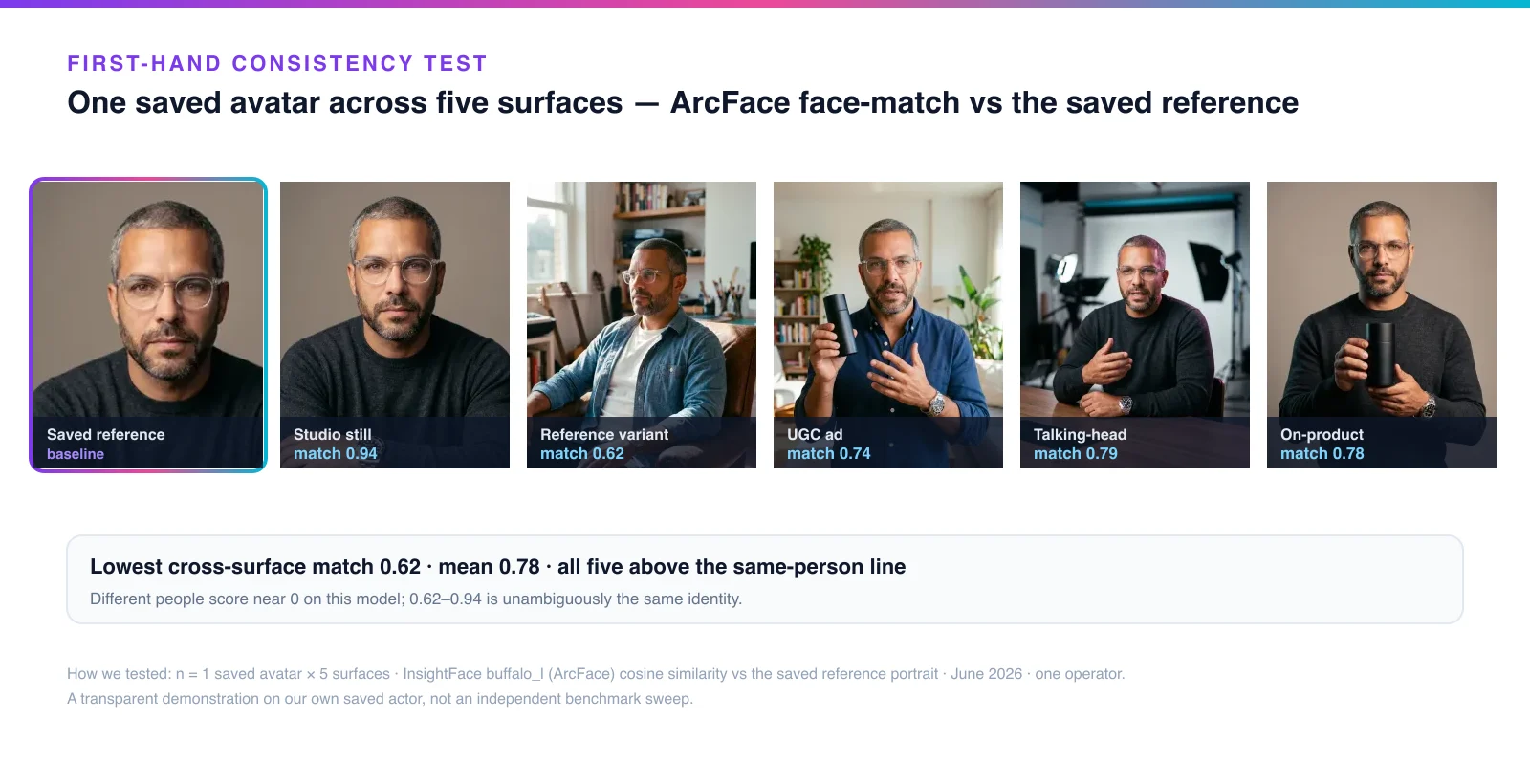
So we measure it, repeatedly. In our published five-surface test, one saved Playcut actor held a 0.78 mean ArcFace face-match (Deng et al., arXiv:1801.07698) across studio still, new pose and outfit, UGC ad frame, talking-head frame, and on-product shot — per-surface range 0.62 to 0.94 (n = 1 actor × 5 surfaces, June 2026; method published here). It measures Playcut self-consistency across formats; it is not a cross-tool benchmark.
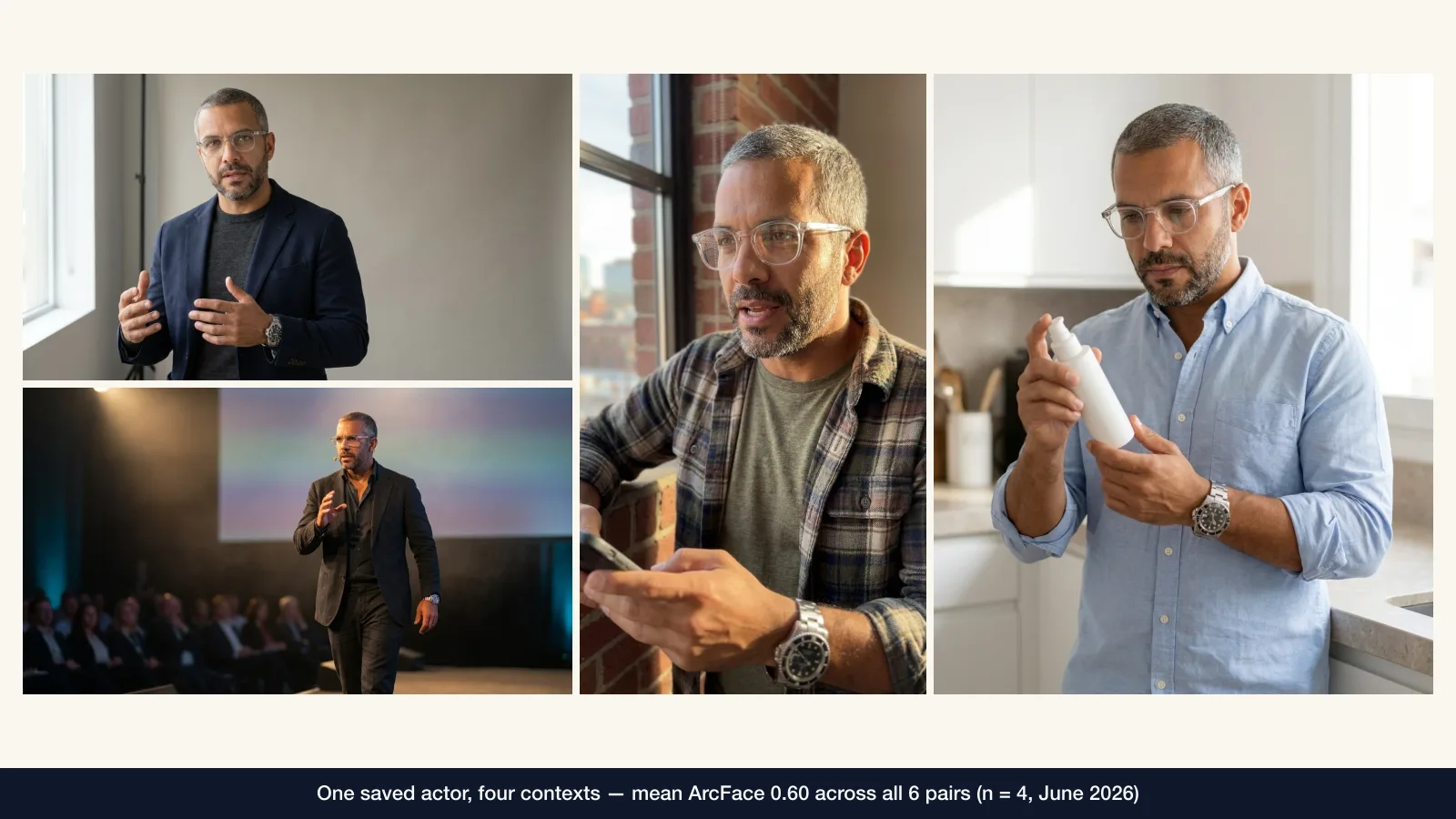
Our June 2026 four-context lab repeated the exercise with a second actor in four commercial contexts — corporate explainer, keynote stage, vertical social, and product presenter — across three wardrobe changes and four lighting regimes. All six cross-context pairs landed in same-person territory: mean 0.6004, minimum 0.5395, maximum 0.6834 (n = 4 stills, self-run; the two lowest pairs involve the wide stage shot, where the face is smallest in frame).
And against other tools: in our May 2026 8-shot holdout, Playcut scored 9.5/10 on identity hold — no other platform tested above 7.5. That score is the identity-hold axis of an internal visual-rubric holdout across five platforms, one actor, eight shots — not an independent benchmark, and platforms outside the five weren’t in it.
Frequently asked questions
What does UGC with AI actors mean?
Creator-style ads fronted by AI-generated people instead of hired creators. Tools either rent you faces from a shared stock library or let you build a custom actor only your brand can use. The strategy that compounds: one saved actor fronting every hook, variant, and language.
Can I use the same AI actor in every ad?
Yes — if your tool saves the actor as a reusable identity. Playcut custom actors persist with appearance, voice, and outfit variants; in our published five-surface ArcFace test, one saved actor held a 0.78 mean face-match across formats. That measures Playcut self-consistency, not a cross-tool benchmark.
Why not just rotate stock avatars?
Stock faces are licensed to every subscriber. By the vendors’ own counts, libraries of a few hundred to roughly 1,800 faces serve customer bases the same vendors describe in the tens of thousands of companies. Rotation also resets recognition: audiences meet a new stranger per ad instead of learning one face.
How much does UGC with AI actors cost?
On Playcut’s Pro plan ($29/month, 2,000 credits), a hook still costs $0.97, a ten-still test batch $9.72, and a measured voiced 10-second clip $5.51. The full still-first ladder — ten stills plus three voiced winners — runs about $26.25 and fits inside one Pro month.
Do AI actor UGC ads actually work?
TikTok’s own data says creator-style ads earn +70% click-through and +159% engagement versus non-creator ads at the same CPM, and NCSolutions’ roughly 450-campaign analysis puts creative at 49% of incremental sales. No independent study isolates AI actors yet — test against your own controls.
Can one AI actor speak multiple languages?
Yes. The Playcut Voice Engine delivers 30+ lip-synced languages from one saved actor, so the same face fronts every market without recasting. Wardrobe and scene variants localize the look while the identity holds.
Do I have to disclose that my UGC actor is AI?
Yes — never pass synthetic actors off as real customers. Platforms require labels on realistic synthetic media, and testimonial-style claims must be truthful regardless of who delivers them. The FTC, Meta, and TikTok rules are covered in our AI UGC guide’s legality section.
One actor, one program: where to start
Start with the casting decision, because everything else in the program inherits it. Build one custom actor matched to your audience on the AI actors page, write your first ten-hook bank, and run the $9.72 still batch before you animate anything. When the winners emerge, ship them as placement-ready UGC ad variants on the same face — and from then on, the only thing you ever replace is the hook.
The longer arc is the same idea at bigger scale: actor consistency is heading toward full multi-scene productions where recurring characters hold the same face, voice, and wardrobe across every scene. The brands that win that era will be the ones whose audiences already know their face. Cast it once at app.playcut.ai and start compounding.