
AI UGC: The Complete 2026 Guide

AI UGC is AI-generated content built to look like a real creator made it — a casual, direct-to-camera product read delivered by an AI actor, not by a person with a phone. It’s also called synthetic UGC.
There are two competing definitions of the term, and this guide names both. Most tools — and this guide — use “AI UGC” for the fully AI-generated kind: a synthetic creator, no filming, no hired talent. A minority use it for a real person’s content scaled with AI editing tools; that’s the second sense, and we flag it where it matters.
This guide teaches the whole category: what AI UGC is, how it’s made in four stages, why brands use it, whether it actually works versus real UGC, what it costs at a glance, and the disclosure rules — including the EU AI Act’s transparency obligations that apply from 2 August 2026.
The hard part isn’t making one clip. It’s keeping the same creator across dozens of variants — which is why a saved AI actor sits at the center of how AI UGC is made.
Table of Contents
- What is AI UGC?
- How is AI UGC made?
- Why do brands use AI UGC?
- Is AI UGC effective? AI UGC vs real UGC at a glance
- What is a good AI UGC strategy in 2026?
- How much does AI UGC cost, and is it legal?
- Can people tell AI UGC is fake?
- Common mistakes with AI UGC
- How Playcut makes AI UGC with one consistent actor
- Frequently asked questions
- Conclusion: getting started with AI UGC
What is AI UGC?
AI UGC (AI user-generated content) is video, image, or audio produced by AI but deliberately made to look and feel like content a real creator filmed themselves — typically an AI actor delivering a casual, direct-to-camera product read, with no filming and no hired creator. It’s also called synthetic UGC.
The term has two senses, and naming both is the first thing most explainers skip. The dominant usage — and the one this guide means — is the fully AI-generated kind (sendshort, Hoox). A minority of vendors use “AI UGC” for a real person’s content scaled with AI tooling, preserving human authorship (D-ID). The muddiness is real, so the rest of this guide is explicit: it means the synthetic-creator kind.
Why the UGC label at all? Because the goal is to borrow the look of organic content. Real user-generated content — a customer filming an honest opinion on a phone — is the most trusted format in marketing; Gartner notes that 84% of millennials say UGC from strangers influences what they buy (Gartner, millennial-scoped). AI UGC chases that trust signal at software speed.
Mechanically, an AI UGC clip is an AI actor given a hook and a script, delivering it direct-to-camera in a casual, handheld register — vertical framing, a raw “this could be me” feel, natural blinking, holding the product. That register is the whole point: it signals “a real person sharing a real opinion,” which is what makes UGC convert. The craft is making a synthetic creator feel unscripted, not making it look expensive.
AI UGC emerged as a named category in 2024–2025 for a simple reason: paid social rewards creative volume, and human UGC couldn’t supply it affordably. A single creator video runs into the hundreds of dollars and takes days to brief, shoot, and revise, while ad algorithms now chew through dozens of fresh variants a week. AI UGC closed that gap — the same trusted format, produced at the speed the feed demands.

AI UGC vs real UGC vs a brand ad
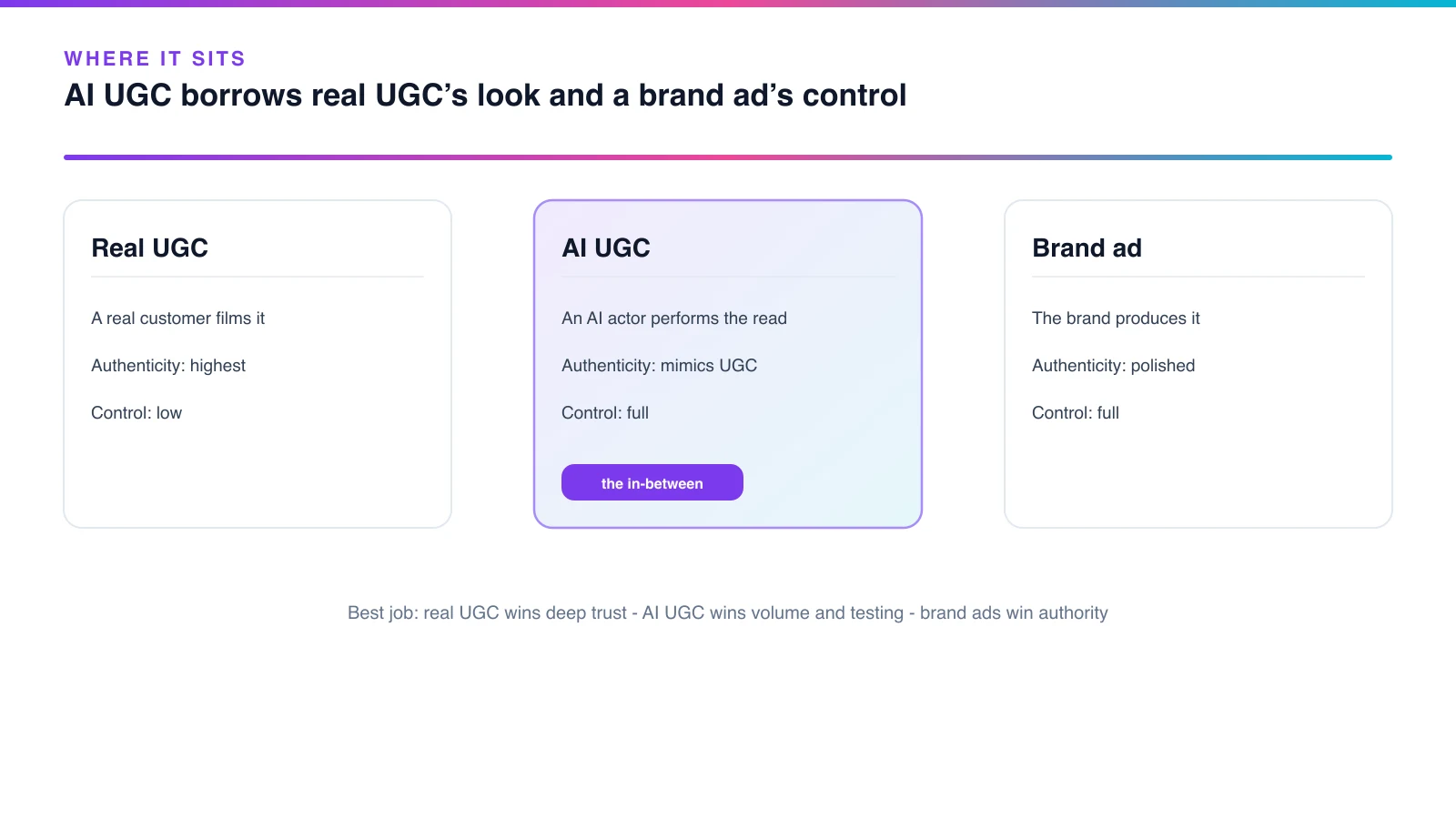
AI UGC sits between two things you already know — real UGC and a brand ad. It borrows real UGC’s raw look and a brand ad’s full control. That in-between position is exactly what makes it useful, and what makes it controversial.
The three differ on who makes them and how authentic they feel. Real UGC is filmed by an actual customer and reads as the most authentic, but you can’t direct it or scale it. A brand ad is polished and fully controlled, but it announces itself as advertising. AI UGC mimics the UGC register while giving you full control of the script, the actor, and the call to action.
A simple way to place it: real UGC is a recommendation from a peer, a brand ad is a statement from the company, and AI UGC is a peer-shaped message the brand controls. That control is the upside — every word, the actor, and the CTA are yours — and the risk, because a controlled “peer” has to be disclosed to stay honest.
The practical takeaway is “best job.” Real UGC wins deep, bottom-of-funnel trust; AI UGC wins volume, hooks, and cheap A/B testing; brand ads win authority and credibility. Most teams don’t choose one — they use each where it’s strongest, with AI UGC as the testing layer they scale winners out of.
Zoom out one level and AI UGC is one of several AI video ad formats: product, demo, testimonial, talking-head, and brand-commercial ads all sit alongside it under the broader AI-video-ads umbrella.
AI UGC, AIGC, synthetic media, and deepfakes — the vocabulary
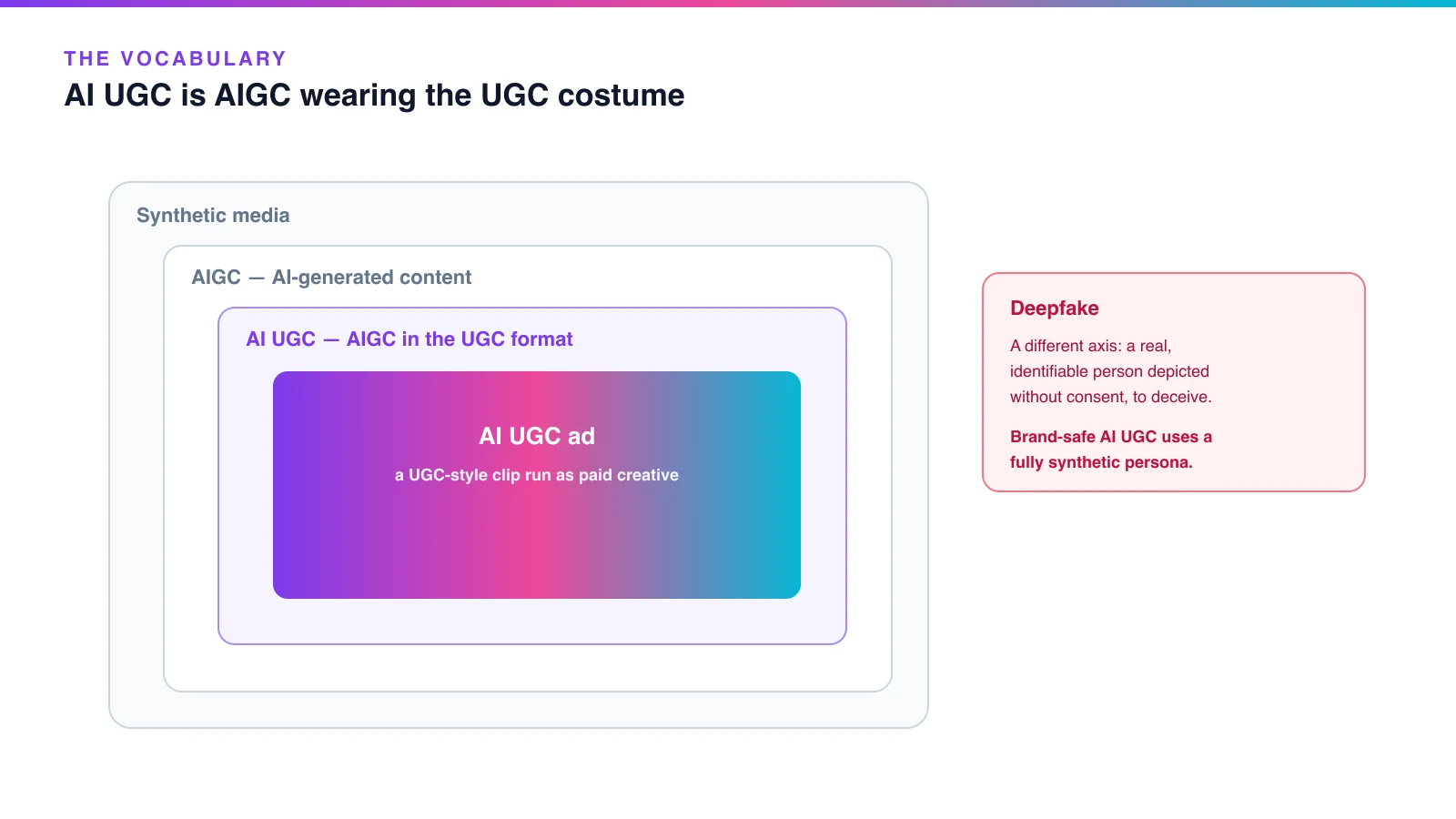
The terms nest, and getting them straight prevents a lot of confusion. Synthetic media is the broad umbrella for any AI-generated or AI-altered content; AIGC (AI-generated content) is the subset produced largely by AI. AI UGC is the slice of AIGC deliberately shaped to look like creator-made UGC — AIGC wearing the UGC costume. An AI UGC ad is simply a UGC-style clip run as paid creative.
A deepfake is not a step on that ladder — it sits on a different axis. A deepfake depicts a real, identifiable person without consent in order to deceive (DTSP synthetic media glossary). Brand-safe AI UGC uses a fully synthetic persona that resembles no real individual, so it isn’t a deepfake; the dividing line is whose face it is and whether there’s consent.
That distinction also separates AI UGC from an AI actor and an AI influencer. The AI actor is the saved, reusable identity underneath the clip; the same actor can run a whole AI influencer feed. For the deeper actor-vs-avatar-vs-digital-double split, see the consistent AI actor guide.
How is AI UGC made?
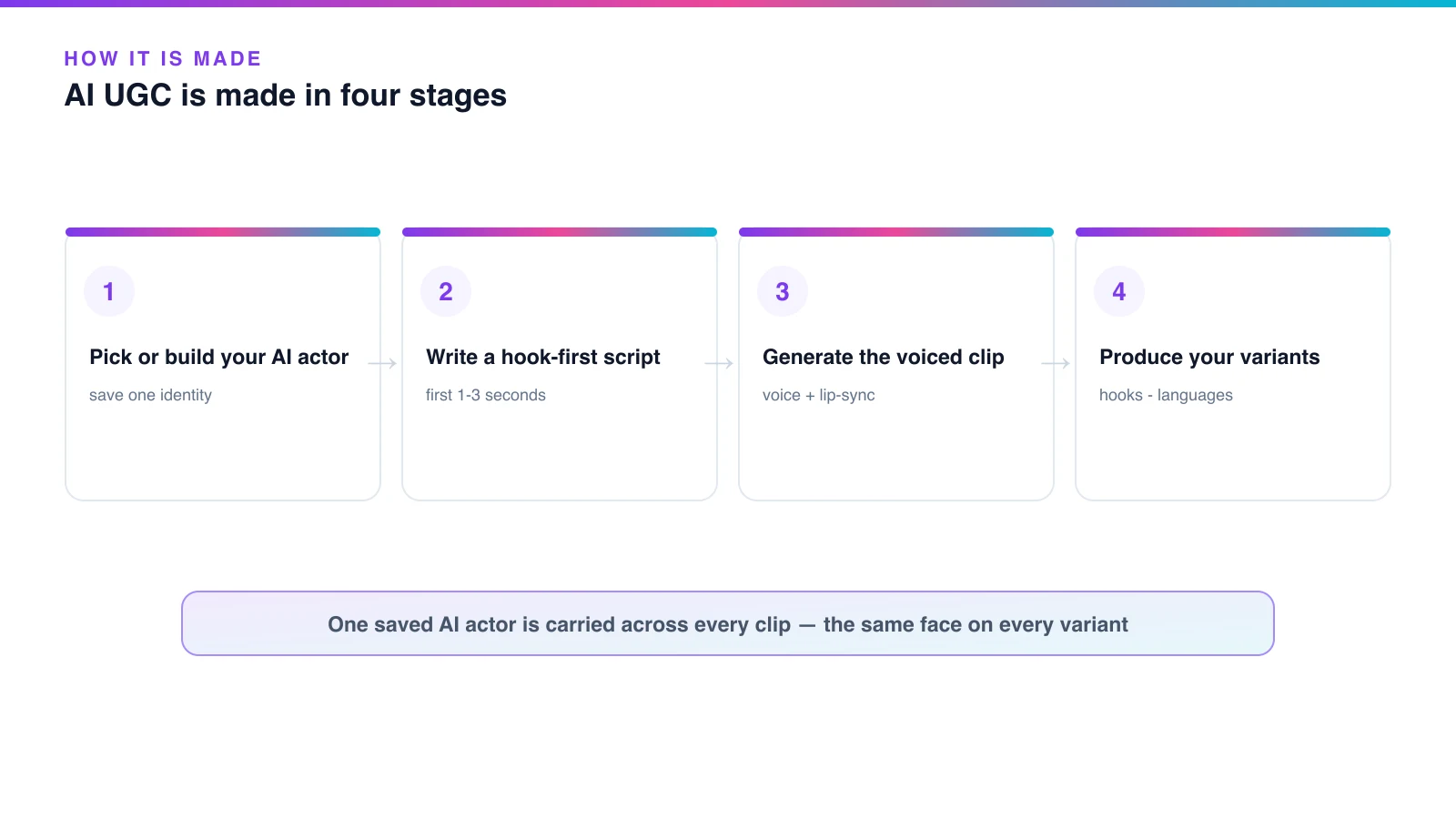
AI UGC is made in four stages: pick or build an AI actor, write a hook-first script, generate a voiced creator-style clip, then spin it into testable variants. The method below is tool-agnostic — it teaches the production loop, not one product’s buttons; for the buttons, exact tools, clicks, and per-step costs, follow the step-by-step AI UGC tutorial.
The thread running through all four stages is consistency. Because the same actor and voice are saved and reused, you can produce dozens of variants that still look like one creator — and that single fact is what turns AI UGC from a novelty into a testing engine.
Step 1: Pick or build your AI actor
AI UGC starts with an AI actor — a synthetic presenter you save once and reuse. There are two real paths: pick a stock presenter from a tool’s library, or build a custom synthetic persona that’s yours alone and matches your audience.
The non-negotiable part is that the actor is a saved reusable identity, not a fresh generation each clip. AI models regenerate from scratch with no memory of the last render, so a re-described face drifts — and drift between hook variants quietly breaks brand recognition and retargeting. The durable fix is one saved actor, reused; the AI actor guide covers the consistency mechanism, and Playcut’s AI actors are built for it.
The choice between stock and custom is mostly about differentiation. A stock face is faster but appears in other brands’ ads too; a custom synthetic persona is yours alone and can be tuned to your audience. Either way, the actor is an asset you build once and amortize across hundreds of clips — which is what changes the economics of UGC. For a ranked, tool-by-tool comparison, see the best AI UGC generators.
One consent note up front: a fully synthetic persona (an invented person) is the brand-safe default. Cloning a real person’s likeness needs their written, use-specific consent — more on that in the ethics section.
Step 2: Write a hook-first script
Every AI UGC clip is a short script that opens with a scroll-stopping hook in the first one to three seconds, then moves to the problem, the product, and a clear call to action. On short-form feeds the first few seconds decide whether the clip gets distribution at all, so the hook does most of the work.
Common hook shapes are worth keeping in a short list: a problem callout, a results-first claim, a contrarian take, a direct question, a specific number, or a pattern-interrupt. Pick one per variant rather than stacking them, so each test isolates a single idea. If you want a starting draft, the free UGC ad script generator turns a product, benefit, and offer into a timestamped, shot-by-shot script.
The register matters as much as the structure. Write it raw, the way a real person talks — not the way an ad reads. The pitfall is an over-polished, robotic script that lands as a commercial and loses the UGC trust signal you came for.
Step 3: Generate the voiced talking-head clip
Next the system gives the actor a voice — synthetic or cloned — and a lip-sync model maps that audio to mouth shapes frame by frame, rendering a vertical, creator-style clip. Modern voice cloning works from only a few seconds of reference audio (SV2TTS), and speaker-independent lip-sync has been a solved building block since Wav2Lip.
This stage is also where multilingual UGC comes from. Because mouth shapes are driven by phonemes, one saved actor can deliver the same script in dozens of languages with native lip motion — no second creator, no reshoot. It’s the single biggest reason global brands reach for AI UGC over hiring a creator per market.
The pitfall is letting the voice change between clips: a new voice per video breaks the persona as badly as a drifting face. Lock one voice to the actor and reuse it across every variant and language.

Step 4: Produce your variants
The payoff is volume. Because the actor and voice are saved, you re-render the same concept with different hooks, languages, and actors to get dozens of testable variants from one script — the reason performance teams reach for AI UGC in the first place.
The strategic payoff is a testing loop, not just raw volume. You ship many cheap variants, let the platform’s algorithm find the winning hook, then concentrate budget there — finding the winner before the spend ramps. That only works if every variant is unmistakably the same creator, so the algorithm is testing the hook, not a new face each time.
The consistency caveat lands hardest here: batch variants only work if the actor’s identity holds across all of them. Variant volume with a drifting face is worse than no volume — it gives you no brand recognition and broken retargeting. If you want a tool built for exactly this, you can make AI UGC ad variants that keep the same actor across every hook instead of re-rolling a new face each time.

Why do brands use AI UGC?
Brands use AI UGC because it delivers the trusted UGC look at software speed and cost — volume, multilingual reach, and no creator sourcing, scheduling, or per-video fees. The most common driver is paid social: it lets a small team test many hooks cheaply instead of betting on a handful of expensive creator videos.
The benefits cluster into four. Speed (clips in minutes, not weeks), volume (dozens of variants from one brief), reach (one actor across 30+ languages), and cost (no creator fees, scheduling, or reshoots). The trade-off is trust — a synthetic creator earns less of it than a real customer — which is why the smartest brands use AI UGC to test and human UGC to close.
The use cases go beyond ads, too. Brands use AI UGC for organic social, testimonial-style content, product demos, and localization. HeyGen reports that Trivago localized ads across 30 markets within a year of using the tool, cutting post-production roughly in half (HeyGen case study) — a vendor-published but named result that shows the localization pull.
Three buyer groups dominate. DTC and e-commerce brands want always-on creative for paid social; agencies productize it as a service (how to start an AI UGC agency); and lean in-house teams use it to ship variants they couldn’t otherwise afford. When the main job is paid ads specifically, the AI UGC ads workflow covers the hook anatomy, and you can build the variants with one custom actor.
There’s an operational pull, too, beyond cost. An AI actor never cancels, ages out of a niche, or needs a 1099, a usage license renewed, or a reshoot when the script changes — and a fully synthetic creator can’t expose a brand to the liability of impersonating a real customer. For teams shipping creative continuously, removing that human-coordination overhead is often the real unlock, not the per-clip price.

Is AI UGC effective? AI UGC vs real UGC at a glance
Whether AI UGC is effective depends entirely on the goal — it wins on volume and cost, and trails on deep trust. It is not a universal replacement for real UGC, and the honest sources say so.
The comparative data is encouraging but vendor-reported. Agency and tool studies suggest AI UGC can reach roughly 85–110% of real UGC’s click-through rate for cold-audience ad testing while cutting production cost sharply, yet real UGC still scores higher on perceived trust and wins more high-consideration, deep-funnel purchases (Superscale, inBeat). Treat every one of those figures as directional, not measured fact.
So the at-a-glance verdict is a split, not a winner. AI UGC wins volume metrics — reach, variant count, cost per asset, speed of testing. Real UGC wins quality metrics — trust, authenticity, and influence on big-ticket buys. The full head-to-head with conversion tables is its own comparison; here, the takeaway is simply that the two complement each other rather than one replacing the other.
The honest counter-case is worth stating plainly. AI UGC underperforms where authenticity is the product — genuine reviews, lived-experience testimonials, and high-trust categories like health or finance, where audiences are primed to distrust a synthetic spokesperson. It also can’t make a first-person experience claim a brand can’t substantiate, which is both an ethics line and an FTC one. Treat AI UGC as the top of the testing funnel, not the trust close.
Where AI UGC measurably earns its place is the top of that funnel. For cold-audience prospecting — where the job is to stop the scroll and test a claim, not to close a considered purchase — the synthetic-versus-real trust gap barely moves the metric, so the cheaper, higher-volume option usually wins on cost per result. The gap widens as buyer intent deepens, which is exactly why the blend in the next section exists.
What is a good AI UGC strategy in 2026?
A good AI UGC strategy in 2026 is a blend: use AI UGC for cheap breadth and testing, and use human UGC for depth and trust. The point isn’t to replace creators — it’s to stop wasting your most expensive creative on unproven hooks.
In practice that means testing wide with AI. Generate many AI UGC variants to find the hooks, angles, and audiences that work, then concentrate human creators and bigger budgets on the winners — where authenticity pays off most. A commonly cited rule of thumb is roughly a 70/30 split between AI and human UGC, but treat that as an agency heuristic, not a measured optimum; the right mix depends on your category and price point.
The loop has a cadence. Ship a fresh batch of AI variants each week to fight creative fatigue — short-form platforms punish stale creative fast — then promote the two or three hooks that beat your control into higher-budget placements, sometimes refilmed with a real creator. The metric that matters early isn’t any single clip’s ROAS but how quickly you find a repeatable winning hook.
Long-form footage feeds the same loop. If you publish podcasts, webinars, or streams, clip-repurposing tools turn each episode into a week of short-form tests — the Opus Clip alternatives breakdown runs the real cost-per-clip math for that workflow, and the free content repurposing planner turns one source video into a per-platform plan with clip counts, aspect ratios, and durations before you cut anything.
Two disciplines make the blend work. First, keep one consistent actor per persona so your “creator” is recognizable across the variants you scale. Second, keep scripts natural and disclose that the content is AI — both protect the trust that makes UGC worth using at all.
One more discipline: measure the right thing. Early on, the win isn’t a single clip’s ROAS but throughput — how many distinct hooks you can test per week, and how fast a winner emerges. AI UGC’s advantage is that it makes that testing loop cheap enough to run continuously, so the teams that benefit most treat creative as an always-on experiment, not a quarterly production.
How much does AI UGC cost, and is it legal?
Two questions decide whether AI UGC fits your plan: what it costs, and what you’re allowed to do with it. The short version is that it’s far cheaper than human UGC and legal to use — provided you don’t deceive and you disclose it. The detail is below.
AI UGC cost at a glance
At a glance, AI UGC runs from a few dollars to about $20 per finished clip — or close to nothing per clip on a monthly subscription at volume — versus roughly $50–$500 for a single human-creator video (DesignRevision). Multiple audits peg AI UGC as about 70–90% cheaper than traditional UGC (Superscale).
| AI UGC | Human UGC | |
|---|---|---|
| Cost per clip | ~$2–$20 (or less at volume) | ~$50–$500 |
| Speed | Minutes to hours | Days to weeks |
| Scale | Dozens of variants | Limited by creator pool |
Those per-clip dollar figures are tool-specific and vendor-reported, so treat them as directional ranges, not quotes. For the exact per-clip credit math broken down across tools, see our AI UGC video cost breakdown. And if you’re the one selling the clips, how much to charge for AI video covers the 2026 rate ladder from the seller’s side.
The bigger cost question isn’t the per-clip price — it’s whether you stitch separate tools together or use one studio. A DIY stack (an image tool, a voice tool, a video tool) is cheap to start but leaks consistency at every handoff; an all-in-one studio that holds one saved actor removes that drift, which is usually where the hidden cost lives.
Is AI UGC legal? The disclosure overview
AI UGC is legal in the US and the EU, but it must not deceive and increasingly must be disclosed. The safe posture is simple: build it from a fully synthetic actor or a consented likeness, hold commercial rights, and label it as AI-generated.
In the US, the FTC treats an AI endorser like a human one. Its endorsement rule defines an endorser as a party whose views the message reflects and who “could be or appear to be an individual” (16 CFR 255.0, via Cornell LII) — the “appear to be” phrasing is what pulls AI-generated endorsers in.
Its 2024 Consumer Review Rule (the fake-reviews rule) carries civil penalties up to $53,088 per violation as of 2026 — up from $51,744 when the rule was announced in 2024 (Alston & Bird).
In the EU, the AI Act’s Article 50 requires deployers to disclose AI-generated “deep fake” content, and that obligation applies from 2 August 2026 (EU AI Act, Article 50). Platforms already enforce the spirit of it — Meta and TikTok auto-label AI content (Meta).
Two practical rules keep you clear. First, build from a likeness you own — a fully synthetic persona is the safe default, and cloning a real person needs their written, use-specific consent. Second, use the platform’s built-in AI-content label on every upload; Meta and TikTok increasingly apply one anyway, so disclosing it yourself keeps you in control of how it reads.
The placement mechanics and state rules go deeper than this overview. The full breakdown, state by state, is in is AI UGC legal?.
Can people tell AI UGC is fake?
Increasingly, people can’t tell AI UGC is fake without tools — which is exactly why disclosure matters more than detectability. Realism has improved sharply, and the quality gap is now use-case-dependent rather than obvious.
Consumers struggle to identify AI video unaided, and at least one vendor blind test claimed most viewers couldn’t distinguish AI clips from real-actor footage — though that’s a single-source, vendor-reported figure, not an independent study. Automated detectors do catch many cases through temporal or physics artifacts, but their accuracy drops after a clip is edited, captioned, or re-compressed (detection survey).
What still gives AI UGC away, when anything does, is the small stuff: slightly stiff gestures, glassy skin, or a beat of lip-sync drift on hard consonants — and those tells shrink every release cycle. Chasing undetectability is the wrong goal, though, because better models will erase the tells anyway.
The trajectory is the important part. Two years ago AI UGC looked obviously synthetic; today the tells are subtle and shrinking, and generation is improving faster than detection. That isn’t a reason to deceive — it’s the reason transparency is the durable strategy. A label costs nothing and ages well, while a hidden synthetic creator is one viral screenshot away from a trust problem.
The honest takeaway is that detectability is a moving target, so it’s the wrong thing to lean on. Realism is already high enough that trust comes from being transparent, not from whether a viewer can spot the AI. Disclose it, and the realism becomes an asset instead of a liability.
Common mistakes with AI UGC
Most AI UGC underperforms for the same handful of reasons. Avoid these and you’re ahead of the majority of accounts running it:
- A drifting actor across variants — re-rolling a new face per clip instead of reusing one saved actor, which kills brand recognition and retargeting.
- Robotic, over-polished scripts — writing ad copy instead of how a real person talks, which loses the UGC trust signal.
- Hiding that it’s AI — skipping disclosure, which is both a legal risk and a trust risk once audiences notice.
- Going all-AI with no human blend — using AI UGC for deep-funnel trust work where real creators still win.
- Treating it as set-and-forget — AI UGC is a testing engine that needs fresh variants and pruned losers weekly, not a one-time asset.
- No human check on claims — letting an AI actor make a first-person experience claim the brand can’t substantiate, which is an FTC problem.
- Ignoring platform labels — skipping the built-in AI-content disclosure toggles that Meta and TikTok now apply anyway.
The thread through almost all of these is consistency and honesty. Reuse one actor, write like a human, disclose the AI, and blend in real creators where trust is the product — and AI UGC becomes a durable testing engine instead of a gimmick.
How Playcut makes AI UGC with one consistent actor
Playcut’s lane in AI UGC is the saved, reusable AI actor that holds the same face and voice across every variant. You build the actor once — synthetic persona, voice, and look — and then every clip, hook, and language re-uses that one identity instead of generating a new face each time.
That solves the single hardest problem in AI UGC: variant volume without drift. Because Playcut is a multi-model studio built on the Actor Engine, the same saved actor can deliver a feed of UGC reads, a localized set, and on-product clips that all look like one creator.
Because that identity lives in one workspace, it isn’t limited to UGC clips — the same actor can carry into stills, on-product shots, and longer video, so a brand’s “creator” shows up consistently everywhere it appears. That cross-format reuse is what turns one saved actor into a durable brand asset. When you’re ready to produce them, Playcut’s AI UGC ad generator makes the variants from one custom actor.
Frequently asked questions
What is AI UGC?
AI UGC (AI user-generated content) is video, image, or audio produced by AI but deliberately made to look like a real creator filmed it — a casual, direct-to-camera product read delivered by an AI actor, with no filming and no hired creator. It’s also called synthetic UGC.
A minority of tools use ‘AI UGC’ to mean a real person’s content scaled with AI; this guide means the fully AI-generated kind, which is the dominant 2026 usage.
How is AI UGC made?
AI UGC is made in four stages: pick or build an AI actor saved as a reusable identity, write a short script with a scroll-stopping hook in the first one to three seconds, give the actor a synthetic or cloned voice that a model lip-syncs to a vertical clip, then re-render the concept as many hook, language, and actor variants. The same saved actor carries across all of them, so the face never drifts between variants.
Is AI UGC effective?
It depends on the goal. AI UGC works for volume, speed, and cheap creative testing, but it trails real UGC on perceived trust and authenticity. Vendor and agency data suggest AI UGC can match real UGC on click-through and ROAS for cold-audience ad testing while cutting production cost sharply, whereas real UGC still wins high-trust, high-consideration purchases. Treat those comparative figures as vendor-reported and directional — most teams blend both rather than going all-AI.
Is AI UGC the same as a deepfake?
No, when it’s made responsibly. A deepfake depicts a real, identifiable person without consent in order to deceive, whereas brand-safe AI UGC uses a fully synthetic persona that resembles no real individual. The line is whose face — cloning a real person’s likeness without consent is a deepfake and a right-of-publicity problem; an invented synthetic actor is not. The underlying technology overlaps, so intent, consent, and disclosure are what separate them.
Is AI UGC legal, and do you have to disclose it?
Yes, AI UGC is legal in the US and EU, but it must not deceive and must be disclosed. Build it from a synthetic or consented likeness and label it as AI-generated.
The FTC treats an AI ‘endorser’ like a human one — its rule covers a party that ‘could be or appear to be an individual.’ In the EU, the AI Act’s Article 50 requires deepfake disclosure from 2 August 2026, and Meta and TikTok already auto-label AI content.
AI UGC vs real UGC — which is better?
Neither is universally better — they win different jobs. AI UGC wins volume metrics like reach, variant count, cost per asset, and testing speed, while real UGC wins quality metrics like trust, authenticity, and influence on high-consideration buys. The strategy most sources converge on is a blend: AI UGC for cheap breadth and testing, real UGC for depth, tuned by category. That split is an agency rule of thumb, not a measured optimum.
How much does AI UGC cost?
At a glance, AI UGC runs from a few dollars to about $20 per finished clip, or close to nothing per clip on a monthly subscription at volume — versus roughly $50–$500 for a single human-creator video.
Sources peg AI UGC as about 70–90% cheaper than traditional UGC. Those per-clip dollar figures are tool-specific and vendor-reported, so treat them as directional ranges; the detailed per-clip credit math is covered in our AI UGC video cost breakdown.
Can people tell AI UGC is fake?
Increasingly, not without tools. AI UGC realism has improved sharply, and consumers struggle to identify AI video unaided — one vendor blind test claimed most viewers couldn’t distinguish AI from real-actor clips, though that’s a single-source figure. AI detectors catch many cases through temporal or physics artifacts, but accuracy drops after a clip is edited or re-compressed. The honest takeaway: realism is high enough that disclosure, not detectability, keeps AI UGC trustworthy and compliant.
Conclusion: getting started with AI UGC
AI UGC is the trusted UGC look produced at software speed — a synthetic creator delivering a hook-first read, reused across dozens of variants from one saved actor. It wins volume, testing, and localization; it trails human UGC on deep trust; and it’s legal as long as you build it from a synthetic or consented likeness and disclose it.
If you’re getting started, the method is the whole game: cast one consistent actor, write like a human, generate, and test wide before you scale. Plan your first set with the free creator tools, or read the consistent AI actor guide for the identity layer that keeps one creator on-model across every clip.
Make AI UGC with one consistent actor.
Build one synthetic creator — face and voice saved once — and produce a whole feed of UGC variants that stay the same person across every hook and language. Start your free trial and ship your first AI UGC clip today.
Start building in Playcut →