
AI Video Ads: 2026 Performance Creative Guide
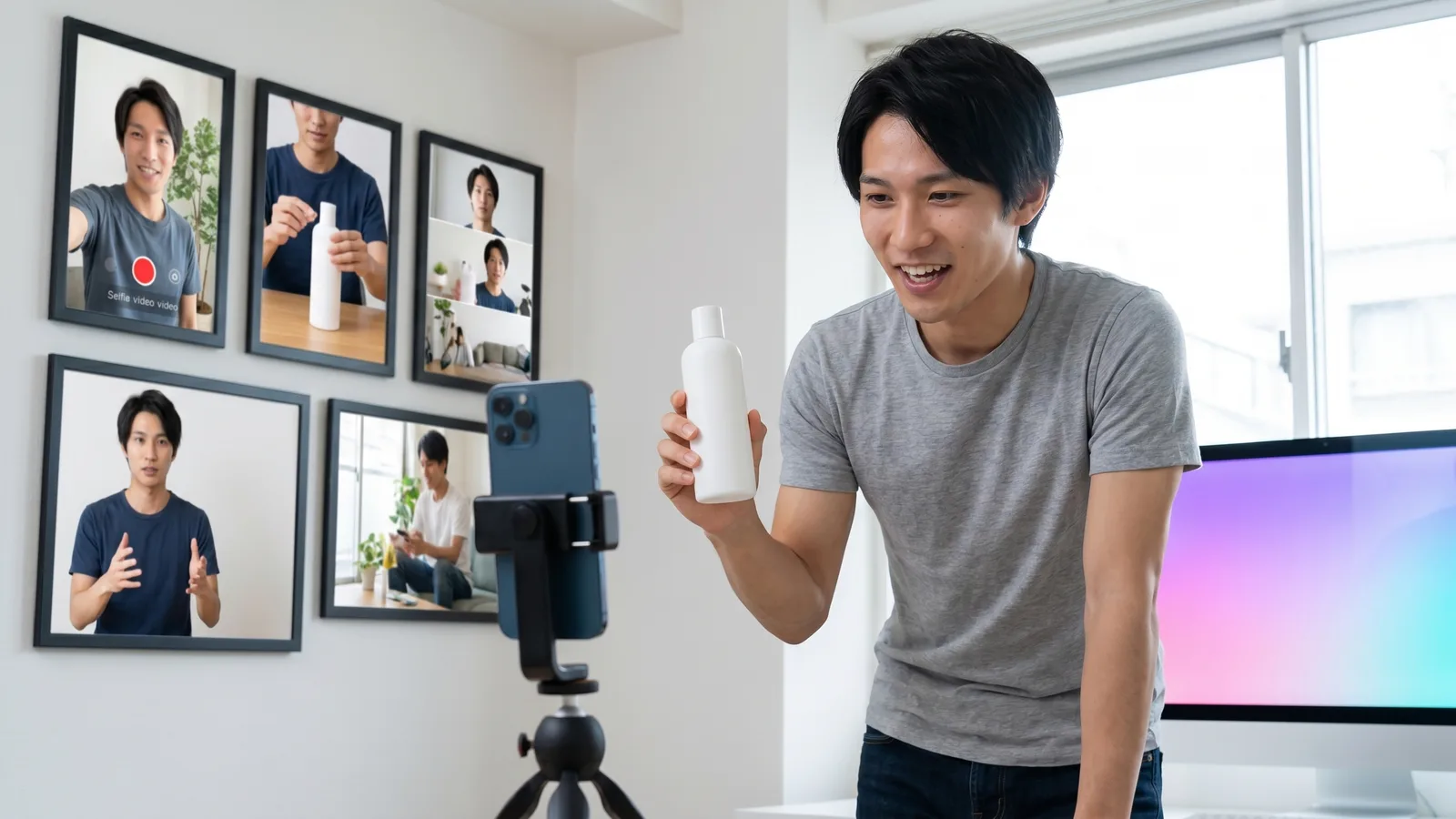
AI video ads are video advertisements made with generative AI — software that produces or assembles the footage, the on-camera presenter, the voiceover, or the whole clip, instead of a film crew and a shoot. They span many formats and run on every major platform.
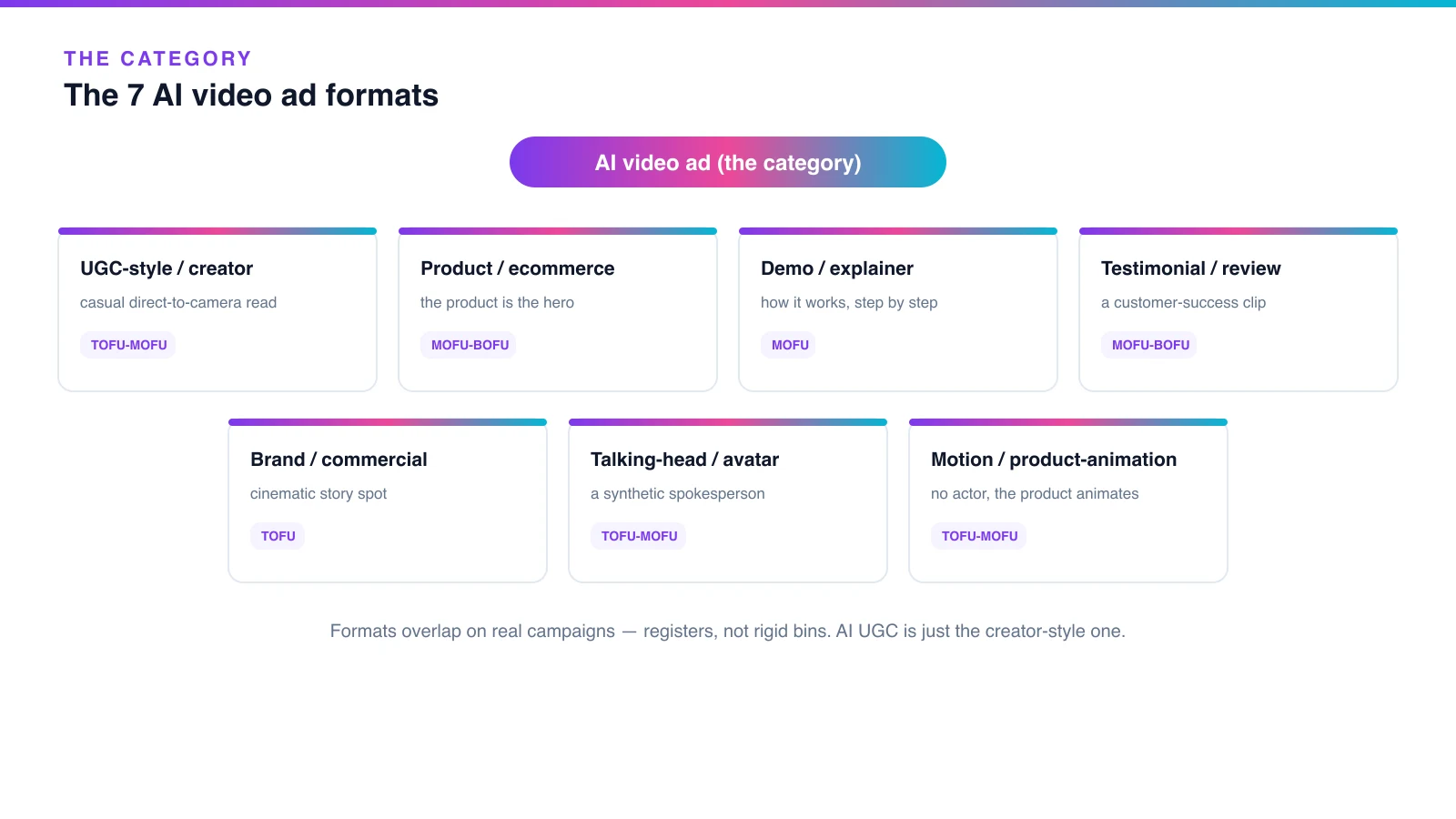
The category is broad, and that’s the thing most guides get wrong. AI video ads include UGC-style creator reads, product and ecommerce ads, demos, testimonials, polished brand commercials, talking-head spokesperson ads, and pure motion graphics. AI UGC is one format of AI video ad — the creator-style one — not a synonym for the whole category.
Adoption is already mainstream: the IAB reports that 86% of advertisers expect to use generative AI to build video ads (IAB). The shift is from “can we make this?” to “which format, and does it convert?”
This guide is the category map: the seven formats, how they’re made across four production paths, whether they actually work (with the honest trust-tax counter-case), what they cost, where they run, and the disclosure rules that apply from 2 August 2026.
Table of Contents
- What are AI video ads?
- What types of AI video ads are there?
- How are AI video ads made?
- Why do brands use AI video ads?
- Do AI video ads actually work?
- How much do AI video ads cost?
- Where do AI video ads run?
- How Playcut makes AI video ads with one consistent actor
- Frequently asked questions
- Conclusion: getting started with AI video ads
What are AI video ads?
AI video ads are video advertisements created with generative AI — the technology that produces new content (images, video, audio, or text) from a prompt or a reference (IBM, McKinsey). Instead of a crew, a set, and a shoot day, software generates or assembles the on-camera presenter, the voiceover, the scene, or the entire clip.
It helps to be precise about AI’s role. In a peer-reviewed deployment, the marketing team “retained full control over message content, using GenAI as a production tool rather than as a creative engine” (MIT IDE). AI doesn’t decide the strategy; it produces the footage faster and cheaper than a camera can.
That framing matters because “AI video ad” covers a wide range of outputs — from a fully synthetic clip with no camera anywhere in it, to a real shoot with an AI voiceover layered on top. The label describes how the footage was made, not how polished it looks.
The shift happened fast. Generative video crossed from novelty to production tool in 2024–2025, as diffusion models got good enough for short ad clips and ad platforms began rewarding creative volume over polish. That combination — usable output plus a feed that eats dozens of variants a week — is why AI video ads went from experiment to default line item in many media plans.
The AI-video-ad spectrum: fully AI to AI-assisted
AI video ads aren’t an on/off thing — they run on a spectrum of how much of the ad is synthetic. At one end, a fully AI-generated ad has every visual produced by a model, with no camera involved. In the middle sits an AI-presenter ad: a synthetic actor or avatar delivers a script, but the structure is a normal ad.
At the other end is the AI-assisted hybrid — a real shoot or stock footage, with AI doing the voiceover, the localization, the editing, or the B-roll. Most “AI ads” running today are somewhere in this middle band, not the fully-synthetic extreme.
The practical takeaway is that “AI-made” describes a production method, not an inherent quality level. A hybrid ad with one AI element and a fully synthetic ad are both “AI video ads,” and either can be excellent or terrible. Judge the ad, not the label.
A concrete example helps. A skincare brand might run a fully AI-generated motion ad of the bottle for TikTok awareness, an AI talking-head explainer for YouTube, and a real founder’s shoot with an AI voiceover localized into five languages for international feeds — three points on the spectrum, one campaign. Most real programs mix modes like this rather than committing to one.
AI video ads vs traditional produced ads
The clean way to tell an AI video ad from a traditional one is to ask who — or what — made the footage. A traditional ad is filmed: a crew, a camera, talent, a location. An AI video ad generates or assembles those elements in software, which is what collapses the cost, the timeline, and the number of versions you can ship.
The difference is the production model, not the final look — a good AI ad and a good filmed ad can be indistinguishable on the feed. What changes is the economics: an AI ad can be made in hours for a fraction of a shoot’s budget, and re-rendered into dozens of variants. The detailed cost comparison sits in the cost section below.
What types of AI video ads are there?
There are seven main AI-video-ad formats, and knowing them is the difference between “make an AI ad” and “make the right AI ad.” They are UGC-style creator reads, product and ecommerce ads, demo and explainer ads, testimonial ads, brand and commercial spots, talking-head spokesperson ads, and motion or product-animation ads.
The category contains all seven, and AI UGC is just the creator-style one — the format people most often mean when they say “AI UGC,” but only one row in a much wider table. The formats also overlap on real campaigns, so treat them as registers, not rigid bins.
| # | Format | What it is | Best platform | Best funnel stage |
|---|---|---|---|---|
| 1 | UGC-style / creator | A casual, phone-shot-looking clip of one person talking to camera about a product. | TikTok, Reels, Meta feed | TOFU→MOFU |
| 2 | Product / ecommerce | The product is the hero, shown in a lifestyle scene, often built from a product photo. | Meta, TikTok, IG Shopping | MOFU→BOFU |
| 3 | Demo / explainer | A step-by-step “how it works / how it solves your problem” walkthrough. | YouTube, LinkedIn, Meta | MOFU |
| 4 | Testimonial / review | A customer-success, review-style clip with first-person results. | Meta, YouTube, LinkedIn | MOFU→BOFU |
| 5 | Brand / commercial | A polished, cinematic, story-driven brand film — emotion over a hard CTA. | YouTube, CTV, brand site | TOFU |
| 6 | Talking-head / avatar | A synthetic presenter delivering scripted copy, lip-synced, often multilingual. | Meta, YouTube, LinkedIn | TOFU→MOFU |
| 7 | Motion / product-animation | No human, no voice — the product animates itself (spins, call-outs, loops). | TikTok, Reels, YouTube pre-roll | TOFU→MOFU |
The clearest way to see the category is one cast across every format. The grid below is one saved AI actor and one product rendered as five different ad formats — a UGC read, a product demo, a testimonial, a talking-head, and a lifestyle scene — the same person in all five. No stock-footage tool can show that, and it’s the whole thesis of this guide: one cast, every format.
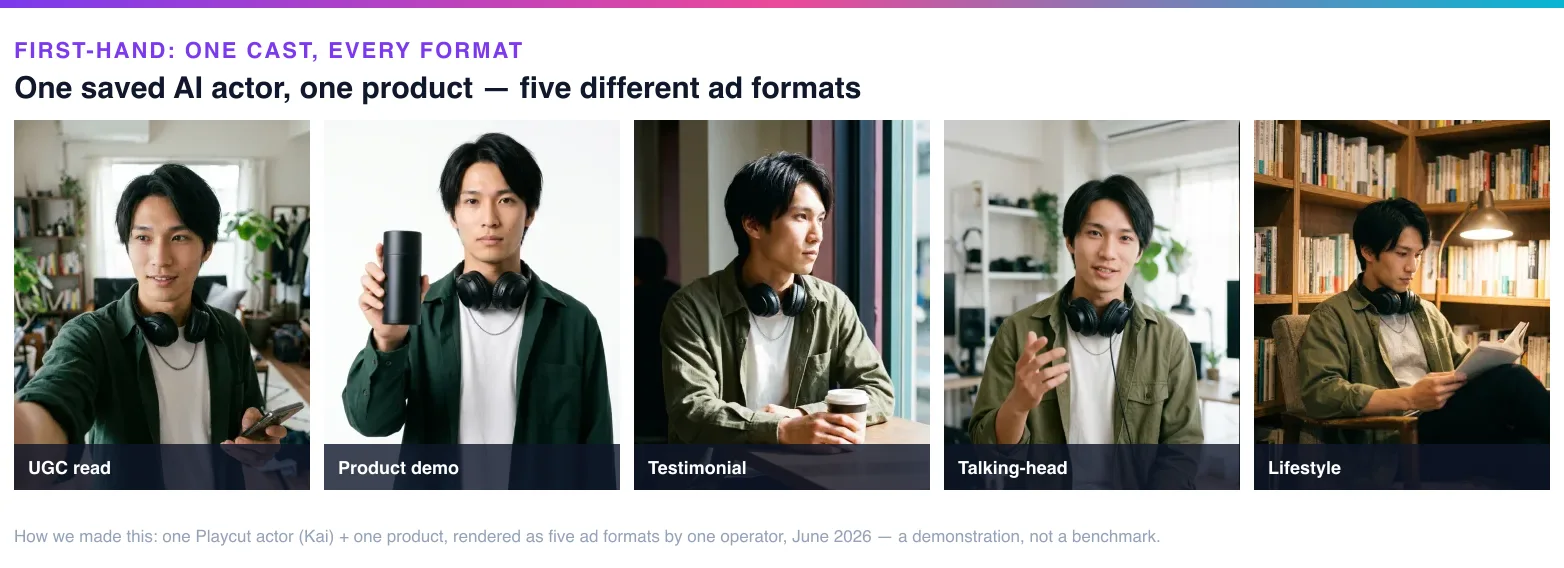
How we made this: one saved Playcut actor (Kai) plus one product sample, rendered as five different ad formats by one operator in June 2026. It’s a demonstration of the formats taxonomy on our own actor, not an independent benchmark; whether the face holds across formats is measured separately in our AI actor guide.
UGC-style and talking-head: the actor-driven formats
Two of the seven formats are built on a person on camera: the UGC-style read and the talking-head. UGC-style ads are the creator-look format — a casual, direct-to-camera product read engineered to feel like organic content.
AI UGC is one format of AI video ad; its full make-it method, the AI-vs-real-UGC verdict, and its own disclosure rules are covered in depth in the complete AI UGC guide, so this guide doesn’t re-teach them. The tool to make UGC-style ad variants from one actor is the AI UGC ad generator.
The talking-head format overlaps UGC but reads differently: a synthetic spokesperson delivering polished, scripted copy, lip-synced, often in many languages. It’s more presenter than raw creator — better for explainers and localized brand messaging than for a “this is just me, a real person” register.
Both formats live or die on consistency. If the face drifts between variants, the “creator” stops being recognizable and retargeting breaks; a consistent AI actor that holds one identity across every clip is what makes either format work at scale.
Product, demo, testimonial, commercial, and motion ads
The other five formats don’t need a creator on camera. Product and ecommerce ads make the product the hero — built from a product photo or page and dropped into a lifestyle scene; the product-ad sub-types and the product-shot-to-video workflow get their own guide to product advertisement. Demo and explainer ads walk through how a product works and are strongest for SaaS and B2B.
For marketplace product pages specifically, the product-hero format has its own spec-bound playbook — see AI video for Amazon listings, where Amazon’s own data shows a 23.8% average sales lift.
Testimonial ads stage a customer endorsement — proof presented as an ad — and they’re where the FTC endorser rules bite hardest, because a synthetic “customer” can’t claim an experience the brand can’t substantiate.
Brand and commercial spots are the cinematic, story-driven register — the AI video commercials people picture when they think “TV ad” — built for awareness rather than a hard click. Famous AI commercial case studies, verified production costs, and the full TV-spot workflow get their own guide to artificial intelligence commercials.
The seventh format is the cleanest “only AI does this well” case. Motion and product-animation ads have no actor and no voice: the product spins, explodes into its parts, or loops through feature call-outs. They sidestep the trust questions that come with a synthetic person entirely, and they’re a strong, under-used way to beat ad fatigue.
Picking the right format is mostly about funnel fit. Awareness formats (brand spots, motion ads, top-of-funnel UGC) buy attention; conversion formats — demos, testimonials, product ads — close consideration. Running a cinematic brand film as a bottom-of-funnel retargeting ad, or a hard-CTA demo as a cold-audience hook, is the most common and most expensive mismatch. Match the format to the job and the same spend does more.
The actor-driven and no-actor formats also differ in production economics. Actor-driven formats (UGC, testimonial, talking-head) cost more to get right because the identity has to stay consistent across every variant, but they carry the trust of a human face.
The no-actor formats, product and motion, are cheaper and faster to iterate because there’s no face to keep on-model, and they dodge the disclosure questions a synthetic person raises. A balanced program usually runs both — a human presence where it sells, the product alone where it can carry the message.
How are AI video ads made?
AI video ads are made in five steps: choose the format, script it to that format, generate the footage along the right production path, stitch the cuts into one ad, then test variants across placements. The method below is tool-agnostic and cross-format — it teaches the production map, not one product’s buttons.
A click-by-click tutorial is its own guide; here the goal is the method, so you can make any of the seven formats rather than memorizing one tool’s UI. The one idea that ties the steps together: the format you pick decides everything downstream.
Step 1: Choose the ad format and funnel goal
Every AI video ad starts with a format decision, not a prompt. Pick from the seven formats based on your goal and funnel stage: brand spots, UGC, and motion ads work top-of-funnel for awareness and scroll-stopping; demos, testimonials, and product ads work mid-to-bottom-funnel where you’re converting consideration into a purchase.
The format decision is load-bearing because it determines three things at once: the production path you’ll use, the platform it fits, and your disclosure exposure. Choose it first and the rest of the steps get easy. The pitfall is generating a polished cinematic spot for a Gen Z TikTok feed where a raw UGC-style cut would outperform it — format-platform fit beats production value almost every time.
Step 2: Script the ad to the format
Each ad is a short script shaped to its format, opening with a hook in the first two to three seconds. A durable structure works across all of them: hook, problem, solution, proof, and one clear call to action. On short-form feeds, the opening seconds decide whether the platform distributes the ad at all, so the hook carries most of the weight.
The register changes by format even when the skeleton doesn’t. A UGC script reads raw and conversational; a commercial script reads cinematic; a demo script reads instructional. The pitfall is forcing one generic script across every format — write to the format, and generate three to five script variants now so step five has something to test.
For a head start on the skeleton, the free ad copy framework generator turns a product, audience, and offer into labeled AIDA, PAS, BAB, or FAB copy you can reshape to the format.
Step 3: Generate the footage along the right production path
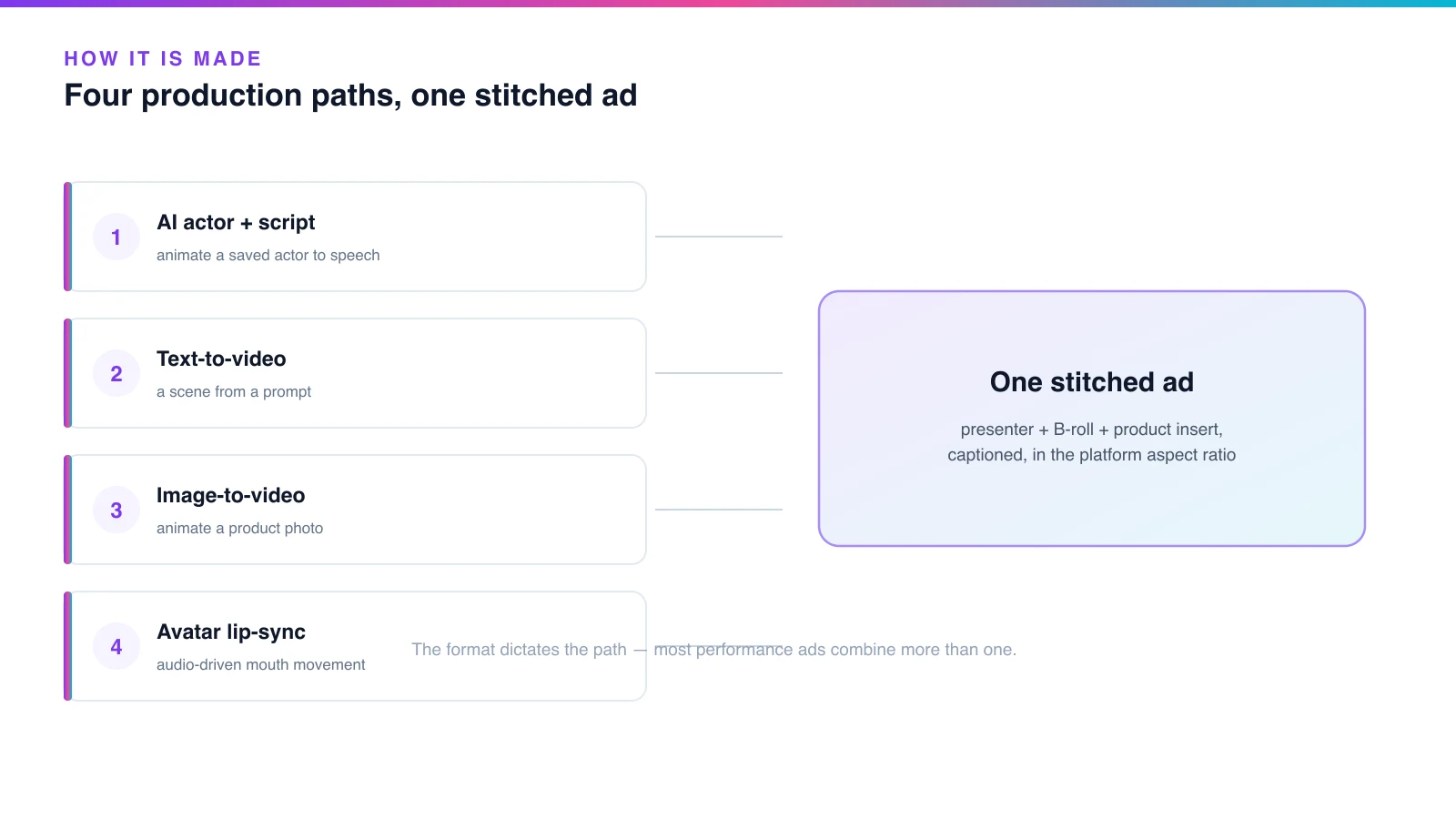
The format dictates which of four production paths you use. AI actor plus script animates a saved, reusable actor to synced speech — the path for UGC, testimonial, and talking-head ads (the consistent-actor mechanism is what keeps the face stable). Text-to-video denoises a scene from random noise with a diffusion model (text-to-video models); quality degrades as clips get longer, which is why ad shots are seconds.
Image-to-video animates a product photo by conditioning on the first frame (Kling start/end frames), and avatar lip-sync maps audio to mouth movement frame by frame (Wav2Lip) with a voice cloned from seconds of reference audio (SV2TTS). The pitfall is forcing one path to do every job — most formats need a specific path, and the best ads combine more than one.
Step 4: Stitch the cuts into one ad
A real performance ad is rarely one clip. It’s usually a presenter (path one) plus a B-roll cutaway (path two) plus a product insert (path three), stitched into a single timeline — that cross-path stitch is what separates a finished ad from a raw generation.
Two finishing moves matter on every platform. Add captions, because the feed is sound-off almost everywhere except TikTok, so the on-screen text carries the message for the silent majority of impressions. Then export the right aspect ratio for the placement. The pitfall is shipping a single uncut text-to-video clip as the whole ad — text-to-video is the B-roll layer, rarely the entire performance ad.
Step 5: Test variants across placements
The payoff is volume. Because the actor and the concept are reusable, you re-render the same idea as genuinely different formats and hooks, render each aspect ratio for its placement, and let the platform algorithm find the winners.
Cheap variant breadth is AI’s real edge over a traditional shoot — and the tool that runs all four production paths and renders every aspect ratio from one prompt is what makes it practical. For a head-to-head on which generator is best, that’s its own ranked comparison.
The caveat is real, though: fresh creative outruns ad fatigue on Meta and TikTok, but raw volume without quality just wastes spend. The pitfall is shipping fifty minor color-swap variants instead of a handful of genuinely different formats — platforms reward creative diversity, not creative noise.
Why do brands use AI video ads?
Brands use AI video ads because they collapse the cost and time of producing performance creative while multiplying how much of it you can test. The six drivers are volume, speed, lower cost, multi-format reuse from one cast, multi-platform localization, and cheap creative testing — and they compound, which is why adoption moved so fast.
Notably, smaller brands are adopting faster than the largest ones, because AI video ads close the production-budget gap that used to keep good creative out of reach (IAB). Four segments dominate: DTC and ecommerce brands, performance marketers, agencies, and lean in-house teams.
The named results are concrete, if vendor- or company-reported. HeyGen reports Trivago localized ads across roughly 30 markets, cutting post-production sharply (HeyGen). Carvana generated over 1.3 million personalized AI videos for customers (Ad Age), and Klarna cut a marketing image cycle from six weeks to seven days with AI (Klarna) — though the Klarna figure is image and ops, not video specifically.
The deepest driver is creative volume itself. Meta and TikTok now reward advertisers who feed many fresh variants into the auction, and they fatigue stale creative faster than any team can shoot replacements. AI video ads are the only practical way to supply that volume — which is why the brands winning paid social increasingly treat creative as an always-on pipeline, not a quarterly production.
Agencies have turned this into a product line of their own — packaging AI video ads into a productized AI UGC service, and rolling it across client accounts with the AI ad creative playbook for agencies. The through-line across every segment is the same: more on-brand creative, tested faster, for less.
Do AI video ads actually work?
AI video ads work for cost efficiency and direct response — but whether they “work” depends entirely on the format and the funnel stage, and the honest answer includes a real trust cost. The flattering numbers are mostly vendor-reported; the credible evidence is narrower and more interesting.
The strongest evidence is peer-reviewed. A field experiment with over 21,000 consumers found AI-personalized video ads lifted click-through by roughly 6 to 9 percent over personalized image ads and generic video (Kapoor & Kumar, Marketing Science; MIT IDE summary). On the platform side, Meta reports a 22% ROAS lift from its Advantage+ AI ad system (Meta Engineering) — a real figure, but platform-reported and tied to the whole Advantage+ system, not AI-generated video alone.
So the verdict is conditional. AI video ads win on cost, volume, and cold-audience testing, where the trust gap barely moves the metric; they’re weakest where genuine authenticity and deep trust drive the purchase. Treat most “X% better” claims as directional, and watch the counter-case below, because consumer perception is the variable brands most consistently get wrong.
It’s worth naming where AI ads underperform. Peer-reviewed work finds an AI voiceover can dampen engagement where a human voice signals trust (ScienceDirect), and the weakest results cluster in high-consideration, high-trust categories where authenticity is the product. The pattern is consistent: AI ads earn their keep at the cheap, high-volume top of the funnel, and give ground as the purchase gets more considered.
The honest counter-case: the AI-ad trust gap
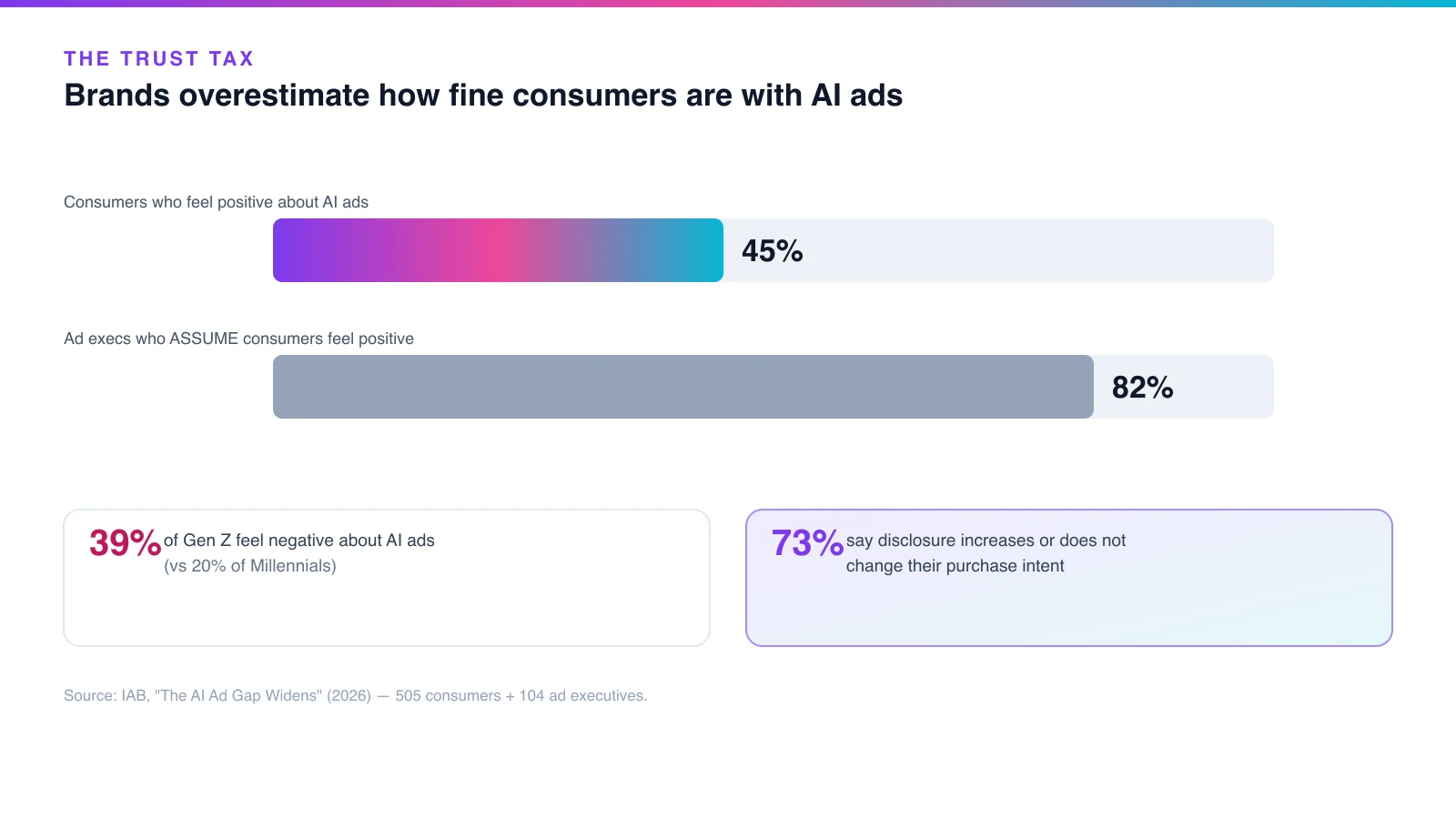
The biggest risk with AI video ads is that brands assume consumers don’t mind — and the data says they do. An IAB study of 505 US Gen Z and Millennial consumers found only 45% feel positive about AI ads, while 82% of ad executives assumed consumers did — a 37-point perception gap (IAB).
Gen Z is the most skeptical (39% feel negative versus 20% of Millennials), and a handful of high-profile AI spots — Coca-Cola’s 2024 holiday ad and the Toys”R”Us Sora film — drew public backlash (NBC News). The “trust tax” is real, and pretending otherwise is how brands walk into it.
The constructive part is that disclosure helps rather than hurts. In the same study, 73% said knowing an ad was AI-made would increase or not change their purchase likelihood — so labeling mitigates backlash rather than worsening it. The lesson is to lean on AI for the formats where authenticity isn’t the product, and to disclose plainly everywhere.
How much do AI video ads cost?
AI-native production collapses the cost of a finished ad by an order of magnitude or more — but the honest number depends entirely on what you’re comparing against. The band below is production cost only, not media spend.
| Production route | Rough cost per ad | Speed |
|---|---|---|
| Traditional broadcast spot | ~$50,000–$500,000+ | Weeks |
| Agency social video | ~$1,500–$50,000 | Days to weeks |
| AI-native | ~$0–$7,000 (tools from low tens of $/mo) | Minutes to hours |
Those bands are directional and corroborated by production-cost surveys (Vidico). One honesty note worth flagging: many AI-cost articles quote a “$342K average, 4A’s 2025 survey” figure — but the 4A’s actually discontinued that annual production-cost survey back in 2014 (MediaPost), so treat that specific number as recycled provenance, not a current fact.
The dollars behind an ad on Meta or TikTok dwarf what it costs to make, and AI doesn’t change that side of the ledger. What AI changes is the cost of having more shots on goal — so the real win is testing ten concepts for what one used to cost, then putting the media budget behind the winner.
The more useful lens is variant economics, not the headline per-ad price. Because the marginal cost of the next AI variant is compute rather than another shoot day, the real saving shows up across a campaign of dozens of versions, not a single ad. For the exact per-clip dollar math broken down across tools, see our AI video cost breakdown.
Where do AI video ads run (and what each platform demands)?
AI video ads run wherever video ads run — Meta and Instagram, TikTok, YouTube, and LinkedIn for B2B — and each platform demands a different cut of the same ad. Matching the format and spec to the placement matters as much as the creative itself.
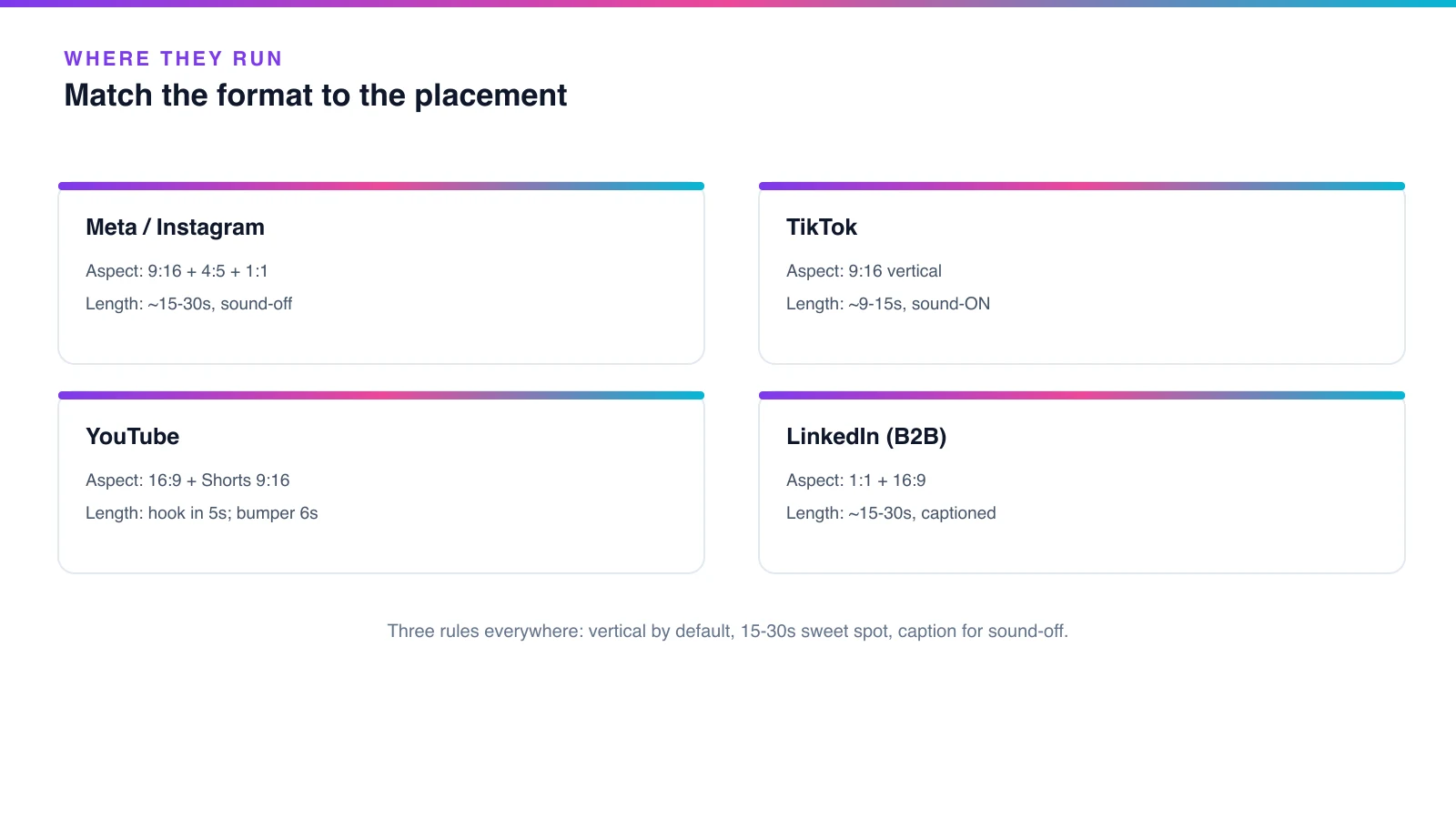
The specs differ in predictable ways. Meta and Instagram favor vertical and square at roughly 15–30 seconds; TikTok rewards a native 9-to-15-second vertical clip with sound on; YouTube wants the hook before the 5-second skip and caps bumpers at 6 seconds (YouTube); LinkedIn skews longer and B2B (QuickFrame). TikTok even has a native “Generate with AI” surface in its ads manager.
Three of those platform cuts now have dedicated makers — the AI TikTok ads maker for native 9:16 with the AIGC label, the AI Instagram ads maker for Reels, Stories and Feed specs, and the AI Facebook ads maker for Meta’s 4:5 feed and 9:16 Reels cuts.
Three rules hold across every platform: go vertical by default, keep most ads in the 15-to-30-second range, and caption everything because the feed plays sound-off almost everywhere except TikTok. Build the ad once, then export the right aspect ratio per placement rather than forcing one cut everywhere.
Do you have to label AI-generated ads?
Yes — AI video ads are legal, but they can’t deceive, and disclosure is increasingly required and platform-enforced. The exposure varies by format: testimonial and UGC ads carry the heaviest endorsement risk because a synthetic “customer” is making a claim, while a product or motion ad is mostly a matter of the platform’s AI label.
The rules are concrete. The FTC treats an AI endorser the same as a human one — its endorsement guide reaches anyone the message “could be or appear to be an individual” (16 CFR 255.0, via Cornell LII). In the EU, the AI Act’s Article 50 requires AI deepfake video to be disclosed from 2 August 2026 (EU AI Act).
In practice, the platforms already enforce the spirit of it: Meta and TikTok auto-label AI content (Meta, TikTok). Build from a fully synthetic or consented likeness, use the platform’s AI-content label, and don’t have a synthetic spokesperson claim an experience the brand can’t substantiate. The complete AI UGC legal guide maps every rule, penalty, and state law in depth.
How Playcut makes AI video ads with one consistent actor
Playcut’s lane in AI video ads is the saved, reusable AI actor that holds one identity across every format. You build the actor once — face, body, and wardrobe — and then a UGC read, a talking-head explainer, a testimonial, and an on-product clip all use the same person instead of a new face per render.
That single fact is what makes the seven formats a system rather than seven unrelated outputs. Because Playcut is a multi-model studio built on the Actor Engine, one saved actor can run every actor-driven format and stay recognizable across a whole campaign. When you’re ready to build that identity, start with a reusable AI actor that holds across formats.
Frequently asked questions
What are AI video ads?
AI video ads are video advertisements created with generative AI — software that produces or assembles the footage, the on-camera presenter, the voiceover, or the full clip, instead of a traditional film crew and a shoot. They run on a spectrum from fully AI-generated (every visual synthesized, no camera) to AI-assisted hybrids (AI layered onto real footage).
The category is broad: it includes UGC-style, product, demo, testimonial, brand/commercial, talking-head, and motion ads — AI UGC is just the creator-style one.
What types of AI video ads are there?
There are seven main formats. UGC-style creator reads mimic organic content; product ads make the product the hero; demo ads walk through how it works; testimonial ads stage a customer endorsement; brand and commercial spots are the cinematic register; talking-head ads use a synthetic presenter; and motion ads animate the product with no actor. They overlap on real campaigns — a testimonial can be shot UGC-style — so treat them as registers, not rigid bins.
Do AI video ads actually work?
Yes for cost efficiency and direct response — but it depends on the format and funnel stage. A peer-reviewed field experiment with over 21,000 consumers found AI-personalized video ads beat personalized image ads and generic video on click-through.
Meta reports a 22% ROAS lift from its Advantage+ AI ad system, though that figure is platform-reported. The honest caveat: wins concentrate at low-price, top-of-funnel testing, most flattering numbers are vendor-reported, and AI ads carry a real consumer-trust cost.
Are consumers turned off by AI video ads?
Many are, and brands overestimate how fine consumers are with it. An IAB study of 505 Gen Z and Millennial consumers found only 45% feel positive about AI ads, while 82% of ad executives assumed they did — a 37-point gap. Gen Z is the most skeptical (39% negative vs 20% of Millennials). The silver lining: 73% said knowing an ad was AI-made would increase or not change their purchase likelihood, so disclosure mitigates backlash.
How much do AI video ads cost?
At a glance, AI-native production collapses the cost of a finished ad from the tens of thousands — a traditional broadcast spot runs roughly $50,000 to $500,000-plus, and agency social video around $1,500 to $50,000 — down to the tens-to-low-thousands of dollars, or pennies per clip at subscription volume.
Those bands are directional and depend on the comparison; the honest lens is variant economics. For the exact per-clip dollar math, see our AI video cost breakdown.
How long should an AI video ad be?
It depends on the platform, and shorter usually wins. TikTok rewards roughly 9 to 15 seconds; Meta and Reels sit around 15 to 30 seconds with drop-off after 30; YouTube wants the hook in the first 5 seconds before the skip button, and bumper ads are a hard 6-second cap.
The universal rule across every platform: land your key message in the first two to three seconds, because that’s where most of an ad’s value is delivered.
Are AI video ads legal, and do you have to disclose them?
Yes, AI video ads are legal in the US and EU, but they can’t deceive and increasingly must be disclosed. The FTC treats an AI endorser like a human one, so a synthetic testimonial can’t claim experience the brand can’t prove.
The EU AI Act’s Article 50 requires AI deepfake video to be disclosed from 2 August 2026, and Meta and TikTok already auto-label AI content. Build from a fully synthetic or consented likeness and use the platform’s AI-content label.
What’s the difference between an AI video ad and AI UGC?
An AI video ad is any AI-generated video used as paid creative; AI UGC is one format of it — the creator-style, casual, direct-to-camera product read that mimics organic content. Other AI video ad formats include product and ecommerce ads, demos, testimonials, talking-head spokesperson ads, and polished brand commercials.
So every AI UGC ad is an AI video ad, but most AI video ads are not UGC. For the creator-style format in full, see our complete AI UGC guide.
Conclusion: getting started with AI video ads
AI video ads are the whole category of AI-generated paid video — seven formats, four production paths, one reusable cast — and AI UGC is just the creator-style corner of it. They win on cost, volume, and fast testing; they carry a real consumer-trust tax that disclosure mitigates; and they’re legal as long as you build from a synthetic or consented likeness and label them.
Getting started is a format decision, not a tool decision: pick the format that fits your funnel, script it to that format, generate along the right path, and test wide before you scale. Plan your first set with the free creator tools, then choose your format and build out from one consistent cast.
Before you pour budget into the winners, the free breakeven ROAS calculator tells you the return on ad spend each variant has to clear to turn a profit, and the ad metrics calculator turns raw CPM, CTR, and CPA numbers into side-by-side variant comparisons.
Make AI video ads from one consistent cast.
Build one saved AI actor and run every ad format from it — UGC reads, product demos, testimonials, talking-heads — all the same person, every aspect ratio. Start your free trial and ship your first AI video ad today.
Start building in Playcut →