
HeyGen vs Arcads (2026): Which AI Video Tool Wins for You?
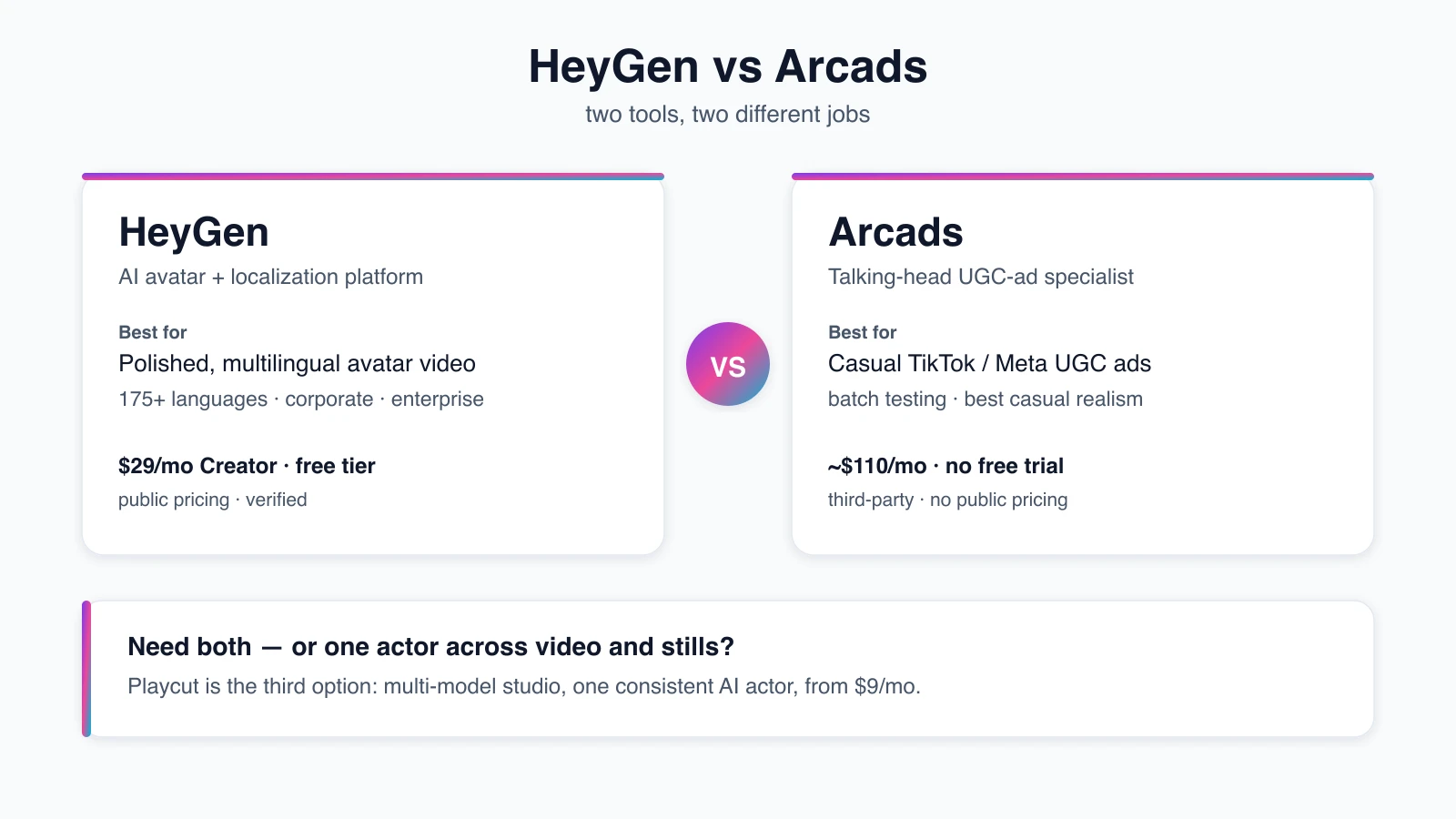
If you’re weighing HeyGen vs Arcads, the honest answer is that they barely compete on the same axis — they win different jobs. HeyGen is an AI-avatar and localization platform; Arcads is a talking-head UGC-ad specialist. Picking between them is really about which job you’re hiring the tool for.
In short: Pick HeyGen if your job is polished, multilingual avatar video — corporate training, explainers, localization across 175+ languages. Pick Arcads if your job is high-volume, casual-looking TikTok and Meta UGC ads that don’t read as AI. If you need both jobs — or one consistent custom actor across image and video — a multi-model studio like Playcut is the third option to weigh.
Are you switching from one of these, or picking your first AI video tool? Either way, the table and the per-use-case breakdown below answer it. Last verified June 5, 2026 — HeyGen pricing is from its official pricing page; Arcads publishes no public pricing, so every Arcads figure here is third-party and flagged.
Table of contents
- HeyGen vs Arcads at a glance
- Who wins each use case
- Why the register matters for ads
- HeyGen: the avatar and localization platform
- Arcads: the UGC-ad specialist
- How the pricing really compares
- Where Revid AI fits
- Where Playcut fits (the honest third option)
- How we compared
- Frequently asked questions
HeyGen vs Arcads at a glance
HeyGen is the avatar and localization heavyweight: a large stock-avatar library, lip-synced dubbing into 175+ languages, and enterprise features. Arcads is narrower and sharper — it turns a script into casual, talking-head UGC ads using AI actors, built for performance marketers running paid social at volume.
The cleanest way to choose is by what each one is for. The table below lays out the decision axes, with HeyGen’s numbers verified from its pricing page and Arcads’ flagged as third-party (Arcads publishes none).
| Decision axis | HeyGen | Arcads | Playcut (third option) |
|---|---|---|---|
| Category | AI avatar + localization platform | Talking-head UGC-ad specialist | Multi-model AI video & image studio |
| Entry paid price | $29/mo Creator ($24 annual) — verified | ~$110/mo Starter — third-party, no public pricing | $9/mo Hobby; $29/mo Pro |
| Free tier / trial | Yes — 3 videos/mo, watermark, no card | No free trial — subscribe to test | Free creator tools; $9 entry |
| Talking-head / UGC realism | Studio-polished; can read presentational | Strongest casual UGC realism | Veo 3.1 default; depends on model + actor setup |
| Actor / avatar library | 700+ stock avatars | 1,000+ AI actors (vendor claim) | Custom actor — one face across formats |
| Languages | 175+ with dubbing | 30+ (homepage) | Gemini TTS (wider coverage) or Qwen (default) |
| Multi-format (stills + video) | Video-focused | Talking-head video only | Yes — image + video |
| Batch variants | Via API/templates | Core feature — many actors per script | Multi-model variant runs |
| Pricing transparency | Public | None (page 404s) | Public 4-tier ladder |
| Best for | Multilingual, corporate, enterprise | High-volume paid-social UGC ads | One studio for video + stills, one actor |
Who wins each use case
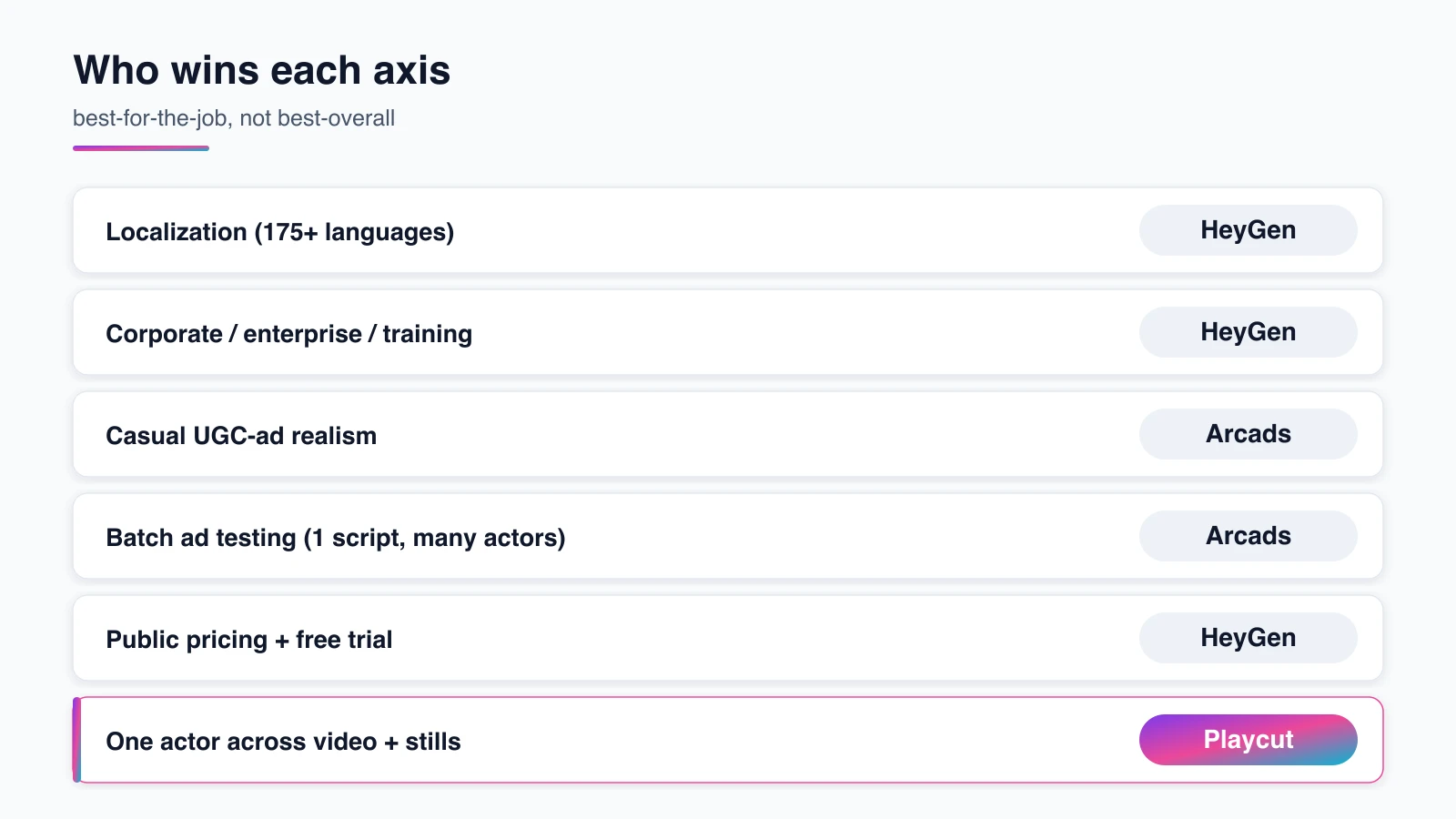
There’s no overall winner — there’s a winner per job. Here’s the honest split:
- Localize into 175+ languages → HeyGen
- Corporate training, explainers, sales presenters → HeyGen
- TikTok and Meta UGC ads with batch testing → Arcads
- One single hero UGC ad, maximum casual realism → Arcads
- Enterprise compliance (SOC 2, SSO, consent) → HeyGen
- First tool, tight budget, test before paying → HeyGen’s free tier (or Playcut’s free tools)
- One consistent actor across video and stills → Playcut
- Both polished video and casual ads from one place → Playcut
The rest of this guide backs up each call with verified detail.
Why the register matters for ads
A comparison can’t just crown “the more realistic tool,” because realism means different things by placement. On a native TikTok or Reels feed, casual and slightly imperfect out-converts polished — the ad has to look like a person filmed it on a phone, which is exactly Arcads’ register. In a corporate explainer or a localized training video, polish is the point, and HeyGen’s studio look is the asset.
So match the register to the placement. A glossy avatar reads as trustworthy in a B2B explainer but as an obvious ad in a UGC feed; a casual creator read reads as authentic on social but unprofessional in a boardroom. That placement fit, more than raw output quality, is what actually decides which tool wins.
HeyGen: the avatar and localization platform
What HeyGen is. HeyGen (founded 2020 by Joshua Xu and Wayne Liang) is an AI-avatar platform built for polished, studio-style video and dubbing. You pick or create an avatar, type a script, choose a language, and render a presenter-style clip — no camera, no crew.
Pricing (verified). HeyGen publishes its tiers: Free ($0, 3 videos/mo, ≤1 minute, watermark), Creator $29/mo ($24 annual), Pro $49/mo, Business $149/mo plus $20/seat, and Enterprise (heygen.com/pricing, checked June 5, 2026). It’s credit-metered, not “unlimited” — premium Avatar IV burns about 20 credits per minute, so heavy use costs more than the sticker.
Realism and avatars. HeyGen’s register is studio-polished, which is excellent for explainers and spokespeople but can read as presentational — even slightly stiff in close-ups — on a casual feed. Its stock library runs 700+ avatars, plus digital twins and one-image Avatar IV.
Languages. This is the genuine win: 175+ languages with lip-synced dubbing, the strongest localization claim in this comparison. If your job is taking one video global, HeyGen leads.
Best for: multilingual, corporate, B2B and enterprise teams. Winner of localization and enterprise: HeyGen. The trade-off is that its polish works against it for native, scrappy social ads.
In brief — strengths: public, predictable pricing with a real free tier; unmatched 175+ language localization; a large avatar library plus one-image Avatar IV; enterprise SOC 2, SSO and consent controls. Weaknesses: it’s credit-metered, so heavy Avatar IV use runs well above the sticker; the polished register can read corporate on casual feeds; and it isn’t built for batch UGC-ad testing.
Arcads: the UGC-ad specialist
What Arcads is. Arcads (founded 2024 in Paris by Dylan Fournier and Romain Torres; $16M seed led by Eurazeo, December 17 2025) is a single-purpose UGC-ad engine. It turns a script into casual, phone-shot-looking talking-head ads using fully AI-generated actors — not a marketplace of real humans filming on demand, a myth some reviews repeat. Per Arcads’ own product page, it creates content with AI actors rather than real creators.
Pricing — the real story. Arcads publishes no public pricing: arcads.ai/pricing returns a 404 (re-confirmed June 5, 2026). Third-party reviews consistently report a Starter plan around $110/mo for roughly 10 videos (about $11 each), a Creator plan near $220/mo, and no free trial. Treat all of these as third-party estimates, never as official Arcads numbers.
Realism and UGC feel. This is Arcads’ home turf. Practitioners rate its casual realism highly — one reviewer called it “so realistic it’s insane” (Marketer Milk). For native TikTok and Meta ads that shouldn’t look produced, it’s the strongest here.
Batch testing. The decisive workflow win: run one script across many AI actors and hooks to test creative at volume — exactly how performance marketers find winners. Winner of UGC-ad realism and batch testing: Arcads. The trade-offs: no free trial, talking-head only, and no built-in editor or captions (you finish in CapCut).
In brief — strengths: best-in-class casual UGC realism; a genuine batch workflow built for performance marketers; pre-licensed AI actors with emotion control. Weaknesses: no public pricing and no free trial, so you pay (around $110/mo, third-party-reported) before testing; talking-head only; no built-in editor; and a non-exclusive output license.
How the pricing really compares
The honest pricing story is mostly about transparency. HeyGen shows everything: a free tier, Creator at $29/mo, and a clear ladder up to Business and Enterprise — you know the cost before you sign up. Arcads shows nothing; its pricing page returns a 404, and you can’t see a number without creating an account.
Third-party reviews put Arcads’ entry around $110/mo for roughly 10 videos with no free trial, versus HeyGen’s $29 and a genuine free tier. For testing-heavy performance marketers, Arcads’ batch workflow can justify that floor; for anyone evaluating cautiously, HeyGen’s free tier and Playcut’s $9 entry are far lower-risk ways to start.
Here’s the tier-by-tier picture — HeyGen and Playcut verified from their pricing pages, every Arcads figure flagged third-party:
| Tier | HeyGen (verified) | Arcads (third-party — no public pricing) | Playcut (verified) |
|---|---|---|---|
| Free / trial | Free — 3 videos/mo, ≤1 min, watermark, no card | None — no free trial | Free creator tools, no card |
| Entry | Creator $29/mo ($24 annual) | ~$110/mo Starter (~10 videos, ~$11 each) | Hobby $9/mo |
| Mid | Pro $49/mo | ~$220/mo Creator | Pro $29/mo |
| Team / scale | Business $149/mo + $20/seat | Custom / sales-gated | Studio $79/mo (4 seats) · Agency $149/seat |
| Pricing page | Public | Returns a 404 | Public 4-tier ladder |
| Test before paying? | Yes (free tier) | No | Yes (free tools + $9 entry) |
The pattern is consistent: HeyGen is the cheaper, transparent start; Arcads asks you to pay before you can see a price or a result; Playcut undercuts both at entry while letting you test free first.
Where Revid AI fits
If your search was really “revid ai vs heygen,” the short version is that Revid is a different category. Revid AI is a short-form automation tool — closer to a posting engine than to HeyGen’s avatars or Arcads’ ad actors. Its real win is Auto-Mode Workers that generate and auto-post a video a day to TikTok, Instagram and YouTube, plus a 3M+ clip remix library.
Pricing runs about $39/mo (a promo off a $99 list) on its Growth tier. The catch is credit opacity — premium models burn credits fast, and billing reviews are mixed. Pick Revid for hands-off short-form volume, not for polished avatars or high-realism ad actors.
Where Playcut fits (the honest third option)
To keep this honest: if your single job is 175-language corporate dubbing, pick HeyGen. If it’s maximum TikTok UGC realism at batch volume, pick Arcads. Neither is wrong, and Playcut doesn’t claim to beat them at their own game.
Where Playcut is genuinely different is the cross-format job neither rival does: one consistent custom AI actor that holds across both video and stills — a UGC ad, a product still, and an on-product shot, all the same face — across multiple models (Veo 3.1, Seedance 2.0, Nano Banana Pro, Grok Imagine). It also lets you try before you pay, with free creator tools and a $9 Hobby tier, where Arcads has no trial at all.
For the deeper picks, see the full HeyGen alternatives and Arcads alternatives breakdowns, the AI actor generators compared consistency test, or build a consistent presenter with Playcut’s AI actors. For the ad-format context, the AI video ads guide maps where each format runs.
How we compared
HeyGen’s pricing and feature claims are taken from its official pricing and product pages, dated June 5, 2026. Arcads publishes no public pricing — its pricing page returns a 404 — so every Arcads figure here is drawn from third-party reviews and flagged as such. Feature claims for both were cross-checked across multiple independent sources, and we re-verify pricing before each update because both vendors ship fast.
We didn’t re-run both platforms head-to-head for this guide; where realism is described, we cite named practitioner reviews rather than asserting our own score. The point of this page is an honest, current, source-cited comparison — not a vendor pitch.
Frequently asked questions
Is Arcads better than HeyGen?
It depends on the job. Arcads wins high-volume, casual-looking TikTok and Meta UGC ads that need to not read as AI, while HeyGen wins polished, multilingual avatar video — corporate training, explainers, and localization across 175+ languages. Neither is universally better; they’re built for different work. If you need both, weigh a multi-model studio like Playcut.
Which is cheaper, HeyGen or Arcads?
HeyGen is cheaper to start and the only one with public pricing: Creator is $29/mo ($24/mo billed annually), and there’s a free tier with 3 videos a month. Arcads publishes no public pricing — its pricing page returns a 404 — but third-party reviews consistently report a Starter plan around $110/mo for about 10 videos, with no free trial. Treat every Arcads figure as third-party and unverified.
What’s the difference between HeyGen and Arcads?
HeyGen is an AI-avatar and localization platform built for polished, studio-style video and dubbing into 175+ languages. Arcads is a single-purpose UGC-ad engine that turns a script into casual, phone-shot-looking talking-head ads using AI actors. HeyGen serves corporate and global teams; Arcads serves performance marketers and DTC brands running paid social.
Which is best for UGC ads?
Arcads is purpose-built for UGC ads and generally wins on casual realism and batch testing — running one script across many AI actors for paid social. HeyGen can make UGC-style ads, but its avatars skew polished and corporate, which can underperform on native TikTok and Instagram feeds. For one consistent custom actor reused across many ad sets and stills, Playcut is a third option.
Does Arcads have a free trial?
No. Multiple third-party reviews report that Arcads has no free trial — you subscribe (commonly cited around $110/mo) before generating a single video. Arcads doesn’t publish this policy publicly, so treat it as consistent third-party reporting rather than an official figure. By contrast, HeyGen has a free tier with 3 videos a month and no card required.
Are Arcads’ AI actors real people?
No — Arcads uses fully AI-generated actors, not a marketplace of real people filming on demand. Some review blogs mischaracterize it as a creator marketplace; that’s incorrect per Arcads’ own product page, which states it creates content using AI actors rather than real human creators. The actors are AI, which is the point of the tool’s speed and scale.
Can HeyGen make UGC ads?
Yes — HeyGen has a UGC-ad product and exports to Meta and TikTok Ads Manager. But its register skews studio-polished, so the output can read as produced on native social feeds, where casual UGC tends to out-convert. HeyGen is the stronger pick when you also need localization, longer-form video, or enterprise compliance alongside ads.
What’s a good alternative to both HeyGen and Arcads?
If you need both jobs — polished video and casual UGC — from one place, or one consistent custom actor across image and video, a multi-model studio like Playcut is worth weighing; it runs Veo 3.1, Seedance 2.0, Nano Banana Pro and Grok Imagine, starts at $9/mo, and has free creator tools to test. Revid AI is another adjacent option for high-volume short-form auto-posting, though it’s an automation tool rather than an avatar or ad-actor specialist.
The verdict
Choose HeyGen if your job is polished, multilingual avatar video — training, explainers, and localization at enterprise scale. Choose Arcads if your job is casual, high-realism TikTok and Meta UGC ads tested at batch volume. They win different work, and most teams that think they need to choose actually need one or the other clearly.
Consider Playcut if you need both jobs from one studio, or one consistent actor across video and stills — and want to test before you pay. Start with the free creator tools, or compare the ranked field in the best AI UGC generators breakdown.