
AI Commercial Generator: Famous Examples, Costs & How to Make One
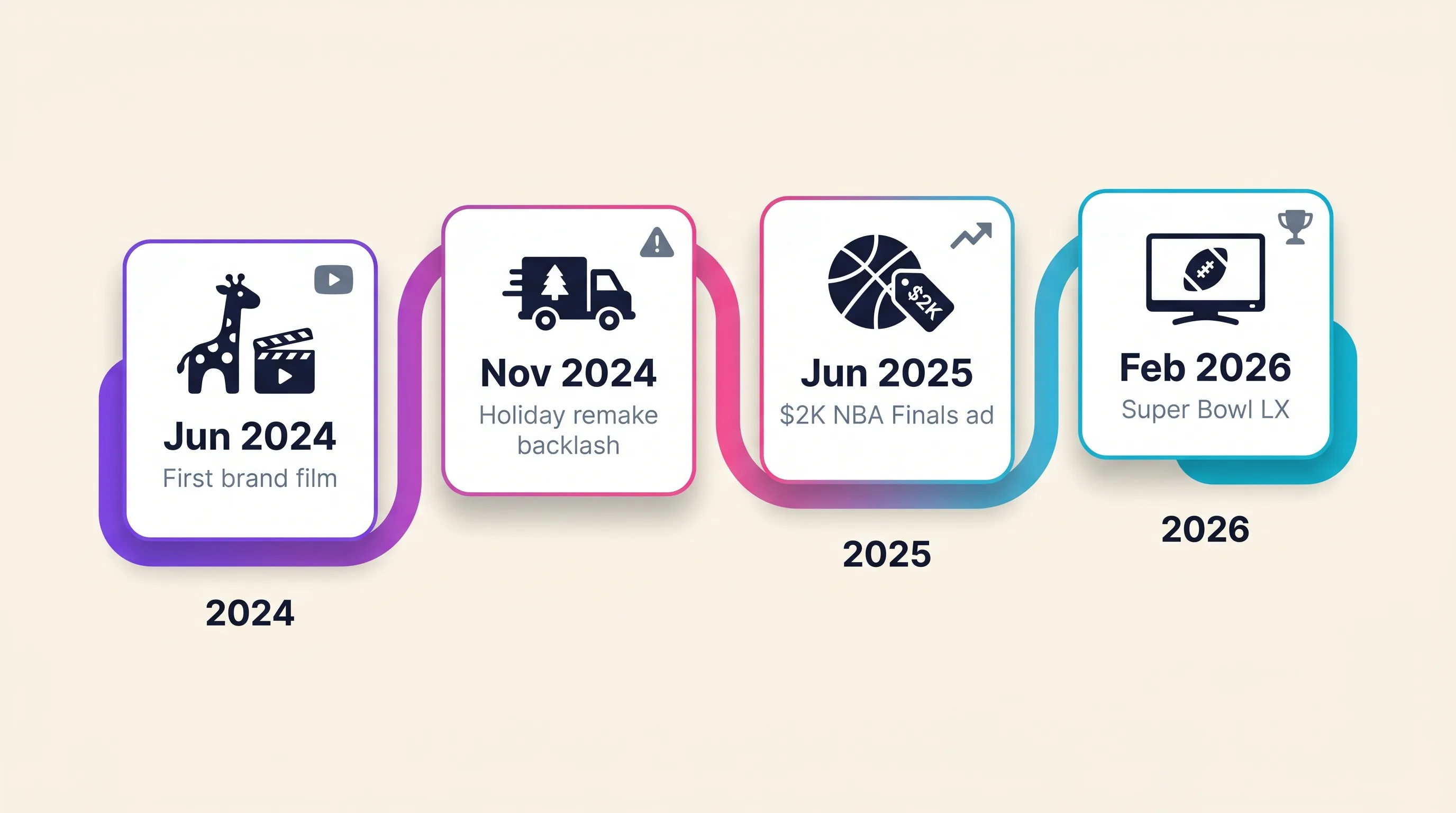
Artificial intelligence commercials are video advertisements where generative AI produces the footage, the voiceover, or the entire spot instead of a traditional film crew. In two years they’ve jumped from a Cannes Lions curiosity to the most expensive ad real estate on television — a $2,000 AI spot aired during the 2025 NBA Finals, and Super Bowl LX carried a primarily AI-generated national ad.
The craft problem that decides whether these spots land is consistency — a character that holds from scene one to scene twelve. That is exactly what the Playcut Actor Engine solves: 100% character consistency across every shot of a commercial, the same face and the same wardrobe from the opening frame to the end card.
This guide assembles the record nobody else has on one page: the famous AI commercials with their budgets and backlashes, verified production costs, an honest tool taxonomy, and the six-step workflow to make a broadcast-ready spot yourself.
Table of contents
- What are artificial intelligence commercials?
- Famous AI commercials: 5 case studies and what they prove
- How much does a video commercial cost? Traditional vs AI
- How to make a commercial with AI (6 steps)
- What is an AI commercial generator (and which kind do you need)?
- How Playcut makes broadcast-ready AI commercials
- Frequently asked questions
- Conclusion: a craft problem, not a budget problem
What are artificial intelligence commercials?
An artificial intelligence commercial is a TV-style video advertisement made partly or entirely with generative AI — the models write, render, or voice what a production company used to shoot. The category spans a spectrum: fully generated spots like Kalshi’s NBA Finals ad sit at one end, and AI-assisted hybrids, real footage with generated scenes, voiceover, or extensions spliced in, sit at the other.
What makes a commercial a commercial, rather than a performance ad, is the register. Commercials are cinematic, story-driven, awareness-first: thirty or sixty seconds built for TV, CTV, YouTube pre-roll, and the brand-film slot on a homepage. They sell a feeling about the brand before they sell a click.
AI commercial vs. AI video ad vs. brand film
An AI commercial is one register inside a larger category. The umbrella term is the AI video ad — any paid video creative made with generative AI — and it spans seven formats from UGC clips to product demos, all mapped in the full AI video ads guide. That pillar owns the performance side: platform specs, testing math, and disclosure rules.
This page owns the cinematic end. A commercial is the produced, scripted, awareness spot; a brand film is its longer cousin — sixty seconds to several minutes of pure story, like the Toys”R”Us origin film below, often with no hard call to action at all.
If what you actually need is the opposite register — a creator talking to a phone camera — that’s a different workflow entirely, built for feeds rather than broadcast. Creator-style UGC ads are faster, cheaper per asset, and tested in volume; commercials are fewer, slower, and built to be remembered.
Famous AI commercials: 5 case studies and what they prove
The fastest way to understand AI commercials is to study the five campaigns that defined them — two backlashes, one economic proof, one iteration story, and one Super Bowl debut. Together they form a record of what works and what backfires that no tool landing page will show you.
Coca-Cola’s “Holidays Are Coming” (2024) — the backlash blueprint
Verdict: the most-seen AI commercial ever made is also the cautionary tale. In November 2024, Coca-Cola released an AI remake of its iconic 1995 Christmas-trucks spot, produced by three AI studios — Secret Level, Silverside AI, and Wild Card — using four different generative models, and the reaction was an immediate controversy.
Creatives and consumers called it “soulless,” with Gravity Falls creator Alex Hirsch among the loudest critics. Yet the ad still racked up billions of impressions. The failure wasn’t technical — it was strategic: Coca-Cola used AI to replace a beloved, human-made tradition, and audiences read that as the brand cheapening its own heritage.
Coca-Cola’s 2025 sequel — doubling down on AI craft
Verdict: the world’s biggest advertiser treated the backlash as a craft problem, not a strategy problem. In late 2025 Coca-Cola released a second AI holiday spot, again with Secret Level — this time built around animals instead of people, with executives publicly framing the approach as “this time is different,” per The Hollywood Reporter’s coverage.
That iteration is the most important signal in this entire record. After the most-criticized AI ad in history, Coca-Cola’s answer was not retreat but better craft — which tells you where the biggest brand budgets believe this is going.
Toys”R”Us × Sora (2024) — first brand film, sentiment collapse
Verdict: a genuine first that became a measurable brand-sentiment disaster. In June 2024, Toys”R”Us premiered the first-ever brand film made with OpenAI’s Sora at Cannes Lions — a roughly one-minute origin story of founder Charles Lazarus and Geoffrey the Giraffe, produced with agency Native Foreign.
The numbers were brutal. Per Marketing-Interactive’s sentiment tracking, positive brand sentiment fell from 12.2% to 3.4% after launch, while negative sentiment exploded from 13.5% to 53.4%. Depicting a real, deceased founder in synthetic footage compounded the uncanny-valley problem with an authenticity one.
There’s a sharp postscript: Sora itself was discontinued on March 24, 2026. The first Sora commercial outlived the tool that made it — a reminder that the campaigns endure while individual models churn.
Kalshi’s $2,000 NBA Finals ad (2025) — the economics proof
Verdict: the single most important data point in AI commercial economics. In June 2025, prediction market Kalshi aired a 30-second, deliberately chaotic spot during NBA Finals Game 3 — made by one AI filmmaker, PJ Accetturo, in about two days for roughly $2,000 using Google’s Veo 3, with Gemini and ChatGPT generating the prompt lists.
The comparison baseline, per Ad Age: a typical NBA-Finals-grade national spot costs $250,000–$500,000 to produce. Kalshi paid about 1% of that and collected roughly 20 million impressions.
The honest footnote is the workflow ratio. Accetturo generated around 400 clips to get roughly 15 usable ones — a 4% hit rate. AI commercial production is a volume game: the cost collapsed, but the selects discipline is the real job.
Svedka and the AI Super Bowl LX (2026) — the biggest stage
Verdict: AI commercials reached the Super Bowl, and craft became the differentiator. In February 2026, Svedka ran “Shake Your Bots Off” — a 30-second spot starring robot characters Fembot and Brobot, billed as the first primarily AI-generated national Super Bowl ad. Roughly 15 of Super Bowl LX’s 66 commercials involved AI in their creation or came from AI companies (verified June 11, 2026).
Reception was mixed-to-negative. The Hollywood Reporter’s best-and-worst rundown flagged inconsistent physics and “emotionally vacant” results across the AI cohort — characters that subtly changed between cuts, objects that didn’t obey gravity. The barrier to airing an AI commercial is gone; the barrier to airing a good one is now consistency.
One precision point competitors blur: OpenAI’s own Super Bowl ads — “The Intelligence Age” at LIX, the Codex spot at LX covered by Adweek — are ads about AI, not necessarily ads made by AI generators. They prove AI’s cultural arrival, not the production method.
When AI commercials work — and when they backfire
The five cases reduce to a usable decision rule. AI commercials win on net-new creative where speed or economics is the story; they backfire when AI visibly replaces beloved human craft. Kalshi worked because nothing human was displaced — the chaos was the aesthetic, and the $2,000 budget was the story.
Coca-Cola 2024 and Toys”R”Us failed for the same structural reason: each took something audiences loved precisely because humans made it — a hand-crafted holiday tradition, a founder’s memory — and rendered it synthetically. Audiences punished the substitution, not the technology.
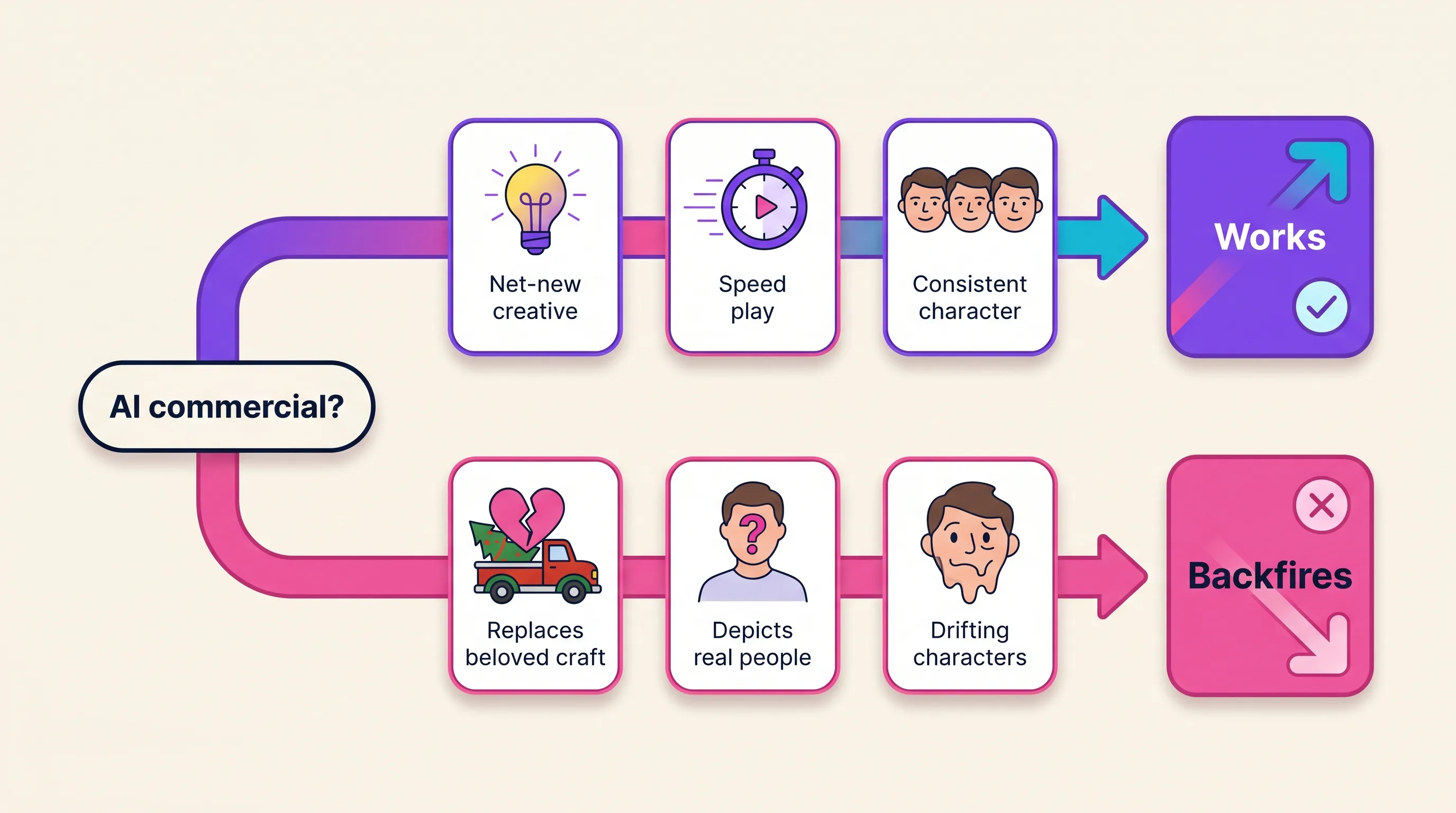
The second half of the rule is craft. Every major criticism of the Super Bowl LX cohort — drifting characters, broken physics, emotional vacancy — is a consistency failure. Brands that locked their characters and treated AI footage to the same edit discipline as film survived review; those that shipped raw generations did not.
How much does a video commercial cost? Traditional vs AI
Traditional video commercial production runs $10,000–$50,000 for most professional 30-second spots and $500,000+ for national campaigns with celebrity talent — production only, before airtime. AI production compresses that to a tool subscription plus days of creative time, with Kalshi’s ~$2,000 NBA Finals ad as the public benchmark. All ranges below were verified June 11, 2026.
| Production route | Typical cost (production only) | Source |
|---|---|---|
| Professional 30-second spot | $10,000–$50,000 | Vidico’s 30-second commercial cost guide |
| National campaign with celebrity talent | $500,000+ | Vidico |
| NBA-Finals-grade national spot | $250,000–$500,000 | Ad Age (Kalshi coverage) |
| Kalshi’s AI Finals ad (2025) | ~$2,000 + creative fee | Ad Age |
| AI studio route | $29–$79/month subscription + 2–5 days creative time | Playcut pricing, June 2026 |
Two clarifications keep this table honest. First, production is not airtime — the media buy is usually the bigger line, and AI changes nothing about what CBS charges for thirty seconds. Second, talent is the biggest traditional variable: per Simulmedia’s TV cost guide, a non-union actor runs $500–$2,000 a day against $3,500–$10,000+ for union talent, and high-end 3D animation alone runs $50,000–$100,000+.
One zombie statistic deserves a debunk. The “$342K average commercial” figure still quoted across the web comes from a 4A’s survey that was discontinued in 2014, as MediaPost reported at the time — any page citing it as current data hasn’t checked its sources in a decade.
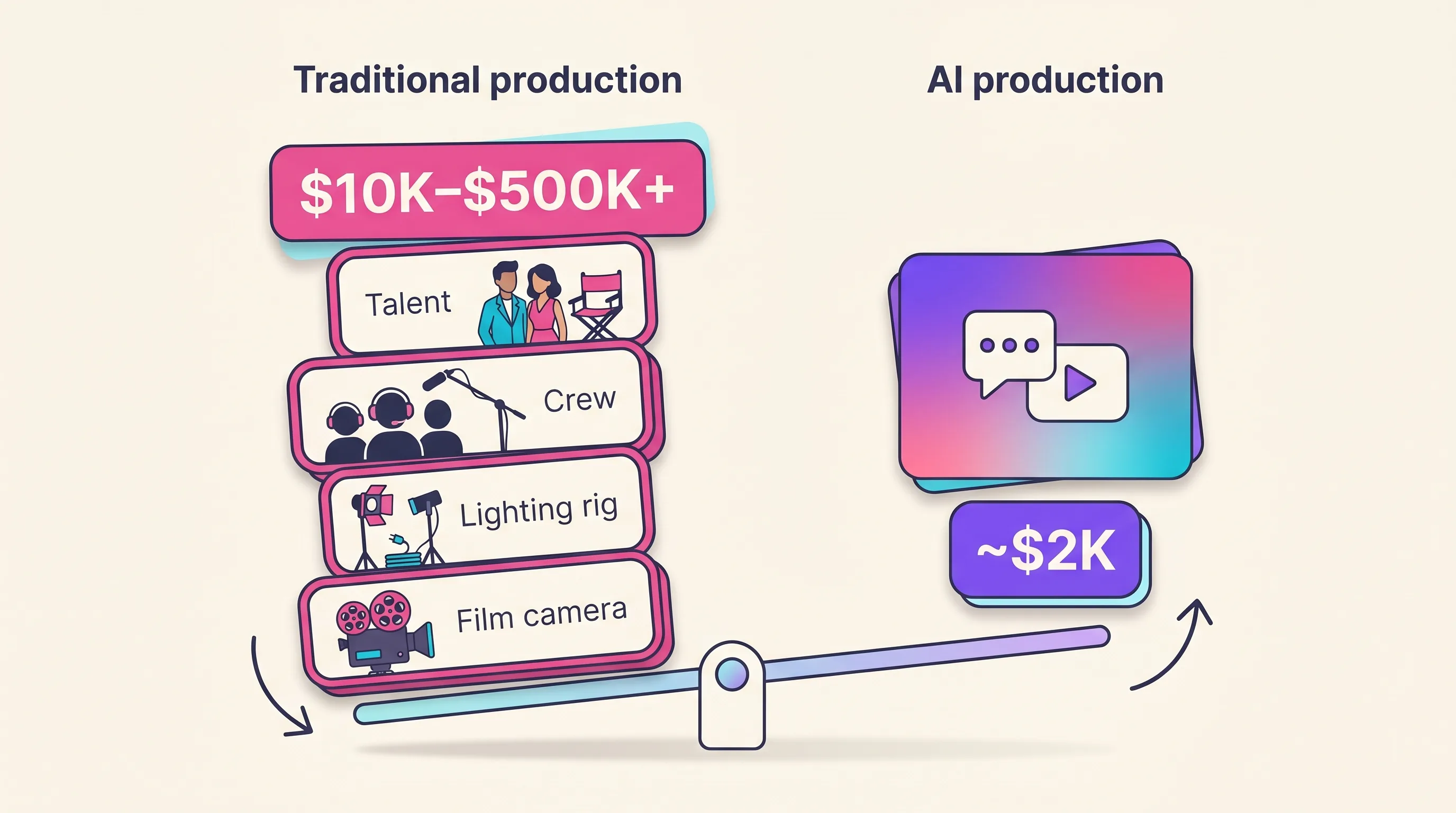
Here’s the Playcut math for the AI column. A 30-second commercial is typically 4–6 generated clips plus voiceover; on the Pro plan ($29/month, 2,000 credits) that’s one spot with room to iterate, while Studio ($79/month, 6,000 credits, 4 seats) covers a campaign’s worth of selects.
The honest framing: AI compresses production, not strategy or ideation — and Kalshi’s 400-generations-for-15-clips ratio is the real workflow cost to budget for.
How to make a commercial with AI (6 steps)
You make an AI commercial in six steps: write the script, cast a consistent AI actor, generate the scenes, add voiceover and sound, assemble under your brand system, and version the cut for every placement. The method below is the cinematic-register workflow — the performance-ad variant lives in the AI video ads pillar.
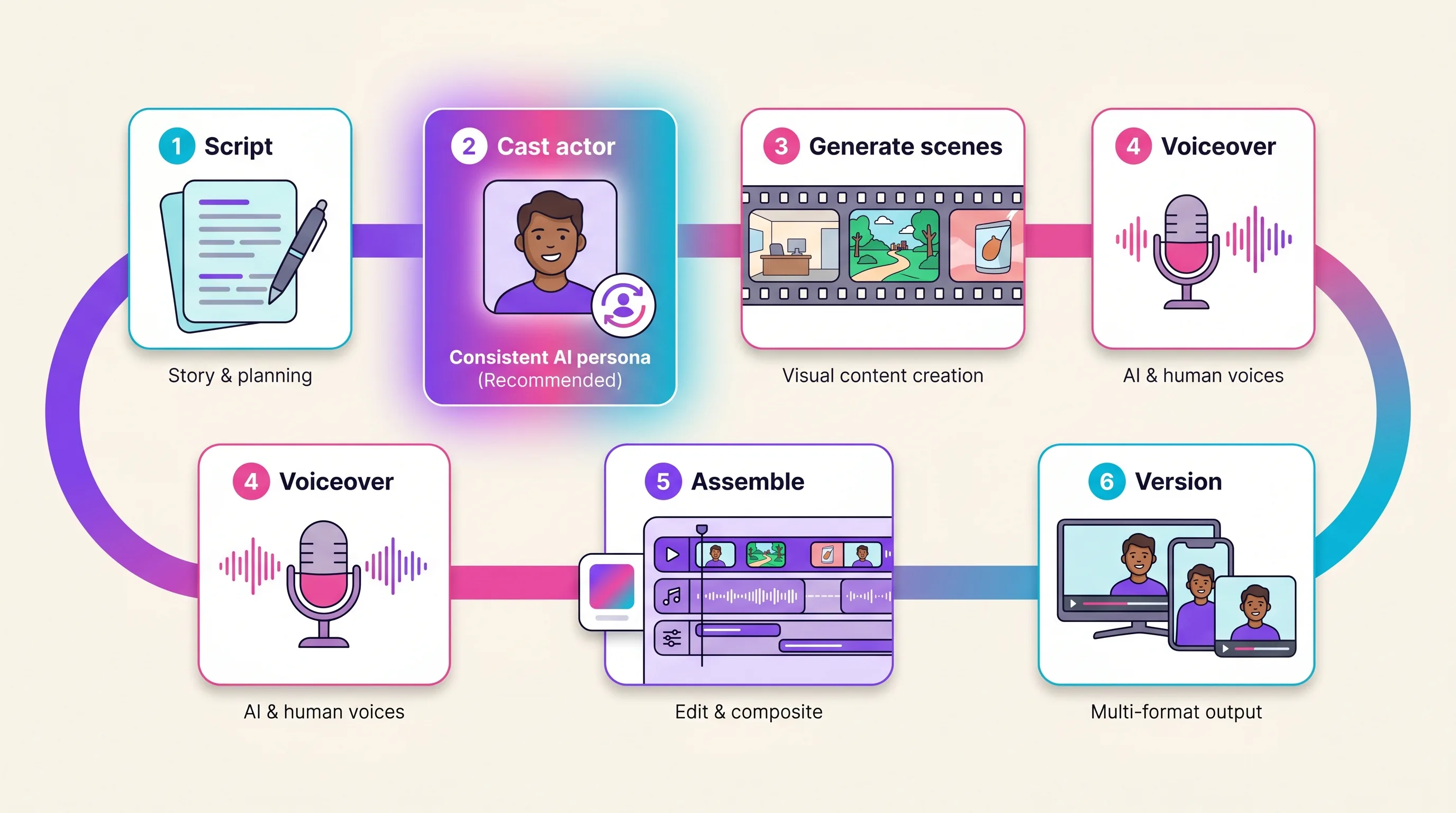
Step 1: Concept and script
Every commercial in the case-study record was won or lost at the concept stage, before a single frame was generated. Decide the one feeling the spot should leave behind, then script to 65–75 words for thirty seconds of voiceover. Kalshi’s script was a list of escalating absurd images; Coca-Cola’s was a beat-for-beat remake — the concept, not the model, made one a win.
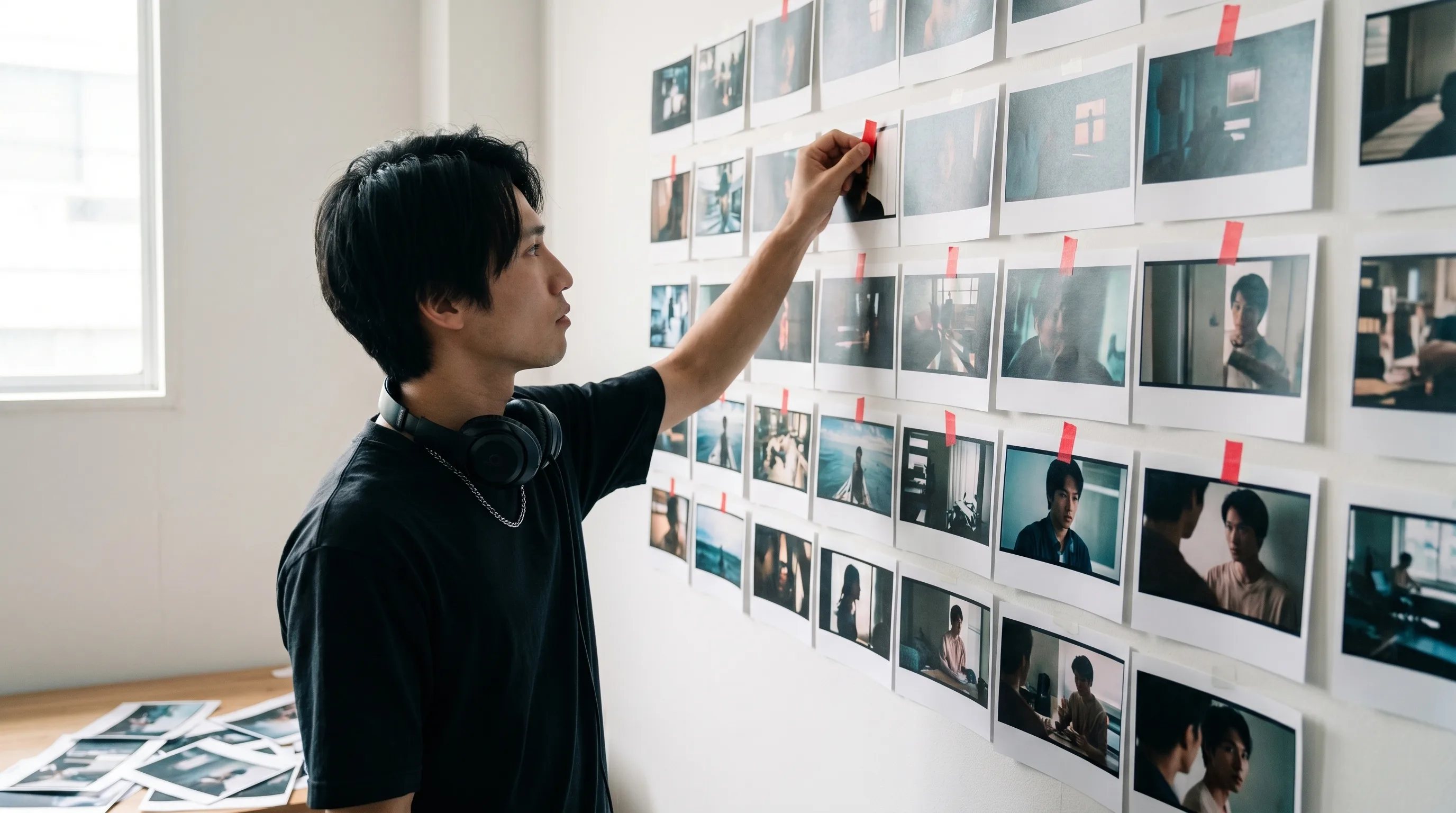
Storyboard before you generate. Print or pin every planned shot, because the 4% selects ratio means undirected generation burns budget fast. The free UGC ad script generator drafts hooks and voiceover lines you can adapt to the commercial register.
Step 2: Cast a consistent AI actor
If a person appears in your spot, lock their identity before generating a single scene. Build a custom AI actor once — appearance and outfit variants — and reuse that saved identity in every shot. This is the step that separates a commercial from a slideshow of strangers, and it’s the exact failure the Super Bowl LX critiques named.
The Playcut Actor Engine holds 100% character consistency across stills and every scene of a spot: same face in the kitchen scene and the end card, same wardrobe from the first shot to the last. Skip this step and you inherit the drift problem no edit can fix.
Step 3: Generate the scenes
Generate each storyboard shot as its own short clip, three to eight seconds, rather than prompting one long take — the free camera movement prompt generator writes the dolly, orbit, and push-in language per shot. Playcut puts a model behind every scene, Veo 3.1 and Seedance 2.0 for cinematic motion, Nano Banana Pro for stills and frames, Grok Imagine where speed and cost win, from one chat surface.
Expect to over-generate. The professional ratio from the Kalshi case is the honest planning number: generate wide, select narrow, and judge every clip on character fidelity and physics before it earns a place on the timeline.
Step 4: Voiceover and sound
For narration over b-roll, record the voiceover as its own pass with the Playcut Voice Engine — a standalone speech tool, since a Playcut voice cannot be bound to an actor. When the actor is on camera, you do the opposite: write the line into the prompt and the video model performs it, which keeps the spot to one generation and no TTS surcharge.
Then treat sound design like a film would. Music drives the emotional register of a commercial more than any single visual, and a licensed track plus two or three foley moments covers most 30-second spots.
Step 5: Assemble and brand
Cut the selects to your storyboard in any editor, holding shots longer than feed-ad instincts suggest — commercials breathe at 2–4 seconds per shot where UGC cuts at one. Color and typography should come from a brand system, not per-project guesses.
This is where Playcut’s multi-brand brand kits earn their place for agencies: each client’s colors, fonts, logos, and voice live in their own kit, so every generation and end card lands on-brand without manual policing.
Step 6: Version for TV, CTV, YouTube, and social
One master cut becomes a placement family: 16:9 at broadcast resolution for TV and CTV, a 6-second bumper and 15-second cutdown for YouTube, 9:16 and 1:1 crops for social. Versioning is also where formats blur — a commercial’s hero shots can seed product-hero ads where the product, not the story, sells.
Deliver to broadcast specs when TV is the target: full HD or 4K, broadcast-safe audio loudness, and substantiation on any factual claims. Standards bodies care what the ad claims and how it sounds — not whether a camera shot it.
What is an AI commercial generator (and which kind do you need)?
An AI commercial generator is any tool that produces commercial video from text, images, or templates — but the label covers three different product categories, and picking the wrong one wastes a month. The honest taxonomy (tool categories verified June 11, 2026):
Template editors — the Renderforest, FlexClip, CapCut, and VEED class — assemble your assets into pre-built scene templates. Fast and cheap for a promo slideshow; structurally incapable of cinematic footage, because nothing is generated.
Avatar tools render a presenter reading your script to camera. Right for talking-head explainers and spokesperson formats; wrong for story-driven spots, since one face at a desk isn’t a commercial.
Generative studios create the footage itself from prompts and references — the category that made every commercial in the case-study record, and the one Playcut belongs to. Here’s how the three compare:
| Template editors | Avatar tools | Generative studios (Playcut) | |
|---|---|---|---|
| Character consistency | N/A — stock footage only | One preset face, single framing | 100% consistent custom actor across every scene (Playcut Actor Engine) |
| Footage source | Pre-made templates + your uploads | Rendered presenter on a background | Generated from text, images, and references |
| Best for | Quick promos, slideshows | Talking-head explainers | TV-style commercials and brand films |
| Cinematic story scenes | No | No | Yes — multi-scene, multi-location |
| Could it have made the Kalshi ad? | No | No | Yes |
The selector question is register. If your spot is a presenter explaining a feature, an avatar tool is enough. If it’s a story — scenes, locations, a character arc in thirty seconds — only a generative studio can make it, and character consistency becomes the deciding spec.
How Playcut makes broadcast-ready AI commercials
Playcut is built for the generative-studio column of that table, with consistency as the headline spec. The Playcut Actor Engine keeps one custom actor 100% consistent across every scene of a spot — stills, motion, and on-product — which is precisely the craft failure that drew the harshest Super Bowl LX criticism elsewhere.

Around the actor sits the studio. One chat surface holds every generation model — Veo 3.1 and Seedance 2.0 for video, Nano Banana Pro for images, Grok Imagine where speed and cost fit — while workspaces with shared and private folders keep a team’s selects organized. Multi-brand brand kits hold each client’s colors, type, logos, and voice, which is what makes commercial work repeatable for agencies.
Pricing is flat and public on the pricing page: Hobby $9/month, Pro $29/month, Studio $79/month with 4 seats, and Agency at $149 per seat with unlimited seats — annual billing takes 17% off. A 30-second commercial workflow fits comfortably inside Pro; agencies running multiple client spots a month live on Studio or Agency.
Frequently asked questions
What are artificial intelligence commercials?
AI commercials are video advertisements where generative AI produces the footage, voiceover, or full spot instead of a traditional film crew. They range from fully AI-generated ads like Kalshi’s 2025 NBA Finals spot to AI-assisted hybrids, and now run on national TV, CTV, and the Super Bowl.
What was the first major AI commercial?
Toys”R”Us released the first brand film made with OpenAI’s Sora in June 2024, premiering at Cannes Lions. Coca-Cola’s AI remake of its “Holidays Are Coming” Christmas ad followed in November 2024. Both drew heavy criticism — and billions of views.
How much does it cost to make a commercial with AI?
Kalshi’s 2025 NBA Finals ad cost about $2,000 plus creative fees, versus $250K–$500K for a typical spot of that grade. Realistically, budget an AI tool subscription (Playcut runs $9–$149/month), a few days of creative time, and heavy generation volume for selects.
How much does a traditional 30-second commercial cost?
Production alone typically runs $10,000–$50,000 for a professional 30-second spot, and $500,000+ for national campaigns with celebrity talent. Talent is the biggest variable. Airtime is a separate, usually larger, cost.
Did Coca-Cola’s AI commercial hurt the brand?
The 2024 AI remake drew intense “soulless” backlash from creatives but earned billions of impressions, and Coca-Cola released another AI holiday ad in 2025. The lesson: replacing a beloved human-made tradition with AI invites backlash; net-new AI creative usually doesn’t.
What is the best AI commercial generator?
It depends on register. Template editors suit quick promos; avatar tools suit talking-head spots; generative studios like Playcut suit cinematic commercials — Veo 3.1, Seedance 2.0, Nano Banana Pro, and Grok Imagine from one chat, with the Playcut Actor Engine keeping your actor 100% consistent across scenes.
Can an AI commercial run on TV?
Yes. Kalshi aired a Veo-generated ad during the 2025 NBA Finals, and Svedka ran a primarily AI-generated national spot in Super Bowl LX (2026). Broadcast standards apply to resolution and claims substantiation, not to how footage was produced.
Do you have to disclose that a commercial is AI-generated?
There’s no blanket US law requiring disclosure for ordinary AI commercial footage, but FTC truth-in-advertising rules still apply, and synthetic depictions of real people or fake endorsements are high-risk. Platform-specific AI-labeling rules are covered in our AI video ads guide.
Conclusion: a craft problem, not a budget problem
For seventy years the commercial was a budget problem — $10,000 minimum to play, half a million to play nationally. The record above shows that constraint is gone: a solo filmmaker put a $2,000 spot on the NBA Finals, and AI reached the Super Bowl fourteen months later.
What remains is a craft problem, and the case studies define it precisely. Pick net-new creative instead of replacing beloved human work, storyboard before you generate, expect a brutal selects ratio, and above all keep your characters consistent — every public AI-commercial failure traces back to violating one of those four.
That last one is the reason Playcut exists. Build your actor once, hold them 100% consistent across every scene, and the rest of the workflow — script, scenes, voice, brand, versions — runs from one studio. Start with a custom AI actor, and your first commercial is a script away.