
AI Ad Creative for Agencies: The 2026 Adoption Playbook

Ad creative AI is software that generates — and increasingly scores — the ad images, video spots, and UGC-style reads an agency ships for clients. The agency buying criterion isn’t generation quality alone: it’s whether a tool holds one consistent spokesperson and one brand identity per client across hundreds of variants. That’s why this playbook leads with 100% character consistency — the Playcut Actor Engine keeps the same face, voice, and wardrobe across every asset in a client’s campaign.
The timing pressure is real. New York’s synthetic performer disclosure law took effect on June 9, 2026, and liability for an undisclosed AI-generated human in an ad reaches whoever produced it — agency included. Meanwhile the volume mandate keeps climbing: large spenders now test hundreds of creative concepts a month, and nobody budgets human shoots for that.
This playbook assumes your agency already exists and already has clients. What to sell and what each deliverable costs to make is covered in our AI video agency services guide, and the founding path is the AI UGC agency playbook. This page owns the adoption problem: rolling AI ad creative across N client accounts — stack choice, brand governance, approval, seat economics, and disclosure. Every price below was verified June 11–12, 2026.
TL;DR: the agency answer in five lines
- What it is: ad creative AI spans four tool classes — static generators, video/actor studios, creative scoring, and platform-native systems — and most agencies run two of them.
- How to adopt it: the six-step playbook below — audit the bottleneck, pick the stack on agency criteria, wire brand governance, rebuild approval for volume, stand up a disclosure SOP, reprice the retainer.
- The seat math punchline: Playcut Studio works out to $19.75 per seat with a 6,000-credit pool; AdCreative.ai’s “for agencies” Ultimate tier works out to $49.95 per seat for 100 download credits.
- Disclosure is now law: New York’s synthetic performer rule took effect June 9, 2026 — $1,000 first violation, $5,000 each after, and the agency that produced the ad is on the hook.
- The multi-brand answer: Playcut Agency is $149 per seat with unlimited multi-brand brand kits — client count never meters the bill.
Table of Contents
- TL;DR: the agency answer in five lines
- What ad creative AI actually covers (and what agencies use it for)
- Why agencies are adopting now: the volume mandate
- The agency adoption playbook: 6 steps
- Running 10 clients from one studio: the multi-brand workflow
- Seat and margin economics: what the stack really costs per client
- The agency tool comparison (2026)
- Handling the client objections
- The disclosure SOP: one register, every ad account
- Frequently asked questions
- The verdict: adopt for velocity, govern for consistency
What ad creative AI actually covers (and what agencies use it for)
Ad creative AI splits into four tool classes, and a working agency usually ends up running two of them — a generation studio plus either scoring or platform-native optimization.
| Class | What it produces | Representative tools |
|---|---|---|
| Static and banner generation | Display creatives, product banners, resized social statics | AdCreative.ai, Recraft |
| Video, actor, and UGC generation | Spokesperson spots, UGC-style ad variants, product video | Playcut, Creatify, Arcads |
| Creative scoring and insight | Pre-flight performance scores, post-spend creative analytics | AdCreative.ai scoring, Madgicx |
| Platform-native optimization | Automatic variant generation inside the ad account | Meta Advantage+ Creative |
The format universe itself — the seven AI ad formats, the four production paths, and whether they convert — is mapped in our AI video ads guide, and this page doesn’t re-teach it. For orientation on cost: a measured Playcut still lands at $0.97, and a voiced 30-second actor spot runs about $14–16 depending on tier, with the full math below.
Meta Advantage+ Creative deserves a note because clients ask: it generates variations natively inside Ads Manager, free. It’s useful last-mile permutation — but Meta-only, remix-only, and blind to a client’s brand system, so it complements an agency stack rather than replacing one.
And ad creative automation — batch-producing dozens of on-brand variants per client monthly — isn’t a separate class. It’s what the first two classes do once governance and approval are wired, which is what the playbook below sets up.
Why agencies are adopting now: the volume mandate
The short answer: the deliverable changed. Performance clients no longer buy one polished video — they buy testable volume, refreshed weekly, and human production economics can’t follow them there.
The refresh data is blunt. Analytics firm MHI, across 500+ DTC ad accounts, found creative refresh rate the #1 predictor of sustained ROAS — weekly refreshers held 3–5x returns while stale accounts decayed. High-spend trackers report $1M+/month advertisers testing 200–500 concepts monthly (Purposeful Profits), and growth shops like Anchour put “roughly 80% of performance work in 2026” in creative operations, feeding Meta’s Andromeda-era delivery systems that evaluate vastly more variants.
Adoption conviction is near-universal; deep adoption isn’t. A StackAdapt × Ascend2 study found 94% of agencies say AI is improving the speed and efficiency of programmatic workflows and 86% of media buyers are using or planning generative AI for video ad creative — yet only 39% of agencies have significantly integrated AI into day-to-day workflows, and 18% have barely scratched the surface.
That gap is the opportunity. The agencies that operationalize AI ad creative now — with governance, not just generation — are competing against a majority that hasn’t.
The agency adoption playbook: 6 steps
Here is the whole agency AI workflow, front to back: audit the per-client bottleneck, pick the stack on agency criteria, wire brand governance, rebuild approval for volume, stand up disclosure, and reprice the retainer. Each step is expanded below.
Step 1: Audit the per-client creative bottleneck
Baseline every client account before touching a tool — four numbers each: assets shipped per month, refresh rate the media plan wants, current cost per asset, and approval cycle time from brief to live.
The audit decides sequencing: the client whose media buyer wants forty variants monthly while production manages twelve adopts first. Adoption succeeds account by account, not agency-wide on day one.
Step 2: Pick the stack on agency criteria, not creator criteria
Creator reviews rank tools on output quality and ease. Agencies need a different rubric — a tool that’s lovely for one brand can be unusable across ten. Score candidates on five questions:
- Consistency: does one actor and one brand identity hold across a campaign’s hundreds of variants?
- Brand metering: how many client brands does the listed price include, and what does brand #6 cost?
- Seat economics: what does a production seat really cost once credit depth is divided in?
- Format breadth: statics, video, and UGC-style ads from one credit pool, or three subscriptions?
- The agency gate: self-serve, or does multi-client use route to a sales call?
The comparison table below runs the 2026 field through exactly this rubric.
Step 3: Wire per-client brand governance before the first batch
Set up one brand kit per client before generating anything — palette, typography, logo, and voice — so every asset is born inside the client’s brand system instead of being corrected into it later. In Playcut, a kit holds all four surfaces and gets tagged on any generation; switching clients is switching kits.

Governance is the half nobody sets up — shared Team folders for client-visible work, private folders for drafts, creator-only edit rights. The full mechanics get their own section below.
Step 4: Rebuild the approval loop for volume
AI volume breaks asset-by-asset approval — forty variants per client can’t ride an email chain built for four. Agency-ops guides from Filestage, CloudCampaign, and Streamwork converge on 2–3 consolidated revision rounds, agreed up front, with cycle time per asset as the metric that matters.
The AI-specific fix is to approve the system, not each asset:
- Client signs off the brand kit, the actor, and 2–3 example outputs — once.
- The agency batch-generates inside the approved kit.
- Internal QA reviews every asset against the kit — the human gate every credible AI shop keeps.
- The client reviews exceptions plus the first batch of each new concept only.
- The disclosure tag is applied, then the batch ships to the ad account.
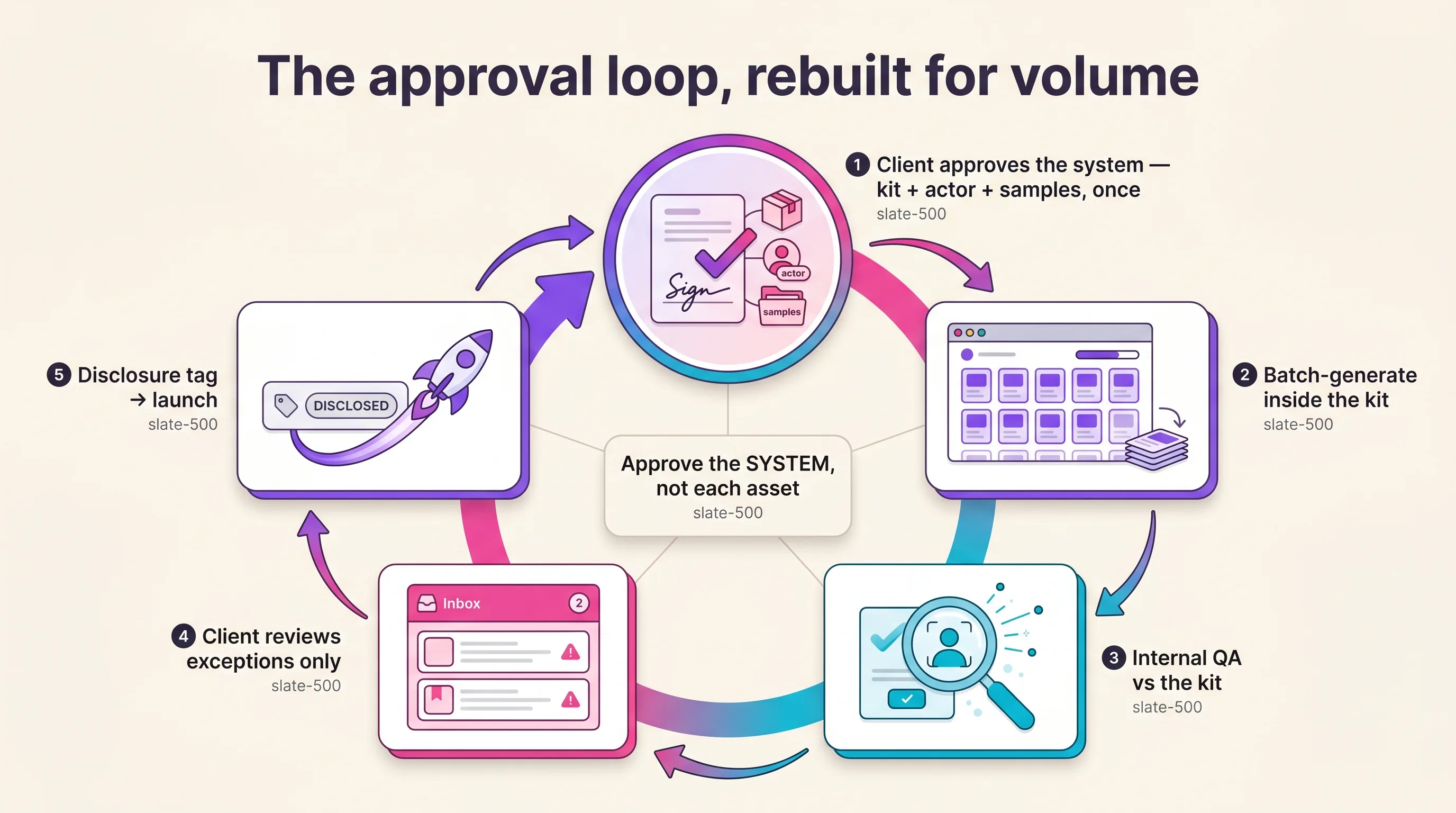
Workspace mechanics carry the loop: drafts live in private folders, the Team folder is the client-visible approved set, and share links handle exception review without another tool.
Step 5: Stand up a disclosure SOP per ad account
Disclosure stopped being a philosophy question on June 9, 2026, when New York’s synthetic performer law took effect — and the obligation attaches to whoever produces the ad, agency included. Meta and TikTok enforce AI labels at the ad level, with rejection as the penalty.
This is SOP work, not legal-theory work: classify, tag, contract, log. The full disclosure SOP is broken out below.
Step 6: Reprice the retainer and reinvest the margin in velocity
Reprice on loaded cost with a true margin formula — never a markup. A $1,000 cost sold at $1,500 is a 50% markup but only a 33.3% gross margin, and the working formula is Retail price = Loaded cost ÷ (1 − target gross margin); the full derivation lives in our white-label AI video margin guide.
Then decide where the freed spread goes. Cutting price hands the efficiency to procurement; the durable move is holding the retainer and reinvesting the margin in testing velocity — the deliverable the client’s ROAS actually responds to.
Running 10 clients from one studio: the multi-brand workflow
AI creative for agencies is a governance problem before it’s a generation problem: every client needs its own palette, typography, logo, and voice, and the moment two clients share a generation surface, drift starts. Adobe’s Experience League research puts the damage plainly — 81% of companies struggle with off-brand content, and multi-client agencies are the worst hit because drift compounds across accounts.
Practitioners are blunter. Brand strategist Simon Davis calls ungoverned AI output “ROI-negative — loads of content you can’t use” (DesignRush), and marketing-AI firm Averi calls prompting without a brand system a “prompt lottery.” The payoff is measurable too: consistent branding lifts revenue by up to ~23% per Marq’s research — a number worth quoting in client QBRs.
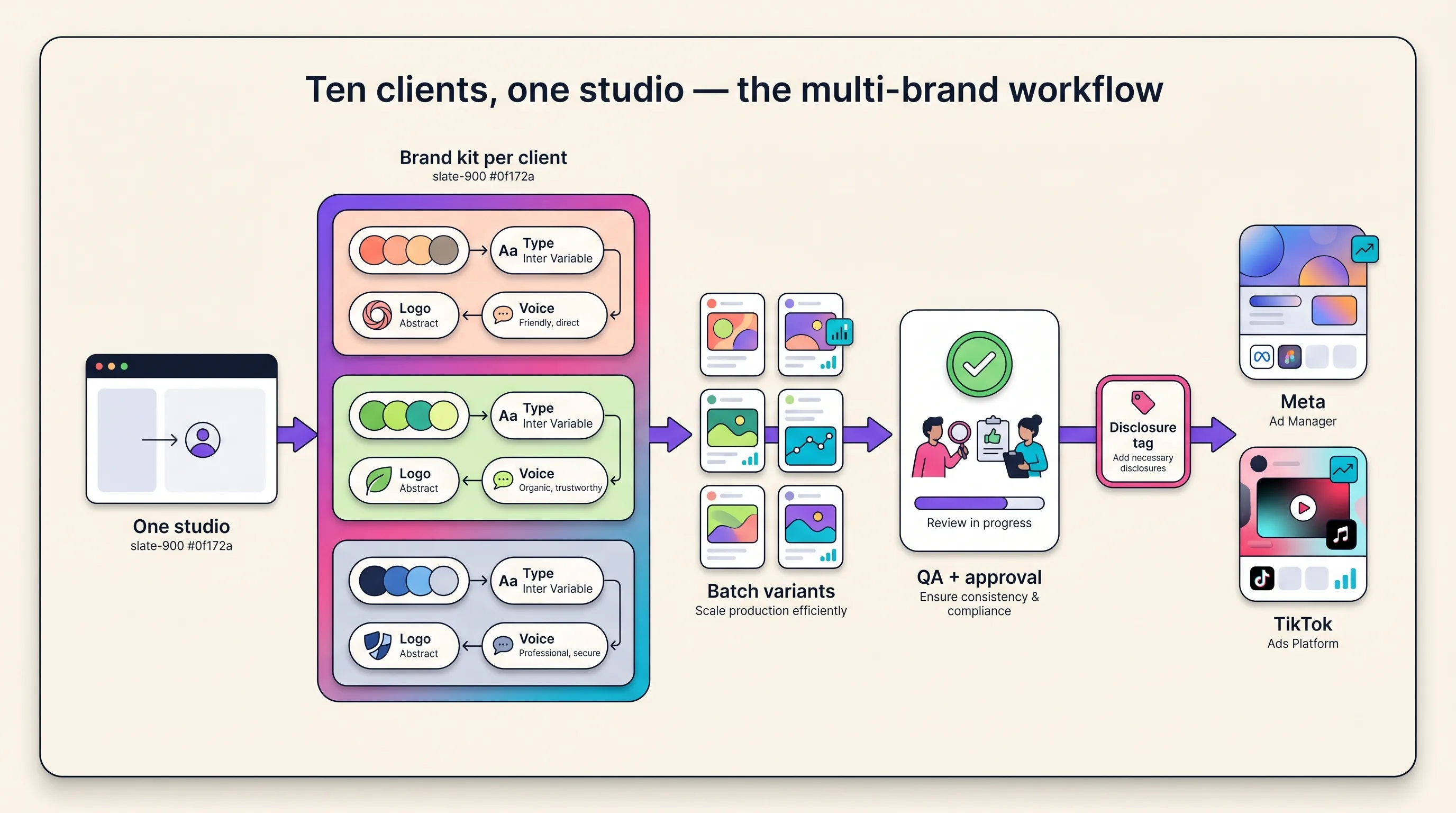
The workflow that prevents drift has four layers:
- One kit per client. A Playcut brand kit pins colors, typography, logos, and voice — tone, do-say/don’t-say, brand story — and gets tagged on any generation. Kits ship on every tier; the multi-brand label sits on the Agency tier, where unlimited kits make ten clients ten governed contexts.
- Workspace isolation. Shared Team folders hold each client’s approved library; private folders hold drafts. Creator-only mutation rules mean nobody edits another producer’s client assets by accident.
- One actor, re-skinned per client. The AI actor library stores appearance, voice, and outfit variants — so one saved spokesperson can be re-dressed and re-voiced per client without re-casting, while the Actor Engine holds the face identical across every variant.
- Approval and disclosure gates from steps 4 and 5, applied per client account.
Honesty requires saying the competitors all have a multi-brand container — the difference is metering. AdCreative.ai prices by brand count (1, 10, or 25 by tier, locking logo, colors, and descriptions per its FAQ); Creatify includes one Brand Space below Enterprise; Pencil’s Growth tier offers unlimited workspaces without publishing what a workspace pins. Of the four, only Playcut names voice and typography as per-brand locked surfaces — and only Playcut leaves client count entirely un-metered.
Seat and margin economics: what the stack really costs per client
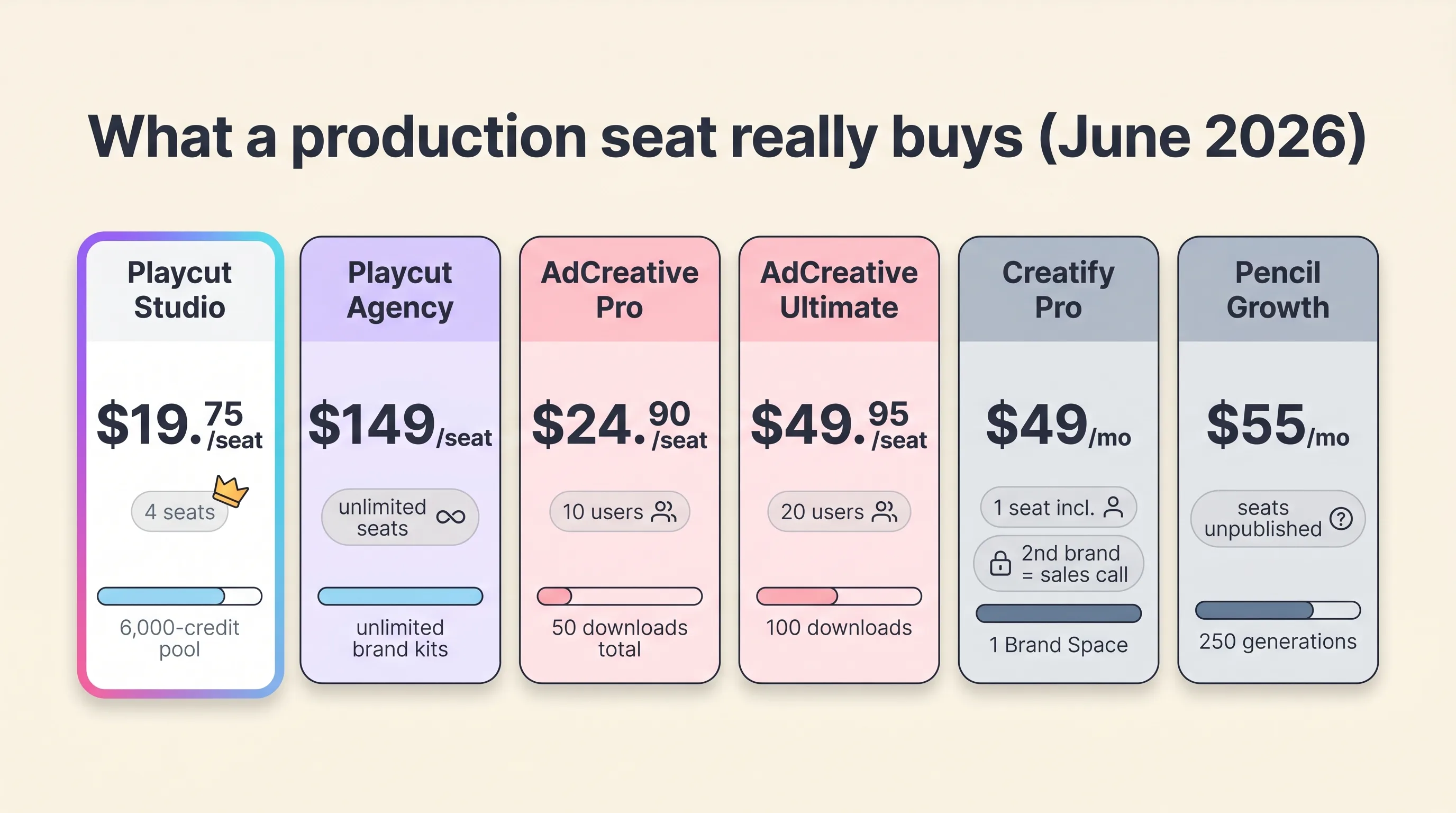
Per-seat stickers mislead agencies twice. First, credit depth per seat is the real constraint — AdCreative.ai Professional’s $24.90 per seat buys 50 download credits across 10 users, or 5 downloads per user per month, while Playcut Studio’s $19.75 per seat carries a 6,000-credit shared pool (~89 measured stills). Second, brand count is the hidden meter, as the table shows. All prices verified June 11–12, 2026.
| Tool · tier | Sticker | Seats included | Effective $/seat | Client brands at list price | Monthly allowance |
|---|---|---|---|---|---|
| Playcut Studio | $79/mo | 4 | $19.75 | Brand kits included (multi-brand labeling sits on Agency) | 6,000-credit shared pool |
| Playcut Agency | $149/seat/mo | Unlimited | $149 | Unlimited multi-brand kits | 10,000 credits per seat |
| AdCreative.ai Professional¹ | $249/mo | 10 | $24.90 | 10 | 50 download credits total |
| AdCreative.ai Ultimate¹ (“for agencies”) | $999/mo | 20 | $49.95 | 25 | 100 download credits total |
| Creatify Pro² | $49/mo (annual billing) | Up to 5 (1 included) | Extra-seat price unpublished | 1 Brand Space | 300 credits |
| Pencil Growth | $55/mo ($44 annual) | Not published | Not published | Unlimited workspaces | 250 generations |
¹ Decoded from the pricing markup on AdCreative.ai’s homepage on June 11, 2026 — their /pricing URL returns a 404 to every user-agent we tested and is absent from their sitemap.
The Ultimate card still shows a $599 strikethrough and “expert team… for $599 a month” copy: evidence of a recent $599 → $999 raise. ² Creatify’s page displays Pro at $49/mo under a “save up to 50% on annual” banner while its own JSON-LD structured data lists Pro at $99 — read $49 as the annual-billed rate (verified June 11, 2026).
What an asset actually costs
The per-unit numbers below reconcile with Playcut’s published credit formulas; only the 67-credit still is lab-measured, and the plan-rate conversions are derived.
| Asset (per unit) | Pro rate | Studio rate (derived) | Agency rate (derived) |
|---|---|---|---|
| Measured still (67 credits) | $0.97 | $0.88 | $1.00 |
| Voiced 30-second actor spot | $15.66 | $14.22 | $16.09 |
One footnote on the 30-second figure: the Act pipeline renders scenes up to 10 seconds, so a 30-second spot is three scenes — budget roughly 5% above the single-scene formula.
The five-client batch, modeled
Take a realistic agency month — five clients, twenty assets each (fifteen stills plus five voiced 30-second spots), 100 assets total. Per client that’s 6,405 credits; across five clients, 32,025. On Studio, the 6,000-credit pool plus the cheapest pack combination (five Large, two Small — packs never expire) comes to $422/month: $4.22 per asset, $84.40 per client.
The same workload on Playcut Agency runs $482 with three seats plus a Medium pack. AdCreative.ai’s right-sized Professional ladder lands at $400 — but that buys 100 static downloads ($4.00 each), with video credit burn unpublished, so the comparison isn’t like-for-like. Creatify Pro’s $49 is the cheapest sticker on paper but includes one seat and one Brand Space; separating five client brands is an Enterprise conversation. These mixes are modeled assumptions, not measurements.
The per-client P&L on a $1,500 retainer
Price that twenty-asset bundle at a $1,500 monthly creative retainer — $75 per asset, the floor of the $75–$269 social-shorts band inBeat documents — and the margin stack looks like this, modeled with a 3% processing fee, four hours of labor at $75/hour, and a 10% revision buffer:
- Platform COGS: $84.40 per client → 94.4% platform-only gross margin.
- Loaded cost (platform + $45 processing + $300 labor + $30 buffer): $459.40 → 69.4% loaded gross margin.
That 69% sits inside the healthy 50–75% white-label band, and the reverse-check confirms the pricing: $459.40 ÷ (1 − 0.70) = $1,531, so a $1,500 retainer is priced almost exactly at a 70% target margin on loaded cost. Labor is the real cost line — AI cuts production COGS, not the service work.
Scale is where the model compounds: at ten clients the fixed platform fee amortizes to $7.90 per client and the all-in batch runs $838 — $83.80 per client, with margin gains coming from amortization, exactly as the white-label math predicts. Plan fit, plainly: Studio suits a team of up to four consolidating tools; Agency buys unlimited seats, per-seat credit depth, the urgent queue, and unlimited multi-brand kits — it scales with headcount, not client count.
The agency tool comparison (2026)
Here is how the AI ad creative tools agencies shortlist in 2026 stack up. Character consistency sits in the top row because it’s the axis the rest of the field structurally can’t win — and the first thing a client notices across a forty-variant campaign. Prices verified June 11–12, 2026, except where flagged.
| Playcut | AdCreative.ai | Creatify | Pencil | Arcads | |
|---|---|---|---|---|---|
| Consistent actor across a client’s campaign | 100% character consistency — same actor across stills, video, UGC, and product shots (Actor Engine) | No actor system — statics + scoring | Avatar ads; no published cross-batch identity metric | No consistent-spokesperson system; predicts and ships variants | 300+ vendor-advertised actors; no published identity-hold metric |
| Client brands at list price | Kits on every tier; unlimited multi-brand at Agency | 1 / 10 / 25 by tier | 1 Brand Space below Enterprise | Unlimited workspaces (Growth) | No multi-brand workspace governance |
| Per-brand metering | None — flat per seat | Yes — brands are the pricing axis | Yes — brand #2 = sales call | No, but generation-capped (250/mo) | n/a |
| Statics + video + UGC from one pool | Yes — multi-model routing, one credit pool | Statics + scoring; video burn unpublished | Video/avatar ads + images | Variants; “generation” unit undefined | Video UGC ads |
| Seats at list price | Studio 4 ($19.75/seat) · Agency unlimited | 10 (Pro) · 20 (Ultimate, $49.95/seat) | 1 included, up to 5 | Not published | Not published |
| Verified entry price | $9/mo Hobby; agency tiers $79 / $149-per-seat | $39/mo Starter (homepage decode) | $33/mo displayed (annual billing) | $14/mo Core ($11 annual) | $77/mo promo, list $110 (search-sourced June 2026) |
| Agency gate | Self-serve | Self-serve (“Ultimate: for agencies”) | Sales call at 2+ brands or 6+ seats | Sales call for Pro governance | $385 Pro tier “for agencies” (search-sourced) |
The verdict for agencies: Playcut is the only stack in the table that pairs a consistency guarantee — the same actor, face, and voice across every variant in a client’s campaign — with unlimited, un-metered client brands at a flat per-seat price.
Credit where due, attributed. AdCreative.ai’s Creative Scoring advertises “>90% accuracy” trained on what it reports as $35B+ of ad-spend data — vendor-reported, no published methodology. Independent review roundups consistently flag billing friction, not output, as its biggest complaint; its own refund policy allows 7 days on monthly and 30 days on yearly plans, only if credits are unused.
Creatify’s competitor-ad library, advertised at 10M+ Meta ads, is a genuinely strong research surface. Pencil holds the price floor at $14, and Arcads’ batch ad-testing workflow is well regarded by performance teams.
Handling the client objections
Three objections come up in every adoption conversation. Answer them with data, not reassurance.
Will customers reject AI ads?
The honest baseline: an IAB study of 505 US Gen Z and Millennial consumers found only 45% feel positive about AI ads, while 82% of ad executives assumed consumers did — a 37-point perception gap. The same study carries the fix: 73% said knowing an ad was AI-made would increase or not change their purchase likelihood, so labeling mitigates backlash rather than worsening it.
On performance, stay honest both ways. Syracuse University’s Newhouse School found AI-generated ads nearly indistinguishable from human-made work but weaker on short-term sales lift in their test — while the agency-side StackAdapt × Ascend2 research shows 94% of agencies reporting real speed and efficiency gains. The winning client argument is velocity, not per-asset superiority: more concepts tested per week beats one slightly stronger asset in performance contexts.
Do we have to tell anyone we use AI?
Increasingly yes — by law in New York since June 9, 2026, and by platform rule on Meta and TikTok, with ad rejection as the platform penalty. The general explainer lives in the pillar’s labeling section; the agency-specific machinery — who carries liability, and the per-account register — is the SOP below.
Will it look like every other AI ad?
Only if it’s generated without a brand system — genericness is a governance failure, not a property of the technology. The “prompt lottery” Averi describes is real when every producer freestyles; it disappears when every generation is tagged to the client’s kit and fronted by the client’s own saved actor.
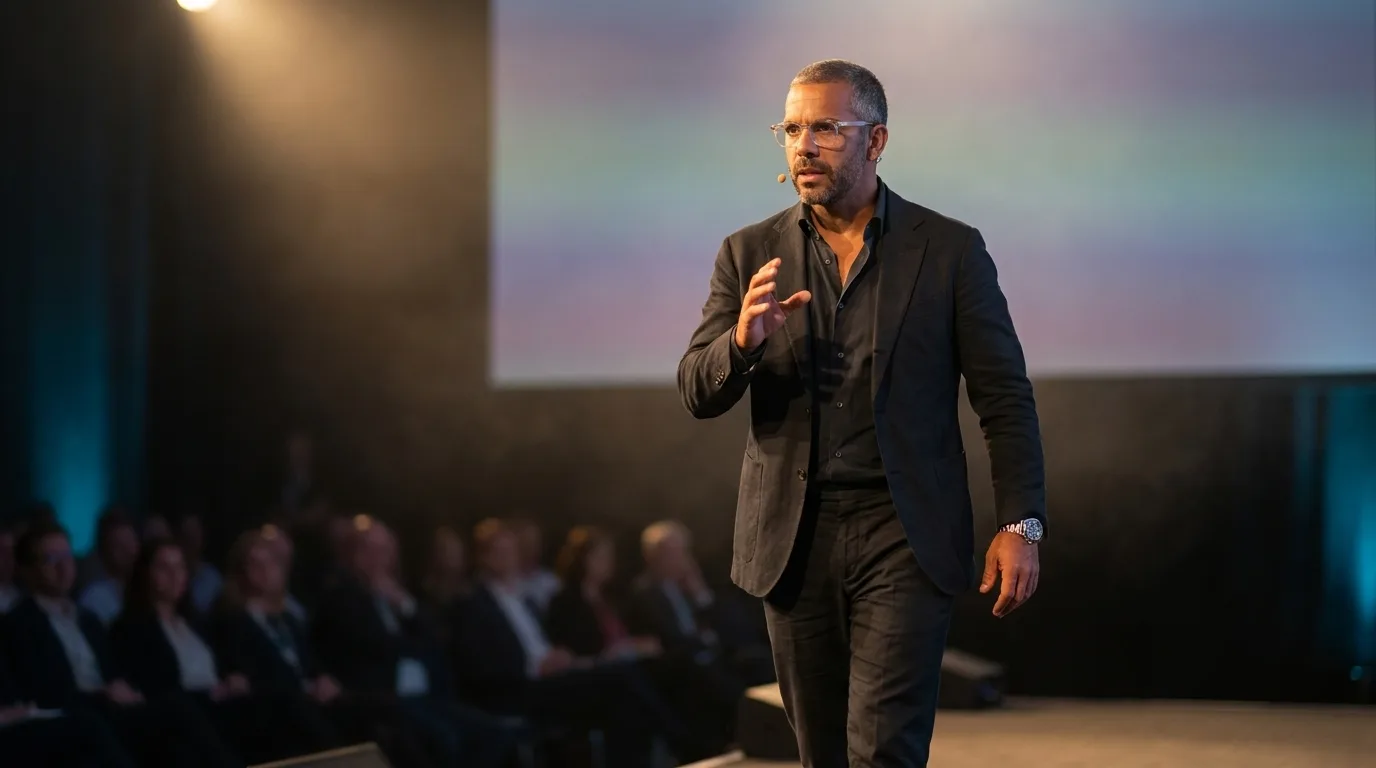
That actor is the same identity as this article’s hero image — different client register, identical face. One spokesperson per client, held at 100% consistency and re-skinned per brand kit, is the practical answer to “it’ll look generic”: each client’s ads look like that client, campaign after campaign.
The disclosure SOP: one register, every ad account
Four regimes now touch agency ad accounts, and the agency — as the producer — carries obligations under each. Here’s the map, then the SOP.
New York (in effect now). The synthetic performer law (S.8420-A/A.8887-B, signed December 11, 2025) took effect June 9, 2026: any ad shown in New York that uses an AI-generated human performer needs a conspicuous disclosure, at $1,000 per first violation and $5,000 per subsequent one.
The obligation falls on whoever produces or creates the ad — brand and agency alike, per Foxwell Digital’s analysis of the law. Exemptions cover audio-only content and product-only shots with no human figure; Foxwell’s practical recommendation is updating client and vendor agreements to allocate disclosure responsibility explicitly.
Meta. Meta auto-applies its “AI info” label to content edited with its own generative tools; third-party AI content — your studio output — needs manual disclosure, and photorealistic AI humans get the label beside the “Sponsored” tag. Undisclosed synthetic-human ads get rejected, so bake the toggle into the Facebook ads workflow per account.
TikTok. Ads containing AIGC must use the AI Disclosure tag at the ad level in Ads Manager, which renders a “Contains AI-generated content” label; TikTok auto-detects via C2PA metadata, and undisclosed AIGC risks rejection or account review. Make the tag a default in your TikTok ads checklist, not a per-launch decision.
EU. The AI Act’s transparency obligations apply from August 2, 2026 — the pillar’s disclosure section covers the general rules, and the statute-level map of every regime, penalty, and platform label is in is AI UGC legal?.
The standards backbone is the IAB’s AI Transparency and Disclosure Framework (January 2026): disclosure is required when AI materially affects authenticity, identity, or representation in ways that could mislead — targeted disclosure, not universal labeling. That materiality test is what makes the SOP tractable:
- Classify each client’s creative against the IAB materiality test — synthetic humans and testimonial-style reads sit at the top.
- Set platform defaults per ad account: Meta’s manual AI disclosure on, TikTok’s AI Disclosure tag on for all AIGC.
- Label NY-bound human-likeness ads conspicuously, regardless of platform.
- Contract it: a disclosure-responsibility clause in every client MSA, allocating who files what.
- Log provenance per asset — folder and brand-kit metadata already carry which actor and kit produced each file, so the register builds itself.
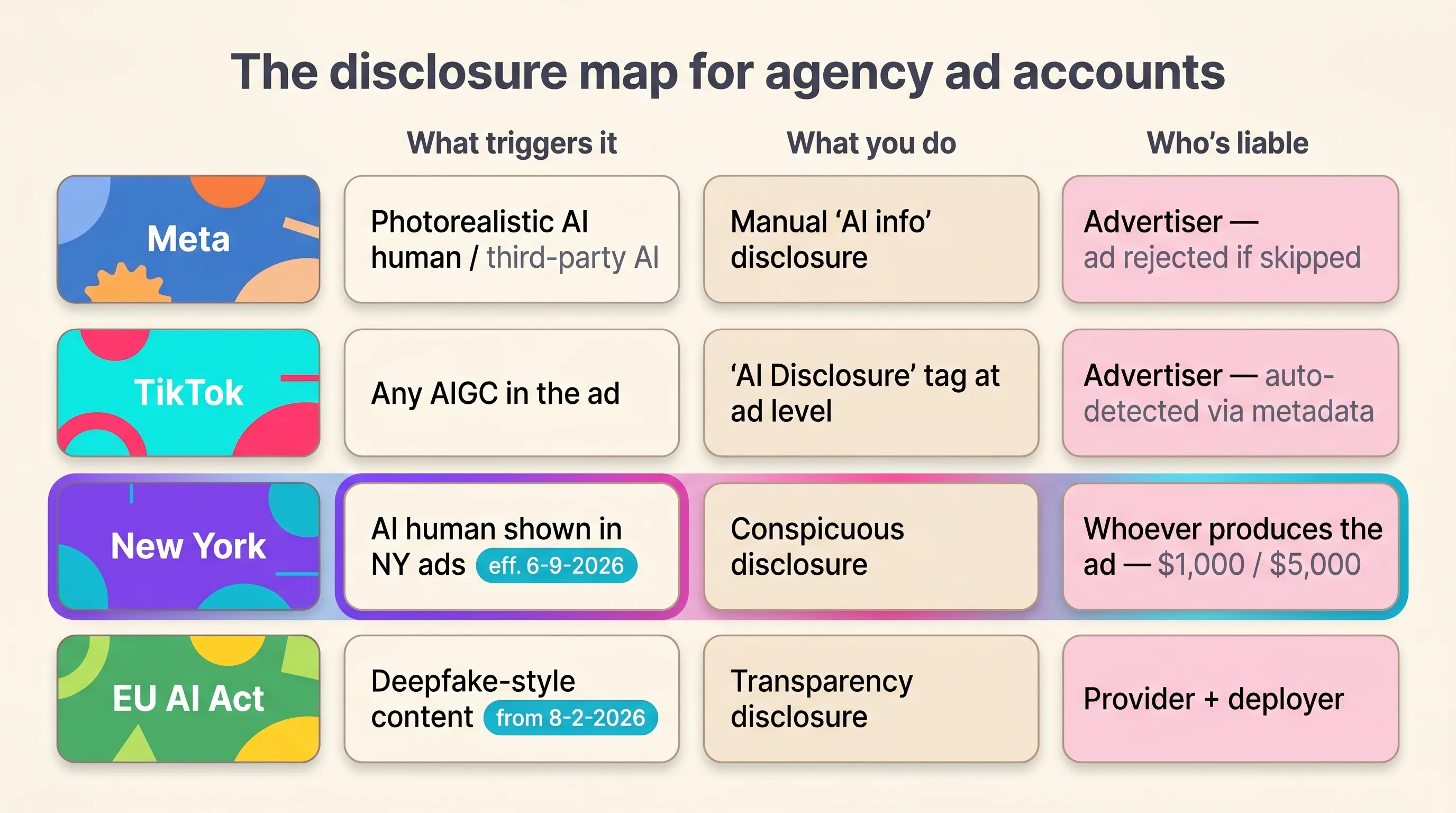
Run as a register, disclosure stops being a launch-day scramble — and it reads as a trust feature in pitches: you can show every client exactly which ads carry which labels in which states.
Frequently asked questions
What is AI ad creative?
AI ad creative is ad imagery, video, and UGC-style spots generated or scored by AI software instead of produced manually. For agencies it spans four classes: static generators, video and actor studios, creative-scoring tools, and platform-native systems like Meta’s Advantage+. The agency-grade requirement is holding one actor and one brand identity per client across hundreds of variants.
What’s the best AI ad creative tool for agencies?
Judge on four agency criteria: actor and brand consistency across variants, client brands included at the listed price, credit depth per seat, and formats from one pool. On those criteria Playcut leads with 100% character consistency from the Actor Engine plus unlimited multi-brand kits on the Agency tier, while AdCreative.ai meters brands and Creatify gates a second brand behind Enterprise.
How much does AI ad creative cost for an agency?
Verified June 2026: Playcut Studio runs $79/month for four seats ($19.75/seat) with a 6,000-credit pool; AdCreative.ai runs $249 for ten users or $999 for twenty ($49.95/seat) with download-capped credits; Creatify Pro displays $49 with one brand space; Pencil Growth is $55. A measured Playcut still costs $0.97; a modeled five-client, 100-asset month lands at $422.
Do agencies have to disclose AI-generated ads?
Increasingly, yes. New York’s synthetic performer law took effect June 9, 2026, requiring conspicuous disclosure for AI-generated humans in ads — $1,000 first violation, $5,000 after, liability reaching whoever produces the ad, agency included. Meta and TikTok require AI labels on synthetic-human ads. Disclosure helps: 73% told the IAB an AI-made label would increase or not change purchase likelihood.
How do agencies bill clients for AI-made creative?
Bill the deliverable or the retainer, never the tool — platform fees are COGS inside your price. Creative-only retainers run $1,000–$3,000 a month for 4–8 deliverables. In our modeled example, a $1,500 retainer for twenty assets carries about $84 of per-client platform cost, leaving a 94% platform-only and roughly 69% loaded gross margin.
Can AI replace an agency’s creative team?
No. Generation replaces production hours, not judgment — strategy, hooks, QA against the brand kit, and client approval stay human, which is why operators describe most 2026 performance work as creative operations. The winning shape is a production line: humans steering concepts and quality, software rendering the volume.
Does Playcut keep the same actor across a client’s campaigns?
Yes — that is the Actor Engine’s core promise: 100% character consistency across stills, motion video, UGC ads, and on-product compositing. Save an actor once, tag the client’s brand kit, and the same face, voice, and wardrobe return in every batch. You can also re-skin one actor per client without re-casting.
The verdict: adopt for velocity, govern for consistency
The 2026 adoption story compresses to three verbs: adopt for velocity, because testable volume is the deliverable performance clients are buying; govern for consistency, because brand kits and a held actor are what separate an agency system from a prompt lottery; and disclose by SOP, because the liability now reaches you.
The economics reward doing it properly. A modeled five-client month runs $4.22 an asset on a stack that holds every client’s identity — and the seat you staff costs $19.75 on Studio, not $49.95.
If the multi-brand workflow is the part you need, that’s the tier built for it: Playcut Agency at $149 per seat with unlimited seats, 10,000 credits each, unlimited multi-brand kits, and the same Actor Engine consistency on every client’s UGC ad batches. Start with one client account, run the six steps, and let the register and the margin math sell the rest of the roster.