
Is AI UGC Legal? The 2026 Rules, Penalties & Compliance Map

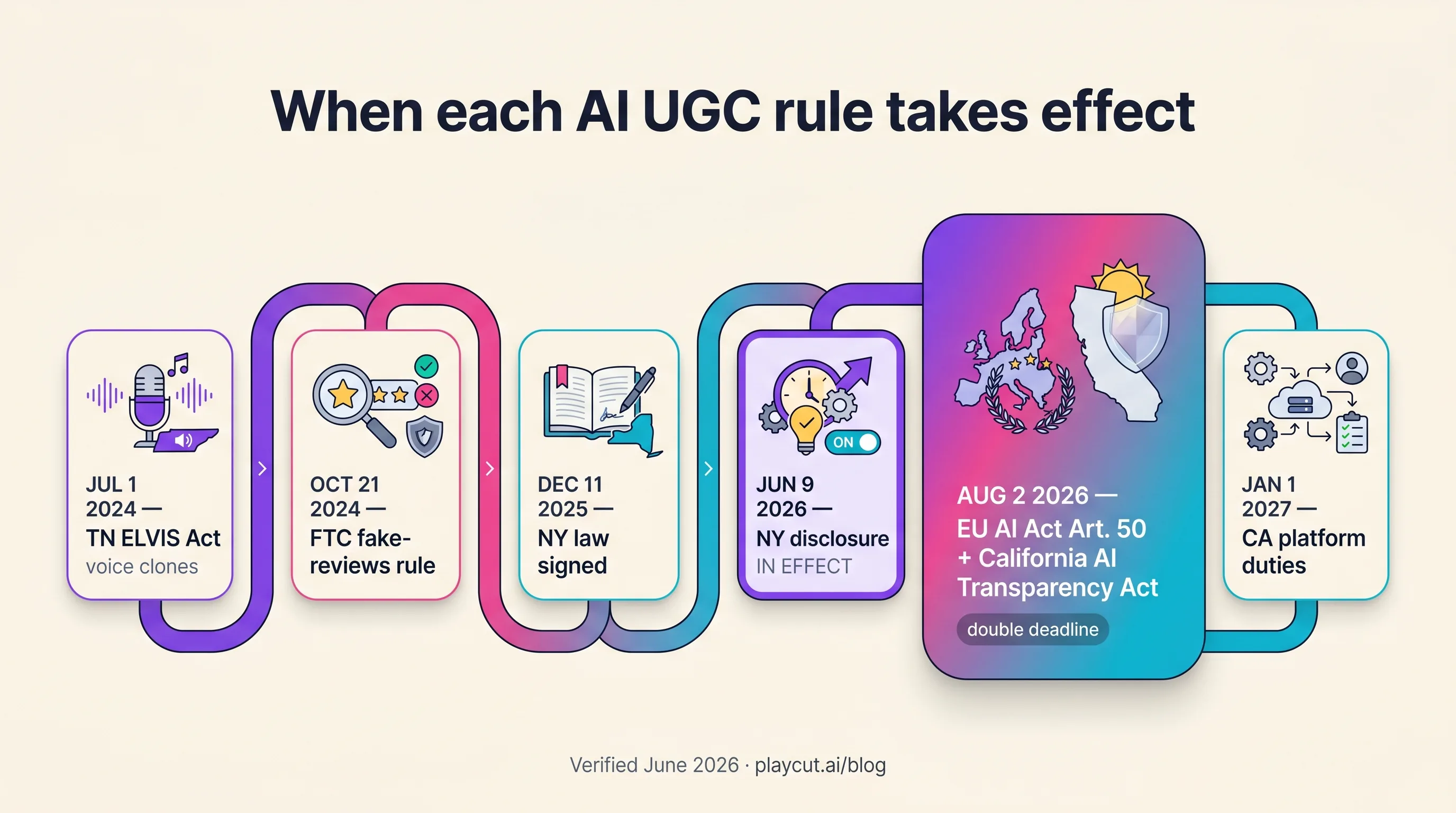
Is AI UGC legal? Yes — everywhere we can verify. No US state, federal rule, or EU regulation bans an AI-generated actor in your ads. What the law regulates is deception and, increasingly, disclosure: New York’s synthetic-performer law went into effect June 9, 2026, and the EU AI Act’s Article 50 and California’s AI Transparency Act both arrive August 2, 2026.
There’s a compliance upside hiding in that: a character built on the Playcut Actor Engine stays 100% consistent across a campaign, which makes it the easiest creative to label cleanly — one actor, one disclosure pattern, every variant.
This is the statute-level companion to our AI UGC guide: every rule with its effective date and penalty, the platform label mechanics, the enforcement record, and a 10-step checklist — re-verified against primary sources on June 12, 2026.
Not legal advice. This guide is general information for marketers, not legal advice. Laws change and apply differently to specific facts — consult a lawyer for your situation.
Table of Contents
- Is AI UGC legal? The short answer
- Every AI UGC rule at a glance: the 2026 legal matrix
- US federal rules: what the FTC actually requires
- US state laws: New York, California, Tennessee
- The EU layer: AI Act Article 50 (August 2, 2026)
- Platform rules: TikTok, Meta, and YouTube labels
- The 10-step AI UGC compliance checklist
- What actually gets brands in trouble
- How Playcut fits a compliant AI UGC workflow
- Frequently asked questions
- Conclusion: label it and keep shipping
Is AI UGC legal? The short answer
AI UGC is legal in the US and the EU in 2026. No jurisdiction prohibits using a synthetic actor in advertising. Three duties attach instead: don’t deceive, disclose where required, and never use a real person’s face or voice without consent.
The line between legal and illegal AI UGC is sharp:
| Legal | Illegal or sanctionable |
|---|---|
| A fully synthetic actor presenting a product in a clearly commercial ad | An AI persona posed as a real customer with a made-up experience |
| Truthful, substantiated claims read by an AI presenter | Claims the brand can’t substantiate, AI or not |
| Labeled AI creative — platform toggles on, NY/EU disclosures where required | Skipping required platform labels or the New York disclosure line |
| A cloned face or voice with written, use-specific consent | Cloning a real person’s face or voice without permission |
Every AI UGC rule at a glance: the 2026 legal matrix
Eight rules plus one adjacent state law govern AI UGC ads in 2026 — the full map, verified against primary sources:
| Rule | Who it covers | What it requires | Effective | Penalty |
|---|---|---|---|---|
| FTC Endorsement Guides (16 CFR Part 255) | US advertisers, endorsers, and agencies | Honest, substantiated endorsements; “endorser” reaches a party that “could be or appear to be an individual” | July 26, 2023 (revision) | None direct — enforced via FTC Act §5; up to $53,088/violation in penalty-offense cases |
| FTC Consumer Review Rule (16 CFR Part 465) | US businesses and advertisers | No fake or AI-generated reviews or testimonials without a real product experience | October 21, 2024 | Up to $53,088 per violation |
| EU AI Act Article 50 | Providers and deployers serving EU users, wherever established | Deployers disclose deepfake-class AI image/audio/video; providers mark outputs machine-readably | August 2, 2026 | Up to €15,000,000 or 3% of worldwide annual turnover, whichever is higher |
| New York GBL §396-b (S8420-A/A8887-B) | Advertisers whose ads are distributed to New York audiences | Conspicuous disclosure of any “synthetic performer” | June 9, 2026 — in effect | $1,000 first violation; $5,000 each subsequent |
| California AI Transparency Act (SB 942, amended by AB 853) | GenAI providers with 1M+ monthly users; large platforms from 2027 | Free AI-detection tool; optional visible disclosure; embedded latent provenance | August 2, 2026 | $5,000 per violation per day |
| Tennessee ELVIS Act | Anyone using a protected voice or likeness commercially | No unauthorized ad use of an identifiable voice — “actual voice or a simulation” | July 1, 2024 | Civil action; knowing violations a Class A misdemeanor |
| TikTok AIGC policy | All creators and advertisers | Label realistic AI content; AIGC toggle on ads | C2PA auto-labels since May 9, 2024 | Undisclosed AI ads “rejected or restricted”; removal |
| Meta AI policy | All users; advertisers running social-issue/electoral/political ads | Self-disclose realistic AI media; mandatory disclosure on SIEP ads | January 1, 2024 (ads rule) | Ad rejection; account-level “penalties” |
| YouTube synthetic-content disclosure | All YouTube creators | Disclose realistic altered or synthetic content at upload | March 18, 2024 | Removal or YouTube Partner Program suspension |
US federal rules: what the FTC actually requires
There is no federal “AI ad” statute. The FTC regulates AI UGC through two existing instruments: the Endorsement Guides and the Consumer Review Rule. Both turn on deception, not on the technology.
The Endorsement Guides: a synthetic endorser is still an endorser
The FTC treats an AI endorser the same as a human one — its endorsement guide reaches anyone the message “could be or appear to be an individual” (16 CFR 255.0, via Cornell LII). The FTC added that phrasing in its July 26, 2023 revision precisely to pull synthetic endorsers into the same rules as human ones.
Two duties follow. Claims made through an endorsement must be substantiated to the same standard as claims the brand makes directly. And an “actual consumer” portrayal must reflect a real, substantiated experience — or disclose that actors are used.
Applied to AI UGC: a synthetic presenter making truthful, supported claims in a clearly commercial ad is fine. An AI actor presented as a real customer, narrating a first-person experience nobody had, is a deceptive endorsement.
One nuance: AI actors remove the influencer-payment disclosure problem — no paid creator, no material connection to disclose. The substantiation and AI-disclosure duties remain in full.
The fake-reviews rule: $53,088 per violation
A separate FTC rule — the Consumer Review Rule, in effect since October 21, 2024 — bans writing, buying, selling, or disseminating fake consumer reviews and testimonials, expressly including AI-generated reviews from someone with no experience of the product (16 CFR Part 465). It also bans review suppression, undisclosed insider reviews, and bought social-media indicators like bot followers.
The 2025 inflation-adjusted civil penalty is $53,088 per violation — up from $51,744 at the rule’s 2024 announcement — set on January 17, 2025 (90 FR 5581), with the 2026 adjustment cancelled per OMB M-26-11. The government shutdown prevented the CPI data the annual adjustment depends on, so agencies continue using 2025 levels — the current eCFR table at 16 CFR 1.98 still codifies $53,088.
The math is what makes this the sharpest federal exposure: each fake testimonial counts as a separate violation. Ten AI “customer” reviews is up to $530,880.
One debunk while we’re here: several widely-ranked pages assert a “verbal disclosure within the first 3 seconds” rule and a “2026 double disclosure” mandate. Neither exists anywhere in 16 CFR Part 255 or 465 — no federal rule prescribes placement by the second. The actual standard is that required disclosures be clear and conspicuous.
US state laws: New York, California, Tennessee
Three state laws matter for AI UGC in 2026: New York’s disclosure mandate (in effect now), California’s transparency act (August 2), and Tennessee’s voice-cloning statute (in effect since 2024).
New York’s synthetic-performer law is in effect now
Since June 9, 2026, ads distributed to New York audiences that use a “synthetic performer” must carry a conspicuous disclosure. The law — companion bills S8420-A/A8887-B, signed December 11, 2025 and effective 180 days later as General Business Law §396-b — is the first US statute aimed at fully synthetic ad actors rather than deepfakes of real people.
A synthetic performer is a digitally created asset made with generative AI that gives the impression of a human performer “not recognizable as any identifiable natural person” (Skadden’s analysis is the clearest breakdown). That definition is the standard AI UGC actor. The duty applies where the advertiser has actual knowledge of the use — which, if you generated the ad, you do.
Penalties are $1,000 for a first violation and $5,000 for each subsequent one — Governor Hochul’s office announced it as the first law of its kind in the nation. No wording, size, or placement is prescribed; a visible “This ad features an AI-generated performer” line covers it.
The exemptions are practical:
- Promos for expressive works (film, TV, games) where the synthetic performer appears in the work itself
- Audio-only ads
- AI used solely to translate a real performer’s speech into another language
- Media and platforms merely publishing third-party ads
Product-only or background AI imagery with no human figure is out of scope. The same signing day also produced S8882 — right of publicity for deceased personalities’ digital replicas, effective immediately on December 11, 2025, with damages of at least $2,000 or actuals plus profits.
The reach is the part brands miss: distribution into New York triggers the duty, and national social campaigns serve New York by default. The product-ad framing of these same rules covers the catalog and product-creative side.
California’s AI Transparency Act: the other August 2 deadline
California’s AI Transparency Act becomes operative August 2, 2026 — the same day as the EU’s Article 50. It was originally due January 1, 2026 as SB 942, but AB 853, signed October 13, 2025, pushed the date back and deliberately aligned it with the EU AI Act.
The duties bind tools and platforms more than advertisers. Covered providers — generative AI systems publicly accessible in California with over 1 million monthly users — must offer a free public AI-detection tool, give users an optional visible disclosure, and embed a latent, machine-readable provenance disclosure in AI images, video, and audio.
AB 853 also extends duties to large online platforms (2 million+ monthly users, which must surface that provenance metadata) and capture-device makers from January 1, 2027. The penalty: $5,000 per violation, with each day counted separately.
Why a brand should care anyway: provenance metadata on AI creative is becoming default infrastructure. “Nobody will know it’s AI” stops being a strategy when the tool marks the file and the platform reads the mark.
Voice clones and the right of publicity
Tennessee’s ELVIS Act — the Ensuring Likeness, Voice, and Image Security Act of 2024 — was the first US law to explicitly cover AI voice clones. Signed March 21, 2024 and effective July 1, 2024, it makes an identifiable voice a protected property right, “regardless of whether the sound contains the actual voice or a simulation of the voice.”
It reaches further than use: distributing a tool whose “primary purpose or function” is producing a particular person’s unauthorized voice or likeness is itself actionable. Violations support a civil claim, and knowing violations are a Class A misdemeanor.
The compliance rule it produces is short: never clone a real person’s voice for an ad without written, use-specific consent. Right of publicity exists in roughly half the states regardless of AI — New York’s Civil Rights Law §§50–51 and California’s Civil Code §3344 reach the same result for faces. And more than a dozen states already regulate AI in political ads; commercial disclosure rules are following New York.
The EU layer: AI Act Article 50 (August 2, 2026)
From August 2, 2026, Article 50 of the EU AI Act makes AI-content disclosure a legal duty for AI UGC served to EU users — and it applies regardless of where the company is established. A US DTC brand running EU Meta campaigns is in scope.
Article 50 splits the duty by role. Providers — the generation tools — must mark outputs “in a machine-readable format and detectable as artificially generated or manipulated” under Article 50(2). Deployers — the brand running the ad — must “disclose that the content has been artificially generated or manipulated” for deepfake-class image, audio, and video under Article 50(4): content that appreciably resembles real persons, places, or events and would falsely appear authentic.
There is an artistic and satirical exemption that limits disclosure to “an appropriate manner that does not hamper the display or enjoyment of the work” — but an ad selling a product rarely qualifies. Plan for the visible disclosure.
The fine for Article 50 violations is set by Article 99(4)(g): up to €15,000,000 or 3% of total worldwide annual turnover, whichever is higher. The €35M/7% figure sometimes quoted belongs to the prohibited-practices tier, not transparency — and SMEs pay whichever amount is lower. The official text is Regulation (EU) 2024/1689.
One date nuance: the European Commission’s draft Article 50 transparency guidelines went out in May 2026 (consultation closed June 3), so exact labeling formats are still finalizing — the obligation date is not. And August 2 is the same day California’s act becomes operative: one calendar day, two regimes.
Platform rules: TikTok, Meta, and YouTube labels
Platforms are the layer most AI UGC teams hit first, because enforcement is immediate: rejected ads, removed posts, suspended monetization. All three majors require labels on realistic AI content today — the per-ad-format breakdown lives in our AI video ads labeling guide.
TikTok: label it or lose the placement
TikTok requires labeling content that is “completely generated or significantly edited by AI” — realistic images, audio, and video. It auto-labels via C2PA Content Credentials, which it adopted on May 9, 2024 as the first video platform, and the auto-applied label cannot be removed. By November 2025, TikTok had labeled more than 1.3 billion videos.
For advertisers the rule is explicit. The ads policy requires the AIGC toggle in Ads Manager “or … a clear disclaimer, caption, watermark, or sticker,” and states: “If we identify AI-generated content that has not been disclosed, your ad will be rejected or restricted.” AI UGC ads effectively carry dual disclosure — the AIGC label plus the commercial-content toggle.
Labels don’t make everything safe: TikTok removes even labeled AI content that fakes authoritative sources or crisis events, depicts under-18 likenesses, or shows adult private figures without permission.
Meta: auto-labels, self-disclosure, and the Ad Library
Meta expects self-disclosure when you post photorealistic AI video or realistic AI audio, and warned in February 2024 that it “may apply penalties” for failures. Its automatic label — launched as “Made with AI” and renamed “AI info” on July 1, 2024 — applies whenever industry C2PA/IPTC metadata signals AI generation.
For ads, the mandatory disclosure rule covers social-issue, electoral, and political ads that are digitally created or altered — in force globally since January 1, 2024, with rejection for missing disclosures. Ordinary commercial ads have no mandatory AI toggle yet.
That “yet” shouldn’t relax anyone. Auto-labeling applies to commercial creative too, and every ad sits in the public Ad Library. Undisclosed AI in a commercial campaign isn’t a secret; it’s a screenshot waiting for a quote-post.
YouTube: disclosure that doesn’t cost you monetization
YouTube has required disclosure of realistic altered or synthetic content at upload since March 18, 2024: content that makes a real person appear to say or do something they didn’t, alters footage of a real event or place, or generates “a realistic scene that didn’t actually occur.” The label shows in the expanded description, or on the player itself for sensitive topics.
Clearly unrealistic content, beauty filters, color correction, scripts, thumbnails, and cloning your own voice are exempt. Enforcement is concrete: creators who “consistently choose not to disclose” face force-applied labels, content removal, or “suspension from the YouTube Partner Program.”
The line worth pinning to the wall is YouTube’s own: “Disclosing AI content won’t limit a video’s audience or impact its eligibility to earn money.”
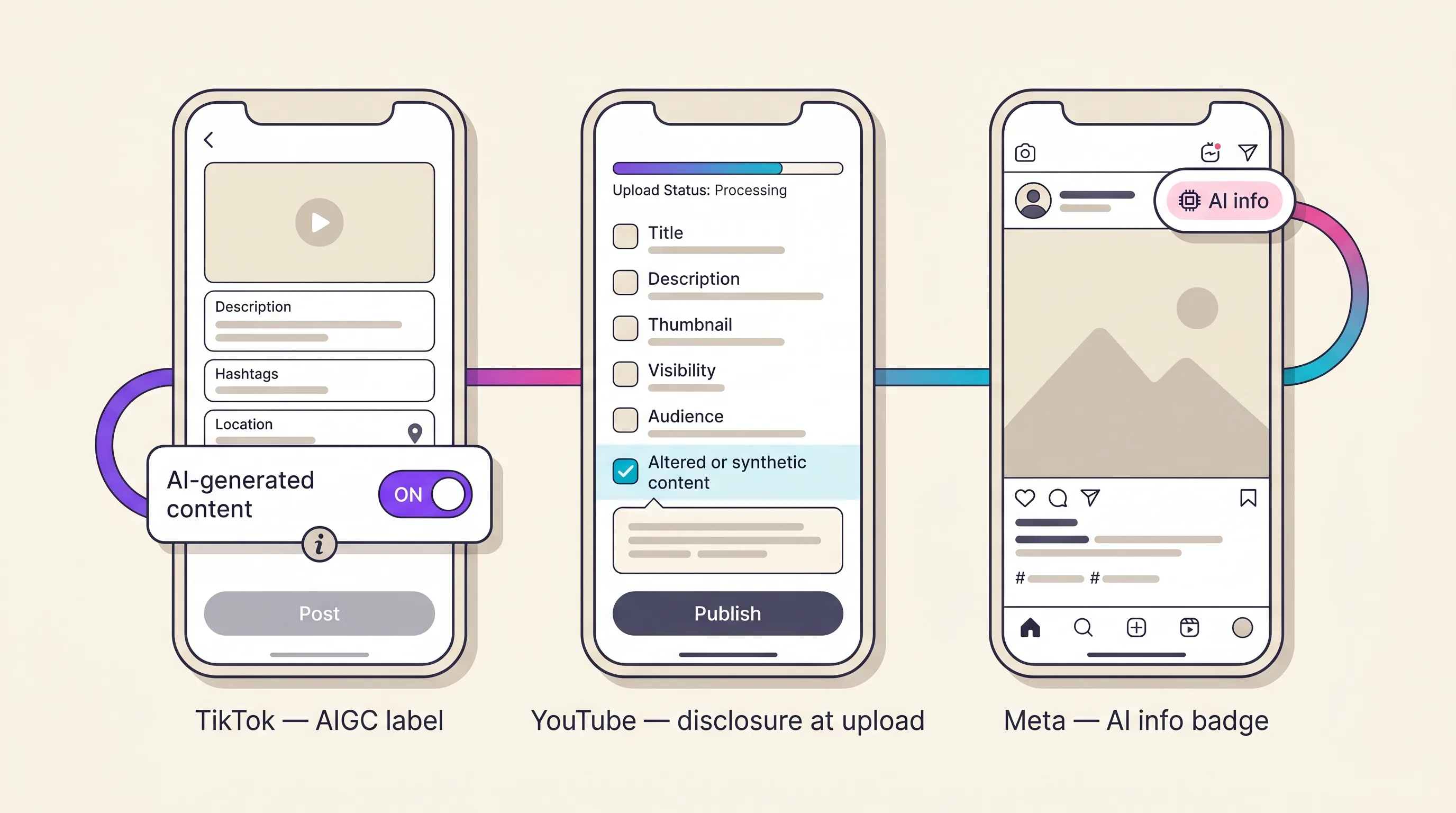
The platform layer in one table:
| Platform | What must be labeled | How | If you skip it | Ads extra |
|---|---|---|---|---|
| TikTok | Realistic AI images, audio, video | AIGC label; C2PA auto-label (non-removable) | Ad “rejected or restricted”; content removal | AIGC toggle + commercial-content toggle |
| Meta | Photorealistic AI video, realistic AI audio | Self-disclosure; auto “AI info” from metadata | ”Penalties”; ad rejection on SIEP ads | Mandatory disclosure only for social-issue/electoral/political ads |
| YouTube | Realistic altered or synthetic content | Altered-content disclosure at upload | Force-applied label, removal, YPP suspension | Paid placements also run under Google Ads policies |
The 10-step AI UGC compliance checklist
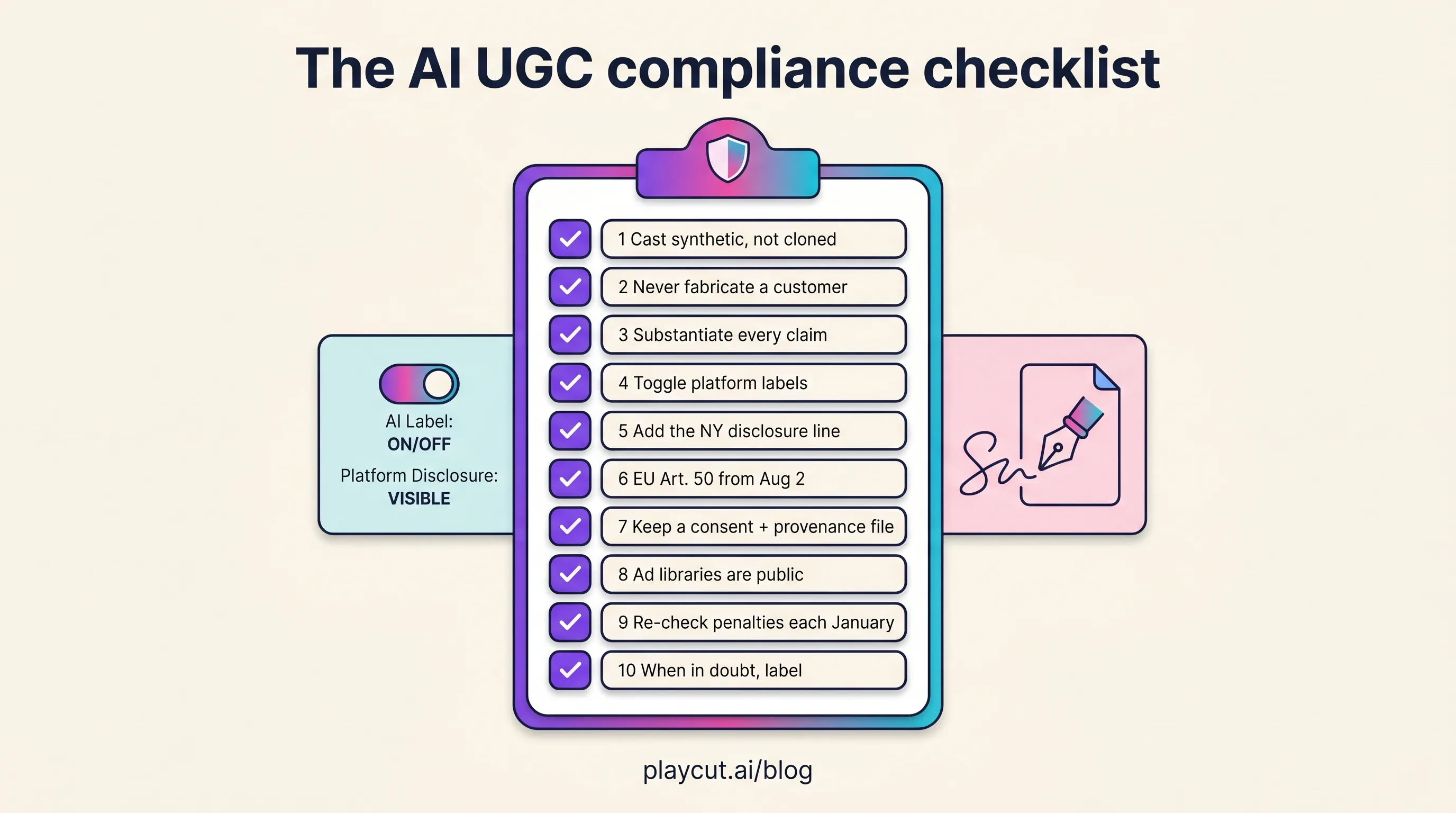
The short version: cast synthetic, never fake a customer, substantiate claims, label everywhere, add the New York line, prep for the EU, keep records. The full operating checklist:
- Cast synthetic, not cloned. Use a fully synthetic persona resembling no real person. If you clone a real creator’s face or voice, get written, use-specific, compensated consent first.
- Never fabricate a customer. No “I’ve used this for three months” from an entity that doesn’t exist. Restate as brand voice (“customers tell us…”) or use a real, substantiated testimonial.
- Substantiate every claim the AI actor makes, exactly as you would for a human spokesperson.
- Toggle the platform label on every upload: TikTok’s AIGC label plus the commercial toggle on ads, YouTube’s altered-content disclosure, Meta’s self-disclosure. Auto-labeling will out you anyway; self-labeling controls how it reads.
- Add the New York disclosure line to any synthetic-performer ad served into New York. A conspicuous “This ad features an AI-generated performer” covers it.
- Running EU traffic? Apply the Article 50 disclosure from August 2, 2026 — a visible AI-generated marking on deepfake-class creative.
- Keep a consent and provenance file per campaign: which tool, which actor, consent documents, label screenshots. That file is the audit answer.
- Remember the Ad Library effect. Meta and TikTok transparency surfaces make undisclosed AI a screenshot risk, not a secret.
- Re-check penalties each January — the FTC figure normally moves with inflation (2026 was frozen at $53,088) — and watch the state trackers.
- When in doubt, label. Disclosure is penalty-proof; non-disclosure never is. The IAB’s own data says disclosure doesn’t hurt — more on that below.
If you run client work, the checklist doubles as a deliverable — see the agency-side compliance posture. Solo creators should pair it with the disclosure habits in our UGC creator guide. The label step also lives inside the full step-by-step AI UGC production walkthrough, where it lands as step 7 of the build.
What actually gets brands in trouble
The enforcement record so far is consistent: regulators have gone after fake testimonials, unsubstantiated AI claims, and unconsented likenesses — not labeled synthetic ads. Four actions and one warning sweep define the risk surface.
FTC v. Rytr (September 2024). In its Operation AI Comply sweep, the FTC moved against an AI writing tool whose “Testimonial & Review” generator let subscribers mass-produce reviews — “hundreds, and in some cases tens of thousands” — unrelated to any real product experience. The final consent order, approved December 18, 2024, banned the service.
FTC v. DoNotPay (final order January 16, 2025). The “world’s first robot lawyer” couldn’t substantiate that its AI performed at human-lawyer level. The order imposed $193,000 in monetary relief plus customer notices — the substantiation duty, applied to AI claims.
FTC v. accessiBe (final order April 2025). A $1,000,000 order combining overstated AI-capability claims with deceptively formatted third-party reviews and undisclosed material connections to reviewers — the endorsement rules applied to AI marketing.
Forrest v. Meta, in the Northern District of California, is the one to watch. In a June 17, 2024 order, Judge Casey Pitts let misappropriation-of-likeness and negligence claims proceed against Meta over AI deepfake scam ads using billionaire Andrew Forrest’s likeness (order via GovInfo).
It’s a notable Section 230 carve-down for the ads business — and a big part of why platforms now police AI ad creative aggressively.
The December 22, 2025 warning letters. FTC staff sent warning letters to ten companies over suspected fake-review practices under the Consumer Review Rule, reciting the exposure in its own words: civil penalties “at up to $53,088 per violation, can quickly add up.” New York’s law has produced no public enforcement yet — but the audit window opened June 9, and violations accrue per ad.
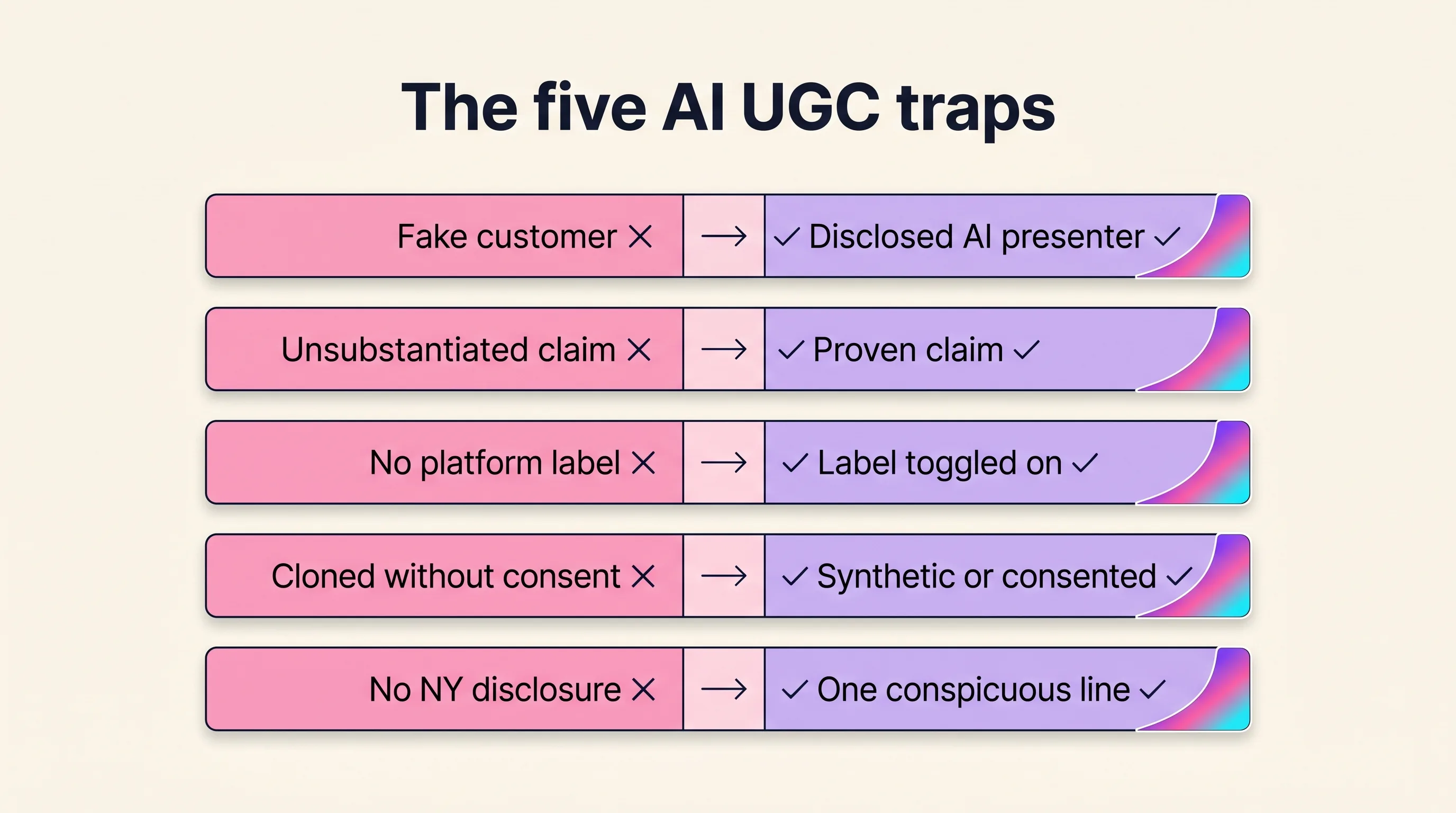
Distilled, five traps account for the real-world risk:
- An AI actor posed as a real customer — fake-review territory under Part 465.
- Experience claims nobody can substantiate — the Part 255 endorsement problem.
- Skipping platform AI labels — account-level penalties up to YPP suspension.
- Cloning a real face or voice without consent — ELVIS Act, right of publicity, NY S8882.
- No New York disclosure on synthetic-performer ads served into the state.
The business case for disclosure is also better than teams assume. An IAB study of 505 US Gen Z and Millennial consumers found only 45% feel positive about AI ads while 82% of ad executives assumed they did — but 73% said knowing an ad was AI-made would increase or not change their purchase likelihood (IAB). Disclosure isn’t the risk; getting caught hiding is.
How Playcut fits a compliant AI UGC workflow
Playcut’s design maps cleanly onto every rule above, starting with casting. Actors built on the Playcut Actor Engine are fully synthetic personas — they resemble no identifiable real person, which is exactly the safe category New York’s statute defines and the default posture that avoids right-of-publicity exposure entirely.
Voice follows the same consent-first logic: clone a voice only with the owner’s written permission, or design a fully synthetic voice in the Playcut Voice Engine and skip the consent question altogether. The script your actor reads still needs the same substantiation a human spokesperson would.
Labeling is where consistency pays off twice. Because one saved actor holds 100% character consistency across every variant, one disclosure pattern covers the whole campaign — compliance scales with the variant count instead of multiplying against it. And since paid plans render without a Playcut watermark and include a full commercial license, you control how the disclosure reads and where each platform’s label goes.

For testing labeled AI UGC at volume, the Pro plan at $29/month (2,000 credits) is the working tier most brands start on. The full workflow — actor, script, voice, label, ship — is on the UGC ads page, and the AI actors page covers building the synthetic identity itself.
Frequently asked questions
Is AI UGC illegal anywhere in the US?
No state bans AI UGC. What’s illegal is deception: fake customer reviews under federal law, undisclosed synthetic performers in ads shown in New York, and unconsented use of a real person’s face or voice anywhere. Use a synthetic actor, label it, and keep claims truthful — that’s legal in all 50 states.
What is the penalty for not disclosing AI in ads?
It stacks by layer: FTC fake-review violations carry up to $53,088 each, New York fines $1,000 for a first violation and $5,000 per subsequent one, the EU AI Act allows up to €15 million or 3% of worldwide turnover, and platforms add ad rejection, removal, and monetization suspensions.
Do I have to label AI ads on TikTok, Meta, and YouTube?
Yes, for realistic AI people. TikTok requires its AI-generated content label and rejects or restricts undisclosed AI ads, and YouTube requires the altered-content disclosure for photorealistic AI. Meta auto-labels “AI info” via industry metadata and mandates disclosure for political and social-issue ads. Self-labeling keeps you in control of how it reads.
Can an AI actor give a testimonial legally?
Only as an ad, never as a fake customer. The FTC treats anyone who “could be or appear to be an individual” as an endorser, so a synthetic “real customer” claiming an experience nobody had violates the endorsement and fake-review rules. A clearly disclosed AI presenter making substantiated claims is legal.
What does the EU AI Act require for AI ads from August 2, 2026?
Article 50 requires deployers — the brand running the ad — to disclose that deepfake-class image, audio, or video content is AI-generated, and requires generation tools to mark outputs machine-readably. Non-compliance risks fines up to €15 million or 3% of worldwide annual turnover, whichever is higher.
Is voice cloning legal for ads?
Only with consent. Tennessee’s ELVIS Act made an identifiable voice — real or simulated — a protected property right, and right-of-publicity laws in most states reach the same result. Cloning your own voice or designing a fully synthetic voice is fine; cloning a real person’s without written permission invites civil liability.
Does New York’s law apply to brands outside New York?
Yes, if the ad is distributed in New York — which national social campaigns are by default. Where your office sits doesn’t matter; delivery does. Either add a conspicuous synthetic-performer disclosure to AI-human creative nationally, or geo-exclude New York, which is harder than adding one line.
Does disclosing AI hurt ad performance?
The evidence says no. In IAB research, 73% of consumers said knowing an ad was AI-made would increase or not change purchase likelihood, and YouTube states disclosure won’t limit a video’s audience or earning eligibility. Hiding it is the real risk: auto-labels, ad libraries, and screenshots surface it anyway.
Conclusion: label it and keep shipping
Is AI UGC legal? Yes — and teams that treat disclosure as a workflow step rather than a threat never appear in enforcement stories. The duties reduce to three lines: don’t fake a customer or a claim, label realistic AI creative on every platform and in New York, and never clone a real person without written consent.
The calendar does the rest. New York has been live since June 9, 2026, and August 2, 2026 brings the EU’s Article 50 and California’s transparency act on the same day — about seven weeks out as of this update. Build the label into the template now and the deadlines pass without a scramble.
Reminder: this guide is general information, not legal advice. Statutes and platform policies change — figures here were verified June 12, 2026 — and how they apply depends on your facts. For a specific campaign, talk to a lawyer.
Make AI UGC that’s built to label cleanly.
Cast a fully synthetic actor that stays 100% consistent across every variant, keep the claims honest, and apply one disclosure pattern to the whole campaign. Start free and ship your first compliant AI UGC ad today.
Start building in Playcut →