
How to Become a UGC Creator in 2026: The 5-Step Career Path
Here’s how to become a UGC creator in 2026: pick a niche, build a spec portfolio, pitch brands while you join two or three marketplaces, price per deliverable, and scale your output with AI. No follower count required — brands pay for content, not reach, and the average UGC video cleared just under $198 this year.
The creators winning 2026 retainers deliver variant volume on top of their own filmed work — and the AI actors they use hold 100% character consistency, because the Playcut Actor Engine keeps the same face, voice, and wardrobe across every cut in a batch.
The five steps, in the order working creators run them:
- Pick a niche brands are already paying for — start from products you already own.
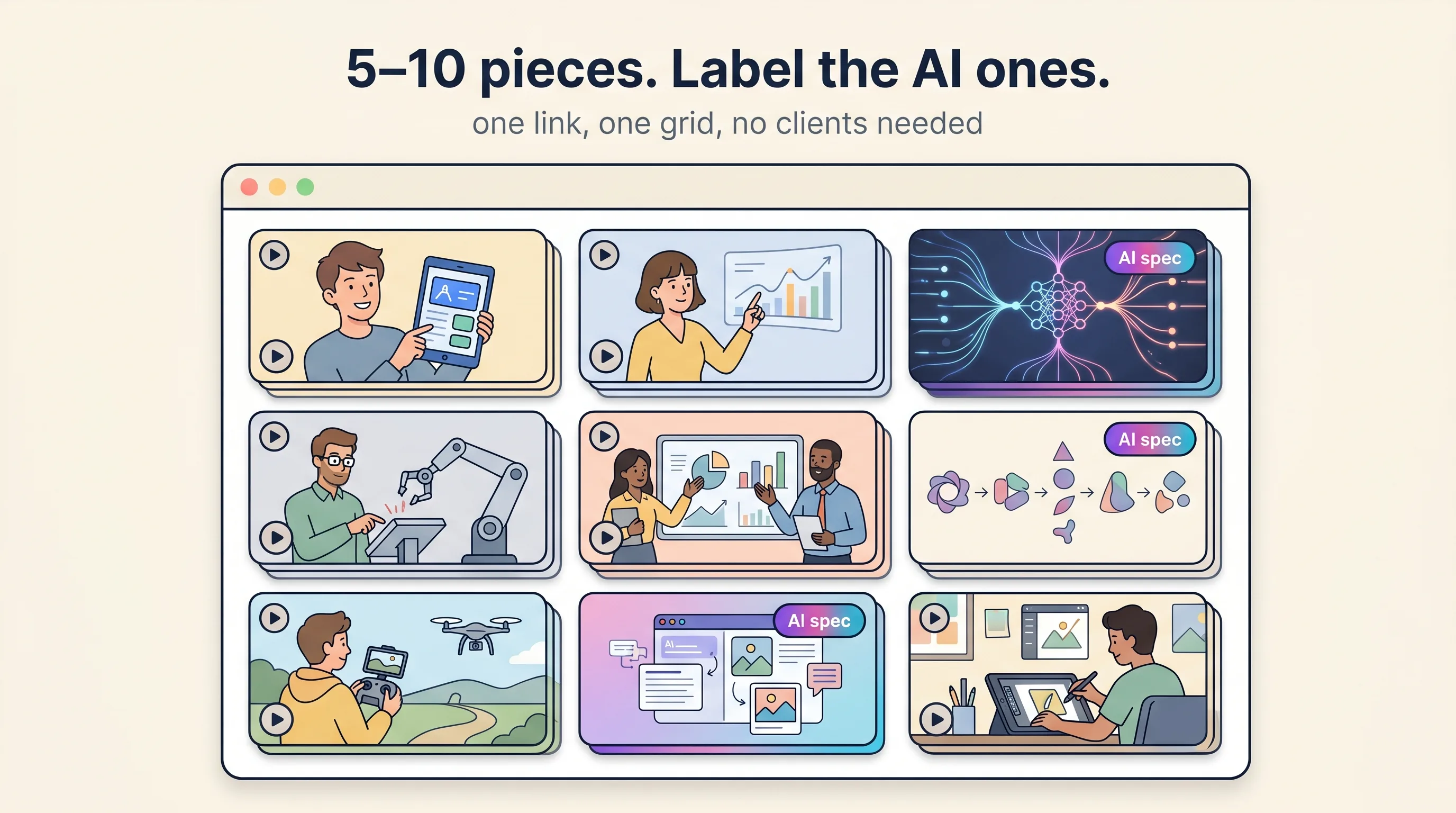
- Build a spec portfolio with an AI assist — 5–10 pieces, no clients needed.
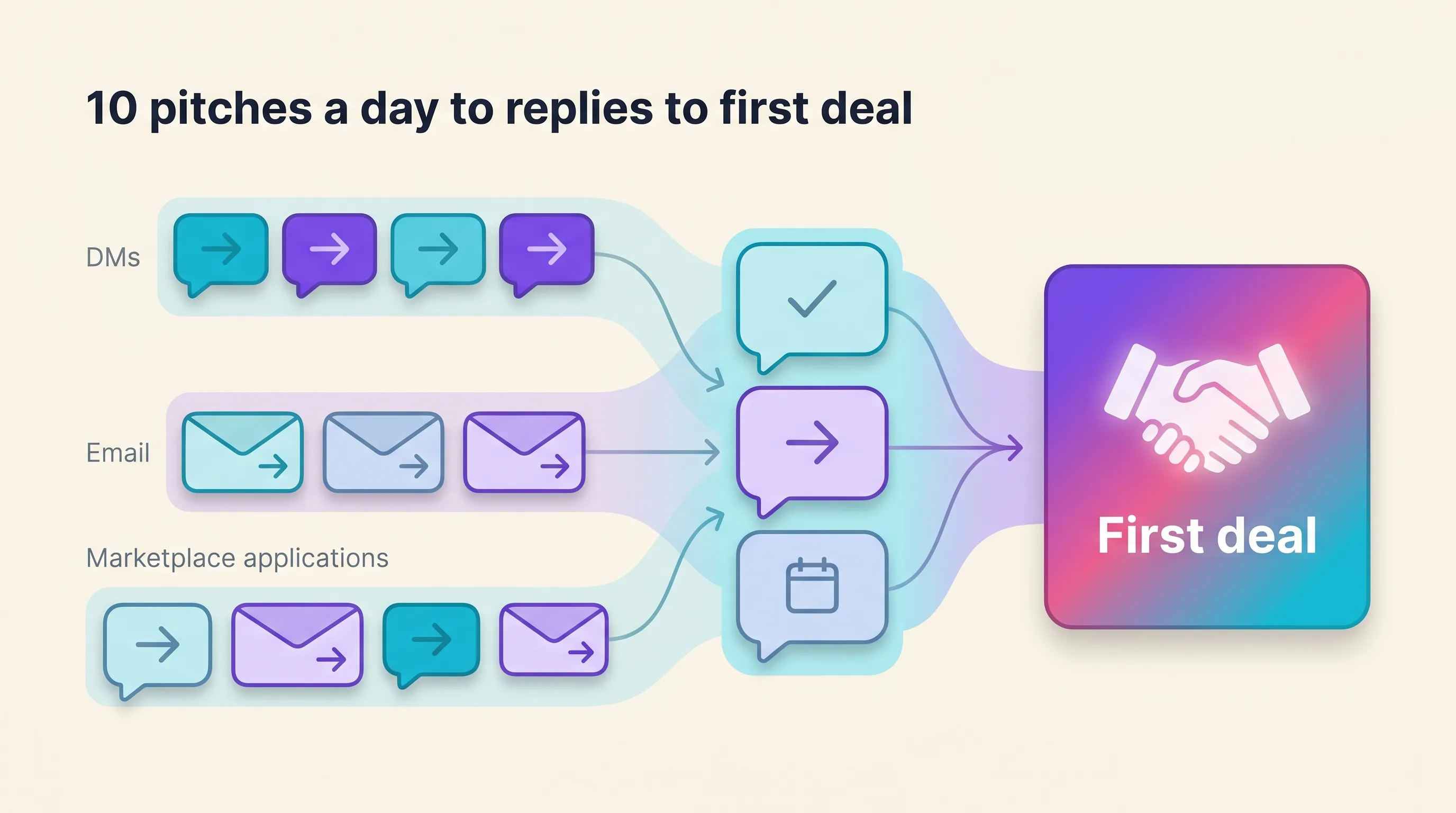
- Pitch brands and join the right marketplaces — 5–10 direct pitches a day plus 2–3 verified platforms.
- Set your rates and get paid — price per deliverable, never product-only.
- Scale your output with AI without losing authenticity — variant volume is what retainers buy.
This guide is the individual creator’s career path. It pairs with our AI UGC pillar guide for what AI UGC actually is, and with how much to charge for AI video for the full rate ladder once deals start landing.
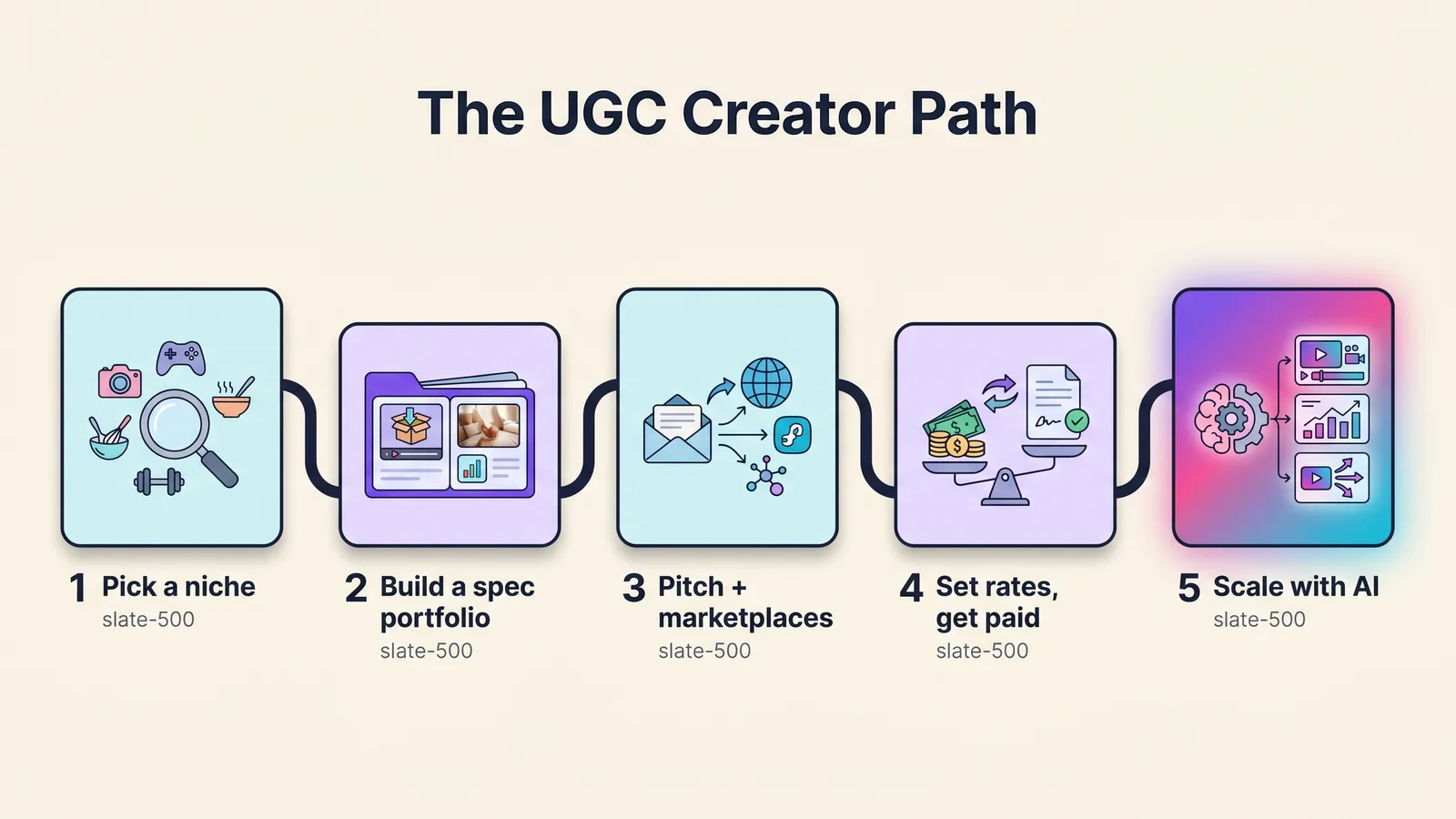
Table of Contents
- What a UGC creator actually does in 2026
- Step 1: Pick a niche brands are already paying for
- Step 2: Build a spec portfolio with an AI assist
- Step 3: Pitch brands and join the right marketplaces
- Step 4: Set your rates and get paid
- Step 5: Scale your output with AI without losing authenticity
- Frequently asked questions
- How to become a UGC creator: your first 30 days
What a UGC creator actually does in 2026
A UGC creator makes ad-style content — short videos, photos, testimonial-style reads — that brands run on their own channels and paid placements. You’re paid per deliverable, not per follower, which is why UGC is the no-audience-required creator career. An influencer sells access to an audience; a UGC creator sells the content itself.
Demand is why this career is worth starting now. In Influencer Marketing Hub’s 2026 benchmark survey of 600+ respondents, 50% plan to grow their UGC-creator work this year — and 0% plan to reduce or stop. Collabstr’s 2026 report, drawn from 21,000+ real collaborations, found UGC’s share of marketplace deals more than doubled year over year to 35% of all collaborations.
The same benchmark survey keeps the door open for beginners: roughly 80% of brands’ UGC-creator deals close under $500, so brands are writing many small checks rather than a few large ones. That is accessible work for a new creator — and a volume problem that AI-literate creators are unusually well placed to solve.
The actual UGC creator requirements are short: be 18 or older for most paid platforms, own a phone that shoots clean 1080p, and deliver on a deadline. Everything else — followers, an audience, expensive gear — is optional.
Step 1: Pick a niche brands are already paying for
Pick one to three niches from products you already own and genuinely use — then verify that brands in those niches are actively buying UGC ads before you build anything. Authenticity is the product you’re selling, and it’s hard to fake enthusiasm for a category you never touch.
The verification step is the one most new creators skip. Search your candidate niche in TikTok’s Creative Center and Meta’s Ad Library and look for creator-style ads from several different brands — recurring spend, not one-off tests. If nobody in the niche runs UGC ads, there’s nobody to pitch.
Be honest about saturation, too. Beauty and lifestyle carry the most demand and the most competition; specialized lanes — SaaS, AI tools, fintech, B2B services — have far fewer creators, and rate guides consistently put their pricing 50–100% above general lifestyle work. If you’re reading a Playcut guide, you’re likely tech-literate enough to take the underpriced lane.
Score each candidate niche on three things: brand demand (live UGC ads running right now), your credibility (do you actually use this category?), and repeat-purchase potential — subscription and consumable products fund the monthly retainers that turn UGC freelance work into stable income.
Step 2: Build a spec portfolio with an AI assist
Build a 5–10 piece spec portfolio around products you already own — spec means you made it on your own initiative, with no client involved. Brands don’t hire UGC creators off a resume; they hire off the first three seconds of a portfolio reel. This is how to start UGC with zero experience: manufacture the experience.
The five spec pieces every portfolio needs
Cover the five formats brands brief most often, using products from your chosen niche:
- Unboxing — first impressions, hands and packaging in frame, honest reactions.
- Talking demo — show the product doing the thing it’s bought for.
- Testimonial-style ad read — scripted like an ad, delivered like an opinion.
- Before/after — the transformation format for anything with a visible result.
- Hook-led ad read — open on the strongest three seconds, then earn the rest.
Film them on your phone: tripod, window light or one basic key light, quiet room, clean audio. Host everything on a single simple link — a one-page site or portfolio page works — and put “UGC creator” plus your niche in every social bio, pointing at that link.
If writing slows you down, the free UGC ad script generator turns a product brief into a hook-problem-product-CTA script you can read straight to camera.

The AI spec layer no one else teaches
Here’s the move the standard advice misses: round out your filmed pieces with clearly labeled AI spec variants — ad-style stills and short clips you couldn’t shoot alone. Different studio looks, different settings, even multilingual reads of the same hook. Labeled honestly (“AI spec work”), they prove two things filmed clips can’t: you think in ad variants, and you can deliver volume.
The economics are the unlock. A spec still on Playcut costs 67 credits — $0.97, measured in our June 2026 lab runs — and generates in about 20 seconds. A five-still spec set is $4.86 of generation and fits inside the $9 Hobby plan with credits to spare; a mixed set — three stills plus two voiced 15-second spec ads — runs about $19 on the $29 Pro plan.
Compare that to the traditional benchmark: a single professional product shoot runs $500–$5,000 per SKU. A new creator’s entire portfolio month costs less than lunch — and because the Playcut Actor Engine holds the same actor across every piece, the set reads as one coherent campaign instead of nine disconnected experiments.
Keep the framing honest inside the portfolio itself. The AI pieces demonstrate range and production volume; your filmed pieces demonstrate the lived-experience read brands license your face for. Brands buy authenticity from creators and volume from AI — the creators winning in 2026 sell both, side by side.
Step 3: Pitch brands and join the right marketplaces
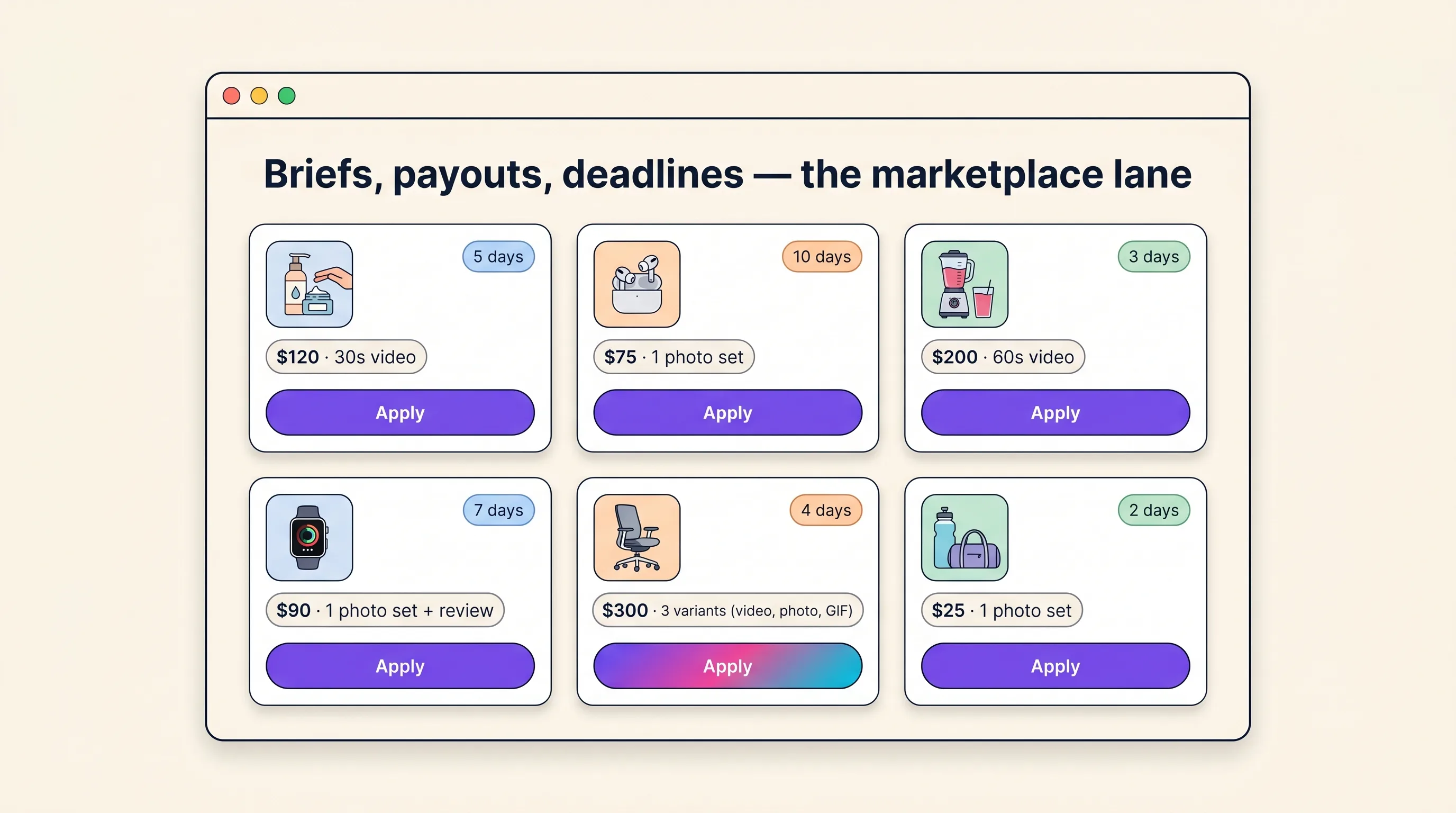
Run both channels at once: direct pitching for rate-card money, marketplaces for baseline deal flow. Marketplaces are where to sell UGC fastest, but they price near the floor; direct clients pay the rates the cards advertise. Treat the platforms as a base salary and direct outreach as the upside.
Direct pitching: 5–10 brands a day
Pitch five to ten brands daily that are already running UGC-style ads — pull them from TikTok Creative Center, Meta Ad Library, and X searches like “UGC creators needed.” A working pitch is two lines plus a portfolio link. Follow up exactly once, a week later, then move on.
Hi [name] — I keep seeing your [product] ads on TikTok. I make UGC for [niche] brands, and here are three spec pieces I made for products like yours: [link]. Want a test video against your current brief?
Expect silence for weeks; that’s the channel working as designed, not failing. Twirl alone reports 400–500 creator applications a week on the marketplace side, which is exactly why a personal pitch into a brand’s inbox is the lower-competition channel. Consistency across 30–60 days is what converts.
The seven UGC marketplaces verified alive in June 2026
Marketplace listicles rot fast — platforms die, merge, and change domains while old roundups keep sending creators to dead signup pages. We checked every platform below on June 11, 2026, from two different user agents, and recorded what their own creator pages say about pay.
| Platform | Entry bar | Pay and payout (their own pages, June 2026) |
|---|---|---|
| Billo | US, CA, UK, AU · 18+ · intro video · no follower minimum | Free for creators; apply to per-task briefs; payments every two weeks via PayPal; “name your price” add-ons |
| Insense | Gated: 1,000+ IG followers OR 500+ median TikTok views, ≥1% engagement | You negotiate your own rates; pay escrowed, released to your wallet on brand approval; reports $8M paid to creators since 2020; advises applying to 20+ campaigns |
| JoinBrands | Open enrollment + verification tiers | Jobs from $10 (images) and $25 (videos) — the honest floor of the market; brand plans add an 8–15% platform fee on top of each creator payment; 5-day image / 10-day video delivery SLAs |
| Twirl | UK, US, DE, FR, IT, ES, UAE | $90–$300+ per project plus whitelisting add-ons; payout within 10 days of approval via Stripe/Lumanu — the most transparent pay page in the set |
| Brands Meet Creators | Open signup | Set-your-own-rate proposals; cash-plus-commission and monthly-retainer deals |
| Trend | US-based, iPhone required, no follower minimum | 100% free for creators; PayPal payout as soon as content is approved; now operating under soona after their merger |
| Collabstr | Open signup; creators list services and set prices | ~550K creators per industry counts; a 15% creator-side fee per third-party breakdowns; its site blocks automated fetchers, so we link nothing — but the platform is alive |
One credibility note other guides skip: the platforms that died. Octoly — still listed in stale roundups — serves no creator marketplace today, and Speekly’s old domain now redirects to an unrelated compliance company. Twirl moved domains (old twirlcreators.com links just redirect), and Billo’s once-public pricing page now sits behind a login. Verify any platform’s creator page yourself before investing profile-building time.
Fiverr and Upwork are a separate lane — gig storefronts rather than UGC marketplaces — and they clear lower but compound through reviews; the full setup is in our Fiverr AI video gig playbook. Across every platform, remember the structural deal: marketplaces sell deal flow and take it back in fees, competition, and floor-level rates. Direct clients are where rate cards come true.
Step 4: Set your rates and get paid
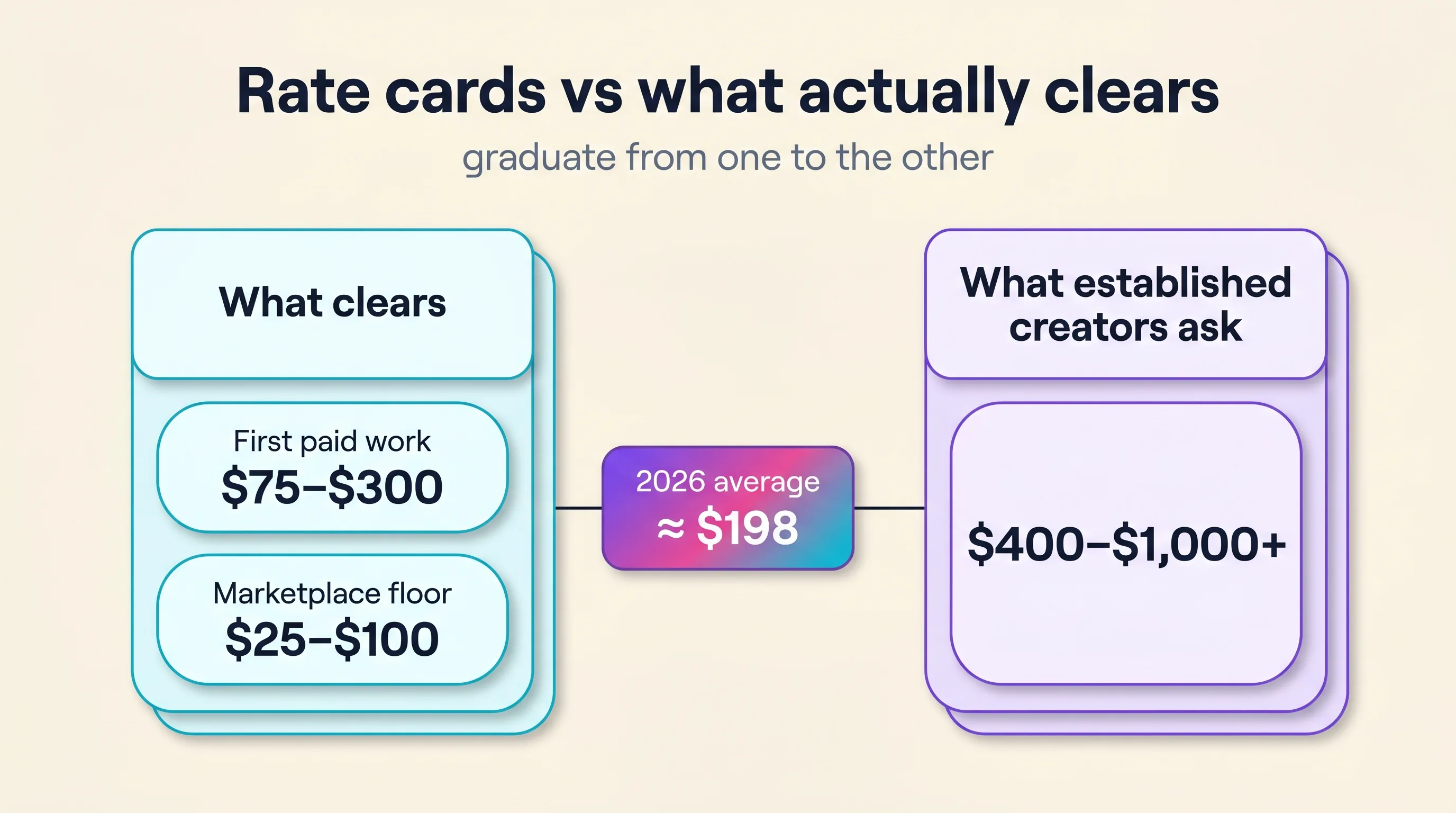
Here’s the honest 2026 rate picture in one band: first paid work clears $75–$300 per video depending on the channel, established direct creators ask $400–$1,000+ on the upper rungs of InfluenceFlow’s 2026 rate-card ladder, and the average sits just under $198 — Collabstr’s 21,000-collaboration dataset and DesignRevision’s pricing data land within a dollar of each other.
The gap between the card and the clear is the channel. Marketplace job boards floor at $25–$100 while direct clients pay the advertised ladder. Both numbers are real — they’re just different markets, and your career arc is graduating from one to the other.
Two pricing rules protect beginners. First: product-plus-fee is normal, but product-only is a ceiling you should never accept once you have a portfolio — free product is a sweetener, not a salary. Second: usage rights are a separate line — paid-ad usage, exclusivity, and buyouts each stack a premium on the base rate, and the full multiplier table in our pricing guide is the reference to quote from.
One number we’re deliberately not repeating: the “$116,000 average UGC salary” stat circulating in this topic’s search results. It comes from job-board title aggregation that lumps in unrelated marketing roles, not from creator payout data. The cleared averages above are the honest anchor.
Rates deserve their own deep-dive, and ours already exists: how much to charge for AI video covers the per-deliverable ladder, rights pricing, and margin math, and the free AI video rate calculator turns your numbers into a defensible quote. For the wider map of UGC income paths, see make money with AI video.
Getting paid runs three ways: marketplace escrow released on brand approval, direct invoicing per deliverable, and monthly retainers once a brand trusts you — the progression most working creators follow in that order.
Step 5: Scale your output with AI without losing authenticity
Start with the honest line, because it’s also the strategy: brands hire UGC creators for the authentic, lived-experience read — and they buy volume from AI. The winning creators in 2026 sell both. AI isn’t a replacement for your on-camera work; it’s the lever that lets a solo creator deliver agency-scale output.
The highest-value fit is variant volume. With one saved AI actor, a solo creator can deliver a 10-variant hook batch alongside their filmed content — different reads, different settings, even different languages, since the Playcut Voice Engine lip-syncs 30+ languages. The Playcut Actor Engine holds 100% character consistency across stills, motion video, UGC ads, and on-product shots, so every variant carries the same face the brand approved.
The second fit is the writing bottleneck. Free tools cover it: the TikTok hook generator drafts hook variants and the script generator from Step 2 structures the read. The production loop itself — script, voice, lip-sync, render — is walked step by step, with measured per-step costs, in how to make AI UGC.
Capacity math at current pricing: the $29 Pro plan’s 2,000 monthly credits cover roughly 29 spec stills, or a mix like a five-still portfolio refresh plus two voiced 15-second clips with room to spare. Heavy delivery months top up with credit packs from $9 for 600 credits — they never expire — and the $9 Hobby plan covers pure portfolio-building months.
Disclosing AI work to clients
Disclosure is a workflow habit, not a legal opinion — three rules cover the creator side.
Tell the client in writing before delivery that a deliverable is AI-generated or AI-assisted; a one-line clause in your agreement does it. Never present an AI actor as a real customer’s testimonial — that’s fake-review territory with five-figure per-violation penalties, mapped in full in is AI UGC legal?. Label your own posts when you publish, not just when you deliver.
The legal anchors: the FTC Endorsement Guides (16 CFR Part 255) cover paid-creator material connections regardless of how the content was produced, and the EU AI Act’s Article 50 transparency obligations apply from August 2, 2026 — weeks after this guide publishes — if you serve EU clients or audiences.
The platforms have their own toggles. TikTok requires its AI-generated content label on realistic AI video plus the branded-content toggle on paid work. YouTube requires an altered-or-synthetic disclosure when AI generates a realistic scene that didn’t occur, and Meta applies “AI info” labels and expects self-declaration. Build the toggles into your delivery checklist once and stop thinking about them.
When you’ve outgrown solo: the agency path and the AI-influencer path
Two graduations sit past this guide. If you’d rather sell a productized service — packages, retainers, margin math, a delivery stack — that’s the agency play, and how to start an AI UGC agency is the operator’s version of this article. And running a fully synthetic persona with its own audience is a different career entirely: how to create an AI influencer covers that one.
Frequently asked questions
Do you need followers to become a UGC creator?
No. UGC creators are paid for content brands run on their own channels, not for reach, so most marketplaces have no follower minimum — Billo and Trend state none, and JoinBrands is open enrollment. The exception worth knowing: Insense gates applications at 1,000+ Instagram followers or 500+ median TikTok views with at least 1% engagement.
How long does it take to get your first paid UGC deal?
Typically 30–60 days of consistent daily pitching. Marketplace competition is heavy — Twirl alone reports 400–500 creator applications a week — so creators who send 5–10 direct brand pitches daily alongside two or three marketplace profiles usually convert faster than marketplace-only applicants.
How much do beginner UGC creators make per video?
First paid work clears $75–$300 per video depending on channel — marketplace jobs floor near $25–$100 while direct clients pay more — and the 2026 cleared average sits just under $198. Established direct creators ask $400–$1,000+. The full rate ladder and rights math live in our pricing guide.
Do you have to show your face to do UGC?
No. Faceless lanes — B-roll, hands-only demos, voiceover reviews, and screen-recorded walkthroughs — are real deliverables brands buy. On-camera testimonial-style work typically pays more because it converts well in ads, but it is a rate lever, not a requirement.
What equipment do you need to start UGC?
A smartphone that shoots clean 1080p, a $20–$30 tripod, a basic light, and a quiet room — under about $150 all-in. Brands buy steady framing, clear audio, and a believable read, not cinema gear. Upgrade only once paid deals are funding it.
Can you use AI to make UGC content for brands?
Yes — with the brand’s written sign-off and clear disclosure. Creators use AI actors for labeled spec pieces and variant volume; the Playcut Actor Engine keeps the same actor across every shot, so a batch reads as one campaign rather than a tool demo. Never present an AI actor as a real customer testimonial.
What’s the difference between a UGC creator and an influencer?
A UGC creator sells content for a brand’s own channels and ads, paid per deliverable, audience size irrelevant. An influencer sells access to their audience by posting to their own following. Many people do both, but UGC is the career you can start with zero followers.
How old do you have to be to become a UGC creator?
18 or older for most paid platforms — Billo requires 18+, and Twirl’s creator network spans ages 18–60+ — because campaign work involves contracts and payouts. Under 18 you can practice spec content, but marketplace accounts and brand contracts need an adult.
How to become a UGC creator: your first 30 days
Here’s the whole guide as a calendar. Week 1: pick the niche, verify live ad demand in TikTok Creative Center and Meta Ad Library, and assemble the sub-$150 kit. Week 2: shoot the five filmed spec pieces and generate the labeled AI spec set — $4.86 of stills on Hobby, or the ~$19 mixed set on Pro. Weeks 3–4: open two or three marketplace profiles and start the 5–10 daily direct pitches.
First deals typically land in the 30–60 day window, and they go to the creators still pitching in week six with a portfolio that proves both authenticity and volume. The demand side is already moving: half of surveyed brands are growing UGC-creator budgets this year, and none plan to cut.
When you’re ready to build the AI spec layer, start free on Playcut — create one actor, hold one face across every piece, and ship a portfolio brands remember.