
Make Money With AI Video: 2026 Business Models

How to make money with AI video comes down to one idea: you sell a deliverable for far more than it costs you to generate. In 2026 the raw cost of an 8-second cinematic clip is roughly $3.20 in API generation, while the same clip sells for $75 to $500 on Fiverr or $150 to $3,500+ as UGC.
That gap is the business. This guide maps the eight proven AI-video business models, the real earnings ranges behind each, and the right Playcut workflow to run them — then routes you to a deep playbook for whichever one fits.
In a hurry?
Eight models, ranked from solo on-ramp to scaled agency: Fiverr gigs, freelance rate-card work, UGC ads, e-commerce product video, a UGC agency, a video production agency, white-label reselling, and ad-revenue content. The margin comes from a ~$3.20 generation cost versus a $75–$3,500 sale. Jump to the margin math or the decision guide.
Table of Contents
- Can you actually make money with AI video?
- The margin math behind every model
- Model 1 — Sell AI video gigs on Fiverr
- Model 2 — Freelance at a rate card
- Model 3 — Produce UGC ads for brands
- Model 4 — Sell e-commerce product video
- Model 5 — Run an AI UGC agency
- Model 6 — Run an AI video production agency
- Model 7 — White-label and resell AI video
- Model 8 — Publish ad-revenue content
- Which model should you pick?
- How Playcut powers every model
- How to start in 30 days
- Frequently Asked Questions
- Verdict
Make money with AI video on one studio.
Every model on this page runs on the same login: Veo for cinematic video, Imagen and Gemini for stills, plus a reusable AI actor library and multi-brand brand kits for client work. Hobby $9/mo, Pro $29/mo. 7-day trial, card required, cancel anytime within the trial at no charge.
Start your AI video business on Playcut →
Can you actually make money with AI video?
Yes — but it is a skill and a business, not a button. The honest framing every credible source agrees on: client-service models pay fast, ad-revenue models pay slowly, and the people earning real money treat AI generation as a cost lever inside a real offer, not as the offer itself.
The verifiable case studies are encouraging. Cliprise reports that a 3-person customer agency cut monthly production cost from $14,000 to $3,100 — a 78% reduction — and lifted gross margin from 52% to 71%, per its published case study (the customer is anonymized and the page carries a results-vary disclaimer).
On the app-revenue side, Learna AI reportedly scaled to roughly $800k MRR in about nine months running ~300 AI-actor ads, per a workflow distilled from Arcads’ co-founder on Startup Spells. Attribute that one carefully: the figure comes from an Arcads-affiliated source with a commercial incentive.
The reality check matters too. Ad-revenue channels are slow — credible guides agree months 1–2 earn close to nothing, with first revenue around month 3–4. Faceless-channel earnings circulating online (Social Blade and vidIQ figures) are estimates, not audited results. Lead with a service model if you want income this quarter.
The margin math behind every model
Every AI-video business is the spread between your generation cost and your sale price. Get this number right and the rest is execution.
Raw generation is cheap. Google Veo 3 via fal.ai runs $0.50/sec (audio off) to $0.75/sec (audio on); Veo 3 Fast is $0.25–$0.40/sec, per Veo 3 API pricing data. So an 8-second clip with audio is ~$3.20 in API cost. A “Basic $75” Fiverr gig delivering one such clip is roughly a 23× markup before edit labor.
On a credit-based studio, the math is just as favorable. Playcut Pro is $29/mo for 2,000 credits; a 15-second UGC actor video with voice runs about 380 credits, and budget Grok video clips cost far less. Your true cost per finished deliverable is cents-to-low-dollars.
Here is the trap that sinks credibility: a 50% markup is not a 50% margin. Per ALM Corp’s reseller pricing breakdown, a $1,000 cost sold at $1,500 is a 50% markup but only a 33.3% gross margin. To hit a true 50% margin you must sell at $2,000 (a 100% markup).
The formula to price by: Retail = Loaded cost ÷ (1 − target margin). “Loaded cost” includes your tool fee, account-management time, revisions, and payment processing — not just the raw API spend. Most healthy agencies target a 40–60% gross margin.
| Channel | Your typical cost | Client/market price | Source |
|---|---|---|---|
| 8-sec Veo 3 clip (audio on) | ~$3.20 | n/a (COGS) | veo3ai.io |
| Fiverr basic gig | ~$3–$10 | $75–$100 | James Palm |
| UGC ad (short-form) | low single dollars | $150–$3,500+ | InfluenceFlow |
| Agency 30-sec brand video | tool + labor | from $5,000 | Lemonlight |
Model 1 — Sell AI video gigs on Fiverr
Selling AI video gigs on Fiverr is the lowest-barrier on-ramp: no audience, no incorporation, first orders in days. Set up a three-tier gig and deliver a customized clip per order.Verified pricing tiers cluster into a Basic / Standard / Premium ladder: Basic $75–$100 (30–60s, 2 revisions), Standard $150–$200 (60–90s, custom voiceover), Premium $300–$500 (90–120s, commercial license, unlimited revisions), per Fluxnote. The average AI-video gig clears around $285/video, with top sellers at $400–$600.
Production is fast — roughly 30–40 minutes per video, an effective $300–$750/hour, with top performers doing 12–25 orders/month for $4,800–$15,000/mo, per a documented Veo 3 Fiverr workflow. Note Fiverr takes a 20% commission from sellers.
The single rule that gets sellers banned: Fiverr requires customized, original work per order — no bulk-identical AI output. Playcut’s per-prompt workspace and actor variants make genuine per-order customization easy to prove. For the full gig-setup, pricing, and TOS-safe delivery walkthrough, read the Fiverr AI video gig playbook.
Model 2 — Freelance at a rate card
Freelancing off-platform lets you keep 100% of the fee and bill by deliverable, minute, or retainer. Once you have a few gig reviews, move clients to direct work at higher rates.The market accepts three billing models. Per-deliverable UGC runs $150–$400 (beginner) up to $1,000–$3,500+ (expert) for short-form, per InfluenceFlow’s 2026 rate card. Per-finished-minute editing baselines at $50–$150/min. Monthly content retainers run $1,500–$5,000/mo for a freelancer.
Usage rights are the hidden multiplier most beginners forget to charge for. Paid-ad usage adds 30–50% per 30-day period, and perpetual buyouts add 100–200% on top of the base, per the same rate card. Always quote rights separately.
For the full rate tables across all three billing models, the markup-vs-margin worked examples, and a copy-paste rate card by deliverable, read how much to charge for AI video. Pair it with the free AI video rate calculator to turn your COGS into a quote.
Model 3 — Produce UGC ads for brands
UGC ads are the highest-volume, highest-repeat AI-video income stream: brands need 30+ fresh creative variants per week and pay $50–$150 per AI ad you deliver. This is where a reusable AI actor library pays off, and the UGC creator career path walks the on-ramp from niche to first paid client.The performance case is real. Creatify reports its AI-generated ads delivered 28% lower cost-per-result and 31% lower CPC than the best human UGC ad in a 5-ad test, per its internal case study. Imalent saw 7× organic TikTok views from AI ads at ~$4/video versus $150–$1,000 traditional, per Creatify’s Imalent study (engagement only — no revenue claim).
The unlock is consistency: the same AI actor across 50 hook variants, 30+ languages, perfect lip-sync — no creator chasing, no 1099s. Playcut’s AI actor library holds one face across an entire campaign, which is what makes a winning hook compound instead of resetting each time the talent changes.
Higgsfield, Arcads, and other single-purpose tools can produce UGC reads but drift across outfit and scene changes; see the Higgsfield alternatives breakdown for the consistency comparison. For the brief-to-live workflow, see the Playcut UGC ads page.
Model 4 — Sell e-commerce product video
E-commerce sellers will pay for product video because it directly lifts conversion — and most do not have the time or shoot budget to make it. You sell PDP clips, ad creative, and lifestyle reveals from a single product upload.The conversion data is the pitch. Amazon states listings with product video generate roughly 23.8% more sales. Shopify-side benchmarks show meaningful sitewide conversion lift when video sits on the product page. Both platforms permit AI-generated video provided it accurately represents the product — you cannot fake size, color, or capabilities.
This is where Playcut’s reference-to-image and image-to-video keep the real SKU in frame, versus hallucination-prone one-click tools. One upload becomes a PDP clip, a vertical ad, and a square feed version.
Two deep playbooks cover this pair: AI video for Shopify walks the media specs, PDP embedding, and ad repurposing; AI video for Amazon listings covers the slot map, the .mp4/1080p specs, the AI-disclosure rules, and the 23.8% lift data with primary citations.
Model 5 — Run an AI UGC agency
An AI UGC agency packages the UGC-ad model into recurring retainers — the step up from one-off ads to predictable MRR. You sell creative volume to brands and keep the spread on a software cost base.Retainer bands are well-anchored. A starter/solo agency runs $1,500–$3,000/mo per brand; growth retainers $3,000–$8,000/mo; performance retainers tied to ROAS $8,000–$15,000/mo. Admiral Media’s public rate card lists €4,000/mo for 20 videos up to €21,500/mo for 80, per its AI UGC agency page.
You reach profit at 5–10 clients, with time-to-first-client of 2–4 weeks, per Bizzby. The structural advantage: multi-brand brand kits and per-client workspaces let one operator run 10 brands without cross-contamination — the thing single-workspace competitors cannot do.
For the full operator playbook — positioning, services, rate cards, margin math, client acquisition, and FTC compliance — read how to start an AI UGC agency.
Model 6 — Run an AI video production agency
A production agency sells the full service catalog — brand spots, product video, social cut-downs — at agency prices on a sub-$5 generation cost base. It is the highest-revenue-per-client model on this list.
The pricing anchor is strong: a full-service AI 30-second brand video starts at $5,000, per Lemonlight, while AI production runs roughly 60% cheaper than traditional at comparable quality. A $60k budget that bought 3–4 traditional videos buys 12–15 AI-produced ones.
The model holds when rework stays low and the tool stack spreads across five or more clients. Playcut workspaces (one per client), brand kits, and the actor library are the “agency-in-a-box” that lets one operator deliver what used to need a crew — though honest creative direction still matters and is your moat.
For the full service catalog, the five-stage production stack, and the per-deliverable margin math, read building an AI video agency. To form the underlying business — incorporation, first-month budget, niche selection — read how to start an AI marketing agency.
Model 7 — White-label and resell AI video
White-label reselling lets you sell AI video under your own brand at reseller margin — and the margin improves as you add clients. This is the scaling endgame for an agency.The canonical model: pay a monthly platform retainer, buy units or credits at wholesale, set your own retail, and keep the spread. One verified worked example pays $500/mo plus $1/credit and resells at $5/credit — a 5× markup, 80% margin on usage, per Fluxnote.
Margins compound at scale because the fixed platform fee amortizes. Per Trillet’s worked table, a service hits 76% margin at 5 clients, 82% at 10, 85% at 20 as the per-client fixed cost shrinks.
One honesty note Playcut maintains: Playcut does not currently offer a literal domain-rebrand reseller license. But brand-kits-per-client plus private workspaces let you deliver branded client work under your own name and capture most of the value. The distinction matters — read white-label AI video for the markup-vs-margin math, contracts, and where true white-label is worth it.
Model 8 — Publish ad-revenue content
Ad-revenue content — faceless YouTube, TikTok, stock — is the passive-income play: slow to start, but it compounds without per-client selling. This is the only model on the list that depends on building an audience.
The earnings reality is honest. TikTok’s Creativity Program pays roughly $0.50–$1.00 per 1,000 qualified views on videos over one minute, per multiple tool blogs. The strongest operator-disclosed YouTube case is Noah Morris, who told vidIQ a single faceless “Court Cases” video earned $20,497.97 on a $250 production cost (~80× ROI) — though his portfolio-level figures are self-promotional and unaudited.
Everything beyond that — Social Blade and vidIQ channel estimates — is exactly that: estimated, not creator-confirmed. Treat ranges like “$5,000–$20,000/mo at 500K subs” as industry rules of thumb, never facts.
The Playcut fit: route faceless cinematic episodes through Veo and stills through Imagen from one chat surface, and disclose AI use where the platform requires it. If the blocker is what to publish, the free video idea generator turns a niche into 18 video ideas with ready hooks. This is best run as a second stream once a service model is paying the bills.
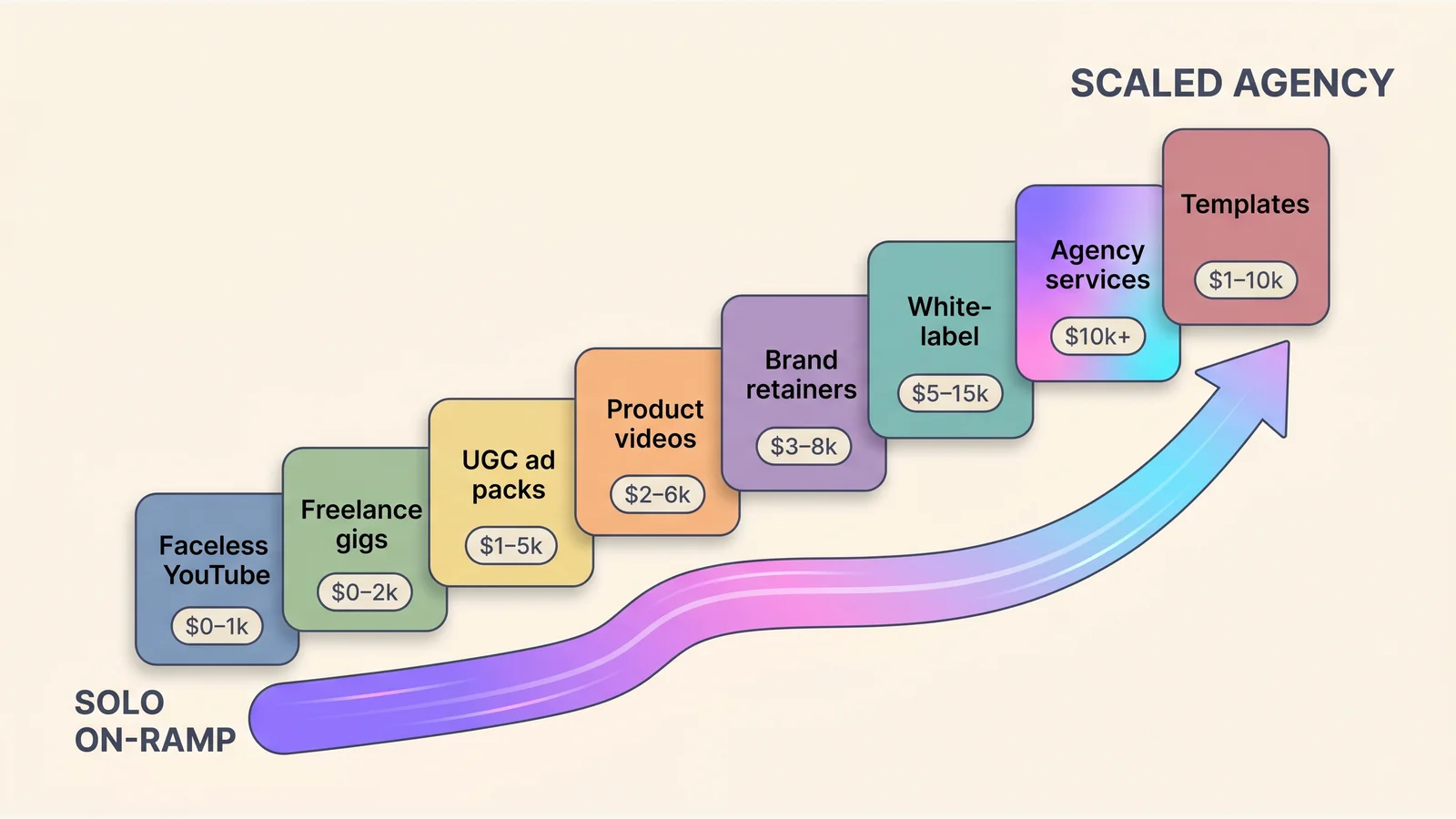
Which model should you pick?
Pick by how fast you need income and how much risk you’ll take. Service models pay this quarter; ad-revenue models pay later but passively.- Need income in weeks, no audience — start with Fiverr gigs, then graduate to direct freelance work at a higher rate card.
- Comfortable cold-pitching brands — UGC ads repeat weekly and convert into retainers fast.
- Sell to store owners — e-commerce product video leans on hard conversion data (23.8% Amazon lift).
- Want a real business, not a side hustle — build a UGC agency or production agency on retainers.
- Already running an agency — add white-label reselling to scale margin past 80%.
- Patient, building an audience — ad-revenue content compounds as a second stream.
| Model | Earnings range | Speed to first $ | Audience needed? |
|---|---|---|---|
| Fiverr gigs | $75–$500/video; $4,800–$15,000/mo at scale | Days | No |
| Freelance rate card | $150–$3,500+/deliverable | 1–2 weeks | No |
| UGC ads | $50–$150/ad sold | 2–4 weeks | No |
| E-commerce video | per-deliverable or retainer | 2–4 weeks | No |
| UGC agency | $1,500–$15,000/mo per client | 2–4 weeks to first client | No |
| Production agency | from $5,000/brand video | 1–2 months | No |
| White-label reselling | 76–85% margin at 5–20 clients | 1–3 months | No |
| Ad-revenue content | wide, estimated | 3–4 months+ | Yes |
How Playcut powers every model
The reason a multi-model studio matters for making money is that every model above needs a different output type — and stitching three single-purpose tools eats your margin. Playcut routes all of them from one login.Single-purpose tools force a stack: an avatar tool for UGC, a text-to-video tool for faceless content, an image tool for product stills. An agency running 10 brands across 3 tools duplicates seats — roughly $7,560/mo in seat duplication — and still cannot answer “which actor was approved for Brand C?”
Playcut collapses that. One chat surface routes Veo for cinematic video, Imagen and Gemini for stills, plus Grok and select fal.ai providers, picking the best model per task. Add multi-brand brand kits, shared and private workspace folders, and a reusable AI actor library that holds one face across a whole campaign.
Pricing is flat and transparent, which is what makes the margin math on this page predictable:
| Plan | Price | Credits/mo | Custom AI actors | Seats |
|---|---|---|---|---|
| Hobby | $9/mo | 500 | 3 | 1 |
| Pro (most popular) | $29/mo | 2,000 | 10 | 1 |
| Studio | $79/mo | 6,000 | 25 | 4 |
| Agency | $149/seat/mo | 10,000/seat | Unlimited | Unlimited |
Annual billing saves ~17% (two months free). Credit packs never expire: 600 cr/$9, 2,500 cr/$35, 5,000 cr/$65. Every plan includes commercial use, no watermark, and a 7-day trial. See the full breakdown on the Playcut pricing page.
How to start in 30 days
You can go from zero to first paid deliverable inside one month with a service model. Here is the fastest path, written as a repeatable plan.Step 1 — Pick one model and one niche (Days 1–3)
Choose a single model from the decision guide and one niche (e.g. skincare UGC, SaaS explainers, Shopify product video). Focus beats breadth when you are starting — one niche makes your samples and pitch sharper.
Step 2 — Build three sample deliverables (Days 4–10)
Open app.playcut.ai, save one AI actor and one brand kit, and generate three finished portfolio pieces. Consistent, real-looking samples are what convert a cold prospect. Try the free creator tools to structure prompts faster.
Step 3 — Price off your cost (Days 11–14)
Calculate your true loaded cost per deliverable, then set retail with Retail = Loaded cost ÷ (1 − target margin) for a 40–60% gross margin. The how much to charge guide has the full worked examples.
Step 4 — List or pitch, then deliver (Days 15–30)
List a Fiverr gig or cold-pitch 50 businesses in your niche. Deliver a customized clip per order. Time to first client is typically 2–4 weeks — you are on schedule if a paid order lands by day 30.
One studio, eight income streams.
Start your AI video business on Playcut.
Veo for video, Imagen for stills, a reusable actor library, and multi-brand brand kits — the margin lever behind every model on this page. 7-day trial, no charge if you cancel inside the trial.
Start your AI video business on Playcut →
Frequently Asked Questions
How do you make money with AI video in 2026?
You make money with AI video by selling a service or publishing for revenue: Fiverr gigs ($75–$500/video), UGC ads for brands ($50–$150/ad sold), e-commerce product video, a UGC or marketing agency on retainer ($1,500–$15,000/mo), white-label reselling, or ad-revenue content like faceless YouTube.
The money comes from the gap between what clients pay and your cost — an 8-second Veo 3 clip costs roughly $3.20 in raw generation, so a $75 Fiverr basic gig is a ~23× markup before edit labor. Client services pay fastest; ad-revenue channels are slowest but most passive.
Can you actually make money with AI video, or is it hype?
Yes, but it is a skill, not a button. The verifiable cases are real: Cliprise reports a 3-person customer agency cut production cost 78% ($14,000 to $3,100/mo) and lifted margin from 52% to 71%; Learna AI reportedly scaled to roughly $800k MRR running ~300 AI-actor ads, per Arcads’ co-founder.
Faceless and ad-revenue channels are slower — credible guides agree months 1–2 earn close to nothing, with first revenue around month 3–4. Treat AI video as a production-cost lever for a real offer.
How much can you earn with an AI video side hustle?
Realistic ranges by channel: a Fiverr gig at 12–25 orders/month lands roughly $4,800–$15,000/mo at top performance; UGC creators charge $150–$400/video as beginners and $1,000–$3,500+ as experts; a starter agency retainer runs $1,500–$3,000/mo per client and you reach profit at 5–10 clients.
A solo operator commonly targets $50k/mo at scale. Ad-revenue channels are estimated by Social Blade and vidIQ at wide, unaudited ranges — treat those as estimates, not promises.
Which AI video tool is best for making money?
The best tool covers every money method from one surface instead of locking you to one workflow. Single-purpose tools force you to stitch a stack.
A multi-model studio like Playcut routes Veo for cinematic video, Imagen and Gemini for stills, plus Grok and fal.ai providers, and adds workspaces, multi-brand brand kits, and a reusable AI actor library — so one login serves faceless YouTube, UGC ads, product video, and agency work. Flat pricing starts at $9/mo (Hobby) and $29/mo (Pro).
Do YouTube and TikTok allow AI-generated content for monetization?
Yes, with disclosure. Both platforms permit AI-generated content but require you to label realistic synthetic media, and the FTC’s Endorsement Guides treat an AI actor’s first-person experience claim like any fabricated testimonial.
TikTok’s Creativity Program pays roughly $0.50–$1.00 per 1,000 qualified views on videos over one minute, per multiple tool blogs. Never have an AI actor make an unverified first-person claim, and always disclose AI use where the platform requires it.
How do I start making money with AI video with no audience or experience?
Start with a client-service model that does not need an audience: list a Fiverr AI video gig or cold-pitch local businesses a UGC ad. Pick one niche, build three sample deliverables, and price off your cost — your generation COGS is cents-to-low-dollars per clip while clients pay $75–$500.
Time to first client for a service offer is typically 2–4 weeks, and you reach profit at 5–10 clients. Audience-dependent ad-revenue models like faceless YouTube are slower and better as a second stream.
What does AI video actually cost to produce in 2026?
Raw generation is cheap: Google Veo 3 via fal.ai runs $0.50/sec (audio off) to $0.75/sec (audio on), and Veo 3 Fast is $0.25–$0.40/sec — so an 8-second Veo 3 Fast clip with audio is roughly $3.20 in API cost.
On a credit-based studio like Playcut Pro ($29/mo, 2,000 credits), a 15-second UGC actor video with voice is about 380 credits. The gap between that and a $75–$500 client price is the margin that makes every model work.
Verdict
The way to make money with AI video in 2026 is to treat generation as a cost lever inside a real offer — then pick the model that matches how fast you need income. Fiverr gigs and freelance work pay in weeks with no audience; UGC ads and agencies build to recurring retainers of $1,500–$15,000/mo per client.
White-label reselling scales margin past 80%, and ad-revenue content compounds slowly as a second stream. The verifiable cases — Cliprise’s 78% cost cut, Learna AI’s reported ~$800k MRR — prove the category economics. The rest is execution and honesty about timelines.
Whatever model you pick, the operational advantage is running it on one studio instead of three. Playcut routes Veo, Imagen, Gemini, Grok, and fal.ai from a single chat surface, with workspaces, multi-brand brand kits, and a reusable AI actor library that keeps your margin where it belongs — with you. Hobby $9/mo, Pro $29/mo, Studio $79/mo, Agency $149/seat/mo, commercial use included, 7-day trial.
Next steps: pick your model from the decision guide, price your first deliverable with the AI video rate calculator, and start generating on Playcut.