
How to Start an AI Marketing Agency 2026
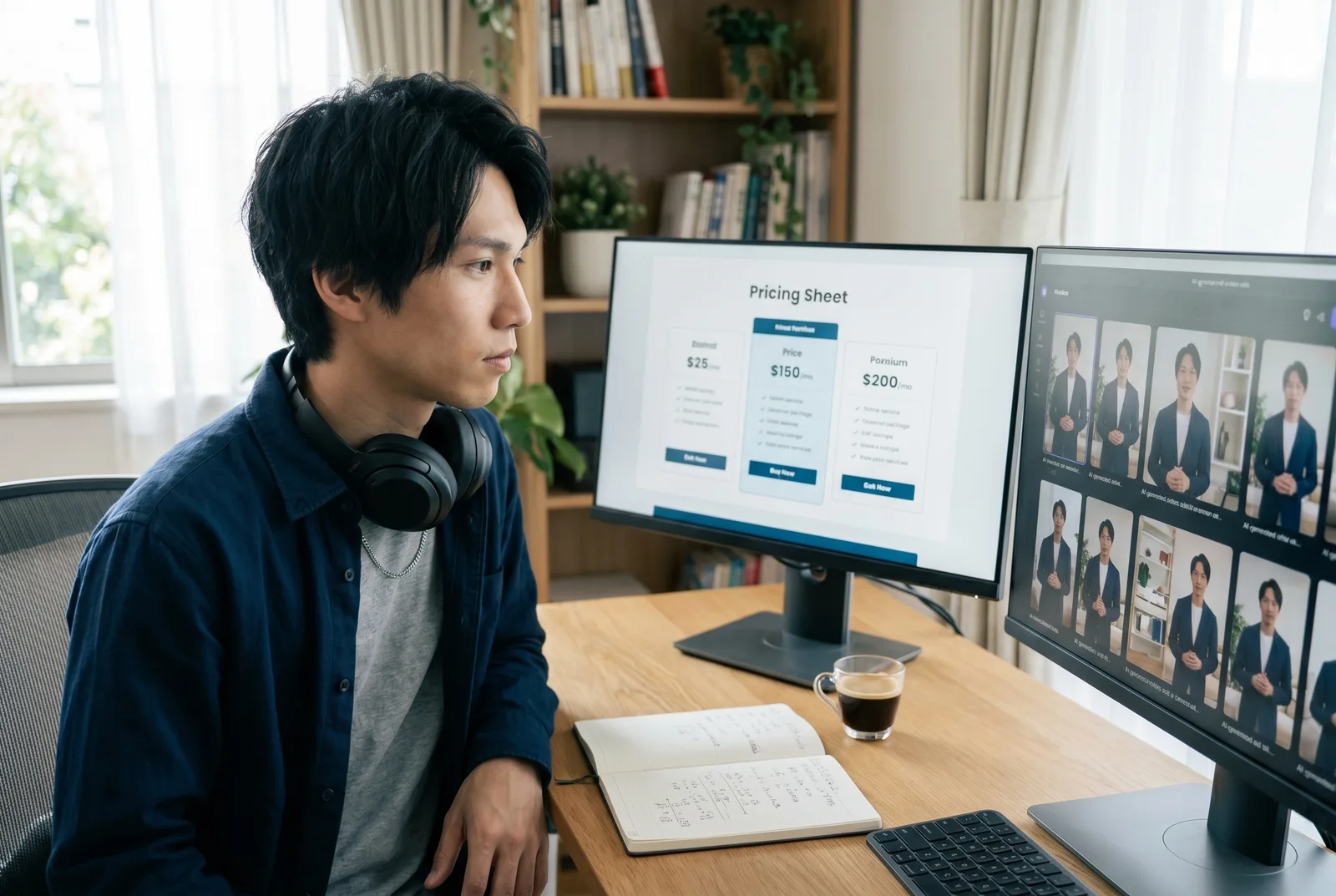
Starting an AI marketing agency in 2026 takes less than $500 in formation costs, a first-month operating budget of $300–$2,000, and a first client in 2–4 weeks. The business works because AI generation collapses a $3,000–$4,000/mo human production line into credits costing pennies per asset — but only if you price it right.
Here is the honest hook: clients do not care that you use AI. They care that you ship faster and cheaper with human review on top. This guide is the only one in its category that gives you real startup-cost math, a copy-paste service menu with prices, the markup-versus-margin formula, and a 90-day launch plan — every number traced to a cited source.
We have run thousands of multi-model generations (Veo, Imagen, Gemini, Grok) for creators and agencies on Playcut, so the workflow numbers below come from the production side, not a course funnel.
Table of Contents
- What an AI Marketing Agency Actually Is
- Step 1: Pick a Niche AI Actually Wins
- Step 2: Build Your Service Menu
- Step 3: The Margin Math
- Step 4: Your AI Tech Stack
- Step 5: Set Up the Business
- Step 6: Get Your First 5 Clients
- Step 7: Deliver Without a Bloated Team
- Common Mistakes That Kill New AI Agencies
- A Realistic 90-Day Launch Plan
- Frequently Asked Questions
What an AI Marketing Agency Actually Is
An AI marketing agency is a creative-and-performance shop that sells marketing output produced primarily with AI tools — video, images, UGC ads, copy, and reporting — at services-class prices with software-class cost structure. The deliverable has flipped from “we manage your ads” to “we ship 30–200 on-brand creative variations a month, tested and reportable.”
The global AI market is projected near $826.7B by 2030 per Digital Agency Network, but that headline number is not why this business works. The operating math is.
The 2026 Shift: One Operator Ships a Crew’s Output
One person now ships what used to need a three-to-five-person crew. The clearest verified proof is enterprise, not anecdote: in the Synthesia × Zoom case study, Zoom’s instructional designers produce training videos 90% faster and save $1,000–$1,500 per employee per month on production they previously outsourced.
On the agency side, one shop reported in the Cliprise case study that a three-person team serving 12 clients cut monthly production cost from $14,000 to $3,100 — a 78% reduction — while lifting margin from 52% to 71%. Treat that as a single self-reported case, not a guarantee; the disclaimer matters because audited P&Ls for pure-play AI agencies are not public.
What You Should Never Promise
Do not promise “fully automated,” “instant rankings,” or “unlimited output without review.” Those claims set expectations AI cannot meet and invite churn the moment a client looks closely. The winning pitch is human-reviewed AI at speed: AI does the heavy lifting, you do creative direction, QA, and strategy. That framing also keeps you compliant when you disclose AI-generated creative on Meta and TikTok.
Step 1: Pick a Niche AI Actually Wins
Pick a niche where the gap between AI compute cost and human production cost is largest — that gap is your margin. The three classic ways to niche are by industry (skincare, supplements, SaaS), by service (UGC ads only, product video only), or by problem (creative-fatigue rescue, listing-video at scale).
The Recommended Wedge: AI Video and UGC Creative
AI video and UGC creative is the strongest 2026 wedge because the cost gap is enormous. A human UGC creator charges a median of about $175 per video, ranging $75–$3,000+, while an 8-second AI clip costs a few dollars in compute (see the margin math below).
This is where a multi-model studio matters. Instead of stacking a video tool, an image tool, and a UGC tool, Playcut routes text-to-video, image-to-video, product stills, and AI-actor shoots through one chat surface — so your COGS is one subscription, not three. For the deeper UGC-ad playbook, see our guide to AI UGC ads that actually convert.
If you want the agency-services catalog and delivery operations in detail, our AI video agency services breakdown covers the production side this post deliberately keeps high-level.
Step 2: Build Your Service Menu
Your service menu should pair per-deliverable pricing for one-off buyers with retainer packages for recurring revenue. Both are anchored to verified 2026 market rates so you are neither leaving money on the table nor pricing yourself out of the SERP.
Per-Deliverable Pricing
Per-deliverable UGC pricing in 2026 lands in three bands, per the Influence Flow 2026 UGC rate card:
- Entry: $150–$400 per video
- Mid: $400–$1,000 per video
- Premium: $1,000–$3,500+ per video
- Usage rights: add +15% to +200% on top, depending on platform, exclusivity, and term
Retainer Packages
Retainers are where AI agencies build durable revenue. Market bands, per Influence Flow and the Admiral Media public rate card:
- Entry retainer: $2,000–$4,000/mo (1–2 channels, 10–30 creatives)
- Mid retainer: $4,000–$8,000/mo (2–4 channels, 30–80 creatives)
- Ceiling: Admiral publishes €4,000 / €9,600 / €21,500 monthly tiers (20 / 40 / 80 videos), claiming −66% CPA, +186% ROAS, and 3–5 day turnaround versus 2–4 weeks for traditional UGC
Copy-Paste 3-Tier Starter Menu
| Tier | Monthly price | What’s included | Best for |
|---|---|---|---|
| Launch | $2,000/mo | 12 AI UGC videos, 1 brand, 1 platform, weekly creative report | First DTC client, $50k–$500k/mo revenue |
| Growth | $4,500/mo | 30 videos, 2 platforms, 1 AI-actor cast, A/B hook testing | Scaling DTC, $500k–$5M/mo revenue |
| Scale | $8,000/mo | 60 videos, multi-brand, dedicated actor library, performance reporting | Multi-brand parents, holdcos |
For the full pricing framework — project-based, per-minute, and value-based models — link out to our dedicated guide on how much to charge for AI video rather than reinventing it here.
Step 3: The Margin Math
The single mistake that quietly kills new AI agencies is confusing markup with margin. Get the formula right and a $29/mo tool subscription supports thousands in monthly revenue.
Markup ≠ Margin
If your loaded cost is $1,000 and you sell at $1,500, that is a 50% markup but only a 33.3% margin. To hit a true 50% margin you must sell at $2,000. The formula, per ALM Corp’s reseller pricing breakdown, is:
Retail = Loaded cost ÷ (1 − target margin)
So $1,000 loaded cost at a 50% target margin = $1,000 ÷ 0.5 = $2,000 retail. Memorize this; it is the whole pricing discipline.
Real Cost-Per-Video Walkthrough
Here is the arbitrage in one line. On Playcut Pro at $29/mo you get 2,000 credits and 10 reusable AI actors. An 8-second Veo 3 Fast clip with audio costs about $3.20 in compute — verified against fal.ai’s Veo 3 pricing of $0.40/sec for audio-on Fast generation.
A comparable Fiverr Basic AI video gig runs ~$75, and client per-video prices land $200–$400. That is roughly a 23× markup on raw compute before your labor. Even after human review, the gross margin sits comfortably in the 50–75% band that Trillet’s white-label AI margin analysis reports for AI-leveraged shops.
Hidden Margin Erosion
Two costs quietly eat the spread. Payment processing takes roughly 3% on every charge, and overhead (tools, VA labor, software stack) adds 5–10% on top, per Feedbird’s white-label cost breakdown. Price with those baked in — a clean 50% on paper becomes 37–42% in the bank if you ignore them.
If reselling another platform’s output under your own brand interests you, that is a distinct model with its own credit-resale spread — we cover it in white-label AI video rather than here.
Step 4: Your AI Tech Stack
A starter AI marketing agency stack runs from about $99/mo and has two layers: the creative/generation layer and everything else. Keep it lean — every tool you add is overhead that erodes margin.
The Creative / Generation Layer
This is the one layer worth consolidating. A multi-model studio like Playcut covers text-to-video, image generation, image-to-video, and AI-actor shoots in one subscription, so you are not paying for three single-purpose generators that each lock assets in a separate workspace.
The agency-specific feature that matters is brand kits per client — colors, typography, logo, and voice stored per brand — plus workspaces that separate each client’s actors and folders. That is the difference between running 10 brands cleanly and maintaining a heroic spreadsheet of “which actor belongs to which client.”
See pricing for the credit math: Hobby $9/mo (500 cr, 3 actors), Pro $29/mo (2,000 cr, 10 actors), Studio $79/mo (6,000 cr, 4 seats), Agency $149/seat/mo (10,000 cr/seat, unlimited seats). Annual billing is 17% off. For consistent on-screen talent across every variant, our AI actor guide walks the casting workflow.
The Rest of the Stack
- AI writer — scripts, hooks, ad copy ($20–$50/mo)
- Project management — Notion or ClickUp for briefs, SOPs, client wikis ($10–$18/seat)
- Reporting — a creative/performance dashboard for weekly client reports
- CRM / outreach — lightweight CRM for lead tracking
- Stripe — billing and recurring retainer charges (~3% per transaction)
Be honest about scope: Playcut is the creative layer, not a CRM or an automation suite. Name the other layers separately so a prospect never feels misled.
Step 5: Set Up the Business
You can be legally operational for about $500 one-time plus $100/year. Do not over-engineer formation before you have a client.
Formation
Stripe Atlas forms a US LLC or C-corp for $500 one-time and $100/year (registered agent), includes an EIN and legal templates from Cooley LLP, and gets you bankable within two business days. Across three years with a CPA, total legal/accounting overhead typically runs $3,100–$4,600. That is the entire legal barrier — the skill barrier is far higher than the capital one.
First-Month Budget
| Line item | Lean (~$300) | Professional (~$2,000) |
|---|---|---|
| Creative studio | Playcut Hobby $9 | Playcut Pro $29 |
| AI writer + PM + reporting | $90 | $250 |
| Paid lead-gen (FB Ads / Thumbtack) | $50–$100 | $500–$1,000 |
| LinkedIn Premium | — | $30–$60 |
| Content / portfolio production | $100 | $500–$1,500 |
Budget ranges are anchored to Bizzby’s UGC-client acquisition guide and Digital Agency Network’s AI agency pricing data. Start lean, reinvest from the first retainer.
Step 6: Get Your First 5 Clients
Operators report landing a first client in 2–4 weeks and reaching profitability around 5–10 clients, with social as the #1 lead source, per Bizzby. The sequence below assumes zero existing portfolio.
Build Proof Without Clients
- Spec / teardown reels — record a 60–90 second teardown of a prospect’s current ads, then rebuild one with AI to show the upgrade.
- Sample ad set — generate 3–5 finished UGC variants for an imaginary or real brand in your niche.
- Mock brand kit — set up a single client brand kit and actor in your studio to demonstrate the multi-brand workflow.
Proof of output replaces a résumé. A prospect who watches you turn their ad into something better in 90 seconds is already half-sold.
Lead Sources, Ranked
- Social (#1) — short “watch me ship 30 ads” clips on TikTok, Instagram, and X
- LinkedIn — direct outreach plus a teardown video in the first message
- Facebook groups — DTC and ecommerce founder communities
- Thumbtack — pay $20–$100 per lead for local service businesses
- Google Business Profile — free local discovery
- Referrals — the cheapest channel once you have 2–3 happy clients
Offer a Low-Risk Paid Pilot
De-risk the first yes with a paid pilot: a $500–$1,000 one-week sprint that delivers 5–10 finished creatives. It is small enough to approve without a committee and proves your delivery before a retainer conversation. Pilots convert faster than free work because paying clients take the output seriously.
Step 7: Deliver Without a Bloated Team
The repeatable production line is brand kit → actor library → batch → QA → deliver, and it is the reason one operator can serve a dozen clients. AI handles generation; you handle the judgment.
Where AI Helps vs Where Humans Stay
AI wins on volume: drafting scripts, generating variants, resizing for platforms, and producing consistent on-screen actors. Humans stay on hook strategy, brand voice, creative direction, and final QA. The agencies that scale cleanly automate the first list and never the second.
The Repeatable Production Line
Set up one brand kit per client so colors, typography, logo, and voice load automatically. Build a per-client actor library so the same face appears across every variant — character consistency is what makes a winning hook compound instead of resetting each time the talent changes. Then batch-generate, QA against the brand kit, and deliver. Playcut workspaces keep each client’s actors and folders isolated, which is the operational unlock for running 10 brands without cross-contamination.
Common Mistakes That Kill New AI Agencies
- No niche — “we do AI marketing for everyone” converts no one. Pick a vertical or a service and own it.
- Selling “we use AI” instead of outcomes — clients buy lower CPA and faster turnaround, not your tool list.
- Underpricing via the markup trap — a 50% markup is a 33% margin; price off
cost ÷ (1 − margin). - Promising automation without review — “fully automated” claims invite churn and platform-disclosure trouble.
- No SOPs — without documented workflows you cannot delegate, so you stay the bottleneck.
- Skipping the usage-rights upsell — usage rights add +15% to +200% and most beginners forget to charge for them.
A Realistic 90-Day Launch Plan
This is a HowTo you can run week by week. The goal: 3–5 paying clients and a repeatable production line by day 90.
Step 1: Weeks 1–2 — Niche, Offer, Formation, Stack
Pick your niche, write your 3-tier service menu, form the LLC via Stripe Atlas, and set up your lean stack (creative studio, AI writer, PM tool, Stripe). Cost so far: roughly $500 one-time plus your first month of tooling.
Step 2: Weeks 3–4 — Portfolio and Outreach
Build 3–5 spec creatives and a teardown reel, set up one mock brand kit, then start daily outreach on social, LinkedIn, and one Facebook group. Send teardown videos, not cold pitches.
Step 3: Weeks 5–8 — Paid Pilots
Convert interest into $500–$1,000 paid pilots. Deliver fast, document the result, and ask for a testimonial and a referral. Aim for 2–3 pilots in this window.
Step 4: Weeks 9–12 — Convert to Retainers
Turn pilots into $2,000–$4,000/mo retainers, formalize SOPs from your delivery notes, and hit 3–5 active clients. At this point you are at or near profitability per the 5–10 client benchmark.
How Playcut Helps Start an AI Marketing Agency
Playcut is the creative engine an AI marketing agency runs on. One subscription routes video (Veo), images (Imagen), and chat-driven generation (Gemini, Grok) so your cost of goods is a single line item, not three. The AI actor library gives every client a consistent on-screen cast, and multi-brand brand kits plus workspaces keep 10 clients cleanly separated on one account.
Ready to build your service-menu COGS? Start free on Playcut — Hobby is $9/mo, Pro is $29/mo, and you can size your first retainer’s margin in an afternoon.
Frequently Asked Questions
How much does it cost to start an AI marketing agency?
About $500 in one-time formation plus a $300–$2,000 first-month operating budget. Stripe Atlas is $500 one-time and $100/year, and a creative studio starts at $9/mo. The barrier is positioning and skill, not capital — most operators land a first client before spending more than a few hundred dollars.
How profitable is an AI marketing agency?
Lean AI agencies run 50–75% gross and roughly 25–35% net margin, because AI generation replaces a $3,000–$4,000/mo human production line with pennies-per-asset compute. An 8-second Veo 3 Fast clip costs ~$3.20 versus ~$75 for a Fiverr Basic equivalent. Margin erodes if you confuse markup with margin or skip the usage-rights upsell.
What services should an AI marketing agency offer?
The highest-margin 2026 wedge is AI video and UGC creative, priced $150–$400 per deliverable or $2,000–$8,000/mo on retainer. UGC ads, product videos, and AI-actor testimonials have the biggest gap between AI compute and human production cost, so they convert fastest and protect margin best.
How do I get my first clients with no experience or portfolio?
Build spec work — teardown reels plus a sample AI ad set — then pitch a low-risk paid pilot on social and LinkedIn. Social is the #1 lead source, backed by LinkedIn, Facebook groups, Thumbtack, and Google Business Profile. Operators report a first client in 2–4 weeks.
What tools do I need to start an AI marketing agency?
One multi-model creative studio, an AI writer, a PM tool, a reporting tool, and Stripe. A multi-model studio like Playcut replaces stacking three single-purpose generators by routing video, image, and UGC through one subscription with per-client brand kits. A lean stack runs from ~$99/mo.
How much should I charge clients for AI marketing?
Price off loaded cost ÷ (1 − target margin), never markup. Entry retainers run $2,000–$4,000/mo, mid-tier $4,000–$8,000/mo, and per-video work $150–$400, with usage rights adding +15% to +200%. See our how much to charge for AI video guide for the full methodology.
Conclusion
To start an AI marketing agency in 2026, form the business for ~$500, run a lean $300–$2,000 first-month budget, pick the AI-video/UGC niche where the cost gap is widest, and price every deliverable off cost ÷ (1 − margin) rather than markup. The margin is real because AI compute costs pennies where human production costs hundreds — your job is to add human review, brand consistency, and outcomes on top.
The fastest path is proof: ship spec work, pitch a paid pilot, and convert to retainers inside 90 days.
Next steps: size your COGS on the Playcut pricing page, then study the full AI video agency services and how much to charge for AI video guides to lock in your service menu.
Related guides: start an AI UGC agency covers the creator-ad niche specifically, and the Fiverr AI video gig playbook is the solo on-ramp before you incorporate. Part of our make money with AI video series.