
White-Label AI Video: Reseller Margins 2026
White-label AI video is reselling AI-generated video under your own brand — your clients see only your name, never the underlying model (Veo, HeyGen, Synthesia) or platform. You pay a platform a wholesale rate and charge a retail markup; the spread between the two is your margin.
This guide is the operator’s playbook the ranking how-to posts skip. It covers the reseller-vs-per-seat decision, the markup-vs-margin math that wrecks agency pricing, the contract and usage-rights terms nobody mentions, and the delivery pipeline that gets a branded file from your account into a client’s hands.
It is built on the same multi-model studio our AI UGC ads guide uses for ad creative — this post goes deep on one specific business model: reselling under your own brand.
Table of Contents
- What “white-label AI video” actually means
- The two pricing models: reseller license vs. per-seat
- Reseller margin math (the part every guide gets wrong)
- Pricing your white-label AI video service
- Contracts, rights, and SLAs
- The delivery pipeline: account to branded output to client
- How to start: stack, formation, and first clients
- Where Playcut fits
- Frequently asked questions
- The bottom line
What “white-label AI video” actually means
White-label AI video means the client sees your brand on the deliverable and the relationship, while the AI generation happens on a platform they never log into. The honest version of the category is narrower than the marketing implies — most tools are not true logo-stripped reseller products.
There are three things people conflate, and they price very differently.
White-label vs. reseller vs. “agency plan”
These three terms describe distinct arrangements, and mixing them up is the first pricing mistake operators make.
- White-label — the output carries your brand. The video file, the cover frame, the export folder, the client-facing report all say your name. The tool underneath does not have to be rebranded for this to be true.
- Reseller — you buy capacity wholesale (a retainer plus credits) and sell it retail under your own pricing. This is a business arrangement governed by the platform’s terms, not a UI feature.
- Agency plan — a seat tier with multi-brand and multi-client features (shared workspaces, brand kits, role permissions). It enables white-label delivery but is usually still per-seat billing, not a reseller license.
Most operators want white-label delivery and assume they need a full reseller license to get it. They usually don’t.
The honest version: most tools are not reseller platforms
Most AI video tools do not let you rebrand the dashboard as your own SaaS product — and that is fine, because clients almost never see the dashboard. What clients see is the finished video, the brand kit applied to it, and the folder you hand over.
That distinction matters for your costs. A true reseller program (a wholesale credit rate plus a removable logo) is rare and usually sales-gated to enterprise contracts. A practical white-label workflow — per-client brand kits, private per-client folders, and watermark-free exports — is available on standard self-serve plans and delivers the same client experience at a fraction of the friction.
We build this distinction into how we describe Playcut later: it is not a rebrandable reseller SaaS, but it runs agency white-label delivery cleanly. Be honest with clients about what you operate; it never comes up if the deliverable is clean.
The two pricing models: reseller license vs. per-seat
Choose between two cost structures: a reseller license (a fixed platform retainer plus wholesale credits you mark up) or a per-seat plan (a flat fee per user). The reseller model has higher margin potential but needs active sales; the per-seat model is predictable and better for internal teams than for reselling.
Reseller license
A reseller license pairs a monthly platform retainer with wholesale credits you resell at a spread. A common structure cited in agency guides is a fixed monthly retainer plus per-credit wholesale pricing — for example, paying a platform retainer and buying credits at a low unit cost, then reselling each credit’s output at several times that cost.
The economics work because the retainer is fixed. One client barely covers it; ten clients amortize it down to near-zero per client, and the marginal cost of each new client is mostly just credits. That is the entire reason the reseller model scales in margin — more on the math below.
Per-seat
A per-seat plan charges a flat monthly fee per user with no wholesale resale spread built in. It is predictable: you know your cost to the dollar each month, and there is no usage metering to forecast.
The trade-off is resale margin. If you pay a flat per-seat fee and bill clients per video, your margin is whatever your output volume divided by the seat cost produces — fine for an internal team, weaker for a reseller because the platform captured the per-unit upside. Per-seat shines when you are the heavy user across many clients, not when you are reselling raw capacity.
Which one fits your agency stage
Match the model to your stage and client count.
- Solo / under 5 clients — a per-seat plan is simpler and cheaper; you are the user, and a reseller retainer would sit half-empty.
- 5–15 clients — the reseller license starts winning as the retainer amortizes; this is the inflection point.
- 15+ clients / white-label SaaS ambitions — a reseller or agency tier with multi-brand workspaces is mandatory; per-seat duplication gets expensive fast.
For a tier-by-tier breakdown of how flat per-seat pricing scales across an agency, see the Playcut pricing guide.
Reseller margin math (the part every guide gets wrong)
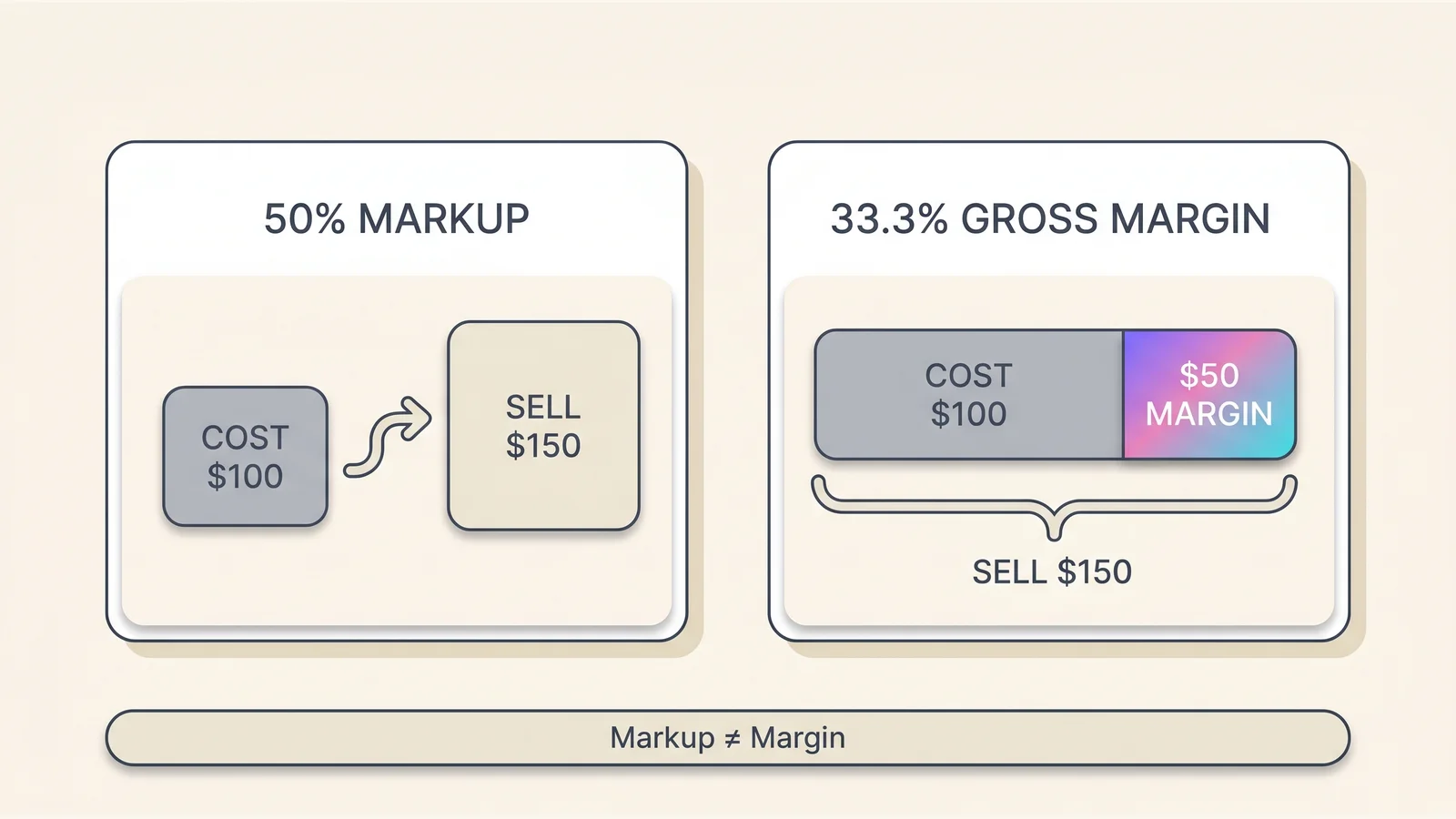
Markup is not margin, and confusing the two is why white-label agencies underprice. A 50% markup is only a 33.3% gross margin; to actually keep half of every dollar you need a 100% markup. Get this formula right before you quote a single client.
Markup is not margin: the $1,000 to $1,500 trap
Here is the trap, stated plainly. If your cost is $1,000 and you sell at $1,500, your markup is 50% — but your gross margin is $500 divided by $1,500, which is 33.3%, per ALM Corp’s white-label reseller pricing breakdown.
To earn a true 50% margin on $1,000 of cost, you must sell at $2,000 — a 100% markup. Operators who price at “cost plus 50%” believing they keep half are quietly running a one-third-margin business and wondering why cash is tight.
The pricing formula
Price backward from the margin you want, not forward from cost. The formula both ALM Corp and Feedbird endorse is:
Retail price = Loaded cost ÷ (1 − target gross margin)
So a loaded cost of $700 at a 40% target margin prices at $1,167; at a 50% target it prices at $1,400. “Loaded cost” is the key phrase — it is not just the platform invoice. Include credits, your time, payment fees, and a revision buffer before you divide.
How margin scales as the platform fee amortizes
Reseller margin improves dramatically with client count because the fixed platform fee spreads across more accounts. Trillet’s white-label AI margin analysis publishes a clean scaling table for a usage-based reseller model.
| Clients | Per-client platform cost | Gross margin |
|---|---|---|
| 5 | Higher (fee split 5 ways) | ~76% |
| 10 | Lower (fee split 10 ways) | ~82% |
| 20 | Lowest (fee split 20 ways) | ~85% |
In Trillet’s example, a $299/month fixed platform fee falls from roughly $60 per client at 5 clients to about $15 per client at 20 clients. The lesson: your margin at client #2 is not your margin at client #20. Model the steady state, not the launch.
Hidden margin erosion
Nominal margin is always rosier than realized margin. Per Feedbird’s white-label cost analysis, a 30% gross margin is the practical floor for hands-on work and 50%+ is the standard for an agency that wants to reinvest.
The leaks are predictable. Payment processing (Stripe, PayPal, wire) takes roughly 3% of gross, and revision and overhead buffers add another 5–10% on top of the wholesale rate. Every client also absorbs two to four hours of management time a month that never shows up on the platform invoice. Price the loaded cost, not the invoice cost.
The AI-generation arbitrage
The reason white-label AI video margins can clear 70%+ is the gap between generation COGS and what the market pays for finished video. Raw model time is cheap. According to fal.ai’s Veo 3 model pricing, standard Veo 3 runs about $0.50 per second with audio off and $0.75 per second with audio on, while Veo 3 Fast runs $0.25/$0.40.
That puts an eight-second audio-on clip near $3.20 in raw model cost on Veo 3 Fast (about $6.00 on standard Veo 3). The market for a finished short-form UGC-style video, by contrast, averaged about $198 per deliverable in 2025/26 per DesignRevision’s pricing data. The arbitrage is real — but it is the arbitrage on finished, on-brand, rights-cleared video, not raw clips. Your margin is the production wrapper, not the model call.
Pricing your white-label AI video service
Price in productized packages, not per-hour, and stack usage-rights upcharges on top. Productization makes your margin predictable and your offer easy to buy; usage rights are where the extra margin hides.
Productized packages
Sell tiers, not custom quotes. A common entry mechanic is a productized starter — for example, a “Social Video Starter” at a flat monthly rate for a fixed number of short-form videos — then a mid-tier retainer and a premium tier above it.
- Starter — flat monthly fee, fixed deliverable count, single brand. Easy yes for an SMB.
- Mid-tier retainer — more deliverables, variations included, faster turnaround. This is the modal AI-UGC band, which DesignRevision puts at $4,000–$8,000/mo for 6–12 videos.
- Premium — multi-brand, AI actors, brand-kit governance, priority SLA. Sold to multi-brand parents and larger DTC accounts.
Per-video vs. monthly retainer vs. usage-based
Each billing shape suits a different buyer.
- Per-video — best for one-off and trial buyers; bundle it so the per-unit price drops with volume (a 4-video bundle priced below 4x the à la carte rate pulls buyers up a tier).
- Monthly retainer — best for predictable cash flow and lower churn; creative-only retainers tend to churn less than media-buying ones because you are not blamed for ad-account performance.
- Usage-based — best when output volume is genuinely variable; mirrors the reseller-credit model and keeps your margin constant per unit.
Usage-rights and exclusivity upcharges
Usage rights are the most under-charged line in white-label video. Per DesignRevision’s UGC pricing data, rights tiers stack meaningfully on top of the base rate.
| Rights tier | Upcharge on base |
|---|---|
| 6-month paid-ad rights | +50–100% |
| 12-month exclusive paid-ad rights | +75–150%+ |
| Perpetual / unlimited rights | +100–150% |
If you hand over full rights and only charge the base rate, you left the most defensible margin in the deal on the table. Spell the rights tier out in the contract — which is exactly where most guides stop.
Contracts, rights, and SLAs
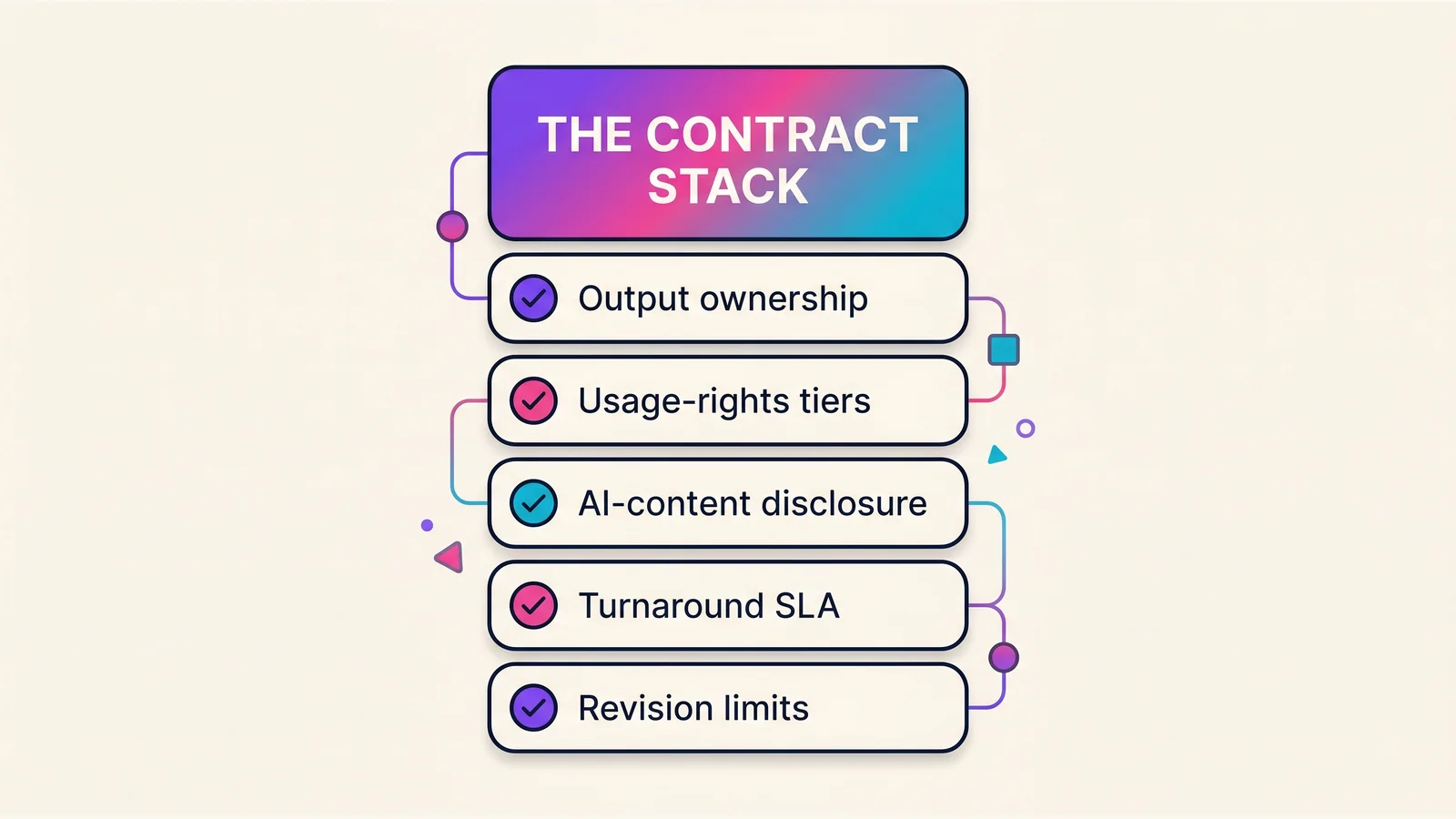
Every white-label AI video contract must answer three questions the ranking guides ignore: who owns the output, what rights the client gets, and what you guarantee on turnaround. Skipping these is how a profitable account turns into an unpaid revision spiral or a likeness lawsuit.
Who owns the output, and the AI-content rights gap
State output ownership explicitly, because AI-generated work sits in a murkier rights position than filmed footage. Confirm in your platform’s terms of service that you hold commercial rights to what you generate, then assign or license those rights to the client in writing.
The cleanest path is fully synthetic actors. A character built from a text prompt — not a real person’s selfie or likeness — sidesteps the right-of-publicity exposure that cloning a real individual carries. Cloning a real public figure without documented consent is a violation independent of the AI tooling, so make “synthetic-only unless we hold a signed release” a contract default.
Usage-rights tiers and exclusivity windows
Encode the rights tier you sold directly into the agreement. If the client bought 6-month paid-ad rights, the contract should say the license expires at six months and renewal is a new fee — otherwise “the videos are theirs forever” becomes the default assumption and your upsell evaporates.
Name the channels, too. Organic-social rights, paid-ad rights, and whitelisting (running ads from the client’s own handle) are separate grants with separate prices. A vague “for marketing” clause gives away all three.
Turnaround SLAs, revision limits, and disclosure
Cap revisions and define turnaround in writing. Unlimited revisions are the fastest way to convert a 50% margin into a 10% one. A typical structure is “two revision rounds included, additional rounds billed hourly,” with a stated turnaround such as 3–5 business days per batch.
Build AI-content disclosure into the deliverable workflow as a standard step, not an afterthought. Where ad platforms offer an AI-content label, the contract should obligate the client to enable it, and your handoff checklist should flag it. Synthetic endorsements still fall under endorsement-disclosure expectations, so disclosure protects both parties. For the UGC-ad-specific version of this compliance workflow, see our AI UGC ads guide.
The delivery pipeline: account to branded output to client
The white-label delivery pipeline is three stages: apply a per-client brand kit, render inside a private per-client workspace, and export watermark-free files into a branded handoff folder. This is the practical white-label layer — no rebranded SaaS required, just clean brand isolation and clean files.
Brand kits per client
Maintain one brand kit per client as the foundation of white-label delivery. A brand kit holds the client’s colors, typography, logo, and voice — so every generation inherits the right look without re-pasting guidelines into each prompt. The full multi-brand ad-creative workflow shows how to wire this governance across N client accounts.
This is also the operational pain that breaks most stacks. Running ten clients on a tool with no brand-kit primitive means re-entering guidelines every project or maintaining a fragile spreadsheet of which asset belongs to which brand. A first-class multi-brand brand-kit feature collapses that into one seat. For the actor side of this, our AI actor guide covers building reusable, brand-locked characters.
Workspaces: shared vs. private folders
Isolate every client in a private workspace or folder so one client’s assets never leak into another’s. Shared (team) folders hold internal templates and your agency’s reusable components; private (per-client) folders hold everything client-specific.
This isolation is what makes the work genuinely white-label and audit-clean. When a client asks for “everything you have on our account,” you hand over one folder — not a search through a shared dumping ground. Role-based access keeps freelancers scoped to only the brands they work on.
Watermark-free export, file specs, and handoff
Export clean, watermark-free files at the platform’s required specs, then hand them over in a branded folder. A watermark on a paid deliverable instantly breaks the white-label illusion, so confirm your plan ships clean output before you sell.
Standardize the handoff: deliver 9:16, 1:1, and 16:9 cuts where relevant, name files to the client’s convention, and include the rights summary in the folder. The client never needs to know which model rendered the clip — only that the file is theirs, on-brand, and ready to run.
How to start: stack, formation, and first clients
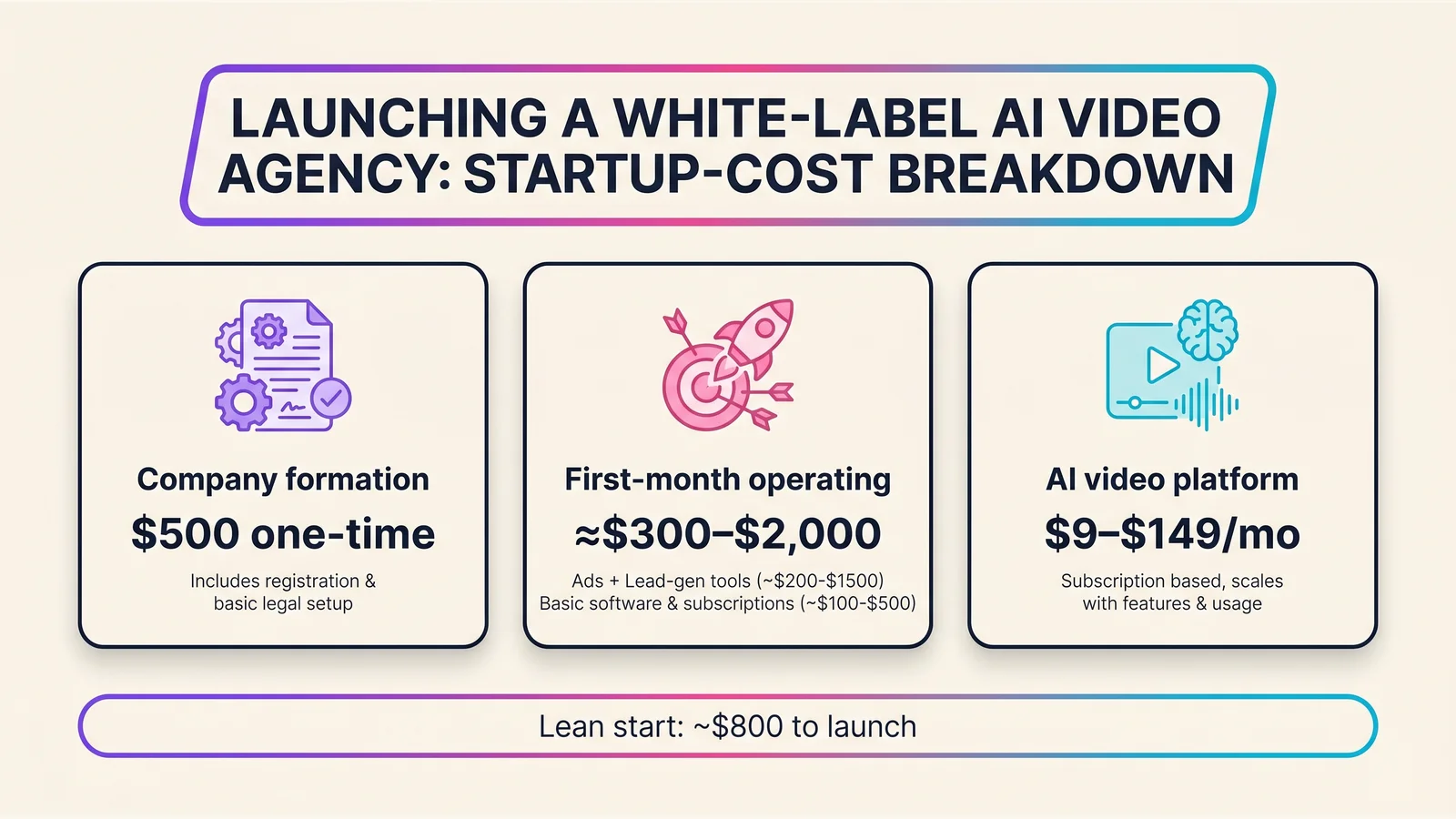
Start a white-label AI video business with a lean tool stack, a one-time company formation, and a 2–4 week push to your first client. Most operators reach profitability somewhere between 5 and 10 clients once the fixed costs amortize.
Tool stack and startup cost
Budget roughly $300 lean to $2,000 professional for the first operating month, plus a one-time formation cost. The formation piece is straightforward: Stripe Atlas charges $500 once for Delaware incorporation, an EIN, year-one registered agent, an 83(b) filing, and $2,500 in Stripe credits, with a $100/year renewal afterward.
The rest of the first-month budget is acquisition and tooling: paid ads ($50–$1,000 depending on appetite), lead-gen tools, and your AI video platform. On the platform line, Playcut runs from $9/mo (Hobby) to $29/mo (Pro) to $79/mo (Studio, 4 seats) to $149/seat/mo (Agency), all flat — see the full ladder on the pricing page. Annual billing saves 17%.
Time to first client and the path to profitability
Expect 2–4 weeks to your first client and profitability around 5–10 clients. The fastest top-of-funnel for AI-native operators is short organic video — IG and TikTok demos of “watch me make 30 ads in 30 minutes” — converted via a 60–90 second personalized teardown of the prospect’s current creative.
The path to profitability is the margin-scaling table in reverse: each new client past the first spreads your fixed platform retainer thinner, so the fifth client is far more profitable than the first. Land a multi-brand parent and one logo becomes several seats. For the ad-creative side of the funnel that fills those retainers, the AI UGC ads guide covers building the deliverables clients actually buy.
Where Playcut fits
Playcut fits as the generation studio behind a white-label AI video service — not as a rebrandable reseller SaaS, but as the multi-model engine that produces on-brand client deliverables. It runs Veo for video, Imagen and Gemini for images, plus Grok and select fal.ai providers, and routes each prompt to the best model for the task.
Be precise about what the white-label layer is. Playcut does not offer a logo-stripped reseller dashboard or an API reseller tier you can sell as your own product. What it offers is the practical white-label stack agencies actually use:
- Multi-brand brand kits — colors, typography, logo, and voice per client, applied automatically to every generation.
- Private + shared workspaces — isolate each client in their own folder; keep agency templates in shared folders.
- AI actor library — reusable, brand-locked synthetic characters with appearance, voice, and outfit variants, which sidestep the likeness-consent gap because they are generated from prompts.
- Watermark-free exports — clean files on every paid plan, ready to hand off under your brand.
- Flat pricing — $9 Hobby to $149/seat Agency, so your loaded cost is predictable when you build your margin model.
The studio is multi-model under the hood; the deliverable is yours on the surface. Explore the AI actor system for the reusable-character layer, or the video generator for the generation surface. If you are comparing studios head-to-head before committing a margin model, our best AI video generator breakdown scores the field on the same rubric.
Run the numbers
White-label AI video margins clear 70%+ once the fixed platform fee amortizes across 10+ clients — but only if you price on loaded cost and a true margin formula, not a markup.
Playcut’s flat $9–$149/seat pricing keeps your cost line predictable while per-client brand kits, private workspaces, and watermark-free exports handle the white-label delivery.
Start free on Playcut →
Frequently asked questions
What is a white-label AI video generator?
A white-label AI video generator is software that lets you resell AI-generated video under your own brand, so clients see only your name — never the underlying model or platform. You pay the platform a wholesale rate and charge a retail markup, and the spread is your margin.
In practice, most tools are not true logo-stripped reseller products; the realistic white-label layer is per-client brand kits, private workspaces, and watermark-free exports rather than a rebranded dashboard.
What’s the difference between a reseller license and a per-seat plan?
A reseller license is a platform retainer plus wholesale credits you mark up to retail — high margin, but it needs active sales. A per-seat plan is a flat fee per user — predictable and lower-margin, better for internal teams than for reselling. The reseller model amortizes a fixed fee across many clients so per-client cost drops with scale; the per-seat model scales cost linearly with headcount.
What margin can a white-label AI video agency actually make?
Healthy gross margins run 50–75%, with top performers above 80%, using a 2–4x markup. But realized margin is always thinner than the nominal markup: after roughly 3% payment processing plus overhead and support time, 30% gross is the floor and 50%+ is the stable target. Remember that a 50% markup is only a 33.3% gross margin — price backward from the margin you want.
How much does it cost to start a white-label AI video business?
Roughly $300 for a lean first month to about $2,000 for a professional launch, plus a one-time company formation cost. Stripe Atlas is $500 once (Delaware incorporation, EIN, registered agent year one, 83(b) filing, $2,500 in Stripe credits) with a $100/year renewal. AI video tooling starts around $9/mo and scales with your client load.
Is it legal to resell AI-generated video under my own brand?
Generally yes, if your platform’s terms permit reselling and you follow AI-content disclosure rules — but confirm output ownership and usage rights in the platform’s terms and mirror them in your client contract. Fully synthetic actors built from prompts carry far less risk than cloning a real person without consent, which remains a right-of-publicity violation regardless of tooling. Our AI UGC ads guide covers the platform-level AI-disclosure workflow in more depth.
Can I white-label Playcut for client work?
Playcut is not a logo-stripped reseller SaaS, so you cannot rebrand the dashboard as your own product. You can run agency-style white-label delivery: per-client brand kits, private workspaces, a reusable AI actor library, and watermark-free exports across a multi-model studio. The deliverable carries your brand even though the studio does not — which is what most clients mean by white-label video.
The bottom line
White-label AI video is one of the cleanest business models in the AI-creative economy because the margin is real and the COGS is low — a few dollars of model time wraps into a finished, rights-cleared deliverable worth far more.
But the model only works if you price on loaded cost with a true-margin formula, write a contract that names ownership and usage rights, and run a delivery pipeline that keeps every client isolated and every export clean.
Get those three right and the business model holds: the fixed costs amortize, the fifth client outearns the first, and a multi-brand parent turns one logo into several seats. Playcut handles the generation and the white-label delivery layer — per-client brand kits, private workspaces, and watermark-free exports across a multi-model studio at flat, predictable pricing. The AI actor guide and AI UGC ads guide cover the deliverables you will resell.
Ready to build the studio behind your white-label service? Compare tiers on the pricing page or start free on Playcut — no credit card required for the trial.
Related guides: AI video agency services maps the full service catalog, start an AI marketing agency covers the broader build, how much to charge for AI video sets the rate card, and the Fiverr AI video gig playbook is the solo on-ramp. Part of our make money with AI video series.