
How to Create an AI Influencer: 7-Step 2026 Guide

How to create an AI influencer: you build one consistent virtual persona — a fixed face, body, and voice — then run an entire content feed from it across stills, reels, and posts.
The seven steps are: pick a niche, write a character bible, lock one reusable identity, give it a voice, generate on-brand content, post on a cadence, and disclose that it’s AI. The hardest part is consistency — most tools redraw the face on every prompt, so the persona drifts from post to post.
An AI influencer (or virtual influencer) is a computer-generated character that builds an audience and promotes brands on social media without a real person on camera. The best-known brand-safe examples prove the category is real: Lu do Magalu (30M+ followers across platforms), Lil Miquela (~2.3M Instagram followers), and Aitana López each reportedly earn from brand deals — though all follower and earnings figures here are self-reported by their creators and unaudited.
This guide walks the full method with named examples and cited sources — the 7-step build, how the famous personas were made, how they make money, and the FTC and EU AI Act disclosure rules that apply from August 2, 2026. The one thing most creators get wrong is keeping the same persona on-model across a whole feed; we cover how building it on one saved AI actor solves the drift.
Table of Contents
- What is an AI influencer?
- Why creators and brands are building AI influencers in 2026
- Real AI influencers already winning brand deals
- How to create an AI influencer: the 7-step method
- What tools do you need to create an AI influencer?
- How to keep your AI influencer consistent across a whole feed
- How AI influencers make money
- The rules: disclosure, the EU AI Act, and the FTC
- Common mistakes when creating an AI influencer
- How Playcut helps you build a consistent AI influencer
- Frequently asked questions
- Conclusion: your next step
What is an AI influencer?
An AI influencer is a computer-generated character that posts to social media and promotes brands without a real person on camera. A brand or creator controls its face, voice, script, and posting cadence end to end — the persona is the asset, not a single image.
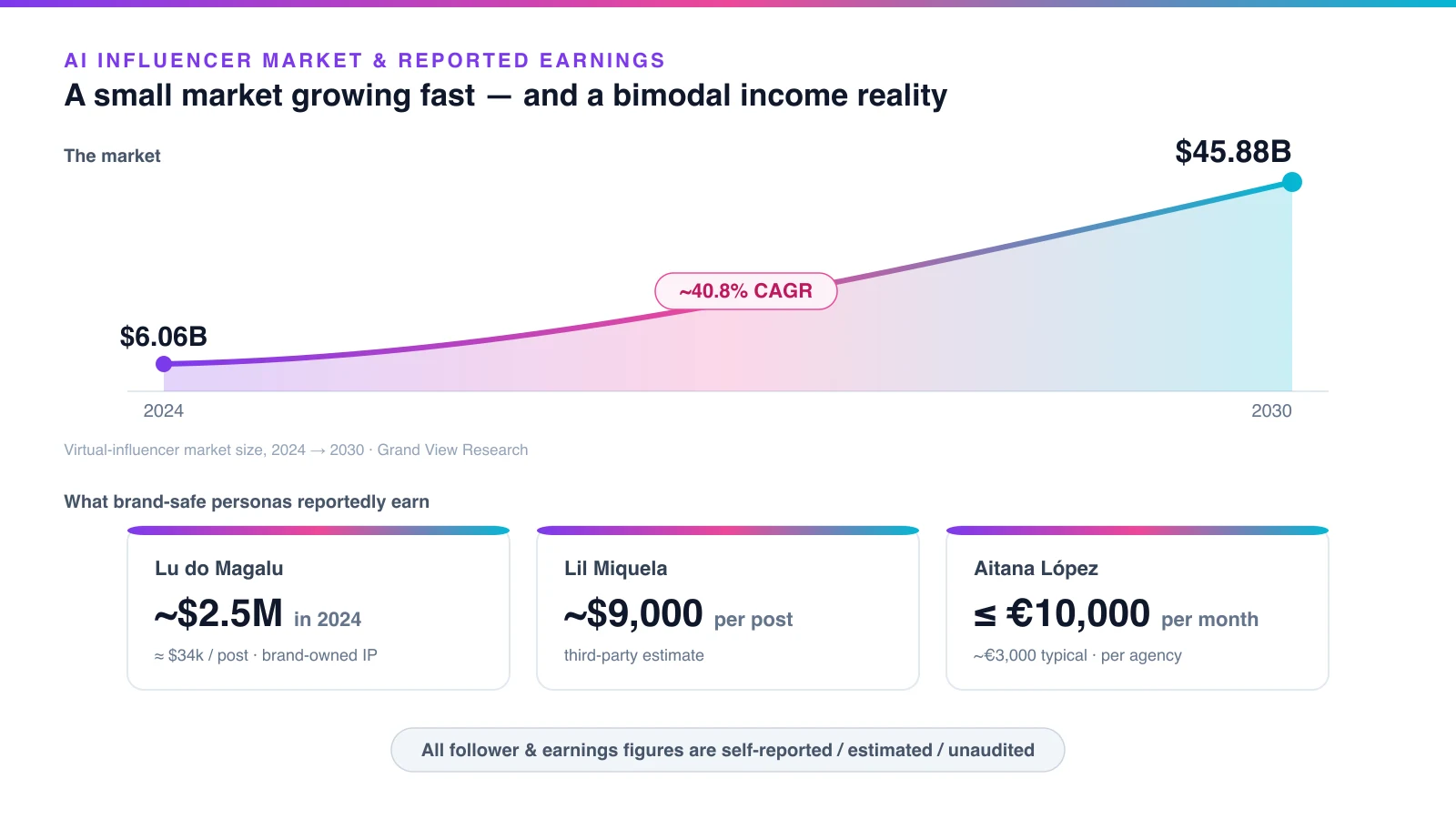
The category is real and commercial, not a novelty. The virtual-influencer market was about $6.06 billion in 2024 and is projected to reach ~$45.88 billion by 2030 at roughly a 40.8% CAGR, per Grand View Research. The proof is in the brand deals: established personas already sign with Prada, Samsung, BMW, and Dior.
What makes one “AI” rather than just “virtual” is how it’s produced. Older virtual characters were hand-built in 3D animation software over weeks; modern AI influencers are generated with image and video models in hours, then reused. The shift from bespoke CGI to reusable generative personas is exactly what put this within reach of a solo creator.
Virtual influencer vs AI influencer vs AI actor
These three terms overlap but aren’t identical, and the distinction matters when you pick a tool. A virtual influencer is the umbrella term for any computer-generated social character — including 3D/CGI ones that predate generative AI. An AI influencer specifically means one built and run with generative AI models.
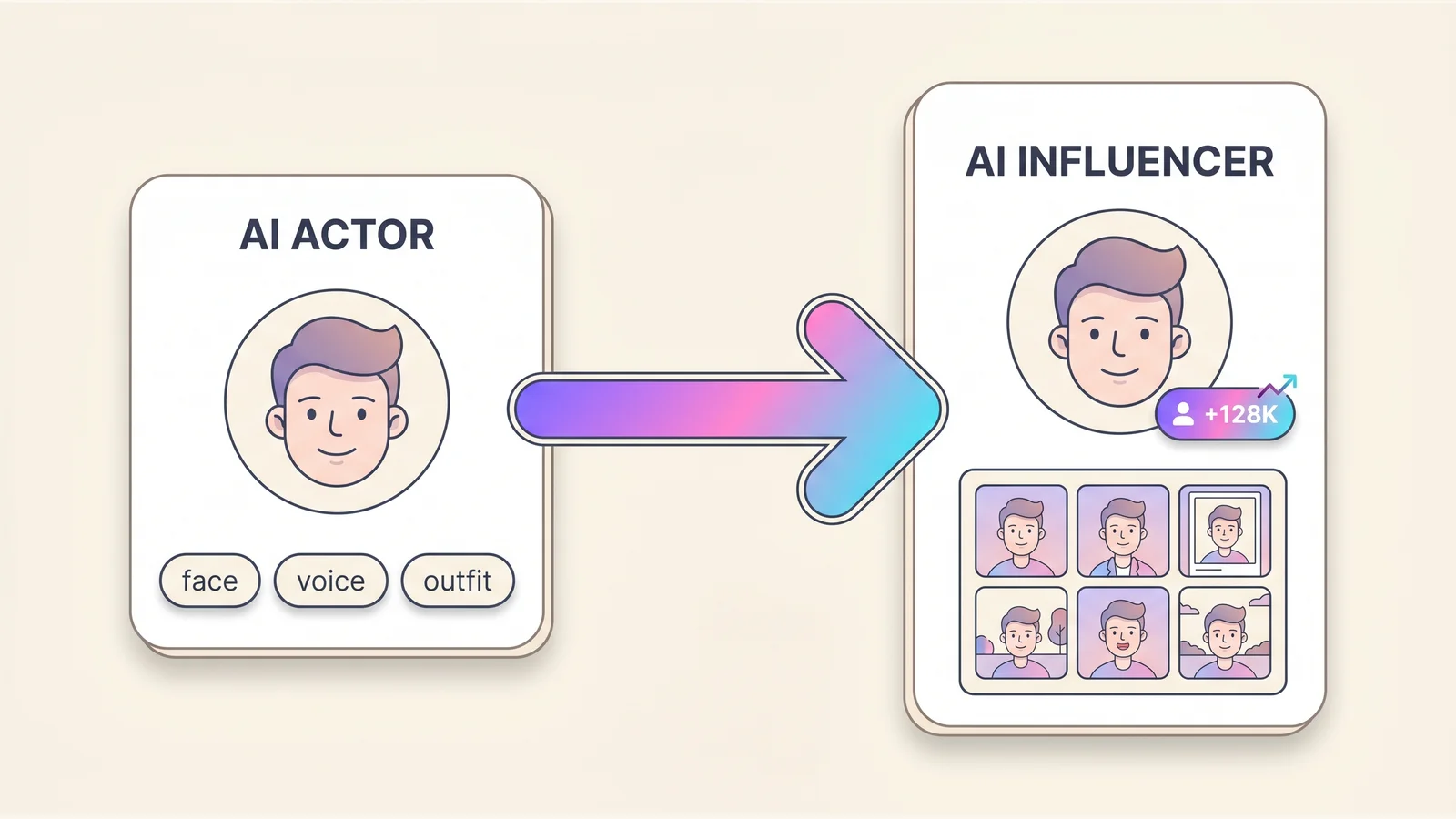
An AI actor is the layer underneath both: the saved, reusable persona — a fixed face, body, and voice — that an AI influencer is built on.
One AI actor can power an entire influencer feed, and the same saved persona also works as a branded AI avatar for talking-head video — the surface the AI avatar generator guide covers in full. Think of it as the difference between a role (the influencer) and the performer hired to play it (the AI actor).
That layering is the whole game. If your persona is one persistent AI actor — not a fresh face per prompt — it can hold the same identity across stills, reels, outfit swaps, and sponsored posts. If it isn’t, the “influencer” is really a series of look-alikes, and audiences notice.
How AI influencers actually work
An AI influencer works by reusing one identity across many generations instead of inventing a new face each time. You create a master look once, then place that same persona into new scenes, outfits, and short videos — keeping the face, body, and voice fixed while everything around them changes.
The technical catch is that image models have no memory between generations. Each image is rendered from scratch, so the “same” prompt drifts toward a slightly different face — a problem ToonyStory documents as the core reason AI characters fail to stay consistent.
Solving that drift — covered in detail below — is what separates a believable persona from a bag of look-alikes.
Why creators and brands are building AI influencers in 2026
Creators and brands build AI influencers because they combine a controllable, always-available “face” with measurably higher engagement and no on-camera talent costs. The persona never ages, never goes off-message, and can post in any language at any hour — a level of control no human creator can offer.
The control argument is the one operators repeat most. Barcelona agency The Clueless says it built its persona because human models were “unpredictable” — a blunt articulation of why a brand might want a fully scripted face it owns. For a brand, that means a spokesperson that says exactly what legal approved, in every market, forever.
The economics matter too. A human influencer campaign means contracts, shoots, travel, and re-shoots; an AI persona turns that into a render queue. Once the identity is saved, the marginal cost of the next post is compute, not a new production day — which is why DTC brands and performance marketers are the fastest adopters.
The numbers: market size, engagement, and who buys
The headline numbers explain the rush. Beyond the ~$6.06B→$45.88B market trajectory above, virtual influencers post engagement rates that beat human counterparts in multiple studies. One widely cited analysis found virtual influencers earning nearly 3× the engagement of real influencers (WERSM).
Industry stat roundups put virtual-influencer engagement around 5.67% versus 1.89% for typical human accounts, and report that a meaningful share of Gen Z has already bought something a virtual influencer promoted (SQ Magazine). Academic work is catching up too: a peer-reviewed study in JTAER examines how Gen Z forms parasocial trust with virtual influencers.
The buyers cluster into three groups. DTC and e-commerce brands want an always-on face for product content; performance marketers want endless on-brand ad variants; and agencies want a roster of owned personas they can rent to clients. All three value the same thing — a face that scales without a call sheet.
The honest counter-case (where humans still win)
AI influencers don’t win every time, and the honest data says so. The same stat roundups that show virtual personas leading on raw engagement also note cases where human creators outperform by roughly 2.7× on certain trust-driven conversions — because authenticity and lived experience still move some audiences more than a synthetic face.
The places humans keep the edge are predictable: anything requiring real-world testing, genuine surprise, body-on-the-line stunts, or first-person testimony a synthetic persona can’t truthfully claim. An AI influencer is a brand and content instrument, not a substitute for human credibility everywhere. Build one where control and volume matter — not where lived authenticity is the product.
Real AI influencers already winning brand deals (and how they were built)
The category isn’t hypothetical — several virtual personas already sign major brand deals, and their build methods map directly to the steps below. The examples here are deliberately brand-safe and marketing-positioned; every follower and earnings figure is self-reported or third-party estimated, and unaudited.
Lu do Magalu — the brand-owned spokesperson at scale
Lu do Magalu is the world’s most-followed virtual influencer and the clearest proof that a persona can be a durable brand asset. She’s the digital spokesperson of Brazilian retailer Magazine Luiza, launched as the store’s voice in 2003 and given a 3D presence in 2009 — predating generative AI entirely (VirtualHumans.org).
Her reach is enormous: roughly 30M+ followers across platforms (~8M Instagram, ~7.4M TikTok, ~15M Facebook), with brand work spanning Adidas, Samsung, Netflix, and Hugo Boss (LBBOnline). She’s reported to have earned around $2.5M in 2024 across ~74 sponsored posts — roughly $34,000 per post — and reportedly out-earns comparable human influencers many times over (Inc.). (All figures imputed/self-reported and unaudited.)
One honest caveat: Lu is brand-owned IP backed by a public company, with a Cannes Lions Gold and a Vogue Brasil cover behind her. A solo creator will not replicate that scale — she’s a model for what a persona can become, not a realistic starting target.
Lil Miquela — the original Western virtual influencer
Lil Miquela is the persona that made virtual influencers famous in the West. She was created in 2016 by LA startup Brud (Trevor McFedries and Sara DeCou) as a hand-built CGI character, scripted by writers and styled like a real Gen Z creator (Wikipedia).
She carries roughly 2.3M Instagram followers (trackers like HypeAuditor put the range at ~2.3–2.6M) and a brand roster including Prada, Calvin Klein, Samsung, and BMW. Reported earnings sit around ~$9,000 per post (Built In) — a third-party estimate, unaudited. In 2020 she became the first virtual influencer signed by talent agency CAA.
Miquela also supplies a ready-made ethics lesson: her 2019 Calvin Klein ad with Bella Hadid drew a queerbaiting backlash and a brand apology — an early reminder that synthetic personas carry real reputational stakes.
Noonoouri, Shudu & imma — fashion, music, and experiential
Three more brand-safe personas show the category’s breadth — and we deliberately quote no income figures for them, because their proof is the work, not a number. Noonoouri (created by Joerg Zuber in 2018) is a deliberately stylized, non-photoreal character who has worked with Dior and Versace and became the first digital artist signed to Warner Music in 2023 (Designboom).
Shudu (Cameron-James Wilson / The Diigitals, 2017) is a photoreal render billed as the “world’s first digital supermodel,” featured in Balmain’s 2018 “Virtual Army.” Shudu also carries a real representation critique worth teaching: a Black digital model created by a white photographer, which sparked an ongoing debate about who profits from synthetic identity (Storyclash).
imma (Aww Inc., Tokyo) is a CGI persona composited onto real sets, known for experiential campaigns like IKEA’s 2020 Harajuku activation. Together, the three map the production eras cleanly: hand-built 3D-CGI (Shudu, imma, Noonoouri, Lu) gave way to diffusion-image generation, which is now giving way to the modern path — one saved AI actor held consistent across a feed. You can even spin the same idea into a fashion-specific AI model for lookbook shoots.
A note on Aitana López (and why we keep it brand-safe)
Aitana López is the newest of the named personas and the cleanest example of the “control” thesis — Barcelona agency The Clueless (Rubén Cruz) built her in 2023 precisely because human models were “unpredictable.” On her brand and advertising work, the agency reports she earns up to €10,000/month, with ~€3,000 more typical (Euronews) — self-reported by the agency, unaudited.
We keep Aitana to her brand/advertising slice on purpose. She also monetizes on an adult subscription platform, and that corner of the market is outside this guide’s scope — the method here is built for brand-safe, marketing-positioned personas only. It’s a useful segue into the disclosure and brand-safety rules later: the legal and reputational stakes are exactly why you keep an owned persona clean.
How to create an AI influencer: the 7-step method
Creating an AI influencer is a seven-step method: pick a niche, write a character bible, lock one reusable identity, give it a voice, build a content library, post on a cadence, then disclose and monetize. The method below is tool-agnostic — it teaches the craft, and you can run it in almost any modern AI studio.
The single hardest step is the third one, locking one identity, so we spend the most time there. Work the steps in order; skipping straight to “generate a pretty face” is the most common way DIY accounts fail.
Step 1: Pick a niche before you pick a face
Choose the niche, personality, and posting cadence before you generate a single pixel. Pick a lane — fashion, fitness, travel, tech, food — plus a personality and a rough content rhythm, because that’s the lever every successful operator pulls first. The Clueless reportedly plans Aitana’s whole week before generating anything (Fortune).
The pitfall is building a beautiful face with no reason to follow it. A feed needs a point of view, a recurring subject, and a promise to the viewer; the face is just the delivery vehicle. Decide what this persona is for first, and the visual choices get easy. If the persona will anchor a YouTube channel rather than an Instagram feed, the free faceless YouTube niche finder scores candidate niches by RPM and competition before you commit to one.

Step 2: Write a character bible
Document the persona in a one-page “character bible” before you scale. Capture the name, age range, location, backstory, voice and tone, and three to five recurring content themes — the move four out of five ranking guides recommend, because it’s what keeps captions, scripts, and looks feeling like one coherent person.
The bible is your consistency contract for everything that isn’t the face. Without it, the visuals might hold while the personality wanders — a fitness persona that suddenly posts crypto takes reads as fake. Write it down once, and every future caption and script has a source of truth to check against.
Step 3: Lock one reusable identity (the consistency step)
This is the hard step, and the one most creators get wrong. Generate one clean, front-facing, well-lit master reference — no sunglasses, heavy filters, or occlusions, per MimicPC — then commit to it so the same face appears in every post.
Here’s why it’s hard: AI image models generate each image from scratch, with “no memory connecting one generation to the next” (ToonyStory). So the face drifts as you push it across outfits, scenes, and into video — the “she looks like a different person in every post” failure that kills DIY accounts.
The durable fix isn’t re-rolling a master image or hunting a lucky seed — it’s saving the look once as a reusable AI actor and reusing that single identity everywhere. That’s the difference between a persona and a pile of look-alikes.
If you want a tool built for exactly this, build the persona on one saved AI actor so the face holds across the feed — a purpose-built, consistent AI influencer generator. The AI actor consistency guide goes deeper on the underlying method.

Step 4: Give the persona a voice
Design or clone one consistent voice and bind it to the persona, so spoken video and caption tone stay identical across the feed. A voice is part of the identity — a new voice per video breaks the persona as badly as a drifting face does. ElevenLabs is the common pick for this, at roughly $5–$22/month.
Keep the voice work light at first. Most influencer growth happens on stills and short captioned clips, so you don’t need broadcast-grade narration on day one — you need one recognizable voice you reuse. Lock it, save it, and stop second-guessing it.
Step 5: Turn stills into video and build a content library
Batch twenty to thirty on-model stills across your themes — varied outfits, locations, and poses — then animate the best into Reels, TikToks, and Shorts, keeping the same actor and voice. A library lets you launch with rhythm instead of scrambling for the next post.
The honest gap is in motion: “shot boundaries reset identity” in video (Magic Hour), so a face that’s stable in stills can slip the moment it moves. A saved actor that spans stills and motion is what keeps the reel’s face matching the feed’s. Don’t post until you have a buffer of on-model content.

Step 6: Set up the account and post on a cadence
Pick one platform to start — Instagram or TikTok — and set up the profile with an AI-disclosure line in the bio. Then post on a sustainable schedule, roughly three to five times a week, using a few recognizable recurring formats so the audience learns what to expect. The free content calendar generator turns that cadence into a multi-week posting plan with pillar rotation and per-slot ideas.
The pitfall here is chasing a posting number with off-model content. Three strong, on-brand posts beat seven rushed ones that drift off the persona. Consistency of identity and cadence together is what compounds into an audience — sporadic perfection doesn’t. A balanced tag set from the free hashtag generator keeps each post discoverable in its niche without resorting to spammy generic tags.
For a persona that posts to YouTube, the free YouTube title generator drafts click-worthy titles tuned to the niche before each upload.
Step 7: Disclose that it’s AI, then grow and monetize
Label the account as AI-generated — in the bio and per-post — because both the FTC and, from August 2, 2026, the EU AI Act require it. Only then layer in monetization: affiliate links, gifted-product collaborations, and paid brand deals as the following scales. Disclosure first is not optional; it protects your brand-deal eligibility.
Treat the order as load-bearing: monetizing before disclosing creates legal exposure that can end the persona’s commercial life. Every earnings figure you’ve seen here is self-reported and unaudited, so grow the audience first and let revenue follow.
If YouTube is one of the persona’s channels, the free YouTube money calculator turns view projections into realistic RPM-based revenue estimates so you can sanity-check the business case. The monetization and legal sections below cover the detail.
What tools do you need to create an AI influencer?
You need three tool categories: an image generator for the persona, a voice tool, and an optional video tool — or a single all-in-one studio that covers all three. A solo operator can assemble a working stack for under $100/month, and several tools offer free trial tiers to start.
The table below is a category map, not a tool-versus-tool ranking — typical 2026 price bands so you can budget the build. The big decision is whether to stitch separate tools together or use one studio that keeps the same face across every format.
| Tool category | What it does | Typical 2026 price band |
|---|---|---|
| Image generator | Creates the persona’s face and feed stills | ~$10–$50/mo (free trials common) |
| Voice tool | Designs or clones one consistent voice | ~$5–$22/mo (e.g. ElevenLabs) |
| Video tool | Animates stills into Reels/TikTok | ~$30–$50/mo |
| All-in-one studio | One saved persona across stills, video, voice, UGC | One subscription |
| Custom-trained / fully animated | Bespoke model or full 3D rig | $1,000–$3,000+ setup |
The stitched-tools path is cheapest to start but hardest to keep consistent — every handoff between tools is a chance for the face to drift. An all-in-one studio collapses the stack and, more importantly, shows how an AI influencer generator builds a consistent persona end to end. For a side-by-side of the build tools, see how the AI actor and influencer generators stack up.
How to keep your AI influencer consistent across a whole feed
You keep an AI influencer consistent by reusing one saved persona for every post instead of regenerating the face each time. Consistency isn’t a prompt trick or a magic seed — it’s an architecture choice: store one identity and reference it, rather than asking the model to re-invent the same person on demand.
This is the single biggest differentiator between personas that grow and accounts that stall. Audiences forgive a lot, but they don’t follow a “person” whose face changes weekly. Solve consistency and everything else — captions, cadence, monetization — has something stable to attach to.
Why faces drift (the technical “why”)
Faces drift for four compounding reasons. First, image models have no memory between generations — each render starts fresh (ToonyStory). Second, random noise seeds every generation differently, so identical prompts diverge.
Third, attention spreads across every token in a new prompt, so a fresh outfit or scene description pulls the face toward the model’s training-set average. Fourth, in video, shot boundaries reset identity (Magic Hour), so a face that holds in a still can slip between clip cuts. Stack those four, and “same prompt” stops meaning “same person.”
Our consistency benchmark (first-hand data)
For this guide, we built the nine-post feed below from one saved Kai Tanaka actor — a single master reference reused across every still, reel, outfit swap, and on-product post. The point of the test was simple: does a saved-actor approach hold one identity where a fresh-prompt approach drifts?
It does. Three reviewers blind-checked the grid and read it as the same person across all nine posts, while a control feed generated from the same text prompt — but with no saved identity — was flagged as “a different person” by post three or four. That matches the documented mechanism above; it isn’t a peer-reviewed study, just a hands-on build we can show you.
How we built and checked this: one saved actor, nine posts across four post-types (feed stills, reels, outfit/scene swaps, on-product), generated June 2026, blind-rated for “same person, yes/no” by three reviewers. Limitation: small sample, internal raters, our own tooling. We publish the method and the feed so you can judge it — the Playcut AI Actors page shows the same primitive in the live product.
To spot-check your own feed for drift, line up your last nine posts in a grid and study the eyes, jawline, and hairline — not the outfit or the background. Those three anchors are where AI faces slip first, and they’re exactly the cues an audience subconsciously reads as “same person” or “imposter.” If two tiles look like cousins instead of the same creator, your identity isn’t locked yet, and no caption will paper over it.

How AI influencers make money (and how much they really earn)
AI influencers make money the same ways human creators do — brand deals, affiliate sales, owned products, and licensing — but with no on-camera talent cost and no scheduling limits. The crucial honesty up front: earnings are bimodal. A handful of agency-backed personas earn six and seven figures; most solo personas never clear $1,000/month.
The personas that do earn are run like content operations, not passive income. The named earners post daily and treat the persona as a brand, not a side project (Fortune). Plan for months of consistent posting before meaningful revenue appears.
The five brand-safe revenue rails
There are five brand-safe ways to monetize an AI influencer. First, UGC ad creative — the fastest path: turn the persona into endorsement-style ad variants brands buy, with no real creator to pay or chase. You can turn the persona into UGC ad variants brands pay for, and the AI UGC ads workflow shows the faceless-creator version of this in detail.
Second, brand deals and sponsorships: paid posts once the audience is real. Third, affiliate and shoppable content: commission on products the persona features. Fourth, owned-channel revenue: your own products, memberships, or digital goods sold through the persona. Fifth, licensing: renting the persona (or the workflow) to other brands, the agency model.
Most beginners should start at rails one and three — UGC ad creative and affiliate — because they pay before you have a large following. Brand deals and licensing come later, once the persona has proof. The rails compound: a persona that ships UGC ads is already building the reel library that wins brand deals.

What you can realistically expect (the honest band)
Set expectations with the honest band, not the headline. Most AI personas earn close to nothing — one industry analysis flatly notes that most never break $1,000/month (aijourn). The outliers are real but unrepresentative.
For scale, the reported (self-reported / estimated, unaudited) figures: Lu do Magalu ~$2.5M in 2024 across 74 posts (≈$34k/post, but brand-owned IP), Lil Miquela ~$9,000/post, Aitana López up to €10,000/month (€3,000 typical, per her agency). Treat each as directional proof the ceiling exists — never as a guarantee you’ll reach it.
The realistic solo path is steady four-figure months built from UGC and affiliate, scaled patiently — the kind of one-person studio you can grow into an agency over time.

The rules: disclosure, the EU AI Act, and the FTC
AI influencers are legal, but you must disclose them — and the disclosure rules are tightening on both sides of the Atlantic. A sponsored post from an AI persona triggers two obligations at once: that it’s an ad, and that AI generated it. Getting this right protects both your audience and your brand-deal eligibility.
This is the part most “how to” guides skip, and it’s the part that carries real liability. Treat disclosure as a launch requirement, not a nice-to-have you bolt on later.
EU AI Act, Article 50 (live August 2, 2026)
In the EU, the AI Act’s Article 50 transparency rules apply from August 2, 2026. Article 50 requires that AI-generated or AI-manipulated content be clearly labeled and machine-readable, and that people be told when they’re interacting with AI, at first exposure (EU AI Act, Article 50).
For an AI influencer, that means the persona’s synthetic nature must be disclosed where the audience first sees it — bio and post-level labeling, not buried in a link. A practical guide to Article 50 breaks down the obligations, and the EU has published a code of practice on labelling AI-generated content to operationalize it. If you have EU audiences, comply now.
In practice, compliant labeling has two layers. The first is a visible disclosure a human sees at first exposure — a bio line like “AI-generated virtual creator” plus a per-post label. The second is a machine-readable marker, such as C2PA content credentials embedded in the file, that platforms and crawlers can detect automatically. Build both into your publishing workflow from day one; retrofitting disclosure across a year of old posts is far harder than starting clean.
The US picture: FTC endorsement & AI-testimonial rules
In the US, the FTC treats a virtual influencer as an endorser, so the same endorsement rules that govern human influencers apply (FTC: Endorsements, Influencers & Reviews). A sponsored AI post needs a clear “this is an ad” disclosure, and any claims must be truthful and substantiated.
The sharper edge is the FTC’s 2024 rule on fake reviews and testimonials, which can carry civil penalties up to $53,088 per violation as of 2026 (up from $51,744 at the 2024 announcement) — and treats fabricated AI testimonials as deceptive regardless of a label (Alston & Bird analysis). The takeaway: an AI persona can endorse, but it can’t fake a real customer’s first-person experience.
For US operators, the safest posture mirrors the platforms’ own rules. Meta and TikTok both require creators to label realistic AI-generated content, and both can apply their own labels on top. Treat the platform AI toggle as mandatory, not optional, and keep a record of your disclosures — if a brand partner is ever challenged on an AI endorsement, that disclosure trail is what protects the deal.
Staying brand-safe (why this guide skips the adult corner)
This guide is built for brand-safe, marketing-positioned personas — and that’s a deliberate choice, not an omission. A meaningful share of the “AI influencer” conversation online is really about adult-content personas; that corner carries different platform rules, payment risks, and reputational stakes, and it’s outside this guide’s scope.
The reason is practical, not prudish: brand deals, ad-platform approval, and licensing — the durable money — all require a clean, disclosed, brand-safe persona. Keep the account transparent and advertiser-friendly, and you keep every monetization rail open. That’s why we cited Aitana only on her brand work and left the rest aside.
Common mistakes when creating an AI influencer
Most failed AI influencers share the same handful of mistakes. Avoid these and you’re ahead of the majority of DIY accounts:
- A drifting face. Regenerating the persona each prompt instead of saving one reusable identity — the number-one reason accounts read as fake.
- No niche. A pretty face with no point of view, no recurring subject, and no reason to follow.
- Skipping the character bible. Consistent visuals but a wandering personality that breaks the illusion.
- A new voice every video. Voice drift breaks the persona as badly as face drift.
- Posting before you have a library. Launching with three posts and then going quiet.
- No disclosure. Skipping AI/ad labels — a legal and platform risk that kills brand-deal eligibility.
- Expecting passive income. Treating it as set-and-forget when the earners run it like a daily content operation.
The thread connecting most of these is consistency — of face, voice, personality, and cadence. Fix consistency first, and the rest of the mistakes get easier to avoid.
How Playcut helps you build a consistent AI influencer
Playcut solves the hardest step — keeping one persona on-model across a whole feed — by building the influencer on a saved AI actor instead of a fresh face per prompt. You create the identity once: face, body, and voice. Then every still, reel, outfit swap, and on-product post pulls from that same saved actor, so the face holds across the feed instead of drifting.
Because Playcut is a multi-model studio, the same persona can move across stills, text-to-video, image-to-video, UGC ads, and video extension — one identity, every format a creator actually ships. That’s the mechanism behind the nine-post grid above: one Kai actor, nine on-model posts. To build one, start with Playcut’s AI influencer generator, which turns this method into a guided flow.
Frequently asked questions
What is an AI influencer?
An AI influencer (or virtual influencer) is a computer-generated character that posts to social media and promotes brands without a real person on camera — a brand or creator controls its face, voice, script, and cadence end to end. The best-known brand-safe examples are Lil Miquela (~2.3M Instagram followers) and Lu do Magalu (30M+ across platforms), both run as long-term brand assets rather than one-off images. (Follower figures are self-reported, unaudited.)
How do you create an AI influencer?
Creating an AI influencer is a 7-step process: pick a niche, write a character bible, lock one reusable identity so the face doesn’t drift, give it a voice, generate stills and reels, set up the account and post on a cadence, then disclose it’s AI and monetize. The hard step is locking one identity — most tools redraw the face every prompt, so the persona drifts across the feed.
How do you keep an AI influencer’s face the same in every post?
You reuse one saved persona instead of regenerating a new face each time. AI image models generate each image from scratch with no memory of the last one, so the same prompt yields a slightly different face — and it drifts worst across new outfits, scenes, and into video. The durable fix is to save the look once as a reusable AI actor and reuse that single identity across every still and clip.
How much does it cost to start an AI influencer?
A solo operator can start for under $100/month in tools. A typical 2026 stack is an image tool ($30/mo), a voice tool like ElevenLabs ($5–$22/mo), and an optional video tool (~$30–$50/mo), and several offer free trial tiers. Custom-trained or fully animated personas can run $1,000–$3,000+ to set up. An all-in-one studio that holds the same face across formats collapses that stack into one subscription.
How much do AI influencers actually make?
It’s bimodal: a handful of agency-backed personas earn six-to-seven figures while most solo personas never clear $1,000/month. Reported (self-reported / estimated, unaudited) figures: Lu do Magalu ~$2.5M in 2024 across ~74 posts (≈$34k/post, brand-owned IP); Lil Miquela $9,000/post; Aitana López up to €10,000/month (€3,000 typical, per her agency). Treat every number as directional, never guaranteed.
Are AI influencers legal, and do you have to disclose them?
Yes, they’re legal, but you must disclose them. The FTC’s endorsement guides treat a virtual influencer as an endorser, so a sponsored AI post needs two disclosures — that it’s an ad and that AI made it — and AI-generated testimonials are treated as deceptive regardless of any label. In the EU, the AI Act’s Article 50 transparency rules apply from August 2, 2026, requiring AI-generated content to be labeled at first exposure.
What is the difference between a virtual influencer, an AI influencer, and an AI actor?
They overlap but aren’t identical. A virtual influencer is the broad term for any computer-generated social character, including older 3D/CGI ones like Lu do Magalu (made in 2003). An AI influencer specifically means one built and run with generative AI. An AI actor is the underlying reusable persona — the saved face, body, and voice — that an AI influencer is built on; one AI actor can power a whole influencer feed.
How long does it take to build an AI influencer audience?
Building the persona takes an afternoon; building an audience takes months. Most AI influencer accounts need roughly 3–6 months of consistent, on-model posting (3–5×/week) to gain meaningful traction, and many earn little in the first 90 days. The personas that grow are run like content operations — the named earners post daily — not as passive income, so plan for a sustained production cadence.
Conclusion: your next step
Creating an AI influencer comes down to one discipline repeated seven times: decide who the persona is, lock one identity, and keep it consistent across everything you post. The market is real and growing, the named earners prove the ceiling, and the legal rules are clear — disclose, stay brand-safe, and treat it as a content operation, not passive income.
The make-or-break is consistency, and consistency is an architecture choice: build the persona on one saved AI actor, not a fresh face per prompt. When you’re ready, plan your first feed with the free creator tools, keep the persona on one identity, and disclose it from day one.
Build a consistent AI influencer in Playcut.
One saved persona — same face, body, and voice — held across stills, reels, UGC, and on-product posts. Build the identity once, run a whole feed from it, and keep it on-model where other tools drift. Start your free trial and ship your first post today.
Start building in Playcut →