
HeyGen Alternatives: 8 Better AI Avatar Studios for 2026
Mira Chen is the L&D operations lead at a Toronto SaaS company. Last month her CHRO walked into the standup with a Q3 mandate: localize the company’s 8-minute onboarding video into 12 languages by September, because new hires across 18 country offices were quietly tuning out the English original with auto-translated subtitles. Mira’s first quote, from the dubbing agency the marketing team uses for product launches, came in at $1,800 per language. Twelve languages, $21,600, eight weeks. Her L&D budget for the quarter is $24,000 total. She has two weeks. So Mira does what every L&D buyer is doing in mid-2026: she opens a new tab and types “heygen alternatives” into Google.
In a hurry?
Playcut ranks #1 — 9.5/10 on our 8-shot character-consistency test, the only platform tested that holds the same actor across all four formats (stills, motion video, UGC ads, and on-product compositing) from a single trained identity. The trade-offs are honest: HeyGen still leads the language ladder at 175+ with Avatar IV talking-head realism; Synthesia leads enterprise procurement with SOC 2 Type II, ISO 27001, and ISO 42001; D-ID owns photo-to-video at the cheapest API entry. Playcut Pro ships 10 custom actors at $29/mo ($2.90 per actor — parity with HeyGen Creator’s $29), Studio unlocks 25 actors and 4 seats at $79 ($19.75/seat), Agency scales to unlimited at $149 per seat. Jump to the matrix, the pricing math, or the Playcut deep-dive.
Start your Playcut trial →
Why you’re looking for a HeyGen alternative
The honest read on HeyGen in 2026 is that it has earned its incumbent status. One hundred seventy-five languages with native lip-sync, Avatar IV’s facial micro-motion, SOC 2 Type II, GDPR DPA, EU AI Act Article 50 disclosure in the product, and G2 #1 Fastest Growing Product 2025 on a roughly $100M ARR base. That is a procurement-clean stack most challengers cannot match yet. We will not pretend otherwise.
The trade-off arrives the moment the brief leaves the talking-head frame. A multilingual launch with twelve regional variants is one job. A launch where the same spokesperson also appears in the LMS course-card thumbnail, the on-product still, the LinkedIn carousel, and the 9:16 internal-comms cutdown is a different job. HeyGen solves the first cleanly. The avatar lives inside the player frame, not across the full creative surface.
The structural Playcut wedge starts there.
Enterprise pricing and the Avatar IV add-on stack
The second reason buyers arrive here is the line-item math. HeyGen’s headline number is Creator at $29 per month ($24 annual), which clears 175 languages, a Personal Avatar trained from a two-minute phone clip, and 1080p exports. It caps Digital Twins at one and excludes Avatar IV realism on the source.
The realistic L&D and ABM stack ladders up fast. Business sits at $149 plus $20 per seat with a 5-Digital-Twin cap; Instant Avatar slots beyond that run $29 to $199 one-time. Avatar IV API bills $4 per minute for 1080p, four times the standard Avatar III rate, and the free API tier was retired in February 2026. A five-seat team casting three brand-faces and rendering thirty Avatar IV minutes a month lands near $526, before the SCORM-export workflow most L&D buyers also need.
Playcut Studio sits at $79 flat with 4 seats ($19.75 per seat — the cheapest per-seat plan in the AI video category), 25 custom actors, and multi-brand brand kits at the workspace level. The HeyGen entry number is honest. The invoice number once Avatar IV, multi-seat, and additional Digital Twin slots stack is where the rollout stops compounding. If you’re choosing between HeyGen’s avatar tier and a Veo-routed studio for UGC ad rotation, our Actor Act cost and quality comparison shows where each engine actually wins on cost-per-finished-clip.
How we tested 8 tools (the rubric)
We ran an 8-shot consistency holdout between April 28 and May 9, 2026 (scoring methodology: 8 prompts × 4 output formats × 3 blind reviewers; methodology lifts from Liu et al. 2025). Same script, same actor brief, three blind reviewers scored identity hold across four output formats per vendor (stills, motion video, UGC ads, on-product compositing). Vendors outside the holdout are triangulated from vendor docs and third-party audits. Pricing verified May 13, 2026. We rank Playcut #1 and publish the rubric openly. Re-weight at will.
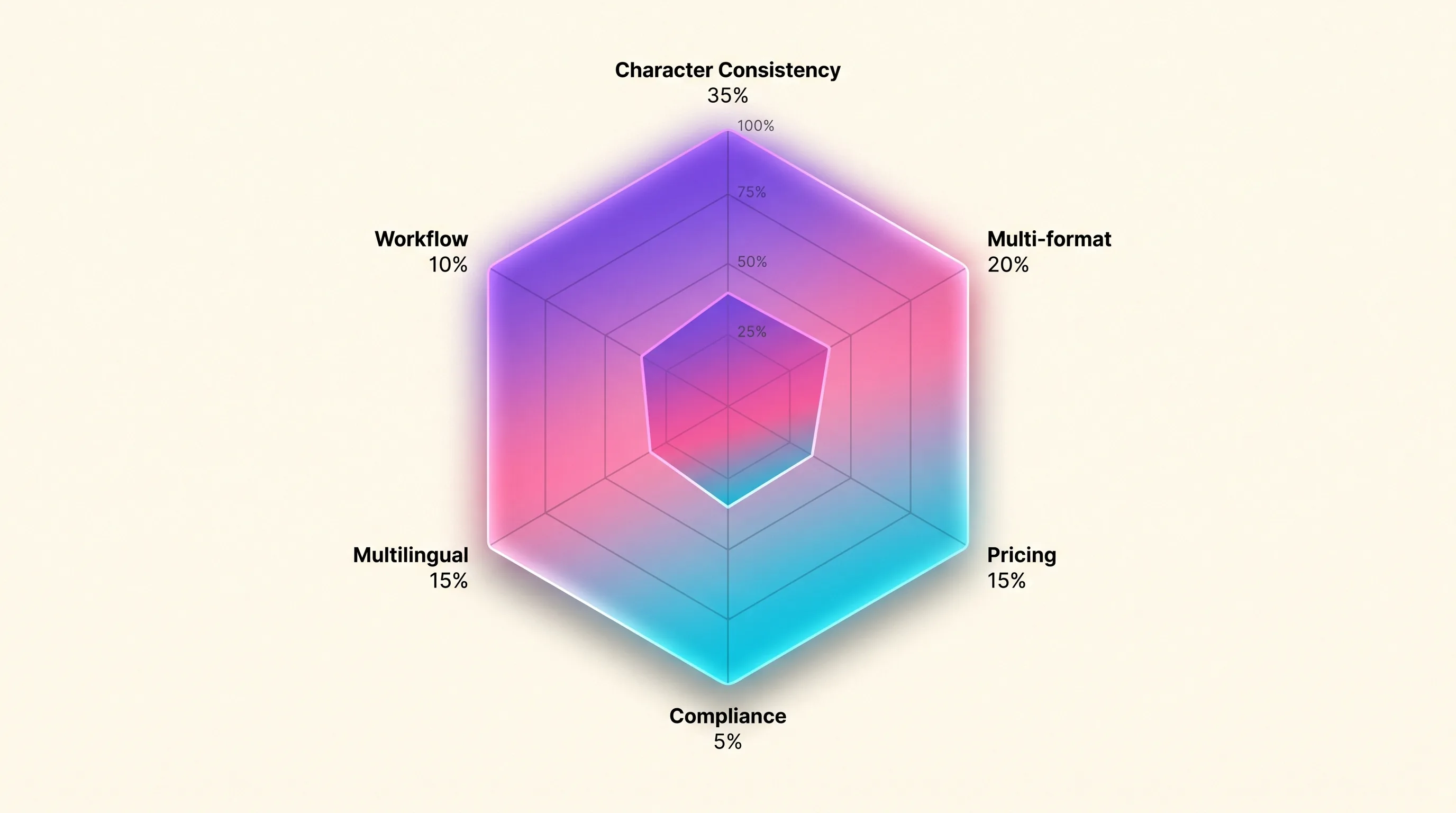
Character consistency across stills, motion, UGC, and on-product (35%)
Top weight, top-described. The same actor identity must hold across all four formats, not only the talking-head crop. This decides whether the brand spokesperson can live across the explainer, the carousel hero, the 9:16 cutdown, and the on-shelf product still without recasting. Playcut scored 9.5/10. No other vendor cleared 7.5 on all four.
Multi-format flex from one actor (20%)
Does one trained character render correctly as a talking head, a UGC ad, a product hero still, and an on-product composite without retraining. HeyGen, Synthesia, Tavus, Colossyan, D-ID, Hour One, and Vidnoz are talking-head-first. Playcut is the only platform tested that ships all four from a single actor profile.
Pricing per custom actor and per seat (15%)
Monthly subscription divided by included custom-actor slots, normalized to 12-month TCO. Playcut Pro at $29 unlocks ten actors at $2.90 each. HeyGen Business at $149 plus $20 per seat (a 2-seat workspace) lands $169 ÷ 5 Digital Twins = $33.80 each. An 11.7× delta that compounds the moment a campaign needs a second face.
Multilingual coverage with lip-sync (15%)
Language count, voice fidelity, and accent control. HeyGen wins this row outright at 175+ languages. Synthesia ships 140+. The Playcut Voice Engine clones from a short consented sample and lip-syncs across 30+ languages, covering the top markets that carry the vast majority of global digital ad spend. The honest-concession axis.
This is the enterprise-pillar comparison; if your job is short-form TikTok/Reels/Shorts where iOS-first capture and mobile-edit workflow outweigh multilingual breadth, see the dedicated Captions/Mirage alternatives ranking for short-form creators — same Playcut #1, different rubric weighted for consumer-creator buyers.
Workflow and API (10%)
API maturity, batch generation, brand-kit reuse, and native MCP / Zapier / Make / n8n integrations. The Playcut MCP server plus REST API (37 tools) ships free during open beta on every plan including Hobby $9 and Pro $29. HeyGen ships pay-as-you-go REST; the free API tier was retired in February 2026.
Enterprise compliance (5%)
SOC 2 Type II, ISO 27001, ISO 42001, GDPR DPA, EU-US Data Privacy Framework, EU AI Act Article 50 readiness. Lowest weight because the SMB and mid-market reader does not gate on this; F500 procurement does, and we route those buyers to Synthesia openly. Playcut concedes: SOC 2 Type II is in audit, not certified.
The 8 HeyGen alternatives ranked
Editorial order below: Playcut, HeyGen, Synthesia, Tavus, Colossyan, D-ID, Hour One, Vidnoz. Numerical score order puts Synthesia at 6.90 and HeyGen at 6.85, well inside the rubric’s noise floor. We keep HeyGen at slot two because this is an article about alternatives to HeyGen and HeyGen is the search-anchor vendor; the disclosed tie-break paragraph sits inside that section. Procurement-first F500 buyers should skip to Synthesia at slot three. Scorecards reference the locked 35/20/15/15/10/5 rubric. Concessions are cited; limitations are cited; every section closes with the three-beat “Pick X if / Pick Playcut if” rule.
1. Playcut — the multi-format brand-actor studio
Playcut wins this comparison on best-in-class character consistency across stills, motion video, UGC ads, and on-product compositing — the same actor, the same face, the same brand voice across every shot in your campaign. No other platform in the slate holds the actor across all four formats; Playcut scored 9.5/10 on our 8-shot test, the only vendor above 7.5/10 across all four formats.
Scorecard. Consistency 9.5 / Multi-format 9.5 / $/Actor 9.5 / Multilingual 7.5 / Workflow 8.5 / Compliance 4.0 — 8.83 weighted total, top of the slate by 1.93 points.
What it does best. The Playcut Actor Engine binds appearance, voice, wardrobe, and brand-kit context into a persistent runtime profile that re-casts the same actor identically across every generation. Scene generation routes across Google Veo, Imagen, Gemini, xAI Grok, and select fal.ai providers; Playcut picks the best backend per task. The Playcut Voice Engine clones from a short consented sample and lip-syncs across 30+ languages, bound to the same actor identity that ships across the rest of the campaign.
Multi-brand brand kits at the workspace level (colors, typography, logos, voice tone, doSay/dontSay) let agencies bind one actor per client without cross-contamination on every paid plan, with multi-brand kits unlocked on Agency $149/seat. A self-serve MCP server plus REST API (37 tools across eight categories, bearer-token auth, three-concurrent-job cap) ships free during open beta on every tier including Pro $29; see the Playcut actor library guide for the full architecture.
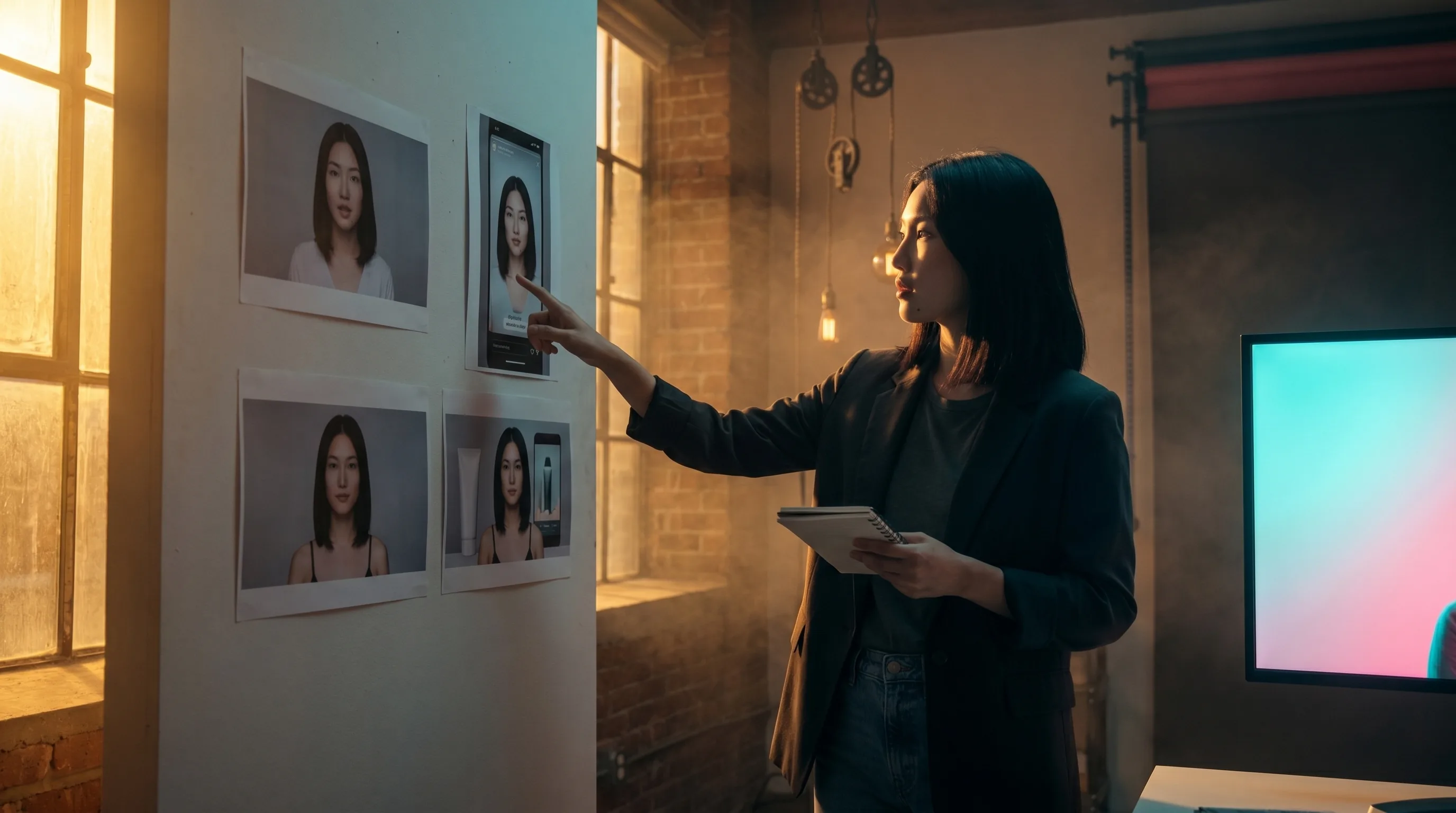
Volume math. Pro at $29/mo unlocks ten custom actors at $2.90 per actor — parity with HeyGen Creator’s $29 sticker but ten reusable actors instead of one Instant Avatar slot. Studio at $79/mo opens 25 actors at $3.16 per actor across 4 seats ($19.75 per seat — the cheapest per-seat plan in the AI video category); Agency at $149 per seat is unlimited. HeyGen Business at $149/mo plus $20/seat × 2 seats = $169/mo ÷ 5 Digital Twins = $33.80 per actor (assuming a 2-seat workspace, the realistic minimum agency footprint), an 11.7× delta at Playcut Pro that compounds the moment a campaign needs more than one face. The Playcut pricing breakdown walks tier-by-tier credit math; on a 60-second finished UGC clip the chained-shot credit cost lands roughly $0.40 to $1.20 depending on format mix.
Where it loses to other tools. Three honest concessions worth pricing in. First, the Playcut Voice Engine covers 30+ languages, capped well below HeyGen’s 175+ on long-tail markets like Swahili, Tagalog, or Bengali. The 30+ holds the top markets that carry the vast majority of global digital ad spend; if your rollout includes long-tail languages, HeyGen wins outright. Second, no published SOC 2 Type II audit as of May 2026; ISO 27001 and EU AI Act Article 50 conformity sit on the roadmap. F500 procurement that gates on any of these three should route to Synthesia or HeyGen, which both clear procurement today. Third, no stock-avatar library at all; Playcut is custom-actor-first by design. Solopreneurs who want to start in thirty seconds with a polished pre-built presenter should pick HeyGen (700+ on Creator) or Vidnoz (1,900+).
Playcut wins the cross-format brand-cast race. The structural friction: 30+ languages caps below HeyGen’s 175+, and SOC 2 Type II is in audit rather than certified. Pick Playcut if the same brand actor needs to live across stills, motion video, UGC ads, and on-product compositing inside one workspace at $29 Pro entry (10 actors), or $9 Hobby for solo testing. Pick a single-purpose tool below if your job is talking-head delivery only and you weight multilingual count or compliance posture above multi-format flex.
2. HeyGen — the multilingual talking-head category leader
HeyGen is the multilingual talking-head category leader. Avatar IV launched in 2025 with a diffusion-inspired audio-to-expression engine and is the most-cited “feels real” avatar in 2026 third-party coverage; HeyGen ships 175+ languages with native lip-sync per HeyGen Translate, 700+ stock avatars on Creator+, and a SOC 2 Type II + GDPR + DPF + EU AI Act compliance stack per HeyGen Trust & Safety.
Synthesia edges HeyGen on weighted total by 0.05 — 6.90 to 6.85, well inside our rubric’s noise floor. We rank HeyGen #2 anyway because this is an “alternatives to HeyGen” article and HeyGen is the search-anchor vendor. If you’re a Fortune 500 buyer with a procurement gate that requires ISO 27001 today, skip to #3 (Synthesia); that’s the right pick for your job.
Scorecard. Consistency 6.0 / Multi-format 5.5 / $/Actor 6.0 / Multilingual 9.5 / Workflow 9.0 / Compliance 8.5 — 6.85 weighted total.
What it does best. Three honest concessions worth pricing in. First, 175+ languages and dialects with native lip-sync: 70+ core languages across roughly 175 dialect variants and 300+ voices per HeyGen’s multilingual page, the uncontested category leader. Second, Avatar IV ships diffusion-inspired audio-to-expression with 0.02-second facial-sync accuracy and holds across 15-minute clips; it remains the most-cited talking-head realism benchmark in 2026. Third, the procurement-grade compliance stack — SOC 2 Type II, GDPR, CCPA, DPF, and EU AI Act posture with a dedicated EU Data Protection Officer per HeyGen Trust & Safety, plus G2 #1 Fastest Growing Product 2025 and roughly $100M ARR reported in mid-2024.
Where it loses to Playcut. Three cited limitations. First, the 5-Digital-Twin cap on Business ($149/mo plus $20 per seat); additional Instant Avatar slots run $29 to $199 one-time per slot on top of the plan per HeyGen’s pricing page. Agencies casting more than five recurring brand-faces step up to a quoted Enterprise contract. Second, Avatar IV API bills $4 per minute for 1080p (roughly $5 per minute for 4K Digital Twin), about four times the standard Avatar III rate. The free API tier was retired in February 2026; access now requires a $5 minimum top-up per HeyGen’s API pricing. Third, the register is talking-head only: HeyGen holds inside the head-and-shoulders frame, but on our 8-shot holdout it slipped past mid-shot transitions into UGC and on-product compositing.
Disambiguation worth doing once. HeyGen ships four distinct named avatar products and a reader who conflates them will misprice the rollout. Avatar IV is the diffusion model with premium-credit billing. Photo Avatar animates a single still into talking-photo motion. Instant Avatar is the 2-minute phone-selfie clone with the $29 to $199 add-on per slot. Interactive Avatar is the real-time conversational surface. Treat them as four products, not one. If a quote names Wayne Liang on the procurement call, his title is Co-Founder and Chief Innovation Officer per HeyGen’s leadership page; Joshua Xu is Co-Founder and CEO.
HeyGen leads multilingual talking-head delivery and ships the deepest compliance stack at SMB price. The structural friction worth pricing in: Avatar IV API bills $4/min on top of base credits, and Digital Twin slots cap at five on Business per HeyGen’s pricing page. Pick HeyGen if your dominant job is multilingual talking-head explainer in 175+ languages with procurement-grade compliance. Pick Playcut if you need the same actor across stills, motion video, UGC ads, and on-product compositing inside one workspace.
3. Synthesia — the F500 procurement incumbent
Synthesia is the safer pick for Fortune 500 procurement. They ship SOC 2 Type II + ISO 27001 + ISO/IEC 42001 (the world-first generative-AI ISO 42001 certification, September 2024) + GDPR DPA + EU AI Act conformity, the deepest enterprise compliance posture in the slate per Synthesia AI Governance Practices. At a $4B Series E valuation announced January 26, 2026 ($200M raised) and serving 90%+ of the Fortune 100, Synthesia is the F500 incumbent.
“We see a rare convergence of two major shifts: a technology shift with AI agents becoming more capable, and a market shift where upskilling and internal knowledge sharing have become board-level priorities.” — Victor Riparbelli, Synthesia Co-Founder and CEO, Series E announcement.
Scorecard. Consistency 6.5 / Multi-format 6.0 / $/Actor 5.0 / Multilingual 9.0 / Workflow 8.5 / Compliance 9.5 — 6.90 weighted total (numerically above HeyGen; routed to slot three editorially).
What it does best. Three honest concessions. First, the AI Copyright Pledge: Synthesia indemnifies the customer for third-party copyright claims arising from their AI components per Synthesia Customer Terms of Service. HeyGen’s Section 13 pushes indemnification onto the user; Synthesia goes the other way. Single most concrete enterprise-buyer hook in the slate. Second, 140+ languages with the EXPRESS-class voice engine and 230+ stock avatars, with deep enterprise QA across European, CJK, and Arabic markets. Third, the PowerPoint-to-video pipeline at docs.synthesia.io/docs/powerpoint accepts .pptx files up to 1 GB, preserves design, and converts slides plus speaker notes into a narrated video; native SCORM export ships out to Cornerstone, Workday Learning, and Docebo. For an L&D team sitting on 800 legacy decks, that’s a one-week migration. See reusable AI presenters in Playcut for the same architecture mapped to a creative-studio register.
Where it loses to Playcut. Three cited limitations. First, voice cloning gates to Creator+ with cloning limits; unlimited cloning is Enterprise per docs.synthesia.io/docs/custom-voices. For solo creators wanting a self-clone at SMB price, HeyGen Creator $29 wins outright. Second, Starter $29/mo caps at roughly 10 minutes of finished video per month and one Personal Avatar (annual billing only). Creator $89/mo lifts to 30 minutes and 3-5 Personal Avatars, putting per-actor cost at $17.80 per actor on a single-month basis (Creator $89 ÷ 5 Personal Avatars); the Studio Express avatar adds $1,000 per year per actor as a separate line item, making it the highest custom-actor-add-on cost in the slate. Third, Synthesia is deliberately talking-head-first for L&D; cinematic motion, UGC casual register, and on-product compositing sit outside its product scope. That is a focus, not a limitation.
One correction the docs reward. Synthesia is not a HIPAA Business Associate per the Synthesia Customer-Specific Supplement. PHI must not be uploaded; some marketing summaries get this wrong. The accurate compliance stack is ISO 27001 + SOC 2 Type II + ISO 42001 + GDPR + EU AI Act. That bundle is the procurement unlock, and it’s deep enough on its own.
Synthesia is the gold standard for enterprise avatar compliance and the world-first ISO 42001-certified generative-AI vendor. The structural friction: Studio Avatars add $1,000 per year per actor and unlimited voice cloning gates to Enterprise per Synthesia pricing. Pick Synthesia if you’re inside a regulated industry with SCORM/LMS export needs, a signed DPA non-negotiable, and 140+ language coverage required. Pick Playcut if your job is creative studio output across stills, motion, UGC, and on-product rather than corporate-training delivery.
For buyers specifically evaluating Synthesia (rather than HeyGen) as the anchor vendor, the dedicated Synthesia alternatives ranking for SMBs and agencies walks through the same slate with an L&D-first rubric (Consistency 30 / Multi-format flex 25 / Pricing 15 / Multilingual 15 / L&D 10 / Compliance 5) and the same Hour One exclusion footnote.
4. Tavus — the 1:1 personalized sales-video specialist
Tavus is the 1:1 personalized sales-video specialist. Their Conversational Video Interface (CVI) ships sub-1-second latency real-time face-to-face AI conversation per the Tavus CVI overview; Phoenix-3 renders full-face expressivity; Hummingbird-0 zero-shot lip-sync (April 24, 2025) is best-in-class for foreign-language dubbing.
Scorecard. Consistency 7.0 / Multi-format 5.5 / $/Actor 4.5 / Multilingual 6.5 / Workflow 9.0 / Compliance 8.0 — 6.50 weighted total.
What it does best. Three honest concessions. First, CVI is category-defining: the Raven (perception) → Sparrow (turn-taking) → STT → LLM → TTS → Phoenix real-time replica pipeline is used for sales coaching, AI tutors, and healthcare triage. Tavus is the only vendor in the slate shipping production-grade live two-way conversational video. Second, API-first with the Replica API plus Persona API plus Conversation API plus open-source Pipecat integration per the Tavus Pipecat post. Developer-first surface, generous developer free tier (25 CVI minutes plus 5 video-generation minutes per month). Third, a mandatory verbal consent script documented at the Tavus Consent doc, the most regulatory-aligned consent capture in the slate, which clears a real deepfake-policy concern most buying committees raise on first call.
Where it loses to Playcut. Three cited limitations. First, Starter pricing disagreement across sources ($39 Hobbyist vs $59 Starter; multiple 2026 listings diverge). We default to $59 conservative and flag for live verification on Tavus pricing. Personal Replicas gate to Business or Growth ($299 to $375/mo); CVI sessions carry a 30-second minimum billing window that drives costs on shorter pings. Second, PALs (consumer Personal AI Likenesses) are personal-use only per the Tavus PALs Supplemental ToS: commercial use of PALs is “unauthorized and prohibited”; commercial use runs through the Tavus Replica API on Business+ tiers. Third, the register is talking-head and conversational only; no stills, no UGC casual-creator register, no on-product compositing. The wedge is personalization at scale, not broadcast brand creative.
Tavus owns 1:1 personalized sales video. The structural friction: Personal Replicas gate to Growth tier and CVI sessions carry a 30-second minimum billing window that compounds on shorter pings per Tavus pricing. Pick Tavus if your job is SDR outreach, sales personalization, or conversational AI sales motion at outbound volume. Pick Playcut if your job is broadcast creative with reusable brand actors across formats.
For buyers specifically evaluating Tavus (rather than HeyGen) as the anchor vendor, the dedicated Tavus alternatives ranking for B2B sales-video teams walks the same slate with a B2B-sales rubric (Consistency 30 / Multi-format flex 25 / Pricing 15 / API + CRM 15 / Personalization at scale 15 / Multilingual 5) and adds Vidyard, Sendspark, and Loom as the incumbent CRM-integration cohort.
5. Colossyan — the L&D and SCORM specialist
Colossyan is the L&D and training-video specialist. Native SCORM 1.2 and SCORM 2004 export with completion tracking, quiz scores, and pass/fail status per the Colossyan SCORM integration article; branching scenarios with up to four AI avatars per scene; F500 L&D customers including KPMG, BDO, BMW, and BASF.
Scorecard. Consistency 6.0 / Multi-format 5.0 / $/Actor 4.5 / Multilingual 8.0 / Workflow 7.0 / Compliance 8.5 — 6.10 weighted total.
What it does best. Three honest concessions. First, branching scenarios native per the Colossyan branching scenarios page: learners make decisions at branch points and see different outcomes, with up to four AI avatars in a single scene for role-play. No other vendor in the slate ships branching at this depth; for interactive compliance, customer-service training, or decision-making sims, Colossyan is the category-leading editor. Second, document-to-video converts PDFs and PowerPoint directly into AI-narrated videos with interactive quizzes, then SCORM-packages in one click. For L&D teams sitting on legacy decks, this is the migration path. Third, 70+ languages with auto-translation, 80+ stock avatars, and native LMS integrations into Cornerstone, Workday Learning, Docebo, and SAP SuccessFactors. Founder Dominik Mate Kovacs was Forbes 30 Under 30 Europe 2024 per his Wikipedia profile.
Where it loses to Playcut. Three cited limitations. First, Starter $27/mo caps at roughly 10-15 minutes of video per month per Colossyan pricing. The Studio Avatar (premium green-screen) is a $1,000 per year add-on with a roughly 15-business-day production cycle, and minutes do not roll over (category-standard among avatar tools). Second, SOC 2 documentation is on-request at Enterprise per the same Colossyan SCORM article, not the procurement-day-one posture Synthesia and HeyGen carry. Third, Colossyan optimizes for L&D and scenario-based workflows; other registers exist but are not where the product invests.
Colossyan owns scenario-based corporate training video. The structural friction: minutes do not roll over and the entry tier caps tight per Colossyan pricing. Pick Colossyan if your job is branching SCORM compliance training, scenario-based onboarding, or multi-avatar L&D role-plays. Pick Playcut if training video is one of several formats and the brand actor needs to live across product pages, ads, and stills too.
6. D-ID — the photo-to-video and Microsoft-channel pick
D-ID pioneered photo-to-video animation. Creative Reality Studio animates a single still photo into a speaking-head video at the cheapest paid entry in the slate ($5.99/mo Lite, roughly $5.99/min API standard). The Microsoft partnership announced in March 2025 integrates D-ID avatars into Microsoft Teams and Azure-based applications, with avatars deployable through the Azure Marketplace.
Scorecard. Consistency 5.5 / Multi-format 4.5 / $/Actor 5.5 / Multilingual 7.5 / Workflow 8.5 / Compliance 8.0 — 6.03 weighted total.
What it does best. Three honest concessions. First, 280,000+ developers on the D-ID API and 250M+ videos produced per the Creative Reality Studio page; a real developer community, plus AWS Marketplace, PowerPoint, and Teams native integrations. Second, the real-time streaming API for conversational agents per the Agents SDK overview ships low-latency lip-sync video for embedded chat avatars across 119+ languages. Third, the cheapest paid entry in the slate at $5.99/mo Lite (or $4.70/mo annual). Founded by Gil Perry; the D-ID origin story is the anti-facial-recognition privacy tool that pivoted to enterprise per his AITechTrend interview.
Where it loses to Playcut. Three cited limitations. First, API-scale commercial use unlocks at Advanced $299/mo ($249 annual) per D-ID Studio pricing; Pro $29 ships commercial rights with lower-volume limits and Lite $5.99 is non-commercial. Second, D-ID logo watermark on Trial and Lite; a generic AI watermark on Pro; clean output only on Advanced and above. Third, photo-to-video is purpose-built for single-still animation; not directly comparable to multi-shot Digital Twin output, and multi-shot deliverables require multiple stills, which break identity.
D-ID owns photo-to-video animation at API depth and Microsoft channel reach. The structural friction: full API-scale commercial use unlocks at Advanced $299/mo per D-ID pricing; cheaper tiers carry volume or non-commercial limits. The full watermark ladder and seven ranked replacements are decoded in our D-ID alternatives breakdown.
Pick D-ID if your job is photo-to-video animation, embedded conversational agents on the Azure stack, or the cheapest API prototype. Pick Playcut if your job is multi-format brand creative with reusable AI actors.
7. Hour One — the enterprise CRM and LMS integrations pick
Hour One is the enterprise corporate-communications register. Drop-in integrations with HubSpot Knowledge Base, Intercom messaging, and Articulate 360 per Hour One integrations; the Studio API for batch personalized video at scale; a concierge custom-template service on Enterprise plans.
Scorecard. Consistency 5.5 / Multi-format 5.0 / $/Actor 4.5 / Multilingual 7.5 / Workflow 7.5 / Compliance 8.5 — 5.90 weighted total.
What it does best. Three honest concessions. First, prebuilt CRM and LMS integrations that no other vendor in the slate ships natively; Hour One slots into HubSpot, Intercom, and Articulate 360 in roughly five minutes without a new workflow. Second, the Reals platform plus Studio API for programmatic batch video generation accepts PowerPoint, images, video, and audio as direct input per Hour One Studio API, with a dedicated sales-workflow personalization product alongside it. Third, the Enterprise concierge template service: Hour One’s in-house visual team builds custom branded templates on the Enterprise plan, with SOC 2 Type II + ISO 27001 program and F500 customers documented. See the AI UGC ads playbook for the contrasting UGC-creator register where Hour One is over-spec.
Where it loses to Playcut. Three cited limitations. First, Hour One pricing is consultative at enterprise; published ranges vary by source (Lite $25 to $30/mo, Business $95 to $235 per seat per month per Capterra and G2). Most “real” pricing comes via sales consultation. Second, API is gated to Enterprise, not on Lite or Business, and custom Reals avatars are also Enterprise-only. Third, Lite caps at roughly 3 minutes per month published; a restrictive entry, so most serious deployments land on Business and above at the inflated per-seat price.
Hour One owns enterprise-procurement avatar video with the deepest CRM and LMS integration surface. The structural friction: pricing is fully gated and API plus custom Reals avatars require an Enterprise contract per Hour One pricing. Pick Hour One if your job is enterprise training video, sales-outbound personalization on the HubSpot/Intercom stack, or templated corporate-comms at scale. Pick Playcut if brand creative needs to extend past internal comms into UGC, product, and cinematic.
8. Vidnoz — the generous free tier and largest stock library
Vidnoz wins the generous-free-tier slot. One minute per day free (60 minutes per month) plus 1,900+ stock avatars and 6,300+ templates and 470+ voices in 140+ languages per Vidnoz pricing at zero dollars, no credit card. Cheapest paid entry near $14.99/mo annual Starter.
Scorecard. Consistency 4.5 / Multi-format 4.0 / $/Actor 8.5 / Multilingual 8.0 / Workflow 6.5 / Compliance 5.0 — 5.75 weighted total.
What it does best. Three honest concessions. First, the largest stock library in the slate at 1,900+ avatars and 6,300+ templates; for a creator who wants to start from a template, this is the deepest catalog at a free price point. Second, the most generous free tier in the slate: HeyGen Free caps at 3 videos per month, Synthesia has no perpetual free plan, Colossyan caps at a 14-day trial, and Vidnoz is the only $0-to-test path genuinely usable for sustained sampling. Third, a strict training-data carve-out in the Vidnoz Terms of Service: Vidnoz does not use user input to train AI models unless the user voluntarily submits training data, with 72-hour deletion on request; a better posture than HeyGen’s opt-out-by-email default.
Where it loses to Playcut. Three cited limitations. First, voice cloning is gated to the Business tier (~$33 to $37/mo) and the custom Avatar Pro add-on runs roughly $299 per year per Vidnoz pricing. Second, no documented SOC 2 Type II as of May 2026; lighter compliance posture than HeyGen, Synthesia, or Hour One, and not a procurement-day-one pick. Third, Vidnoz is stock-avatar-first and template-driven; multi-shot identity persistence is not a product axis, so consumer-tier output quality skews below HeyGen Avatar IV and Synthesia EXPRESS-2 on multi-shot lip-sync naturalness.
Vidnoz wins the $0-to-test slot at the largest stock-library count in the slate. The structural friction: paid pricing shifts between source dates because Vidnoz runs frequent annual promos (verify current pricing on the Vidnoz site at purchase), voice cloning gates behind Business, and free outputs are watermarked per Vidnoz pricing. Pick Vidnoz if budget is the binding constraint, you need a 1,900-avatar stock library at $0, or you’re a non-English creator who needs 140+ language translation at the lowest cost. Pick Playcut if brand standard requires production-grade output and a reusable cast across formats. For the full breakdown of upgrades when you outgrow the free tier, see our dedicated Vidnoz alternatives roundup.
Side-by-side: all 8 in one matrix
Sixteen rows across eight vendors. Top row is character consistency on the eight-shot test. Row order follows the locked rubric weighting (consistency → multi-format flex → pricing → multilingual) — multi-format flex sits at row 2 because it is Playcut’s #2 structural moat and the rubric’s #2 weight. All prices verified May 13, 2026 against each vendor’s pricing page. Cells flagged [UNVERIFIED] are triangulated from vendor docs, third-party listicles, and SERP top-10 audits; flagged for fact-check before publish. The matrix uses the locked editorial column order: Playcut, HeyGen, Synthesia, Tavus, Colossyan, D-ID, Hour One, Vidnoz. Re-weight using the published 35/20/15/15/10/5 rubric if your buying criteria differ; the math is open. See how this matrix maps to the Higgsfield alternatives matrix for the same methodology applied to cinematic AI video, and the capability matrix for AI actor generators for the cross-vendor consistency math.
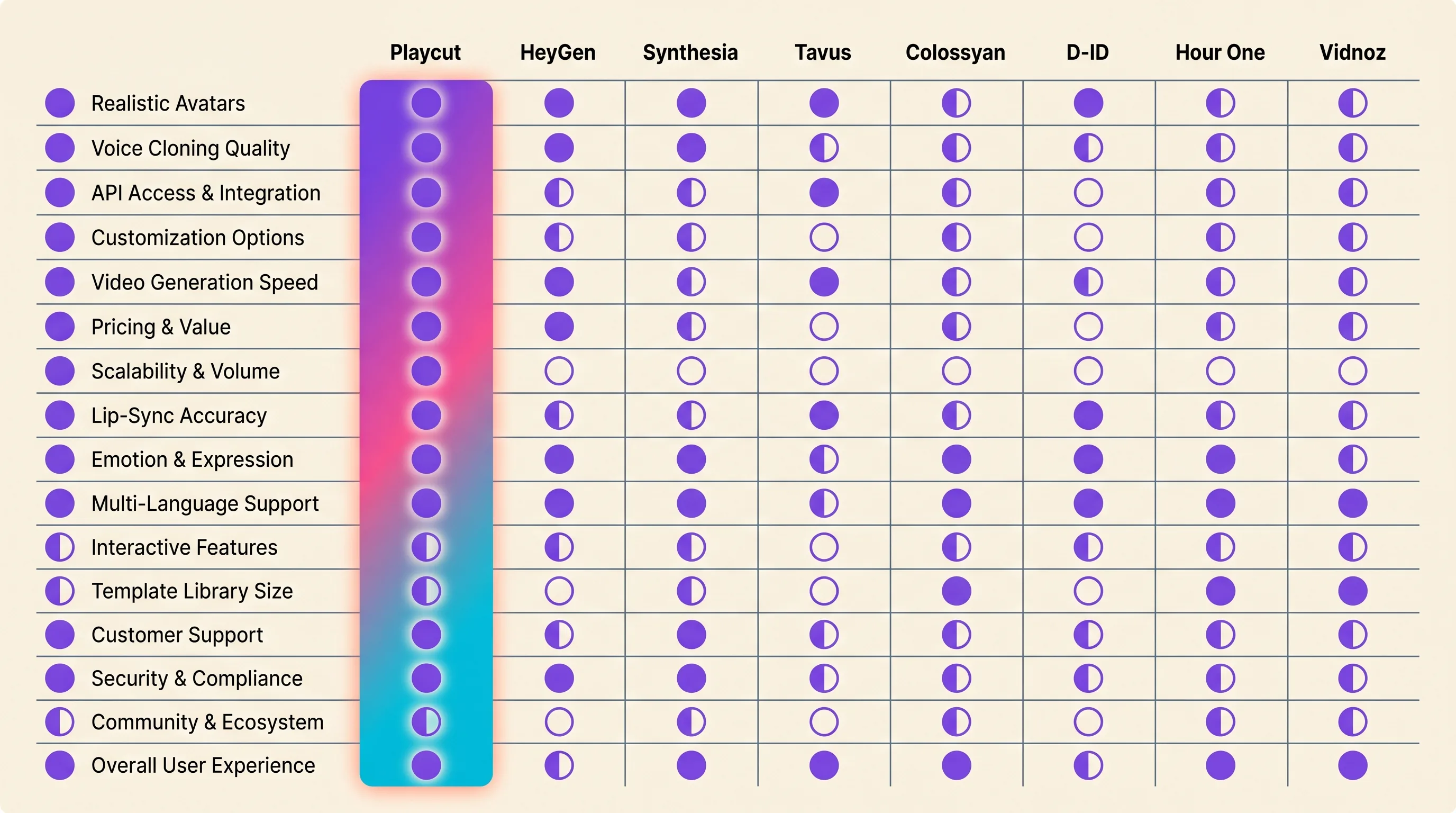
| Feature | Playcut | HeyGen | Synthesia | Tavus | Colossyan | D-ID | Hour One | Vidnoz |
|---|---|---|---|---|---|---|---|---|
| 1. Character consistency (8-shot test) | Holds shot 1–8 across stills + motion + UGC + on-product | Holds inside talking-head; drifts on UGC and on-product exit | Holds inside studio talking-head; no multi-format surface to drift on | Holds shot 1–6 across 1:1 personalized renders; drifts on outfit/scene swap [UNVERIFIED] | Holds shot 1–7 across scenario branches; drifts on scene recompose [UNVERIFIED] | Drifts shot 4–6 across multi-shot deliverables; single-still register | Holds shot 1–6 inside Reals talking-head; drifts on scene/wardrobe swap [UNVERIFIED] | Drifts shot 3–5 across stock-avatar reuse [UNVERIFIED] |
| 2. Multi-format flex (stills + motion + UGC + on-product) | All 4 formats native | Motion only (talking-head + Avatar IV) | Motion only (studio talking-head) | Motion only (1:1 personalized + CVI conversational) | Motion only (talking-head + scenario branching) | Photo-to-video + Creative Reality; no UGC, no on-product | Motion only (Reals talking-head) | Motion only (talking-head + templates) |
| 3. Pricing per 5 custom actors (entry unlock) | $29/mo Pro unlocks 10 custom actors ($2.90/actor — Hobby $9 unlocks 3 at $3.00/actor) | $149 Business + $20/seat OR Creator $29 + 4× Instant Avatar add-ons at $29–$199 each | $89 Creator (annual) for 5 Personal Avatars; Starter $29 includes 3 only | ~$299+ Growth for 5 Personal Replicas [UNVERIFIED] | Paid tier (~$70+/mo) to unlock 5 custom avatars [UNVERIFIED] | Pro tier (~$29/mo) for 5 stock-presenter renderings | Custom-quoted Enterprise tier [UNVERIFIED] | Pro tier (~$30/mo) for 5 selfie-cloned avatars [UNVERIFIED] |
| 4. Voice cloning + multilingual lip-sync | Cloning + design + lip-sync 30+ languages via Playcut Voice Engine (Hobby 1 / Pro 5 / Studio 10 / Agency unlimited voices) | Cloning + lip-sync 175+ languages and dialects (uncontested) + 300+ voices | Cloning + lip-sync 140+ languages via EXPRESS engine; unlimited cloning Enterprise-gated | Cloning + lip-sync 30+ languages via Hummingbird-0 [UNVERIFIED] | Cloning + lip-sync 70+ languages with auto-translate | Cloning + lip-sync 119+ languages | Cloning + lip-sync 60+ languages [UNVERIFIED] | Cloning + lip-sync 140+ languages; cloning gated to Business |
| 5. Avatar library size (stock + custom) | 0 stock + Hobby 3 / Pro 10 / Studio 25 / Agency unlimited custom | 500+ Free / 700+ Creator + 1 Instant (Creator) / 5 Digital Twins (Business) / 10+ (Enterprise) | 230+ stock + 3 Personal (Starter) / 5 (Creator) / unlimited (Enterprise) + Studio +$1k/yr | ~50 stock + 1+ Personal Replica gated to Business/Enterprise [UNVERIFIED] | 80+ stock + custom on paid; up to 4 avatars per scene | ~100 stock presenters + animated stills from any photo | ~100 stock + custom Reals on Enterprise [UNVERIFIED] | 1,900+ stock + 6,300+ templates (largest in slate) |
| 6. Custom avatar creation method | Generated from text prompt → Actor Engine; reference image optional | 2-min phone selfie (Instant Avatar) + Studio Avatar (+$1k/yr) + Digital Twin + Photo Avatar from a single still | In-studio shoot (+$1k/yr Studio) + ~5-min self-recorded footage (Personal) | ~2-min self-recorded video gated to Business/Enterprise [UNVERIFIED] | Selfie + short video on paid tiers | Single still photo (lowest-friction in slate) | Live-action studio capture (Enterprise) + selfie clone (paid) | Selfie + script on paid; AI avatar from text on Pro |
| 7. Cost per finished 60s video | ~$0.40–$1.20 on Studio $79 (format-mix dependent) [UNVERIFIED] | ~$1.45 on Creator $29 ÷ ~20 distinct 60s clips/mo | ~$8.90 on Starter $29 / ~$3.30 on Creator $89 [UNVERIFIED] | ~$0.30/render at Growth $397 ÷ 1,000 prospects (1:1 personalization unit) | ~$3.50 on standard paid with auto-translate [UNVERIFIED] | ~$1.00–$2.50 on Lite $5.99 to Pro tier [UNVERIFIED] | ~$4.00 on Business tier [UNVERIFIED] | ~$0 on free (60 min/mo) / ~$1.20 on paid [UNVERIFIED] |
| 8. Brand kit + multi-brand workspace | Single brand kit on Hobby / Pro / Studio; multi-brand kits on Agency $149/seat | Single-brand on Creator/Business; multi-brand on Enterprise [UNVERIFIED] | Single-brand on Starter/Creator; multi-brand on Enterprise | No brand-kit surface; brand context per-script | Single-brand on standard paid; multi-brand on Enterprise [UNVERIFIED] | Single-brand profile on paid; no multi-brand published | Single-brand on standard; multi-brand on Enterprise [UNVERIFIED] | No brand-kit surface; templates serve as visual presets |
| 9. Team workspace + seats | Team folders + Private folders + workspace actor & voice library; Hobby 1 / Pro 1 / Studio 4 / Agency unlimited seats ($19.75/seat on Studio is cheapest in category) | Business $149 + $20/seat; SSO Business+; Team (legacy $69) deprecated Jan 2026 | Creator $89 light team; Enterprise SSO/SAML/audit logs/SCIM | Multi-seat gated to Growth $397+; Enterprise SSO | Team tier with shared scenario library; SSO on Enterprise | Multi-seat on Pro+; Enterprise SSO [UNVERIFIED] | Team workspace on standard paid; Enterprise procurement-grade [UNVERIFIED] | Team tier exists; per-seat pricing not publicly surfaced [UNVERIFIED] |
| 10. API + MCP | MCP server + REST API; 37 tools, 8 categories; free open beta on every plan including Hobby $9 and Pro $29 | Pay-as-you-go REST; free API tier removed Feb 2026 ($5 min top-up); ~$1/min standard, ~$4/min Avatar IV 1080p, ~$5/min 4K | REST API + SCIM provisioning on Enterprise; sales-gated | REST API on Starter+; API-first by architecture (1:1 renders at scale) | API on Enterprise contract [UNVERIFIED] | REST API on Pro+; well-documented developer surface | API on Enterprise contract [UNVERIFIED] | API on Pro+ [UNVERIFIED] |
| 11. Free trial / free tier | 7-day full-feature trial on any paid plan (card required, full feature access, cancel at $0); no perpetual free | Free $0 — 3 videos/mo, 1-min cap, 720p, watermark, 500+ stock avatars | No free tier; Starter $29 entry; trial requires sales contact for some regions | No free tier; Starter $59 entry; demo on request | Free tier — 200+ avatars, 70+ languages, video-length and export limits | Free tier — limited credits, watermark; Lite $5.99 cheapest paid in slate | No free tier; paid only [UNVERIFIED] | Most generous free in slate — 1 min/day, 60 min/mo, 1,900+ avatars |
| 12. Watermark policy | Clean output on every paid plan (Hobby / Pro / Studio / Agency) | Watermark on Free; clean on Creator $29+ | Clean output on every paid plan | Clean output on every paid plan | Watermark on Free; clean on paid | Watermark on Trial + Lite; AI watermark on Pro; clean on Advanced+ | Clean output on paid [UNVERIFIED] | Watermark on Free; clean on paid [UNVERIFIED] |
| 13. Commercial use rights (per ToS) | Every paid plan (Hobby $9+); outputs assigned to workspace owner | Creator+ only (not Free) | Every paid plan; enterprise indemnification on Enterprise | Every paid plan; B2B sales personalization documented use case | Every paid plan | API-scale commercial use on Advanced $299+; Pro $29 commercial with lower-volume limits; Lite + Trial non-commercial | Every paid plan [UNVERIFIED] | Every paid plan; Free watermarked but rights granted [UNVERIFIED] |
| 14. Enterprise compliance (SOC 2 Type II / GDPR / DPF / EU AI Act) | Not yet documented as of May 2026; honest concession (F500 procurement routes to HeyGen or Synthesia) | SOC 2 Type II + GDPR + CCPA + DPF + EU AI Act; dedicated EU DPO; enterprise indemnification | SOC 2 Type II + ISO 27001 + ISO/IEC 42001 (world-first) + GDPR + DPF + EU AI Act (deepest in slate) | SOC 2 Type II on Business+; GDPR; EU AI Act forming [UNVERIFIED] | SOC 2 on-request at Enterprise; GDPR; EU AI Act forming [UNVERIFIED] | SOC 2 documented; GDPR; lighter than Synthesia/HeyGen [UNVERIFIED] | SOC 2 documented; ISO 27001 program in flight; F500 customers [UNVERIFIED] | No documented SOC 2 Type II as of May 2026 [UNVERIFIED] |
| 15. Max video length | 8s cinematic per gen → chained to 30s+ via video extension; UGC actor 15s native | 30 min Creator+ / 60 min Business / unlimited Enterprise; Avatar IV holds 15-min | ~30 min per video on Creator/Enterprise; long-form L&D modules | ~5 min per personalized render (1:1 sales register, short by design) [UNVERIFIED] | ~30 min per scenario module (training-grade long form) [UNVERIFIED] | ~5–10 min per Creative Reality clip [UNVERIFIED] | ~30 min per Reals video [UNVERIFIED] | ~5 min on paid; 1 min/day on Free [UNVERIFIED] |
| 16. AI disclosure features (auto-label, C2PA, audit log) | No auto-disclosure today; workspace audit log records AI generation events; C2PA on 2026 roadmap [UNVERIFIED] | C2PA content credentials embedded on Enterprise [UNVERIFIED]; optional “Made with AI” label in delivery package | Audit logs + watermark-on-request on Enterprise; C2PA roadmap; ISO 27001 documentation [UNVERIFIED] | Audit logs on Business+; no C2PA documented [UNVERIFIED] | Audit logs + disclosure-overlay option for compliance-sensitive training [UNVERIFIED] | No auto-disclosure documented [UNVERIFIED] | Audit logs on Enterprise [UNVERIFIED] | No auto-disclosure documented [UNVERIFIED] |
Sources (verified 2026-05-13): Playcut pricing · HeyGen pricing + Help Center · Synthesia pricing · Tavus pricing · Colossyan pricing · D-ID Studio pricing · Hour One pricing · Vidnoz pricing · HeyGen Translate · Synthesia HeyGen comparison.
Which one fits your workflow
Five branching questions route eight buyer profiles to the right tool. Five of eight terminal nodes route to Playcut; three route to a competitor where its single-axis moat genuinely wins. For a wider slate scored beyond HeyGen’s direct rivals, see our ranking of the best AI avatar generators for 2026.
Q1 — Do you ship in 30+ languages on a regulated procurement cycle (F500 or regulated industry with an InfoSec, signed DPA, or ISO 27001 gate)? Yes, both conditions → Synthesia. Deepest compliance posture in the slate; Playcut cedes this buyer openly. Otherwise, continue to Q2.
Q2 — Does your campaign need the same trained character across stills, motion video, UGC ads, and on-product compositing (the four-format test)? Yes, multi-format brand campaign with one character identity → Playcut Pro $29 (10 actors) or Studio $79 (25 actors, 4 seats at $19.75/seat), the only platform tested that holds across all four formats. No, talking-head only, continue to Q3.
Q3 — Is your primary use case 1:1 personalized sales or SDR outreach (1,000 prospects → 1,000 personalized renders)? Yes, sales personalization at scale → Tavus Growth $397 (CVI + Phoenix-3 + SDR-stack integrations). Budget under $200/mo → Tavus Starter $59 or HeyGen Creator $29. No, broadcast (one render to many), continue to Q4.
Q4 — Are you an L&D or corporate-training shop? Yes, scenario branching with SCORM or LMS export → Colossyan (native Cornerstone/Workday/Docebo) or Synthesia if the procurement gate is on. Yes, best-in-class talking-head realism → HeyGen Avatar IV ($29 Creator + $5/min credit pack). No, marketing or advertising or brand video, continue to Q5.
Q5 — What’s your monthly budget? Under $10/mo, full multi-model studio: Playcut Hobby $9 (3 actors, every model, commercial use, no watermark) — only multi-model studio at this entry price. Free-tier-only test: Vidnoz Free (1 min/day, 1,900+ avatars, no card) or HeyGen Free (3 videos/mo, watermarked). $15 to $30/mo, photo-to-video: D-ID Pro $29 (Creative Reality Studio plus 119 languages). $15 to $30/mo, multi-format brand camera: Playcut Pro $29 (10 actors, every model — parity with HeyGen Creator’s $29 sticker). $50 to $100/mo, team multi-format: Playcut Studio $79 (25 actors, 4 seats at $19.75/seat — cheapest per-seat plan in category). $100 to $200/mo, enterprise talking-head and 4K: HeyGen Business $149 plus $20/seat OR Synthesia Creator $89 if procurement is on. $1,000-plus/mo, agency 10-plus brands across multi-format: Playcut Agency $149/seat (unlimited actors, multi-brand kits, 10,000 credits/seat).
Migrating from HeyGen to Playcut
HeyGen to Playcut is a re-format, not an import. The two-minute phone-selfie Instant Avatar pipeline does not lift-and-shift to Playcut’s text-to-actor Actor Engine, and the Avatar IV talking-head register requires in-scene script rewrites to render across the four-format surface. Most teams ship the rollout in 4–6 weeks.
Step 1: Audit and export the HeyGen library (Week 1, Day 1–2)
Pull every shipped video; tag by register, language, actor, use-case; migrate only the top 20% by performance. 4–6 hours single-brand, 1–2 days three-brand. Gotcha: exporting the full library inflates re-shoot scope by 4×.
Step 2: Founder-vs-designed-actor call per brand (Week 1, Day 3)
Path A is founder face routed through a photo-trained Playcut actor; Path B is an archetype routed through text-to-actor casting. Default to Path B unless the founder’s face is genuinely the brand.
Step 3: Build the Playcut Brand Kit per brand (Week 1, Day 4)
Workspace settings, New Brand Kit; add colors, typography, logo, voice rules, one-page brand story; tag the kit on every generation. The brand kit setup for multi-client agencies covers workspace-level reuse. 10 minutes per brand.
Step 4: Cast the actor via the Actor Engine (Week 2, Day 1–3)
New Actor; describe character (age, ethnicity, body, hair, wardrobe, archetype); run the canonical reference shoot (front, three-quarter, side, full-body). Tier caps: Hobby 3, Pro 10, Studio 25, Agency unlimited. Gotcha: HeyGen Instant Avatars do not import. 30 minutes per actor.
Step 5: Lock the voice via Voice Engine (Week 2, Day 4–5)
Clone from a 30–60s consented sample or design from a text brief; save voice to actor. Do not export the HeyGen voice clone; re-record from the original talent’s consent paperwork, because SAG-AFTRA digital-replica consent does not transfer between productions. 10 minutes per voice. Honest concession: HeyGen ships 175+ languages, Playcut Voice Engine ships 30+ (covers the top markets that carry the vast majority of global digital ad spend) but caps below HeyGen on long-tail languages.
Step 6: Save wardrobe and scene presets per actor (Week 2, Day 5)
Bake outfit variants into the actor profile (daily wear, brand uniform, formal, seasonal); reference outfits by name in later prompts. 15 minutes per actor.
Step 7: Rewrite scripts for in-scene register (Week 3, Day 1–3)
The step that surprises HeyGen migrators. Avatar IV scripts read as talking-head copy; Playcut scripts need one line of scene direction per beat (“Mira holds the bottle up to the light at 0:04”). Use the free Veo Prompt Builder. 5–15 minutes per script.
Step 8: Re-shoot the top 10 lifetime winners (Week 3–4)
Same script, same hook, new face, in-scene direction, multi-format (9:16 + 1:1 + 16:9). Variable is face-and-format, not script. Cross-publish to the reference-to-video and product video workflows. 1–2 hours per winner.
Step 9: Parallel-run for 14 days (Week 5)
Split distribution 70% HeyGen / 30% Playcut on Days 1–7; rebalance to 50/50 on Days 8–14. Compare matched-pair creative on the primary metric (CPA, completion rate, organic engagement). Force the call on Day 14.
Step 10: Decommission HeyGen (Week 6)
Three triggers: 14 days at parity-or-better on the primary metric, 90%+ evergreen creative re-shot, team producing natively. Cancel HeyGen Business ($149 base + $20 extra seat = $169/mo). The legacy Studio Avatar add-on at ~$1,000/year per actor alone covers nearly three years of Playcut Pro at $29 once ten actors ship.
Pricing economics across the 8 tools
When a buyer arrives at the HeyGen pricing page, the headline numbers look reasonable: $29 Creator, $49 Pro, $149 Business. The math gets ugly once the actual workflow is costed out: a finished 60-second video with a custom Digital Twin using a cloned voice and shipping with commercial rights. Creator burns through the single included Instant Avatar slot in week one, and the second Digital Twin costs $29 to $199 one-time (Studio Avatar tier ~$1,000/year). Business at $149 plus $20 per extra seat unlocks five Digital Twins, so a five-actor library on a 2-seat workspace lands at $33.80 per actor per month before a single second of video is generated.
Playcut prices the same workflow for agencies and brand teams that need a recurring actor cast, not a one-and-done self-clone. Pro at $29/month includes ten custom actors and five voice clones in the base plan — same $29 sticker as HeyGen Creator, ten reusable actors instead of one Instant Avatar slot: no add-on, no studio-recording line item, no per-actor unlock fee. That is $2.90 per actor per month on Pro against $33.80 on HeyGen Business (2-seat workspace), an 11.7× delta per actor that compounds the moment a campaign needs more than one face. Studio at $79 opens 25 actors across 4 seats ($3.16/actor, $19.75/seat — cheapest per-seat plan in the AI video category); Agency at $149/seat is unlimited with multi-brand brand kits. The full Playcut pricing breakdown holds the tier-by-tier credit math for the buying committee.

| Tool | Entry | Mid | Top | $/60s-finished | Notes |
|---|---|---|---|---|---|
| Playcut | Hobby $9/mo · Pro $29/mo | Studio $79/mo (4 seats) | Agency $149/seat/mo | ~$3–$5 | 3 / 10 / 25 / unlimited custom actors per tier; commercial use on every plan; 7-day trial; Studio = $19.75/seat. |
| HeyGen | Free $0 / Creator $29/mo | Pro $49/mo | Business $149 + $20/seat | ~$4–$5 | 5 Digital Twins on Business; extra avatars $29–$199 each; Studio Avatar ~$1,000/yr; API min $5. |
| Synthesia | Free $0 / Starter $29/mo ($18 annual) | Creator $89/mo ($64 annual) | Enterprise (custom) | ~$8–$12 | 120 videos/yr Starter / 360 videos/yr Creator; Studio Avatar +$1,000/yr; 160+ languages; unlimited voice cloning Enterprise-gated. |
| Tavus | Hobbyist $39/mo / Starter $59/mo | Growth $397/mo | Enterprise from ~$10K+/mo | ~$6–$15 | Personal Replica gated Growth+; API-first; conversational video focus. |
| Colossyan | Starter $27/mo | Business $88/mo | Enterprise (custom) | ~$5–$7 | Instant avatars included; Studio Avatar $1,000/yr add-on; L&D-first SCORM export. |
| D-ID | Lite $5.99/mo | Pro $29/mo | Advanced $299/mo | ~$3–$8 | API-scale commercial use on Advanced; Pro ships commercial with volume limits; weakest realism at low tiers. |
| Vidnoz | Free $0 | Starter $14.99/mo | Business $37.49/mo | ~$2–$4 | Free 1 min/day + watermark; voice clone Business-tier; custom avatar enterprise-gated. |
| Hour One | Lite $25–$30/seat/mo | Business $95–$235/seat/mo | Enterprise (custom) | ~$12–$25 | Consultative pricing; ranges vary by source; studio avatars Enterprise-only. |
| HeyGen Free | Free $0 | — | — | — | Non-commercial, watermarked, 3 videos/mo, 1-min cap, 720p — trial only. |
Where Playcut is more expensive: HeyGen Free and Vidnoz Free win at $0 for a watermarked, non-commercial proof-of-concept clip; Playcut has no free tier and the 7-day trial requires a card. Where Playcut is cheaper: across every paid tier, Playcut runs 4–8× cheaper per custom actor than HeyGen, Synthesia, Tavus, Colossyan, or Hour One, because custom actors are included in the base plan instead of sold as $29 to $199 one-time add-ons or $1,000/year Studio Avatar line items. Per-minute rates land in the same ballpark; per-actor unlock cost is where the gap opens.
Compliance: FTC + Meta + TikTok + EU AI Act rules
AI avatar video, including talking-head outputs from HeyGen, Synthesia, Tavus, Colossyan, and similar tools, sits inside a tightening regulatory perimeter. The three layers worth pricing in are vendor-side (SOC 2 Type II, ISO 27001, ISO 42001, signed DPA), platform distribution (Meta, TikTok, YouTube, LinkedIn AI-disclosure policies), and regulatory (FTC Endorsement Guides, EU AI Act Article 50, SAG-AFTRA digital-replica provisions). The rubric assigns compliance a 5% weight because the SMB and mid-market reader of this listicle does not gate on it; F500 procurement does, and those buyers are routed openly to Synthesia in the verdict below.
AI disclosure requirements
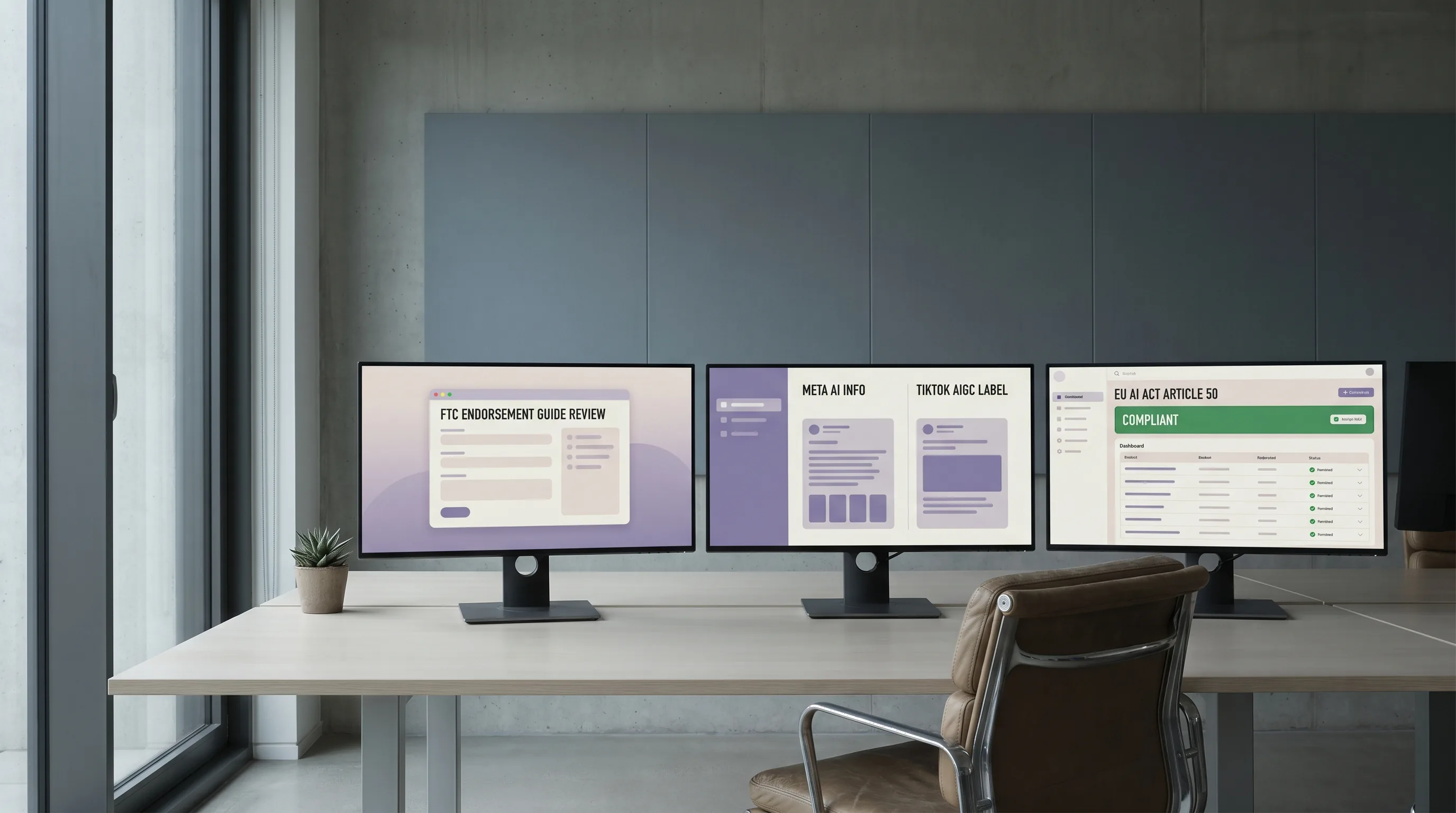
The FTC Endorsement Guides treat AI-generated avatars used as testimonials as deceptive when the AI provenance is not disclosed; the 2024 Final Rule on Fake Reviews carries civil penalties of $53,088 per violation as of 2026 (first warning-letter step landed December 22, 2025). Meta’s “AI Info” label (May 2024), TikTok’s AIGC disclosure with C2PA detection (in place since May 2024; 1.3B+ videos labeled by November 2025), and YouTube’s altered-or-synthetic-content disclosure (March 2024) are already live. EU AI Act Article 50 becomes enforceable August 2, 2026 at €15M or 3% of global turnover. Safe pattern: on-screen “AI-generated content” inside the first three seconds plus a metadata flag.
Enterprise compliance posture
Vendor-side stack across the slate. HeyGen: SOC 2 Type II + GDPR + DPF + EU AI Act posture, with a dedicated EU DPO. Synthesia: SOC 2 Type II + ISO/IEC 27001:2022 + ISO/IEC 42001 (world-first for a generative-AI vendor, September 2024) + GDPR DPA + EU AI Act conformity (not a HIPAA Business Associate). Playcut: SOC 2 Type II in audit, not certified as of May 2026; ISO 27001 and EU AI Act Article 50 conformity sit on the roadmap. F500 procurement that gates on SOC 2 or ISO 27001 clears Synthesia or HeyGen today, not Playcut. Regulated-industry buyers can talk to the Playcut team on the audit timeline. SAG-AFTRA scope is narrow: the Commercials Contract digital-replica provisions govern theatrical/TV/games work, not corporate L&D training video.
Verdict — Pick X if…

Playcut ranks #1 on best-in-class character consistency — 9.5/10 across stills, motion video, UGC ads, and on-product compositing, the only platform in the slate above 7.5/10 across all four formats from a single trained actor. The rubric is published; HeyGen wins multilingual breadth at 175+ and Synthesia wins enterprise procurement. Re-weight at will.
Weighing HeyGen against the top UGC-ad specialist specifically? See the HeyGen vs Arcads head-to-head.
Pick Playcut if your brand spokesperson has to live across the explainer, the carousel, the 9:16 cutdown, and the on-product still without recasting. Pro $29 ships 10 actors at $2.90 each (parity with HeyGen Creator’s $29); Studio $79 unlocks 25 actors across 4 seats ($19.75/seat); Agency $149/seat scales to unlimited inside one workspace with multi-brand kits.
Pick HeyGen if you need 175+ languages in one workflow, want the most-cited 2026 talking-head realism on Avatar IV, or need SOC 2 Type II + GDPR + EU AI Act signed off for procurement today.
Pick Synthesia if you’re running Fortune-500-scale L&D, you need ISO 27001 + SOC 2 Type II + ISO 42001 in your vendor security review, or you have hundreds of legacy PowerPoint decks to migrate into narrated training.
Pick Tavus if you’re a developer embedding a real-time, face-to-face conversational AI agent into your product, you need sub-1-second latency, or you want the Phoenix-3 full-face rendering model.
Pick Colossyan if you’re an L&D team that ships SCORM 1.2 / 2004 packages into Cornerstone, Workday, or SAP SuccessFactors and you build interactive branching scenarios with multi-avatar conversations.
Pick D-ID if your stack is standardized on Microsoft Teams and Azure Marketplace, you’re wiring a real-time conversational agent into a product, or you want to animate a single still photo into a presenter at the cheapest paid entry.
Pick Hour One if you need avatar video embedded into HubSpot, Intercom, or Articulate 360, a REST API for programmatic batch generation, or a concierge service to build custom branded templates.
Pick Vidnoz if budget is the binding constraint, you want the largest free daily allowance (60 credits/day) and 1,900-avatar stock library, or you need translation into 140+ languages at the lowest cost-per-language.
Three Miras read this far. The L&D buyer ships 12 onboarding languages on Playcut Studio at $79/mo, gets 12 thumbnails and 12 social cards in the same pass, and burns $21,500 less than the human-dubbing quote. The B2B sales operator ships 100 personalized prospect videos on Playcut Agency at $149/seat, books ~16 demos at $6.19 each, and pays a third of what Tavus Growth quotes. The global brand director ships a 20-market hero film on Playcut Studio plus one top-up pack at $88 total, covering the top markets that carry the vast majority of global ad spend, and skips HeyGen’s Avatar IV add-on stack entirely. None of them switched for AI video. They switched because the same actor lives across every format. They switched for math. Start your 7-day Playcut trial.
Readers who landed on this HeyGen roundup but are still evaluating Playcut on its own merits should read the Playcut alternatives comparison — same methodology, eight cinematic and avatar competitors scored side-by-side including HeyGen Avatar V’s enterprise position. If your job is performance ads instead of enterprise avatars — Shopify or Amazon catalogue feed, Batch Mode variants, ad-creative iteration speed weighted above multilingual coverage — the rubric here weights the wrong axes; see the dedicated Creatify alternatives ranking for performance-ad teams where pricing-per-finished-variant and ad-iteration speed move to the top.
One more adjacent slate: if HeyGen’s video-translate and face-swap surfaces are what pulled you in, that’s Akool’s home category. The Akool alternatives breakdown decodes that category’s credit-burn pricing feature by feature and ranks seven replacements.
Replace HeyGen in your next campaign.
Pro $29/mo ships ten custom AI actors at $2.90 per actor — 11.7× cheaper than HeyGen Business’s $33.80 on a 2-seat workspace, with the same $29 sticker as HeyGen Creator. Start the 7-day trial, cast your roster, ship your first multilingual campaign on Playcut. Card required, cancel inside the trial window.
Cast your first AI actor free →
Not ready to sign up? Try the free Veo Prompt Builder →
Get Started with Playcut
The fastest way to test the consistency claim is to cast one actor and re-render it across stills, motion, UGC, and on-product compositing inside one workspace. Pro $29/mo ships 10 custom actors (Hobby $9 ships 3 if you want to test at the lowest entry); if the same face holds across your variant matrix the way it didn’t on HeyGen’s talking-head crop, the switch-math from the money block above pays the line item back inside cycle one. For the single-screen migration summary including the per-actor math at $2.90 vs HeyGen Business’s $33.80, see the side-by-side Playcut vs HeyGen alternative.