
7 Best Akool Alternatives for 2026 (Real Pricing Decoded)

If you’re hunting for an Akool alternative in mid-2026, you’ve probably hit one of three walls: credits that expire every month and burn up to 12× faster on some features than others, a bill that multiplies with every teammate you add, or a pricing page that literally shows you $0.
This guide ranks the seven best alternatives — led by Playcut, whose Actor Engine holds 100% character consistency across stills, motion video, UGC ads, and on-product shots from a single custom actor. And one thing no other list does: we decoded Akool’s real prices from its own live plan data on June 11, 2026. Akool’s pricing page renders “$0 /seat /mo” placeholders to crawlers and fresh loads, so most roundups quote conflicting numbers. Ours come from the source.
In a hurry?
Akool’s real ladder is Pro from $15–$30/mo, Pro Max from $59, Business from $249 — credits expire monthly and every seat re-pays the full price. Playcut is the #1 pick if one actor needs to live across stills, video, UGC ads, and product shots (Pro $29/mo, 10 custom actors, shared team workspaces).
HeyGen wins translation-led marketing video, Tavus wins real-time streaming avatars, Hedra upgrades the talking photo. Jump to the ranked list or the decoded Akool pricing tables.
Start your 7-day Playcut trial on Hobby →
Table of Contents
- TL;DR: the best Akool alternatives at a glance
- Why people look for an Akool alternative
- What Akool actually costs in 2026
- How we ranked these Akool alternatives
- Akool alternatives compared at a glance
- The 7 best Akool alternatives in 2026
- Which Akool alternative fits your workflow
- Who should stay on Akool
- Switching from Akool: a practical 5-step guide
- Frequently Asked Questions
- Verdict
TL;DR: the best Akool alternatives at a glance
The best Akool alternative depends on which Akool you actually use — the translator, the face swapper, the talking-photo tool, or the streaming avatar. One-line winners per use case, front-loaded:
- Best for one consistent AI actor across every format — Playcut. The Actor Engine holds the same face across stills, motion video, UGC ads, and on-product compositing. Pro $29/mo, 10 custom actors, shared team workspaces instead of per-seat billing.
- Best for video translation and marketing avatars — HeyGen. Transparent $29/mo Creator pricing, the most-cited avatar realism in 2026 roundups.
- Best for real-time streaming and conversational avatars — Tavus. The deeper answer to Akool Live Avatar. Starter $59/mo.
- Best for enterprise localization and L&D — Synthesia. 140+ languages, SCORM, compliance. Starter $29/mo ($18 annual).
- Best expressive talking-photo replacement — Hedra. Basic $15/mo with commercial use.
- Best free face swap and budget option — Vidnoz. The biggest free tier in the category, watermarked and non-commercial.
- Best cheap photo-to-video API — D-ID. Build $18/mo; see the watermark caveats below.
- Stay on Akool if you genuinely use translate, face swap, and streaming avatars from one login and your credit burn is predictable.
For the wider field, our ranking of the best AI avatar generators for 2026 covers thirteen tools with the same verified-pricing method.
Why people look for an Akool alternative
Most switchers leave Akool over the billing model, not the features: monthly-expiring credits with wildly uneven burn rates, per-seat pricing with no shared pool, and a pricing page that renders $0. All three patterns are structural, and each gets its own breakdown below.
Akool earned its traction: it bundles video translation, face swap, talking photos, streaming avatars, and image generation under one login and one credit pool. By Akool’s own count it serves 10M+ users and 73K+ companies, with a self-displayed 4.8/5 G2 rating — vendor-advertised figures worth weighing against the fact that Trustpilot has flagged Akool’s listing for fake reviews.
Credits that expire monthly and burn unevenly across features
Everything in Akool draws from one credit balance, and unused credits expire at the end of each billing cycle — pricing trackers report there’s no rollover. The catch is that burn rates vary wildly by feature, per Akool’s own API pricing page (the rates render even where the dollars don’t).
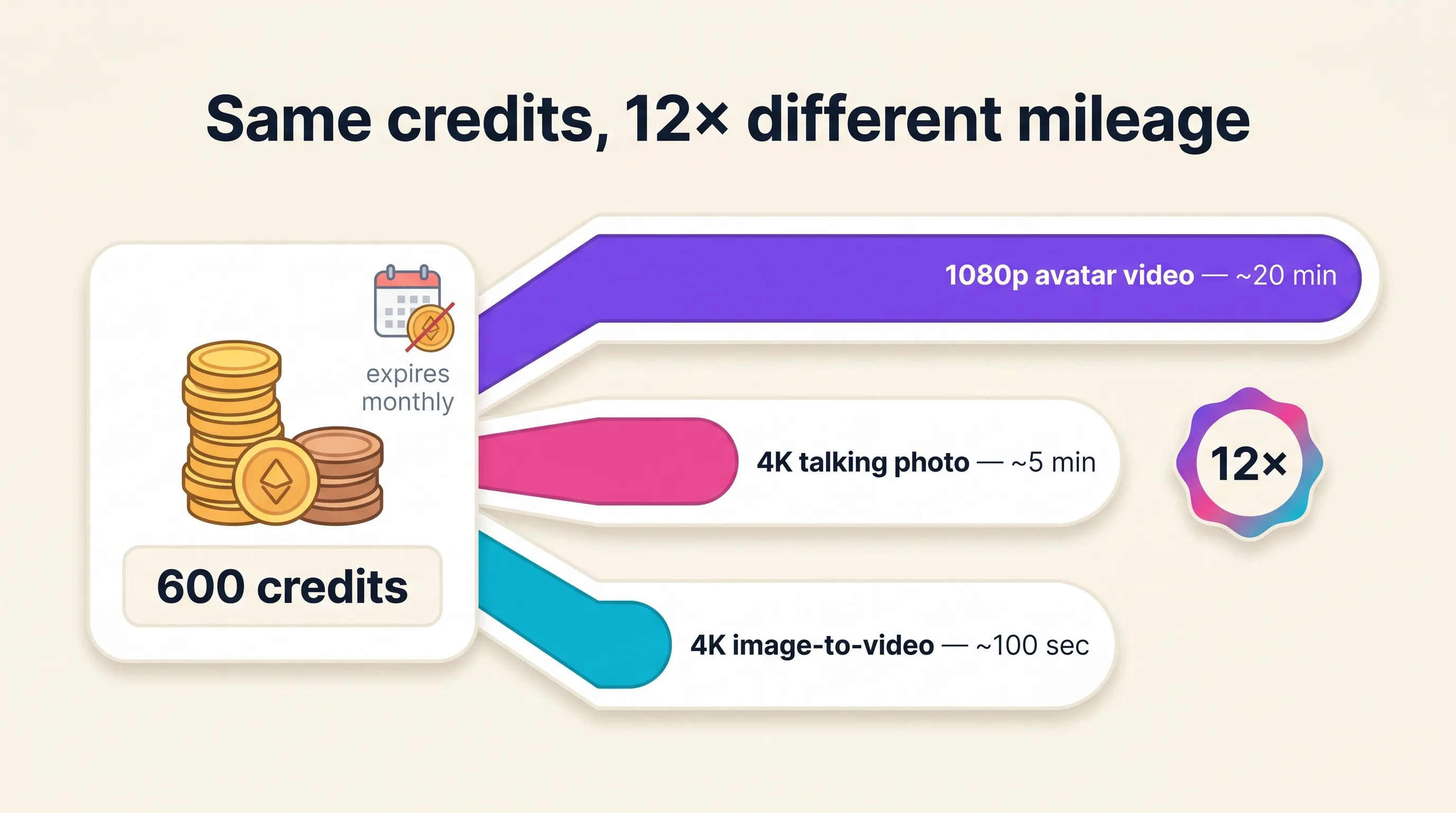
The same 600-credit Pro month buys roughly 20 minutes of 1080p avatar video, OR about 5 minutes of 4K talking photo, OR about 100 seconds of 4K image-to-video. That’s a 12× mileage spread on identical credits — and reviewers consistently name this unpredictable burn as Akool’s biggest frustration.
Per-seat pricing with no shared team pool
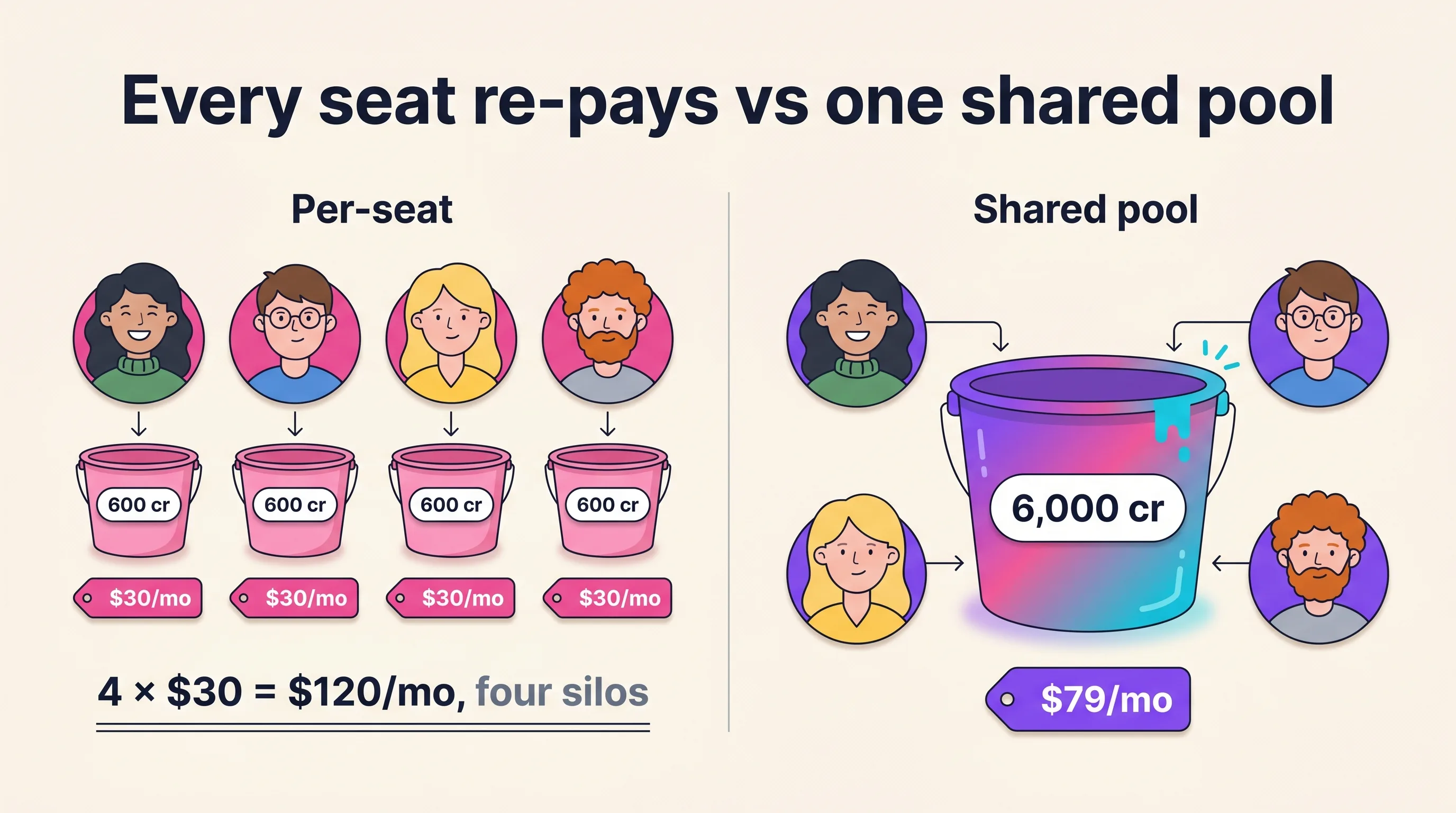
Akool’s own pricing page spells it out: “if the owner pays $30 a month for a PRO Plan, any added admins or editors will also be charged $30/month (per added member).” There is no shared credit pool. A four-person Pro team pays 4 × $30 = $120/mo for four siloed 600-credit balances.
Compare team models built around sharing: Playcut Studio is $79/mo flat for four seats drawing on one 6,000-credit pool, and HeyGen Business adds seats at $20. For agencies, the per-seat multiplication is often the deciding line item.
Placeholder pricing and the trust gap
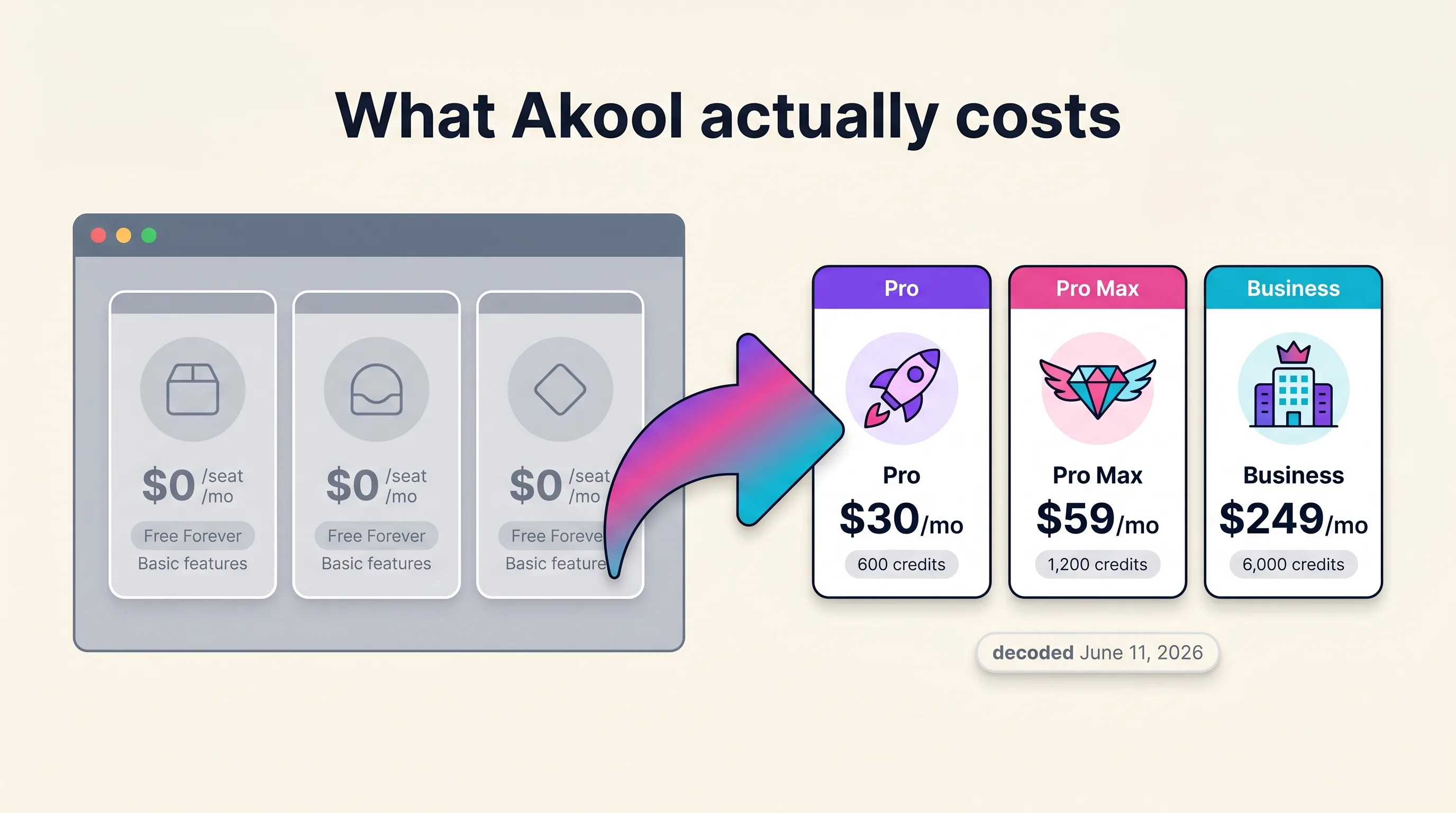
Load Akool’s pricing page without a session and every paid tier reads “$0 /seat /mo.” The real dollars are injected client-side, which is why review sites contradict each other on what Akool costs. It’s a trust problem before you’ve paid a cent.
The billing reviews extend the pattern. Independent reviewers report surprise charges for credits they didn’t intend to buy — some citing multiple charges in a single day — a strict no-refund policy, and a trial-cancel button that doesn’t work, forcing email-only cancellation. Others report 60-plus-minute processing waits on Pro, with faster generation positioned as a Pro Max upsell. These are paraphrased user reports, not audited findings.
What Akool actually costs in 2026
Akool’s real ladder: Pro from $15/mo (250 credits) or $30/mo (600 credits), Pro Max from $59/mo, Business from $249/mo — annual billing saves about 30%. We pulled those numbers from Akool’s own live plan data on June 11, 2026 — the part no page ranking for “akool pricing” gets right.
Because the pricing page renders $0 placeholders, third-party sites scrape stale caches and disagree: one lists Pro at $21, another puts Pro Max at $119 and Business at $500.
Each tier is a credit selector — you pick a credit amount within the tier, and the price scales. The canonical ladder, per seat:
| Tier | Monthly (per seat) | Annual (≈/mo, ~30% off) | Credit options |
|---|---|---|---|
| Basic (free) | $0 | — | Limited; 720p, 5-min video cap, watermark |
| Pro | $15 (250cr) · $30 (600cr) · $58 (1,200cr) · $109 (2,400cr) | $10 · $21 · $39 · $76 | 250 / 600 / 1,200 / 2,400 |
| Pro Max | $59 (1,200cr) · $119 (2,400cr) · $229 (4,800cr) · $449 (9,600cr) | $41.30 · $79 · $159 · $309 | 1,200 / 2,400 / 4,800 / 9,600 |
| Business | $249 (6,000cr) · $500 (12,000cr) · $1,000 (25,000cr) · $3,000 (80,000cr) | $174.30 · $350 · $700 · $2,100 | 6,000 / 12,000 / 25,000 / 80,000 |
| Enterprise | ”Let’s Talk” | — | Custom |
This is why other sites disagree: the “$21 Pro” figures floating around are annual-effective prices mislabeled as monthly, and the “$119 Pro Max / $500 Business” figures are mid-ladder credit options mistaken for entry prices. Pro Max starts at $59, Business at $249. Vidmetoo’s Akool pricing breakdown got fragments right; the plan data resolves the rest.
What the credits buy. At the documented burn rates, Pro’s headline $30/600cr works out to $1.50 per minute of 1080p avatar video (about $1.05 annual). Talking photos at 4K burn 120 credits a minute — four times the avatar rate — and face-swap video burns twice it. Every credit not spent by renewal day evaporates.
The feature ladder that does render (verified June 11, 2026): 720p on Basic, up to 4K on Pro, up to 8K on Pro Max; video length caps at 5 / 30 / 45 minutes; the watermark comes off on all paid plans. Developer docs live at docs.akool.com, and the API is genuinely productized — that matters for the “who should stay” section below.
How we ranked these Akool alternatives
Five weighted criteria, the same rubric family as our cross-vendor AI actor consistency benchmark:
- Character consistency across formats (35%) — does one identity hold across stills, motion, UGC, and product shots, or does the face drift as you move between tools?
- Verified, transparent pricing (20%) — real numbers from live vendor pages or plan data, checked June 11, 2026, with no placeholder games.
- Output breadth (20%) — talking heads only, or scenes, b-roll, and multi-format work?
- Honest free tier (10%) — what $0 actually buys, stated plainly.
- Real-time avatar depth (15%) — because streaming avatars are one of Akool’s genuine differentiators, any alternative claiming that lane needs to beat it there.
We cut several candidates to keep each slot distinct: Captions (mobile-editor register), CAMB.AI, Rask, and Vozo (dubbing-only — that persona routes to HeyGen and Synthesia below), and JoggAI/Creatify (UGC-ad niche, covered on our sibling roundups).
Akool alternatives compared at a glance
Character consistency sits in the top row because it’s the axis Akool structurally can’t win — its identity lives in separate tools, and the face changes as you move between them. All prices verified June 11, 2026, except where flagged.
| Playcut | HeyGen | Tavus | Synthesia | Hedra | Vidnoz | D-ID | Akool (baseline) | |
|---|---|---|---|---|---|---|---|---|
| Character consistency across formats | Holds one actor across stills + motion + UGC + product | Talking-head frame only | Replica holds in conversational frame | Studio talking-head only | Single-image character, frame-bound | Stock-avatar reuse, drift on re-render | Single photo, single frame | Identity drifts across its separate tools |
| Transparent entry price | $9/mo (Hobby) | $29/mo (Creator) | $59/mo (Starter) + usage | $29/mo (Starter) | $15/mo (Basic) | ~$26.99/mo (unverified) | from $5.90/mo (watermarked) | $15–$30/mo Pro — rendered as $0 to crawlers |
| Credits and seats | Shared workspace pools; credit packs never expire | Monthly credits; Business adds seats at $20 | Pay-as-you-go overages | Minutes quota | Monthly credits, no rollover | Daily free credits | Credits void monthly, 15s round-ups | Expire monthly; every seat re-pays full price |
| Free tier | 7-day trial on Hobby only, no perpetual free | 3 videos/mo, watermarked | 25 conv. min + 5 gen. min/mo | 10 min/mo, watermarked | Limited watermarked generations | Most generous in category, watermarked | 14-day trial, full-screen watermark | 720p, 5-min cap, watermark |
| Standout | One actor, every format | Translation + avatar realism (most-cited in 2026 roundups) | Real-time conversational video | SCORM + compliance | Expressive talking photos | Free face swap, price floor | Cheapest photo-animation API | Translate + face swap + streaming in one login |
The 7 best Akool alternatives in 2026
Each entry: what it is, where it beats Akool, verified entry pricing, the honest limitation, and a one-line verdict against Akool itself.
1. Playcut — best for one consistent AI actor across every format
Playcut wins this list on character consistency — the same actor, the same face, the same wardrobe across stills, motion video, UGC ads, and on-product compositing. Akool’s breadth is its weakness here: move a campaign from talking photo to avatar video to face swap and the identity drifts between tools.
The Playcut Actor Engine builds one custom AI actor from reference images, with locked appearance and outfit variants, then re-casts it identically everywhere. Voice is a separate engine — Playcut cannot bind a voice to an actor. In our May 2026 8-shot holdout, Playcut scored 9.5/10 on identity hold — no other platform tested above 7.5.
Measured, not asserted. In our published five-surface test, a single saved Playcut actor held a 0.78 mean ArcFace face-match cosine across five output surfaces (range 0.62 on a full pose-and-wardrobe change to 0.94 on a studio still), scored with ArcFace embeddings against the saved reference portrait. It measures Playcut self-consistency across formats; it is not a cross-tool benchmark. Method and per-surface scores live in our AI avatar generator guide.
Where it beats Akool. The localization job, with a face attached: you write the line in the target language and the video model performs it, so the spokesperson’s face stays identical market to market — the job Akool sells as “translate,” minus the drift.
Playcut ships no actor lip-sync and no dubbing; the standalone Voice Engine covers ten languages for separate voiceover audio. Rendering runs cinema-grade through the Actor Engine’s 2026 generation stack, and scene generation runs on Veo 3.1, Seedance 2.0, Nano Banana Pro, and Grok Imagine, well past the talking-head register.
Pricing (v2, current). Hobby $9/mo (3 custom actors, 500 credits) · Pro $29/mo (10 actors, 2,000 credits) · Studio $79/mo (4 seats sharing 6,000 credits) · Agency $149/seat (10,000 credits each, multi-brand kits). Annual saves 17%; credit packs never expire.
The Akool contrast is blunt: Pro’s $29 buys ten reusable custom actors at $2.90 each, while Akool’s $30 buys 600 expiring credits for stock or instant avatars — and re-bills the full $30 per added teammate.
Honest limitations. No perpetual free tier — the 7-day trial is Hobby-only and needs a card; Pro, Studio, and Agency bill at checkout. Playcut isn’t a real-time conversational or streaming-avatar product (Tavus below is the answer there), there’s no face-swap feature, and its economics favor short cinematic and UGC shots over hour-long talking-head rendering.
Playcut vs Akool in one line: Akool sells six tools that each render a slightly different person; Playcut sells one cast member who shows up everywhere. Pick Playcut if the same face has to live across formats, brands, or campaigns.

2. HeyGen — best for video translation and realistic marketing avatars
HeyGen is the clean exit for the marketer who bought Akool for translation. It pairs deep multilingual lip-sync with the most-cited avatar realism in 2026 roundups — and, crucially after Akool’s $0 placeholders, a pricing page that just says what things cost.
Where it beats Akool. Transparency and focus: Creator runs $29/mo ($24 annual) for 600 credits, 1080p export, and watermark removal — verified June 11, 2026. Pro at $49 adds 4K; Business at $149 adds seats for $20 each instead of re-billing the full plan. The free tier is honest too: 3 watermarked videos a month, non-commercial.
Honest limitations. Custom Digital Twins gate to Business at $149/mo, extra avatar slots carry one-time fees of $29–$199, and the register is talking-head-first — identity drifts outside that crop.
HeyGen vs Akool in one line: HeyGen does Akool’s most popular job with published prices and a shared-seat model. Pick HeyGen if translation-led marketing video is the whole brief — and see our full HeyGen alternatives breakdown if you’re weighing it as the anchor vendor.
3. Tavus — best for real-time streaming and conversational avatars
Tavus is the deeper answer to Akool Live Avatar. Its Conversational Video Interface runs real-time, sub-second face-to-face AI conversation, with replica training handled programmatically — the category’s real-time leader in 2026.
Where it beats Akool. Conversation depth and developer ergonomics — Tavus goes further than Akool’s Live Avatar on perception, turn-taking, and latency in one API stack. The ladder, verified June 11, 2026: a free tier with 25 conversational minutes and 5 generation minutes per month, Starter at $59/mo (100 conversational minutes, 10 generation minutes, 3 replica trainings, overages at $0.37 and $1 per minute respectively), then Growth at $397/mo.
Honest limitations. Pay-as-you-go costs are harder to forecast than Akool’s flat credit tiers, enterprise contracts carry a high floor, and the register is talking-head-first. Our Tavus alternatives roundup covers the reverse decision.
Tavus vs Akool in one line: Tavus wins the real-time conversation race; Akool wins simpler flat pricing for casual streaming use. Pick Tavus if you’re embedding a live avatar into a product and can absorb usage-based billing.
4. Synthesia — best for enterprise localization and L&D
Synthesia is where teams land when Akool’s translate feature meets a compliance checklist. It ships 140+ languages, SCORM export into the major LMS platforms, and the deepest enterprise certification stack among avatar vendors.
Where it beats Akool. Governance — the structured workspaces and LMS handoff that procurement actually asks about. Starter runs $29/mo monthly or $18/mo annual for 10 minutes of video a month (the annual plan pools 120 minutes a year); Creator is $89/mo ($64 annual). Verified June 11, 2026.
Honest limitations. SCORM, SSO, and brand kits gate to Enterprise. Custom studio avatars cost about $1,000/year each, and the minutes-quota model penalizes high-revision workflows much as Akool’s expiring credits do.
Synthesia vs Akool in one line: if your localization output feeds an LMS and a compliance review, Synthesia wins; if it feeds a social feed, look at HeyGen instead. Pick Synthesia if you’re a training or localization team at enterprise scale — our Synthesia alternatives roundup maps the reverse switch.
5. Hedra — best expressive talking-photo replacement
Hedra is the like-for-like upgrade for Akool’s Talking Photo. Its Character-3 model turns a single image into a character that emotes, sings, and gestures — a register more alive than the standard photo-animation loop.
Where it beats Akool. The economics of this one feature: on Akool, 4K talking photos burn 120 credits a minute, so the $30 Pro month yields about 5 minutes.
Hedra Basic costs $15/mo for 1,500 credits — roughly 4.2 minutes of Character-3 output with commercial use included, comparable mileage at half the sticker. Creator is $30/mo (5,400 credits), Professional $75/mo (14,400); verified June 11, 2026 — re-check credit counts at purchase, as Hedra adjusts them.
Honest limitations. Output is 720p-centric, monthly credits don’t roll over (the same expiry model you’re escaping), and there’s no enterprise or compliance story.
Hedra vs Akool in one line: same trick, livelier performance, simpler bill. Pick Hedra if talking photos are genuinely your whole Akool use case.
6. Vidnoz — best free face swap and budget talking heads
Vidnoz answers Akool’s face-swap roots at a price of zero. Its free tier — the most generous in the category — includes face swap, daily free credits, and a large stock-avatar library, no card required.
Where it beats Akool. The $0 test, especially after the surprise-charge complaints in Akool’s reviews. Vidnoz’s free output is watermarked, capped near three minutes at 720p, and non-commercial — but it’s a real sandbox. Paid plans run around $26.99/mo (about $19.99 annual) with commercial rights (unverified — the page renders promo-framed credit pricing; confirm at checkout).
Honest limitations. It’s a single-purpose budget tool: no streaming avatars, no real translation pipeline, and the free tier is a demo, not production. Our Vidnoz alternatives roundup covers where it tops out.
Vidnoz vs Akool in one line: Vidnoz is the free sandbox; Akool is the paid toolbox. Pick Vidnoz if you want face swap and talking heads at zero risk while you learn.
7. D-ID — best cheap photo-to-video API
D-ID is the developer’s version of Akool’s talking-photo trick. It pioneered photo-to-video, and its API remains the cheapest credible entry in the category: Build at $18/mo, verified against D-ID’s live pricing data June 11, 2026.
Where it beats Akool. Programmatic photo animation at scale, with a mature API and an Azure/Microsoft Teams channel no one else here has. Studio plans start at Lite from $5.90/mo — but clean output doesn’t arrive until Advanced at $196/mo.
Honest limitations. Fixed-frame talking heads only, credits that void monthly with 15-second round-ups, and watermarks across the affordable tiers. The full teardown is in our D-ID alternatives breakdown.
D-ID vs Akool in one line: D-ID wins the photo-animation API on price; Akool wins breadth beyond the photo. Pick D-ID if you’re animating photos programmatically and can live inside the watermark ladder or the $196 clean tier.
Which Akool alternative fits your workflow
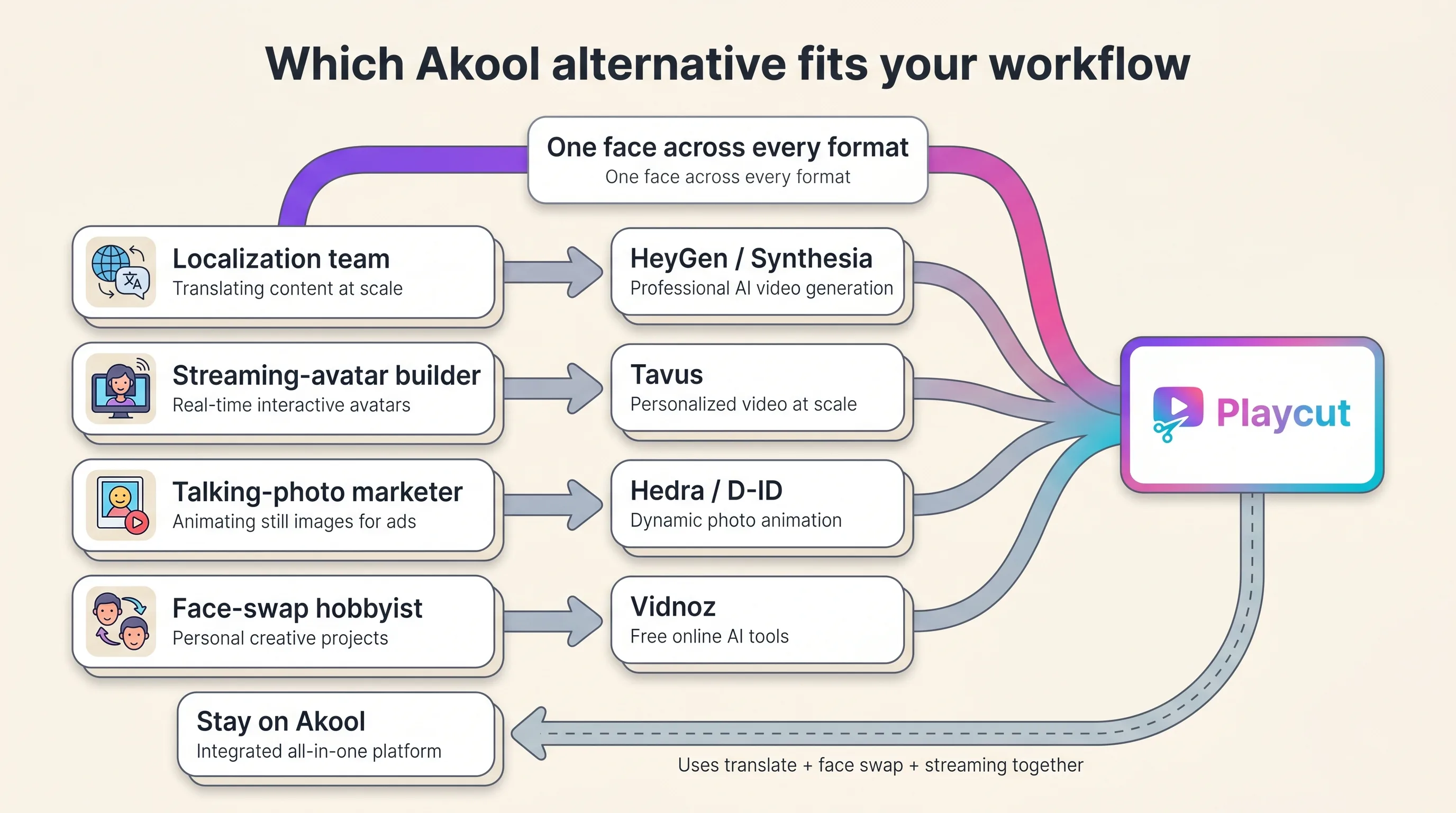
Route by the Akool you actually use. The matrix below maps each persona and symptom to the honest pick — including a branch that ends at “stay.”
| Your situation | Symptom | Pick | Why |
|---|---|---|---|
| Localization team on Video Translate | Credit burn + per-seat multiplication | HeyGen or Synthesia | Transparent pricing; deeper language and compliance stories |
| Streaming / Live Avatar builder | Needs deeper real-time control via API | Tavus | Category-leading conversational video; accept usage-based billing |
| Talking-photo marketer | Credits vanish on 4K output | Hedra or D-ID | Like-for-like upgrade; cheaper per finished minute |
| Face-swap hobbyist | Surprise charges, wants a free lane | Vidnoz | Free face swap; accept watermark and no commercial use |
| Brand or agency needing one face everywhere | Identity drifts across Akool’s separate tools | Playcut | Actor Engine consistency across formats; shared team pools; $2.90/actor at Pro |
| Developer animating photos at scale | Wants programmatic and cheap | D-ID | Build $18/mo is the API price floor |
| Enterprise localization with audit requirements | No SCORM/SSO governance | Synthesia | 140+ languages plus the compliance stack |
| Genuinely using translate + face swap + streaming in one login | None — it works | Stay on Akool | Breadth-in-one-login is real; no alternative here replicates all three |
Who should stay on Akool
An honest alternatives list routes some readers back. Three groups should probably keep their subscription.
Teams using the whole toolbox. If translate, face swap, and streaming avatars all carry real workload in your month, no single tool here replaces all three — face swap in particular has no like-for-like slot in this roster outside Vidnoz’s free demo lane. Consolidation has a price, and you’re getting it.
Streaming-avatar users who don’t need an API deep-dive. Akool’s Live Avatar is genuinely productized — kiosk and web-embed deployments work today. If Tavus’s usage-based model is more machinery than you need, staying is rational.
Dabblers at the $15 on-ramp. Pro’s 250-credit option at $15/mo is one of the cheapest paid entries in the category. If your usage is light and single-seat, the per-seat and burn-rate problems above mostly don’t apply to you.
Switching from Akool: a practical 5-step guide
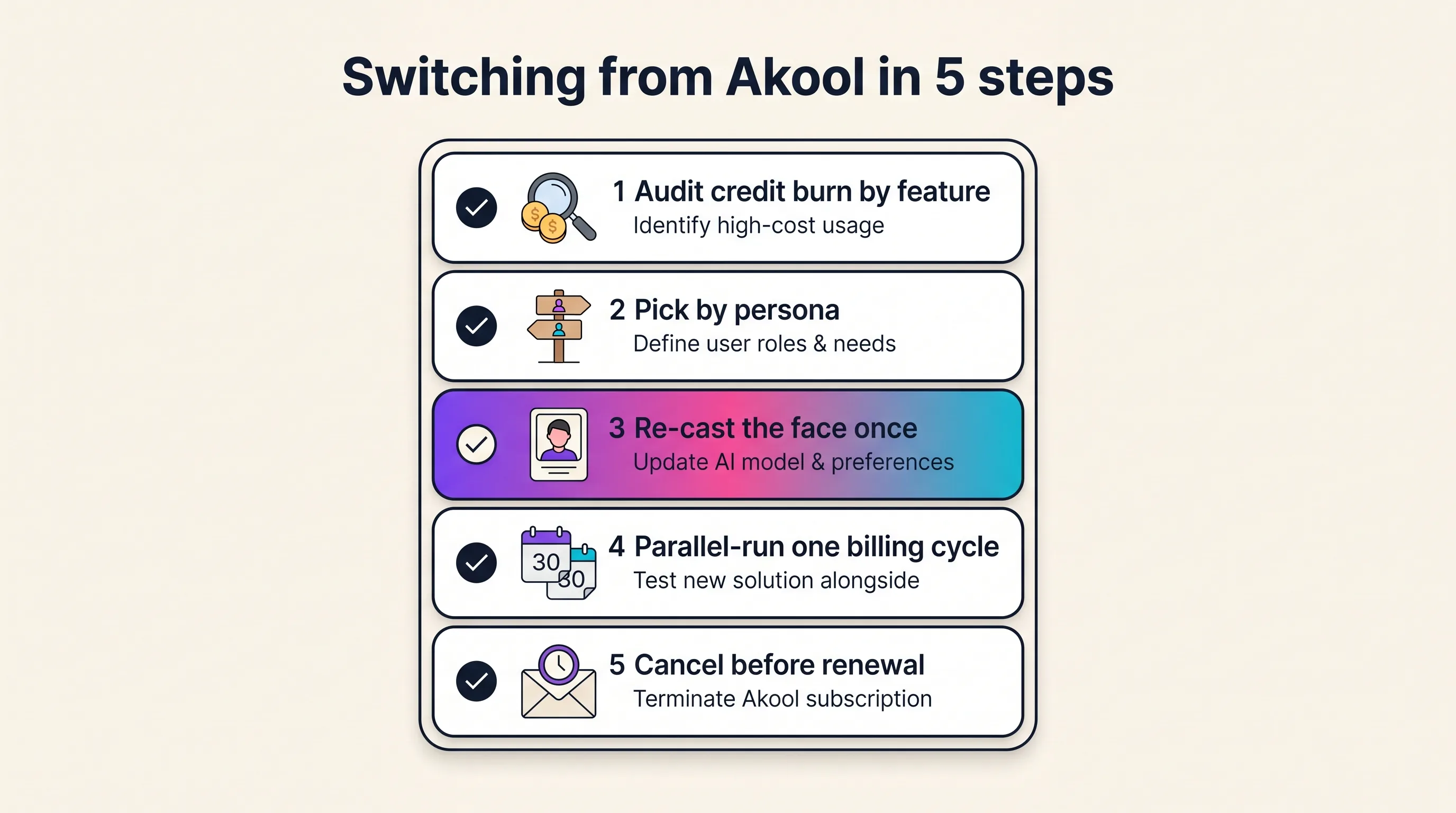
Step 1 — Audit your credit burn by feature, and export everything. Pull three months of usage split by surface: translate minutes, talking-photo minutes, face swaps, streaming time. The split tells you which persona you are — and how much spend evaporated as expired credits. Download every asset; access ends with the subscription.
Step 2 — Pick by persona, not by feature list. Use the matrix above. Localization routes to HeyGen or Synthesia, streaming routes to Tavus, talking photos route to Hedra or D-ID, face-swap hobbyists route to Vidnoz, and multi-format brands route to Playcut.
Step 3 — Re-cast the face once. Akool identities don’t migrate. On Playcut, create the replacement in the Actor Engine: describe the character or work from a reference, lock appearance, save outfit variants. Thirty minutes, reusable forever — the AI avatar generator page walks the workflow.
Step 4 — Parallel-run one billing cycle. Keep Akool live for one month while the replacement carries matched real briefs. Compare finished-asset cost — including re-renders and expired credits — not plan stickers.
Step 5 — Cancel before renewal, in writing. Akool’s review pattern includes a non-functional trial-cancel button, email-only cancellation, and a strict no-refund stance, per independent reviewers. Don’t treat a refund as your safety net: email the cancellation several days before renewal and keep the confirmation.
Frequently Asked Questions
What is the best Akool alternative?
It depends on the job. Playcut is the pick for one consistent custom actor across stills, video, and UGC ads (Pro $29/mo, 10 custom actors). HeyGen covers video translation and marketing avatars, Tavus wins real-time streaming avatars, Synthesia wins enterprise localization, and Hedra is the like-for-like upgrade for Akool’s talking photos.
How much does Akool cost in 2026?
Decoded from Akool’s own live plan data on June 11, 2026: Pro from $15/mo (250 credits) or $30/mo (600 credits — about 20 minutes of 1080p avatar video); Pro Max from $59/mo (1,200 credits); Business from $249/mo (6,000 credits). Annual billing saves about 30%. Credits expire monthly, and every added seat re-pays the full tier price.
Why do Akool prices show as $0?
Akool’s pricing page renders “$0 /seat /mo” placeholders to crawlers and fresh page loads; real prices are injected client-side. That’s why third-party sites report conflicting numbers — annual-effective prices mislabeled as monthly, mid-ladder options mistaken for entry prices. The accurate ladder (Pro $30, Pro Max $59, Business $249 monthly) comes from Akool’s own plan data.
Is there a free Akool alternative?
Vidnoz has the most generous free tier in the category, and it includes face swap — watermarked, 720p, non-commercial. HeyGen (3 videos/month) and Hedra (limited generations) ship watermarked free tiers too. Akool’s own Basic tier is free but capped at 720p and 5-minute videos, with a watermark.
What is the best Akool alternative for video translation?
HeyGen, for multilingual marketing video with transparent $29/mo pricing — or Synthesia, for enterprise localization with 140+ languages, SCORM export, and compliance posture. Both avoid Akool’s per-seat credit multiplication. If the translated campaign also needs one consistent on-screen face, Playcut holds a single locked actor across every market cut — the video model speaks each localized line, since no voice is ever bound to an actor.
Why are people leaving Akool?
Four patterns recur across independent reviews: credits that expire monthly and burn unevenly by feature (a 4K talking photo drains credits four times faster than a 1080p avatar), per-seat pricing with no shared pool, surprise and repeat charges paired with a strict no-refund policy and a broken trial-cancel button, and “$0” placeholder pricing that erodes trust before you pay.
Akool vs HeyGen: which is better?
HeyGen is the cleaner pick for multilingual marketing avatars — the most-cited avatar tool in 2026 roundups — with transparent $29/mo Creator pricing and seats at $20 on Business. Akool keeps the breadth case: face swap plus streaming avatars in one login. Localization marketers should pick HeyGen; teams genuinely using Akool’s full spread may stay.
How is Playcut different from Akool?
Akool spreads work across separate tools — translate, face swap, talking photo, streaming avatar — and the face drifts between them. The Playcut Actor Engine builds one custom AI actor with locked appearance and wardrobe, reused with 100% character consistency across stills, video, UGC ads, and product shots. Plans start at Hobby $9/mo; Pro is $29/mo with 2,000 credits.
Verdict
If one face has to live across your whole creative surface, Playcut is the #1 Akool alternative — 100% character consistency from a single trained actor, shared team credit pools instead of per-seat re-billing, and ten custom actors at $2.90 each on Pro.
The concessions are published openly: HeyGen and Synthesia take the translation lane, Tavus takes real-time conversation, Hedra takes the expressive talking photo, and Akool keeps the breadth crown for teams that truly use the whole toolbox.
What no alternative should make you accept in 2026: a pricing page that renders $0, credits that expire monthly while burning at 12× variance across features, and a bill that doubles every time you add a teammate. Every tool on this list clears at least two of those bars — most clear all three.
Replace the toolbox with a cast member.
Playcut Pro ships ten custom AI actors at $2.90 each — one dollar less than Akool’s 600-credit Pro, with 2,000 credits in a shared workspace, ten voice languages, and the same face across stills, video, UGC ads, and product shots. Test-cast on Hobby’s 7-day trial; Pro bills at checkout.
Cast your first AI actor →
Not ready to sign up? Try the free creator tools →