
AI Spokesperson: Build a Brand Face That Never Drifts (2026)
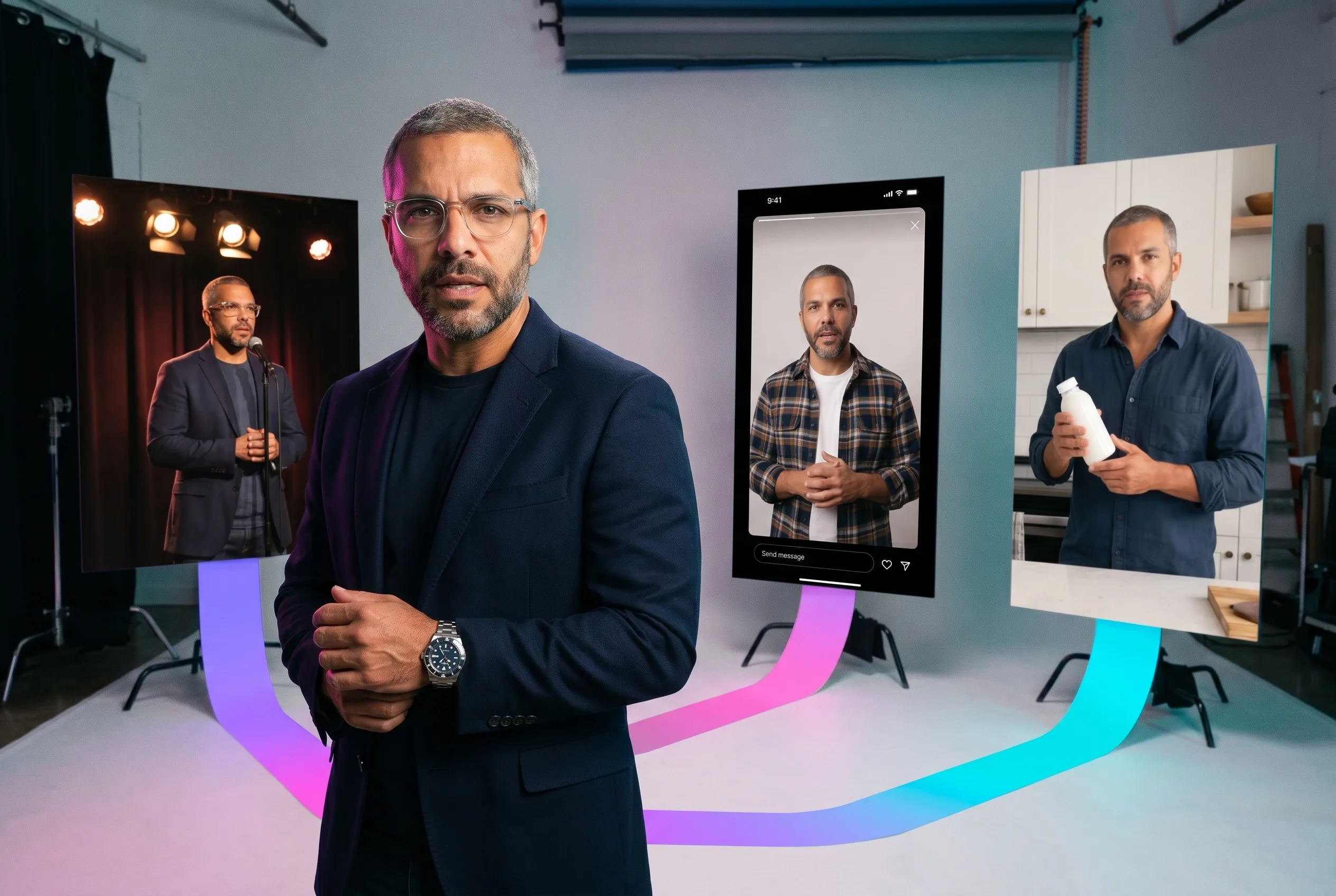
An AI spokesperson is a persistent, AI-generated brand presenter — one face and one voice that fronts your explainers, courses, social video, and multilingual content without session fees, holding fees, or usage renewals.
The standard that makes the role work is 100% character consistency across stills, motion video, UGC ads, and on-product compositing — the same actor, the same face, the same brand voice across every shot in your campaign. That is what the Playcut Actor Engine is built to hold.
Our verdict up front: build the spokesperson as a custom actor you own — Playcut includes three at $9/month — not a stock face you rent by the video. We built one and shot him across four commercial contexts: 4/4 first-take, identity verified by ArcFace at a 0.6004 mean cosine across all six pairs, $3.89 for the set.
This guide prices both sides of the ledger — union session fees, holding-fee meters, creator retainers — against a measured AI program cost, then walks the five-step build, the platform comparison, and the disclosure rules. All pricing verified June 11, 2026.
Table of Contents
- What is an AI spokesperson?
- What a traditional spokesperson costs
- We built one and measured it
- Build the program in 5 steps
- AI spokesperson platforms compared
- Five jobs for an AI spokesperson
- Rights and disclosure
- Frequently asked questions
- Verdict: own your spokesperson
What is an AI spokesperson?
An AI spokesperson is a synthetic on-camera presenter with a persistent identity — a saved face, voice, and wardrobe that returns unchanged in every video the brand ships. The persistence is the definition. A tool that generates a different attractive face per clip makes AI videos, not a spokesperson.
Vendors blur the term — tool landing pages use spokesperson, presenter, and avatar interchangeably. They are three different things.
Spokesperson vs AI actor vs AI avatar: role, asset, format
- The spokesperson is the role. A named, persistent presenter with a speaking register and a wardrobe — plus the program around it: which formats it fronts, in which markets.
- The AI actor is the asset that plays the role. A saved identity — appearance, voice, and outfit variants — portable across stills, motion video, and ads. The asset taxonomy lives in our AI actor guide.
- The AI avatar is the format most tools ship. A talking-head frame driven by a script — the technology is covered in the AI avatar generator guide, and you can build one directly.
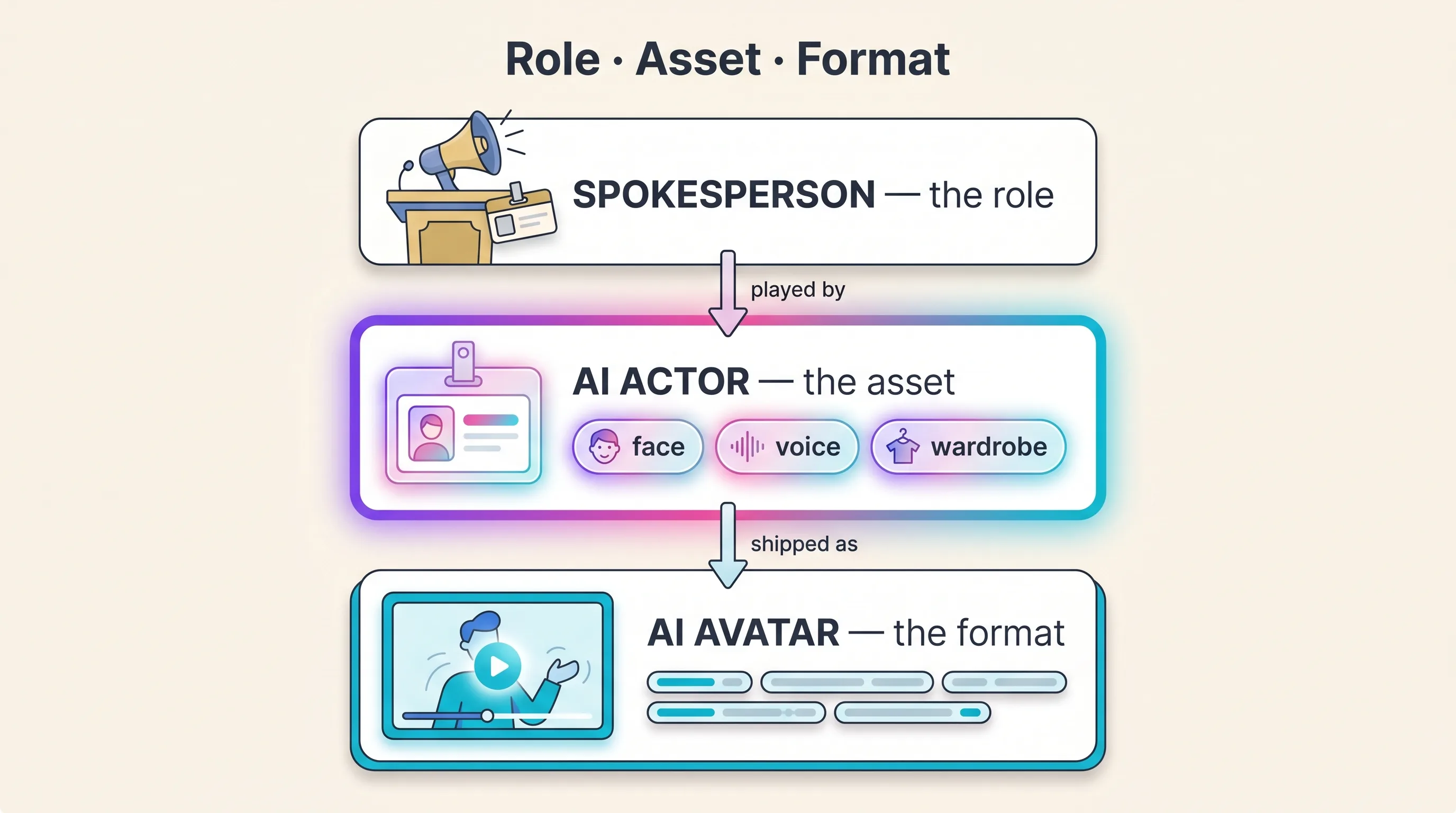
The mapping mirrors the buying decision: buy at the format level and you re-buy the face with every order; buy at the asset level and the spokesperson compounds instead of resetting.
The older term virtual spokesperson predates AI: agencies sold green-screened human presenters embedded on websites, priced per minute. The per-minute economics survived; the human in the green-screen room is what changed.
Is an AI presenter the same thing?
An AI presenter here means a synthetic on-camera host — the talking-human sense. Half the tools ranking for the phrase are slide-deck generators (Gamma- and Canva-class) that present decks, not faces; nothing in this guide is about slides.
What a traditional spokesperson costs in 2026
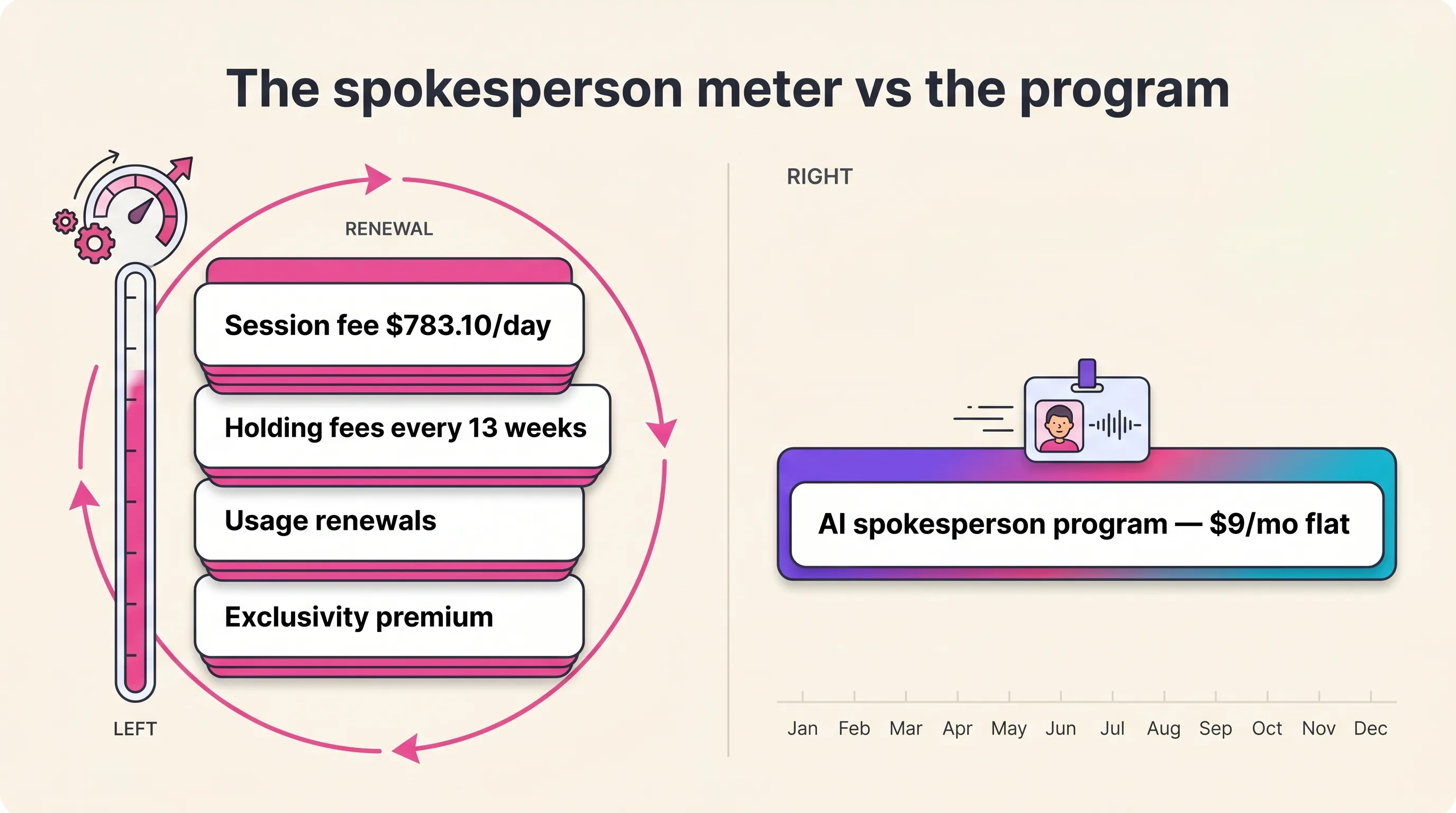
A human spokesperson costs between $783.10 for one union session day and tens of millions for a celebrity deal — and the sticker is never the real number. The real number is the meter: holding fees, usage renewals, exclusivity premiums, and re-shoot days that recur for as long as the face stays on the brand.
Celebrity and ambassador money
George Clooney’s Nespresso deal is widely reported around $40 million multi-year, Beyoncé’s Pepsi at $50 million, Taylor Swift’s Diet Coke at $26 million; B- and C-list personalities land between $10,000 and $500,000 per deal by industry-tracker consensus. None of it buys the face — it licenses it, for a window, in a territory, with renegotiation built in.
Professional talent: the session fee is the cheap part
Hire union talent for a commercial and the on-camera session fee is $783.10 per eight-hour day under SAG-AFTRA’s Class A commercial rates, per Wrapbook’s SAG rates guide; theatrical work runs $1,246 per day or $4,326 per week. That fee buys the shoot day — not the right to keep airing the spot.
Usage stacks on top — the more a Class A spot airs, the more you pay — and holding fees recur on fixed 13-week cycles to keep the performer exclusive and the spot airable; stop paying and the rights lapse. Pension and health contributions add roughly 23.5% on covered earnings.
The 2025 Commercials Contract went further on digital replicas: 48 hours’ notice before creating or using one, written consent in a rider, and 1.5× the scale session fee per commercial that uses it — plus full use and holding fees as if the performer had worked in person.
Under union terms, digitally replicating your human spokesperson is contractually more expensive than hiring them — precisely why fully synthetic spokespersons, faces that are no one’s likeness, became the budget path.
Production stacks on top. A basic talking-head corporate video runs $1,500–$5,000 and typical projects span $3,000–$50,000, per Vidico’s corporate video cost data; marketplace surveys put non-union on-screen talent at $50–$500 an hour, plus director, DP, and camera-operator day rates. Every re-shoot — new product, new message, new language — re-incurs all of it.
Creator ambassadors: the per-post rate card
The influencer lane looks cheaper until the meter shows up. Shopify’s influencer pricing guide (February 2026) puts Instagram sponsored posts at $25–$150 for nano creators, rising through $250–$5,000 (micro) and $1,600–$10,000 (mid-tier) to $10,000–$50,000+ for mega accounts; TikTok runs $5–$200 up to $7,000–$20,000+.
Brand-ambassador programs layer 6–12-month retainers on top, typically two to four posts per month. Usage rights for paid ads cost extra, and exclusivity — in Shopify’s phrasing — “can significantly increase rates.” You license content; you never own the face.
The meter problem, in one table
Side by side, the pattern holds: traditional spokesperson economics charge per appearance and per renewal, and ownership never transfers.
| Spokesperson type | Upfront | Recurring | What you own |
|---|---|---|---|
| Celebrity endorser | $10K–$500K (B/C-list) → $1M+/yr (A-list) | Renewals + usage + exclusivity | Nothing — their face, their terms |
| Union professional | $783.10 per 8-hr session + $3K–$50K production per video | Holding fees every 13 weeks + per-use fees | The spot, for the licensed window |
| Creator ambassador | $250–$10K per post (micro–mid) | Monthly retainer; usage and exclusivity billed extra | Content licenses, not the face |
| Done-for-you AI service | ~$249 for the first minute | ~$100 per additional minute, every video | Finished videos only |
| AI spokesperson platform (Playcut) | $9–$29/mo | $0.97/still · $3.48/voiced 6-s hook · ~$16/voiced 30-s clip; no holding fees or usage renewals | The actor: face + voice + wardrobe, every output, full commercial rights |
A year of a Playcut Hobby spokesperson program — $108 on monthly billing, $90 paid annually — is less than one-seventh of a single union session fee, before a dollar of crew, studio, or holding fees enters the frame. And no 13-week meter is running.
Done-for-you AI spokesperson services vs owning the platform
AI spokesperson services split into two models; volume decides between them. A done-for-you agency produces the AI spokesperson videos for you: Gisteo’s AI Spokesperson Agency charges $249 for the first 60 seconds and $100 per additional minute, scriptwriting and two revisions included. You get finished files; the agency keeps the workflow.
A platform sells the opposite: you own the spokesperson — actor, voice, and wardrobe — and generate as much as your credit pool covers. One video means buy the service; a permanent brand face means own the platform. Playcut sits in the platform lane — the actor lives in your workspace and attaches to every shoot.
We built an AI spokesperson and measured it
On June 11, 2026, we ran the thesis as a lab: one saved Playcut actor — Andre Laurent, mid-40s, salt-and-pepper hair, clear-frame glasses, steel dive watch — shot across four commercial contexts in one sequential session. Every shot landed first-take. Total time, first request to fourth finished still: 4 minutes 46 seconds.
The contexts were chosen to stress identity, not flatter it: three wardrobe changes, four lighting regimes, and three aspect ratios across a studio explainer, a tungsten-lit keynote stage, a golden-hour vertical, and a bright-kitchen product shot.
| # | Context | Aspect | Render time | Credits | Attempts |
|---|---|---|---|---|---|
| A | Corporate explainer (daylight studio) | 16:9 | 19.2 s | 67 | 1 |
| B | Keynote / trade-show wide (stage, audience bokeh) | 16:9 | 21.1 s | 67 | 1 |
| C | Social vertical, casual register (golden-hour loft) | 9:16 | 20.5 s | 67 | 1 |
| D | Product presenter (skincare bottle, kitchen set) | 4:5 | 20.4 s | 67 | 1 |
Mean render time: 20.30 seconds per still. The continuity anchors — clear-frame glasses and steel dive watch, required visible in every frame as the consistency tell — held in all four shots.
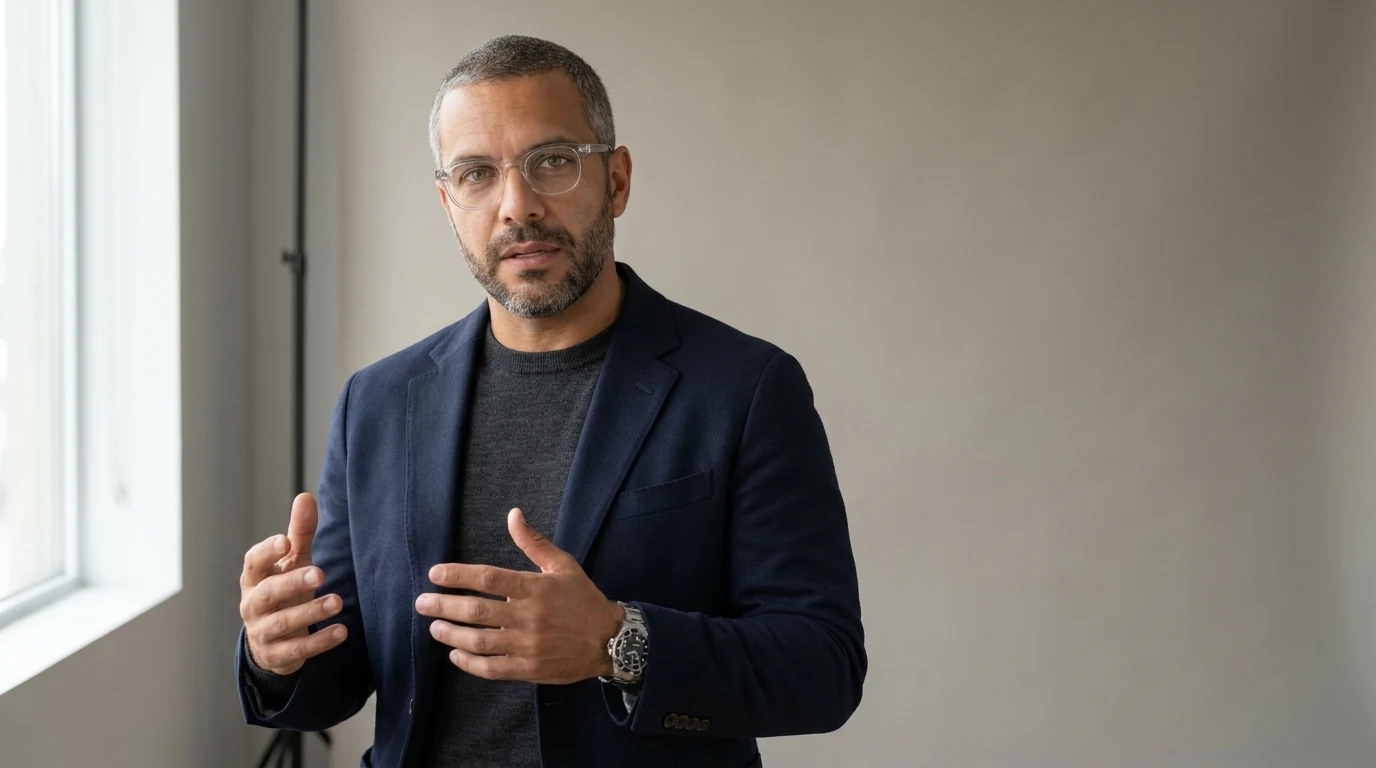
Context A, the corporate explainer register — first take, 19.2 seconds.
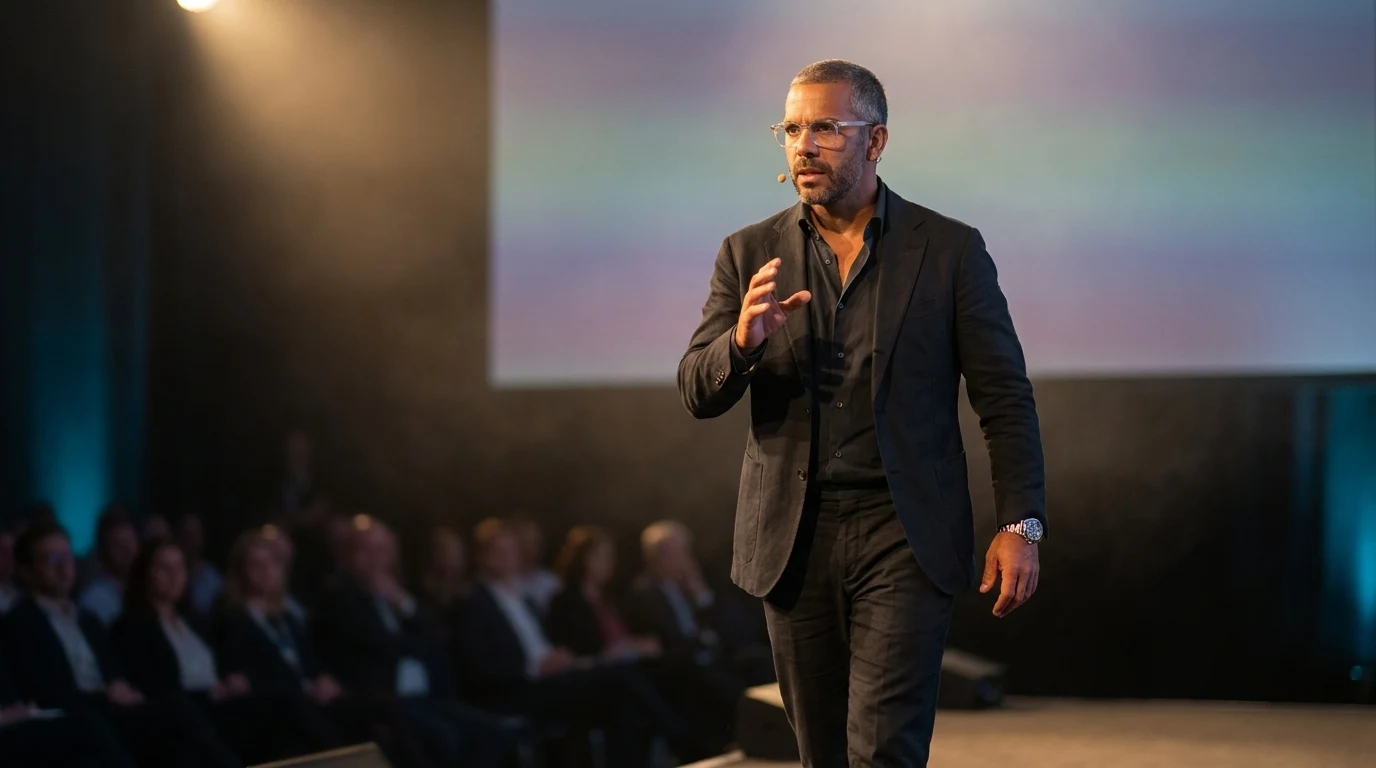
Context B, the keynote wide — the smallest face and hardest test in the matrix below.
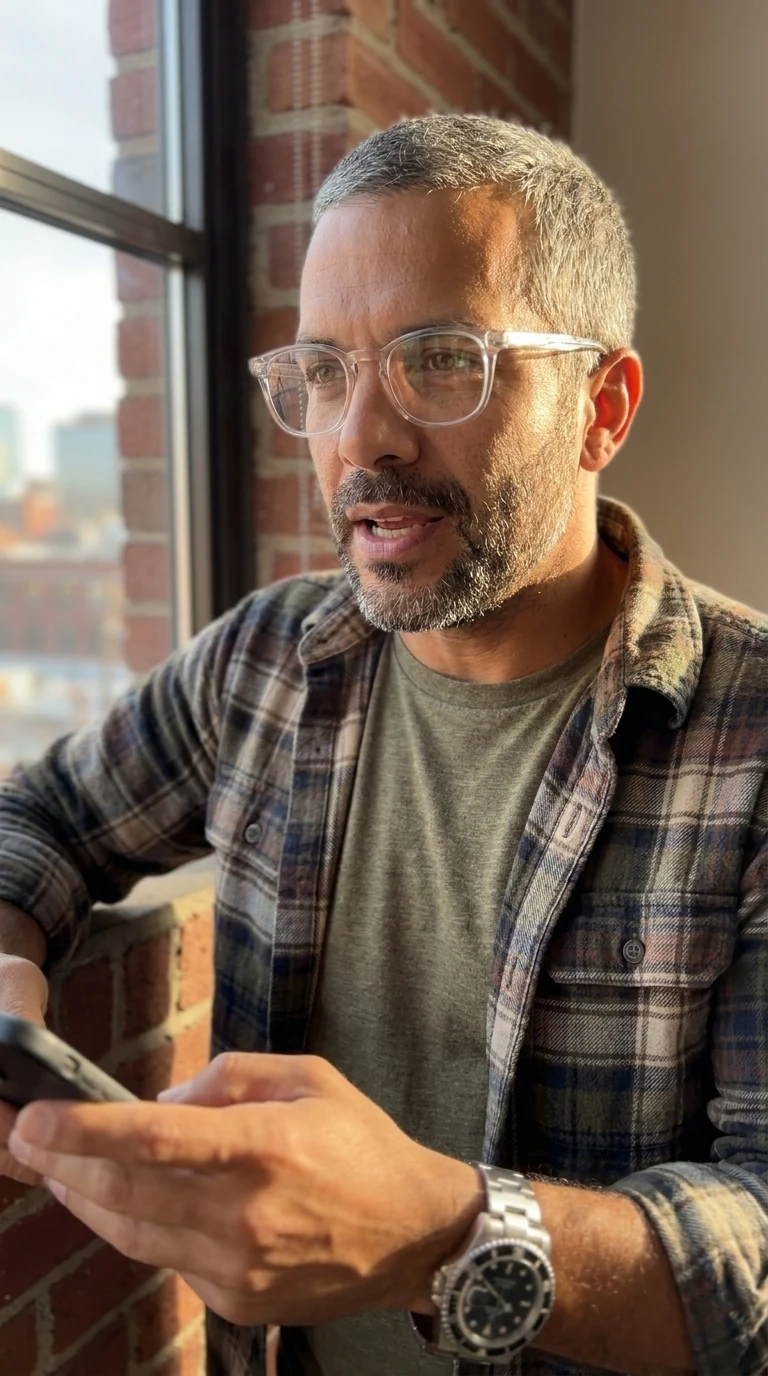
Context C, the 9:16 social register — three of four lab contexts pictured, one saved actor, same face in every panel.
The identity numbers
Visual sameness is cheap to claim, so we measured it with ArcFace — the face-recognition model whose embedding cosine separates same-person pairs (roughly 0.4–0.9+) from different people (0.0–0.3). All six pairs of the four contexts:
| Cosine | B · keynote | C · social | D · product |
|---|---|---|---|
| A · corporate | 0.5987 | 0.6274 | 0.6834 |
| B · keynote | — | 0.5395 | 0.5423 |
| C · social | — | — | 0.6110 |
Mean of all six pairs: 0.6004 (min 0.5395, max 0.6834). Every pair sits comfortably in same-person territory across aggressive context shifts. The two lowest pairs both involve the keynote frame — where the face is smallest and the lighting harshest, exactly where a wide shot should cost some embedding similarity — and both still clear the bar with margin.
No reference image was re-uploaded between shots — the only identity input was the saved actor ID. That is the spokesperson mechanic: the identity lives in the actor, not in a photo you keep re-processing.
This run extends two earlier measurements. In our May 2026 8-shot holdout, Playcut scored 9.5/10 on identity hold — no other platform tested above 7.5. A saved actor also previously held a 0.78 mean ArcFace cosine across five output surfaces. It measures Playcut self-consistency across formats; it is not a cross-tool benchmark.
What the program costs
The four-context set burned 268 credits — 67 per still, metered and twice reconfirmed by clean balance reads. At Pro rates ($29/month, 2,000 credits) that is $3.89 for the full set, or $0.97 per still; at Hobby ($9/month, 500 credits), $4.82.
A monthly four-context refresh — new wardrobe, season, or campaign — costs 3,216 credits a year: 53.6% of Hobby’s pool. A $9/month Hobby plan runs the entire 12-month program with 232 credits of monthly headroom — $108 a year, or $90 paid annually.
One honest framing note: the subscription buys the whole studio — the marginal cost of a refresh is the $3.89–$4.82 set.
When the spokesperson graduates to voiced video: 30 credits per scene start, plus 15 per second of video and 20 per second of Playcut Voice Engine audio — $3.48 for a voiced six-second hook, about $16 for a voiced 30-second clip (three 10-second scenes) at Pro rates.
How we measured: n = 4 stills, one per context, first outputs kept — zero regens used. June 11, 2026, Playcut Actor Shoot, 1K outputs, one saved actor, sequential run. Face match: InsightFace buffalo_l (ArcFace), cosine on L2-normalized embeddings, largest face per image. Limits: one actor, stills only — nothing here measures spokesperson video — self-run on our own platform, no external raters.
Two prompt deviations, disclosed: the keynote rendered a conference headset mic where the prompt specified a lavalier, and the social vertical put the phone in his hands instead of off-frame. Neither breaks usability — and ArcFace measures the face, not the props.
How to build an AI spokesperson program in 5 steps
The build takes an afternoon; the discipline is treating the spokesperson as a program, not a video order. The steps below are the Playcut flow — the program’s home in the product is the AI actor library — and they generalize to any platform that saves identities.
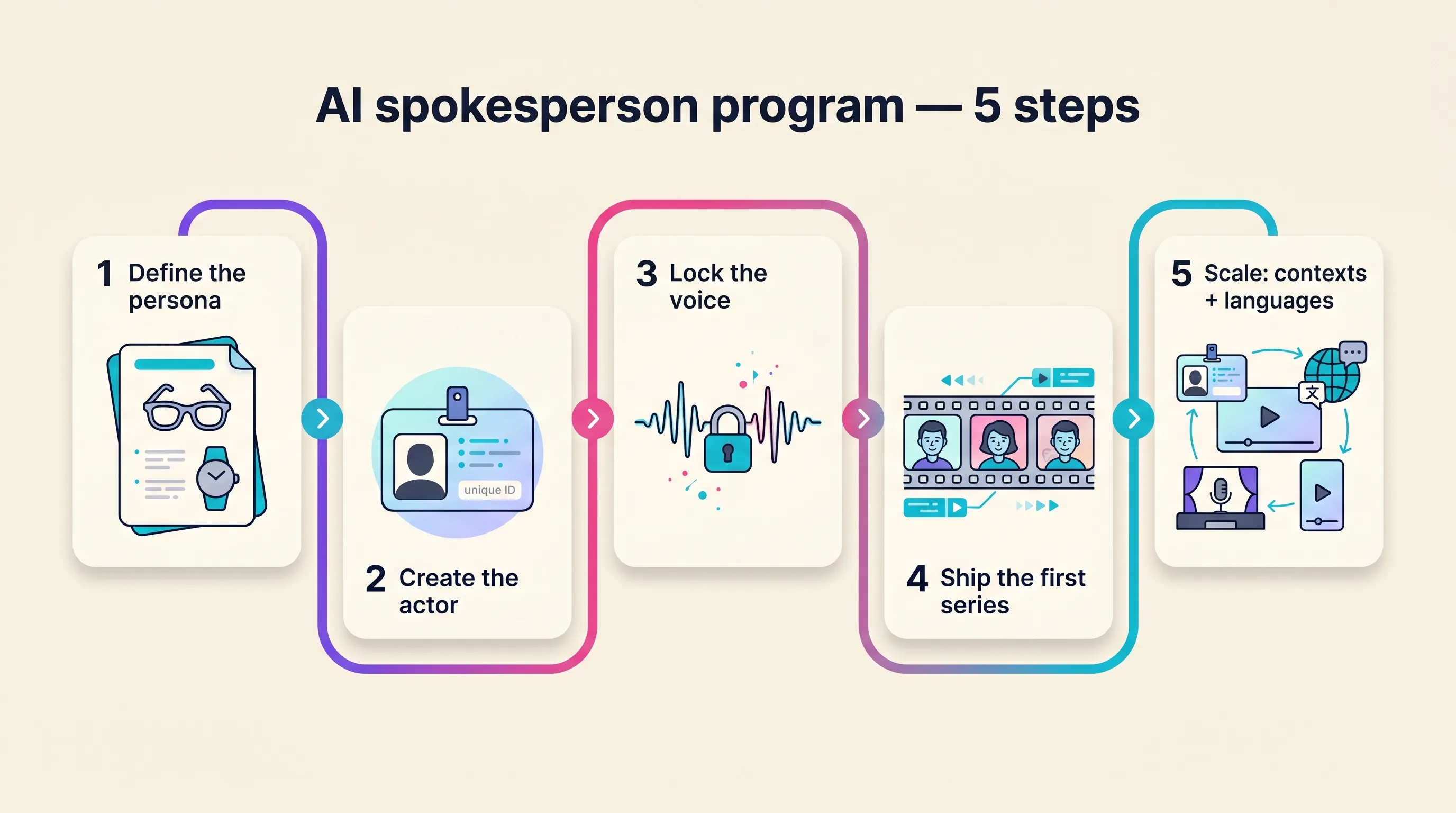
Step 1: Define the persona
Write the persona before generating anything: a name, an age range, a speaking register (authority, practitioner, peer), and two or three wardrobe anchors. The anchors matter most — our lab actor’s clear-frame glasses and steel dive watch are continuity tells that make drift instantly visible. The free AI actor persona builder structures this in ten minutes.
Step 2: Create the actor
Build the actor from plain-language descriptors, or from a photo if the spokesperson should look like you or your founder — the photo path is its own tested workflow. Either way, the output is a saved actor with a stable ID in your library, not a file. One consent rule, no exceptions: a real person’s face requires that person’s written consent.
Step 3: Lock the voice
A spokesperson who sounds different every episode drifts as badly as one who looks different. Clone a voice from a sample or design one, then bind it to the actor — the Playcut Voice Engine handles both, with one custom voice on Hobby and five on Pro. Voice continuity is half the recognition.
Step 4: Ship the first series
Ship four or five pieces in the first week — the program proves itself in repetition, not a pilot. Budget from measured numbers: stills run 67 credits ($0.97) and landed first-take four-for-four in our lab; voiced clips run $3.48 per six-second hook, about $16 per 30-second read (three 10-second scenes).
Step 5: Scale across contexts and languages
Reuse is where the program out-runs every human lane: the same actor moves from explainer to keynote to vertical social to product shot — the four contexts measured above — with no re-shoot day and no usage renegotiation. Localization rides the same identity: 30+ lip-synced Playcut Voice Engine languages, one spokesperson for every market.
AI spokesperson platforms compared: persistent presenters only
This table is scoped to platforms with a real persistent-presenter mechanism — a custom face you can save and re-summon. No independent head-to-head benchmark exists; vendor numbers are self-reported, and the only measured figures below are ours, with method linked above. Pricing verified June 11, 2026; ranked verdicts live in our best AI avatar generators breakdown.
| Playcut | HeyGen | Synthesia | D-ID | Hedra | Tavus | |
|---|---|---|---|---|---|---|
| Identity consistency | Measured: 9.5/10 identity hold (May 2026 holdout) · 0.6004 ArcFace mean across 4 contexts (this page) | Twin holds in talking-head frame; vendor-claimed | Studio avatar, talking-head frame; vendor-claimed | Photo-based, single frame | Image-driven per render; expressive, frame-bound | Replica holds in conversational frame; vendor-claimed |
| Persistent-presenter mechanism | Saved custom actors — appearance + voice + outfits, auto-attached every shoot | Digital twins; 1 free (non-commercial); add-ons $29–$199 | Personal avatars from Free (webcam-grade); studio avatar = $1,000/yr add-on | Photo avatars; custom = Enterprise-gated | Any uploaded image performs; no identity library | Footage-trained replicas; 3 trainings/mo on Starter |
| Entry price (verified Jun 11, 2026) | $9/mo Hobby — 500 cr, 3 custom actors, 1 custom voice | $29/mo Creator ($24 annual) | $29/mo Starter ($18 annual) | $5.90/mo Lite | $15/mo Basic (1,500 cr) | $59/mo Starter + usage |
| Watermark | None on any tier | Free tier only | Free tier watermarked | Until Advanced, $196/mo | Free tier only | n/a — API / white-label lane |
| Spokesperson program math | Per actor + per output: $3 per face/mo on Hobby · $0.97/still · $3.48 voiced 6-s hook | $0.97/min talking-head at Creator (20 cr/min) | $2.90/min at Starter (10 min/mo) | $0.59/min watermarked at Lite; first clean minute ≈ $1.96 at $196/mo | ≈$3.60/min | $1.00/min overage |
One framing note: Playcut’s math is per actor and per output, not per minute. A spokesperson program is a saved identity shipping stills and short clips — not a metered talking-head feed — so the table prints dollars per still and per clip beside per-minute rates.
On price: Playcut is the cheapest watermark-free custom spokesperson program in this roster at $9/month — D-ID’s $5.90 sticker and Synthesia’s free personal avatars exist, but they carry a watermark-until-$196/month ladder and a webcam-grade, self-only gate respectively. Three custom actors on Hobby works out to $3 per persistent brand face per month; Pro’s $29 buys ten reusable custom actors at $2.90 each.
The honest fit lines: stay with Synthesia for enterprise L&D infrastructure — SCORM exports, compliance workflows — at enterprise budgets, and with HeyGen for the largest advertised language count (175+, by its own count). D-ID is the cheapest sticker if you tolerate the watermark ladder — mapped in our D-ID alternatives breakdown — Hedra the expressive talking-photo lane, Tavus the developer API replica lane.
Five jobs for an AI spokesperson
These jobs are presenter-shaped — formats where the same face compounding over episodes is the value. (Ad-production jobs — DTC stills, UGC ads, compositing — belong to the actor guide.)
1. Explainer and product-update series
The spokesperson’s value compounds with episode count — exactly what per-session human pricing punishes. Episode 40 costs the same $0.97 still or $3.48 hook as episode one, and the face is identical in both. When the series graduates to paid creative, the same actor carries the campaign — see our AI video ads guide.
2. Course and training presenter
Enterprise L&D has run synthetic presenters for years — Synthesia built its business there, with studio-grade custom avatars as a $1,000/year add-on. The unserved buyer is the solo educator or SMB trainer who needs one persistent instructor across forty modules without that gate; a custom presenter from $9/month closes it.
3. Social brand face
A named, persistent presenter fronting TikTok, Reels, and Shorts gives the channel a recognizable host without a creator contract — an AI brand spokesperson in the literal sense. One fence: running the persona as an influencer — growing and monetizing its own audience — is a different discipline, covered in how to create an AI influencer.
4. Multilingual spokesperson
One presenter, one script, every market: the Playcut Voice Engine lip-syncs 30+ languages with voice cloning, so localization reuses the identity instead of re-hiring native-speaker talent per market or paying per-language dubbing fees. Vendors advertise bigger counts — 160+ by Synthesia’s count, 175+ by HeyGen’s — self-reported, and a genuine reason to evaluate them at extreme language spreads.
5. Trade-show and kiosk loop
A looping booth presenter who never takes a break — the keynote-stage context from our lab is exactly this register. Event staffing books per day — non-union presenter rates run $175–$2,925 by production-marketplace surveys — with event-usage buyouts on top. A kiosk loop generated once runs the whole show.
Rights and disclosure for AI spokespersons
Three rules cover most of it. First, disclose: the FTC’s endorsement guides — the July 2023 final rule — explicitly extend “endorser” to virtual or fabricated endorsers, and an experience claim spoken by an AI spokesperson is treated like a fabricated human testimonial. Pair paid creative with a clear AI-generated disclosure.
Second, consent: never clone a real person’s face or voice without written permission — right-of-publicity liability attaches to the likeness, and the union replica terms above made consent contractual, not just ethical. Third, prefer synthetic: a fully synthetic spokesperson is no one’s likeness, which removes the consent problem entirely — disclosure still applies.
The deep treatments live in the ethics chapter of the AI actor guide and the full statute-level breakdown of whether AI UGC is legal — every rule, penalty, and platform label, state by state.
Frequently asked questions
What is an AI spokesperson?
A persistent AI-generated brand presenter — one consistent face and voice that delivers your explainers, courses, social videos, and announcements. Unlike a one-off avatar video, a spokesperson is a saved identity you reuse across every video, in any language, without re-hiring talent.
How much does an AI spokesperson cost?
Platform programs start at $9/month — Playcut Hobby includes three custom actors, with stills at $0.97 and voiced six-second hooks at $3.48. Done-for-you services run about $249 for the first minute. The human equivalent: $783.10 per union session day, plus crew, 13-week holding fees, and usage renewals.
What’s the difference between an AI spokesperson, an AI actor, and an AI avatar?
The spokesperson is the role — a persistent brand presenter with a name and a register. The AI actor is the asset that plays it: a saved identity portable across stills, video, and ads. The AI avatar is the talking-head format most tools ship that asset in.
Can I make an AI spokesperson that looks like me?
Yes — start the actor from a photo and clone your voice. Use only your own likeness or get written consent first; replicating someone else’s face or voice without permission invites right-of-publicity liability. Fully synthetic faces avoid the likeness problem entirely.
Do I have to disclose that my spokesperson is AI?
In paid creative, yes. The FTC’s endorsement guides explicitly cover virtual or fabricated endorsers, and AI-generated experience claims are treated like fabricated human testimonials. Pair ads with a clear AI-generated disclosure, and keep consent records if the face is based on a real person.
Can an AI spokesperson speak multiple languages?
Yes. The Playcut Voice Engine ships 30+ lip-synced languages with voice cloning, so one presenter localizes an entire library. Vendors advertise bigger counts — 160+ by Synthesia’s count, 175+ by HeyGen’s — but those numbers are self-reported, not independently benchmarked.
Does the same face stay consistent across every video?
That’s the test separating spokesperson platforms from clip generators. In our May 2026 8-shot holdout, Playcut scored 9.5/10 on identity hold — no other platform tested above 7.5. In our June 2026 spokesperson lab, four contexts matched at a 0.6004 mean ArcFace cosine. A spokesperson who drifts isn’t a spokesperson.
Verdict: own your spokesperson
Compounding only works if the face holds. 100% character consistency across stills, motion video, UGC ads, and on-product compositing — the same actor, the same face, the same brand voice across every shot — is the entire job description, and it’s the axis where we publish measured numbers instead of adjectives.
The economics aren’t close. A union spokesperson meters at $783.10 per session day plus 13-week holding fees; a creator ambassador retainers at thousands a month with usage billed extra; a done-for-you service charges $249 for the first minute. A measured Playcut program ships four contexts for $3.89, refreshes monthly inside a $9 Hobby plan — and the actor is yours.
Build the persona, save the actor, lock the voice — start in the Playcut actor library or jump straight into app.playcut.ai. Where this is heading: the consistency that holds one spokesperson across four contexts is what multi-scene, multi-character AI films will be built on — the spokesperson program is the first rung.