
Playcut vs Pika: Cinematic Studio vs Quick Generator
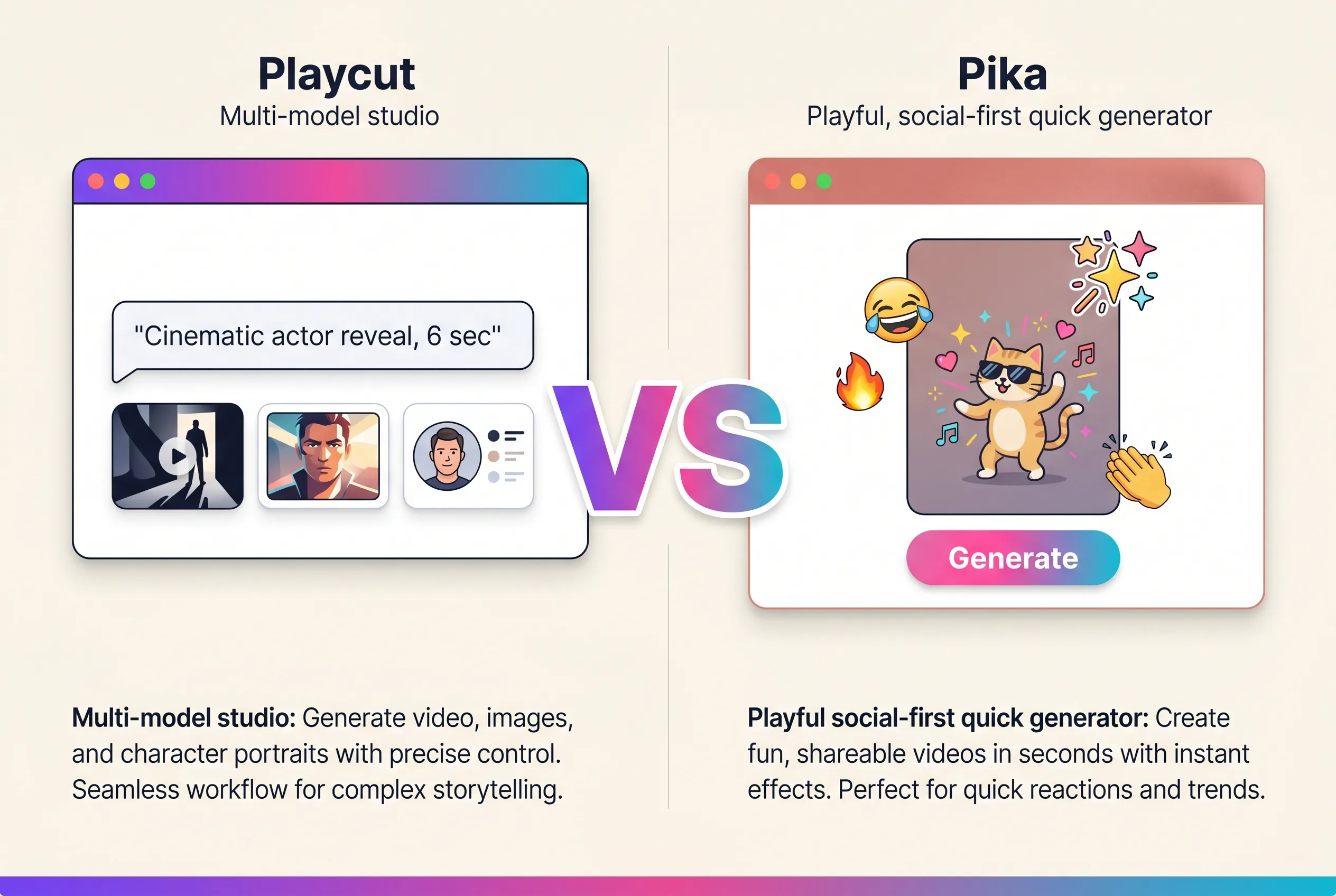
Playcut vs Pika is the comparison every creator runs when choosing between cinematic AI studio software and a fast, stylized AI video generator. Both ship great output. Both have growing communities. But they’re built for different jobs.
This guide compares Playcut and Pika across models, generation quality, pricing, workflow, and team features — so you can pick the one that matches your work.
Table of Contents
- Quick Comparison Table
- Models & Generation Quality
- Pricing
- Workflow & Community
- Team & Workspace Features
- Brand Kits & AI Actors
- Image Generation
- Use-Case Fit
- Verdict
- Frequently Asked Questions
Quick Comparison Table
| Feature | Playcut | Pika |
|---|---|---|
| Cinematic video model | Google Veo 3.1 | Pika 2 |
| Image generation | Nano Banana 2 + Nano Banana Pro + Grok Imagine | — |
| Reference-style video | Yes | Yes (Ingredients) |
| Lip sync | Via providers | Yes |
| Sound effects | — | Yes |
| AI actor library | Yes (Photoshoot + Act pipeline) | — |
| Workspaces & team folders | Yes | — |
| Multi-brand brand kits | Yes | — |
| Starting paid tier | $9/mo (Hobby) | $8/mo (Standard, annual) |
| Free tier | — (7-day trial instead) | 80 cr/mo, 480p only |
| Community | In-product | Discord-first |
Models & Generation Quality
Playcut: Multi-Model Studio
Playcut routes video to Google Veo 3.1 (premium) and Grok Imagine Video (budget) — strong motion fidelity, long-shot coherence, prompt adherence. For images, it routes to Nano Banana 2, Nano Banana Pro (4K flagship), and Grok Imagine (budget). Voice runs through Qwen, Inworld, or Gemini TTS; music through Lyria 3.
This means you can do cinematic Veo 3.1 video in the morning, photorealistic 4K Nano Banana Pro stills in the afternoon, and reference-driven AI actor shots for social — all in the same workspace, all on one credit ledger.
Pika: Pika 2
Pika is built on its in-house Pika 2 model. Strong creative output, especially for stylized and social-friendly clips. Pika has shipped fun features — sound effects, lip sync, scenes (multi-shot), Ingredients (reference-based generation).
The catch: it’s one model. Cinematic motion fidelity at the high end usually loses to Veo. Long-shot coherence is weaker.
Verdict on Models
For cinematic motion and long-shot coherence: Playcut (Veo 3.1). For fast, stylized, social clips with built-in lip sync and SFX: Pika is genuinely fun and the community has built strong prompt patterns. Different goals, different winners.
Pricing
Playcut Pricing (v2 — launched 2026-05-27)
| Plan | Price | What you get |
|---|---|---|
| Hobby | $9/mo | 500 credits, 3 custom AI actors, 1 seat, every model |
| Pro | $29/mo | 2,000 credits, 10 custom actors, 1 seat, every model + Act pipeline |
| Studio | $79/mo | 6,000 credits, 25 custom actors, 4 seats ($19.75/seat), shared workspace |
| Agency | $149/seat/mo | 10,000 credits/seat, unlimited custom actors, unlimited seats, multi-brand kits |
Annual billing saves 17% (2 free months).
Pika Pricing (verified 2026-05-27)
| Plan | Price | What you get |
|---|---|---|
| Free | $0 | 80 credits/mo, 480p only |
| Standard | $8/mo | 700 credits (annual billing) |
| Pro | $28/mo | 2,300 credits (annual billing) |
| Fancy | $76/mo | 6,000 credits (annual billing) |
Cost Verdict
Pika Standard at $8/mo is $1 cheaper than Playcut Hobby at $9/mo on raw entry price — and Pika’s Free tier (80 credits/mo, 480p) is a real on-ramp. For a solo creator who only wants to play with stylized single-model AI video, Pika Standard is the cheapest paid surface.
But Playcut Hobby’s $9 ships every Playcut model — Veo 3.1 video, Grok Imagine Video, Nano Banana Pro 4K images, voice via Qwen/Inworld/Gemini TTS, music via Lyria 3 — plus 3 custom AI actors with the Photoshoot and Act pipeline. Pika’s $8 Standard is single-model video at 700 credits with no actor system, no image flagship, and no voice/music routing. For $1 more, Playcut Hobby is a full multi-modal studio. At Pro, the two are essentially matched on price ($29 vs $28); Playcut Pro adds the AI Actor library, Act pipeline, image, voice, and music. See our Playcut pricing guide for the full breakdown.
Workflow & Community
Playcut: In-Product Studio
Playcut’s workflow lives inside the product. One chat surface, multi-model routing, takes saved to your workspace. Brand kits and AI actors are wired into the chat. Team folders organize generations.
Pika: Discord-First, Community-Driven
Pika’s gravity is in Discord — that’s where the community shares prompts, hacks, and clip examples. The product itself is more conventional, with the model running on the website. The cultural energy is in the community, not the studio.
For solo creators who learn through community, Discord-first is a real positive. For teams shipping client work, Discord-first is friction.
Team & Workspace Features
Playcut
Workspaces hold:
- Team folders (shared)
- Private folders (per-user, auto-created)
- Multi-brand brand kits
- AI actor library
- Workspace-shared voice library
- Creator-only mutation rules
This is built for agencies and teams — five people working on three brands in one workspace, no stepping on each other.
Pika
Pika doesn’t have a workspace architecture. Generations live in your account, you can share clips, but there’s no folder-level organization, no brand kit abstraction, no shared library. Built for solo creators.
Verdict: Playcut wins for teams. Pika doesn’t compete here.
Brand Kits & AI Actors
Playcut
Multi-brand brand kits per workspace. Tag a kit on any generation. Brand colors, typography, logos, and voice travel with every prompt.
AI actors are reusable: generate a character once, reuse across shoots. Library is workspace-shared, so the whole team pulls from the same character set.
Pika
Neither feature exists in Pika. You’d rebuild references and characters every project.
Verdict: Playcut wins. This is the agency unlock.
Image Generation
Playcut
Image generation routes to Nano Banana 2, Nano Banana Pro (4K flagship), and Grok Imagine (budget) — high quality, broad use cases (hero images, product stills, mood boards, reference inputs for video prompts), up to 16 reference images per generation.
Pika
Pika is video-first. Image generation is not a meaningful capability. If you need stills, you’d use a different tool and import.
Verdict: Playcut wins clearly.
Use-Case Fit
Pick Playcut if:
- You’re a creator, marketer, or agency shipping across image AND video AND voice AND music.
- You want cinematic motion and longer-shot coherence (Veo 3.1).
- You need workspaces, brand kits, or AI actor reuse.
- You want one studio for everything on one credit ledger, starting at $9/mo.
- You’re shipping client work and need team architecture.
Pick Pika if:
- You’re a solo creator playing with AI video for fun or social.
- You want fast, stylized output with a strong community.
- You’re on the cheapest possible paid tier ($8/mo Standard) and only need single-model video.
- You’re already plugged into Pika’s Discord and prompt culture.
Verdict
Pika is fun. Playcut is production.
If you’re a solo creator making short stylized clips for TikTok or X, Pika is genuinely great and the community is a real asset. If you’re a creator, marketer, or agency shipping cinematic video and image content at any meaningful scale, Playcut’s multi-model studio, team workspaces, and brand kits are the better fit.
Try Playcut → — pick a plan, card required, cancel anytime within the 7-day trial.
Frequently Asked Questions
Is Playcut better than Pika?
Playcut and Pika serve different needs. Pika is optimized for solo creators wanting fast, stylized video output through a Discord-first community. Playcut is a multi-model studio built for teams and agencies. If you want quick fun clips, Pika. If you want studio-grade cinematic output and team workflow, Playcut.
How does Playcut pricing compare to Pika?
Pika (annual, verified 2026-05-27): Standard $8 (700 cr), Pro $28 (2,300 cr), Fancy $76 (6,000 cr), plus a Free tier (80 cr/mo, 480p). Playcut v2: Hobby $9, Pro $29, Studio $79, Agency $149/seat. Pika Standard $8 is $1 cheaper than Playcut Hobby $9, but Hobby ships every Playcut model (Veo 3.1, Nano Banana Pro 4K, Grok video, voice, music) plus 3 custom AI actors — Pika Standard is single-model video only with no actor system.
Does Pika support image generation?
Pika is video-first and does not have meaningful standalone image generation. Playcut routes images through Nano Banana 2, Nano Banana Pro (4K flagship), and Grok Imagine — high-fidelity stills, up to 16 reference images per generation, strong prompt understanding.
Can my team use Playcut together?
Yes. Playcut workspaces support shared Team folders, per-user Private folders, multi-brand brand kits, and a workspace-shared AI actor library. Pika has no team workspace architecture.
Which has better cinematic motion — Playcut or Pika?
Playcut routes cinematic video to Google Veo 3.1, which generally outperforms Pika 2 on motion fidelity, prompt adherence, and longer-shot coherence. Pika excels at fast, stylized, social-friendly output.
Conclusion
For solo creators who want to play with AI video and have fun with the Pika community, Pika is a great fit at a low price. For teams, agencies, and creators shipping production content, Playcut wins on model quality, image generation, team architecture, brand kits, and AI actor reuse.
Start your Playcut 7-day trial → — pick a plan, card required, cancel anytime within the 7-day trial.
Next steps: Read What Is Playcut? for the full overview, or compare against Runway, Kling, and Sora.