
Pixelcut AI vs Playcut AI: Different Tools, Different Jobs (2026)
Pixelcut and Playcut sound similar enough that people Google one when they meant the other. The names rhyme, both ship AI tools, and both surfaced in 2026 search results for “AI photo and video” queries. They are different companies, building different products, for different jobs.
This pixelcut vs playcut breakdown is the short, honest version: what each tool does, who each one is for, and how to tell which one you actually wanted. No FUD against either side. One is a strong mobile-first toolkit; the other is a professional studio. The rest of this article shows where each one fits.
In a hurry?
Pixelcut is a mobile-first photo and casual AI toolkit for solo creators and ecommerce sellers, while Playcut is a professional AI video and image studio for brand campaigns and agencies. The Playcut Actor Engine holds 100% character consistency across stills, motion video, UGC ads, and on-product compositing, which is the job Pixelcut does not target. Jump to the routing table or the side-by-side matrix to see which fits your work.
Pixelcut and Playcut are not the same company
Pixelcut and Playcut are two separate companies building two different tools that happen to share a similar name. Pixelcut is co-founded by Dominique Yahyavi (CEO) and Prasanth Veerina, founded in 2022 and headquartered in Oakland, California, with a $250K seed from AI Grant (PR Newswire, March 3, 2026). The product is a mobile-first photo and casual AI toolkit used by 70M+ creators worldwide.
Playcut is built by Blox Labs Inc. as a chat-driven AI video and image studio for brand campaigns and agencies. For the full product picture, see what Playcut is and isn’t. With the names cleared up, the rest of this article covers what each tool actually does and which one matches the job you brought.
What Pixelcut does best
Pixelcut is the right call when the job is fast, mobile, and photo-led. Seventy million-plus creators use it to remove backgrounds, drop products into ready-made scenes, upscale to 16K, and now lip-sync casual AI talking-head clips — all from a 4.7-star iOS app or the free no-watermark web tool. That depth of mobile-first ecommerce tooling is genuine, and Playcut doesn’t compete on it.
The mobile dominance is real. Pixelcut ships a 4.7-star iOS app from 214K reviews (App Store) and a 4.2-star Android app with 10M+ installs (Google Play). The product is designed for thumb-driven editing in a checkout line, not a desk session.
Scale matches the ratings. Pixelcut reports 70M+ creators, 15M monthly active users, and 100M+ images processed each month (PR Newswire, March 3, 2026). That reach is earned, and it ranks among the largest AI photo platforms in the category.
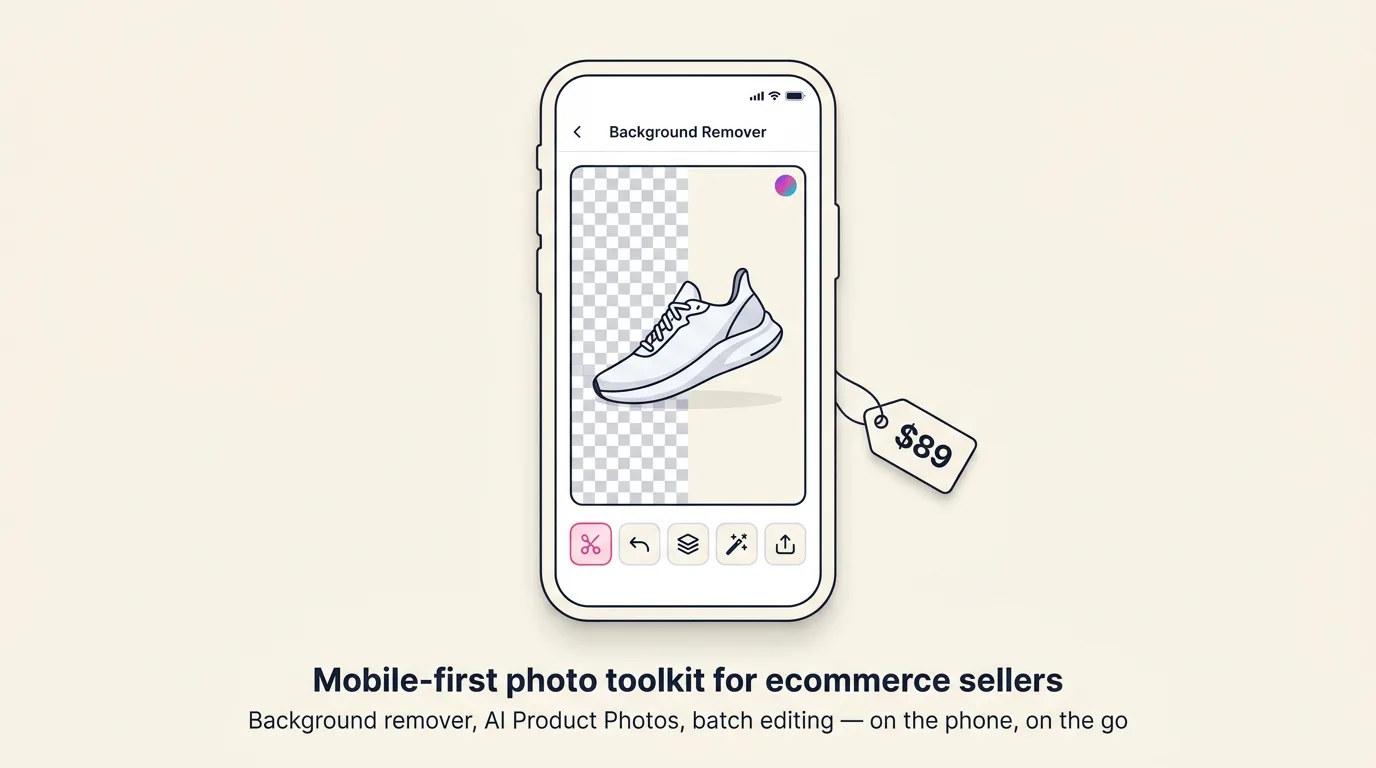
The product surface is photo-led. Pixelcut ships a free Background Remover with no watermark, Magic Studio for AI Product Photos optimized for Shopify, Etsy, and Amazon sellers, an Image Upscaler that reaches 16K, and Uncrop for outpainting beyond original edges. The whole flow is built around listing prep.
Pixelcut also shipped AI Actors with multi-language lip-sync and short AI Video generation in 2026, routing Google Veo 3 for video and FLUX.2 for stills (Morphed review, 2026). These features are positioned as casual mobile capabilities for solo creators, not professional brand-studio tooling.
Pricing is accessible. Pixelcut runs a generous free tier, Pro $10/mo ($8 effective with annual billing), and Business $30/mo ($24 effective with annual billing) with batch processing up to 100 files per job on Pro (Pixelcut pricing). That entry price is a genuine strength for solo sellers shipping listings on a tight budget.
What Playcut does best
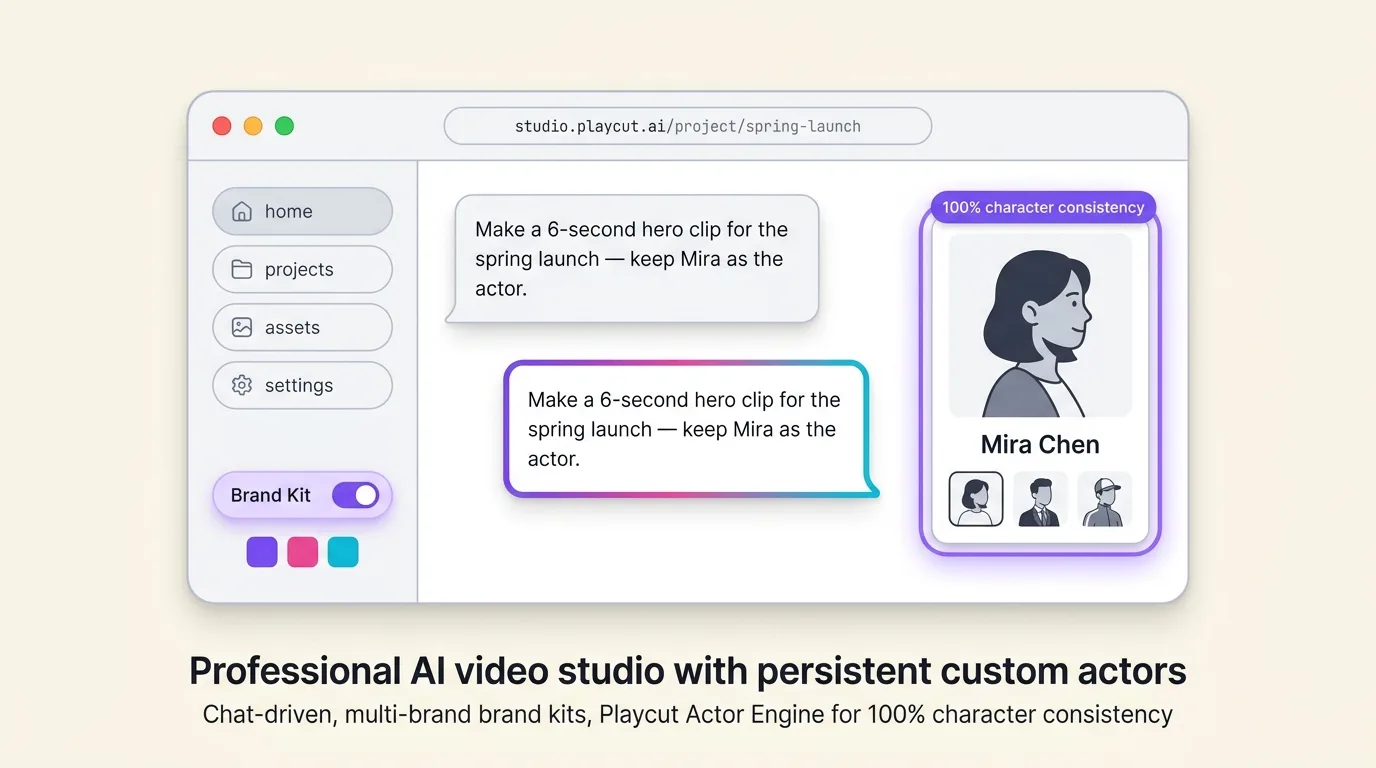
Playcut is the right call when the job is a custom-actor brand campaign that has to ship across stills, motion video, UGC ads, and on-product compositing without the face changing. The Playcut Actor Engine holds 100% character consistency across a tested 10-product brief, and multi-brand brand kits, agency seats, and the MCP server let one workspace run many clients. Pixelcut is excellent at photos; this is a different job.
The Actor Engine is the wedge. It binds appearance, voice, and wardrobe into a persistent runtime profile that re-casts identically across every generation. In a head-to-head 10-product brief tested against Lalaland, Botika, Arcads, HeyGen, and Flair.ai, Playcut was the only studio that did not drift — see the AI actor consistency holdout test and the Playcut custom actor builder for the methodology and the live tool.
The Playcut Voice Engine handles cloning, voice design, and lip-sync across 30+ languages on Solo and above. That is the matching half of identity: appearance from the Actor Engine, voice from the Voice Engine, then a single profile that re-uses across formats. Pixelcut’s lip-sync is mobile-first; the Voice Engine is studio-tier.
The image studio is the surface that overlaps most with Pixelcut’s photo work. Playcut routes Imagen, Gemini, and fal.ai providers for editorial stills, on-product compositing, and reference-anchored batches of 12 editorial scenes per SKU. See the Playcut image studio for the full surface, including 8 photographer-style filters.
Multi-brand brand kits per workspace store colors, typography, logos, and brand voice per client. Team adds 4 seats; Agency adds unlimited seats with 500GB per seat. The workspace primitive is built for agencies juggling 5+ brands without rebuilding actors or kits for each campaign.
The MCP server ships 37 tools across 8 categories (actors, images, videos, voice, assets, brand kits, sessions, batch), with a REST API at api.playcut.ai, free during open beta. That is the AI-agent automation lane Pixelcut’s REST API does not match, since Pixelcut has no documented MCP server.
Pricing is flat per seat. Solo $19/mo ships 1,500 credits, 5 custom actors, and 1 seat; Team $49/mo ships 4,000 credits, 25 custom actors, and 4 seats; Agency $99/seat/mo ships 7,500 credits per seat, unlimited actors, and unlimited seats. Every plan includes a 7-day full-feature trial. For the full studio overview, see the full Playcut studio overview.
Which tool fits your job
The routing comes down to the job you brought, not which tool is “better.” The 8-row table below is built from primary product audits — Pixelcut’s public materials and Playcut’s source-of-truth documentation, not opinion. Pick the row that matches the job on your calendar this week. Both tools earn an “Ideal” verdict on the jobs they were designed for, and both get an honest “Not built for this” call where the surface stops.
| Job-to-be-done | Pixelcut | Playcut | Pick |
|---|---|---|---|
| Remove the background from one product photo for a Shopify listing | Ideal — free no-watermark BG remover, 3 free removals/day, HD PNG export, no signup | Not built for this — plan-gated, no standalone free BG tool | Pixelcut |
| Create a consistent AI brand actor for a 30-spot UGC campaign | Not built for this — AI Actors feature ships with lip-sync, but no documented consistency methodology across 10+ shots | Ideal — the Actor Engine holds the same face across the 10-product holdout test | Playcut |
| Batch-generate 50 product mockups for an Etsy seller | Ideal — AI Product Photos with a dozen+ scene styles, batch up to 100 files on Pro at $10/mo | Works — Playcut does one-photo-to-12-editorial-scenes per SKU, but at Solo $19/mo and without ecommerce-template presets | Pixelcut for the casual seller; Playcut if the same actor or brand kit needs to thread through the scenes |
| Run a multi-brand agency workflow with 5+ client accounts | Not built for this — Business gives 10 team seats but no multi-brand brand-kit system in public materials | Ideal — multi-brand brand kits per workspace, Agency $99/seat/mo with unlimited actors and unlimited seats | Playcut |
| Make a quick lip-sync AI talking-head video on a phone | Ideal — AI Actors with multi-language lip-sync inside the 4.7-star iOS / 4.2-star Android apps used by 70M+ creators | Not built for this — Playcut is web/MCP/API only, no native mobile app | Pixelcut |
| Build a cinematic AI brand film with custom actors and on-product compositing | Not built for this — Pixelcut’s video output is short ad/social format via Veo 3, not cinematic brand film | Ideal — Playcut routes for cinematic motion, holds the same actor identity across stills + motion + UGC + on-product | Playcut |
| One-off profile picture clean-up and headshot enhancement | Ideal — dedicated Profile Picture Maker, AI Cleanup, and up to 16K image upscale on mobile + web | Not built for this — Playcut is brand-and-agency, not a consumer headshot tool | Pixelcut |
| Image + video MCP / API for an automated content pipeline (Slack, n8n, Claude Code) | Works — REST API covers BG removal, upscale, BG gen, virtual try-on; no MCP server | Ideal — full MCP server with 37 tools across 8 categories, plus REST API at api.playcut.ai | Playcut |
If two or more rows above describe your work, the table has answered the question. If the closest match sits between casual mobile output and cinematic brand-campaign output, lean toward whichever tool already serves the rest of your stack. For readers whose job is closer to cinematic AI video than to anything in this table, see the 8-tool Playcut alternatives roundup for a wider comparison set.
Side-by-side quick reference
Same facts as the routing table, organized by feature axis. Use this when you already know roughly which tool you want and need to confirm a specific dimension before signing up.
| Dimension | Pixelcut | Playcut |
|---|---|---|
| Primary surface | Mobile-first photo + casual AI toolkit (iOS, Android, web) | Web studio for AI video + custom actors (chat-driven, MCP, REST API) |
| Custom AI actor with persistent identity | AI Actors / Personas feature with multi-language lip-sync; consistency methodology not publicly documented | Playcut Actor Engine — 100% character consistency tested across a 10-product brief vs Lalaland, Botika, Arcads, HeyGen, Flair.ai |
| AI video generation | Short-form clips via Veo 3 (image-to-video, animate, video BG removal) | Cinematic + UGC + actor video routed across multi-model — up to 4K, with extensions and interpolation |
| Mobile app | iOS 4.7-star (214K reviews) + Android 4.2-star (10M+ installs) | None — web + MCP + API |
| Multi-brand brand kits / agency seats | No multi-brand kit system; 3 seats on Pro, 10 seats on Business | Multi-brand brand kits per workspace; Agency $99/seat/mo unlimited seats, unlimited actors, 500GB/seat |
| MCP server / API for AI agents | REST API (developer.pixelcut.ai) for BG removal, upscale, BG gen, virtual try-on; no MCP server | Full MCP server, 37 tools across 8 categories, plus REST API at api.playcut.ai; free during open beta |
| Free tier limits | Free with 3 BG removals/day, 1 AI BG gen/day, watermarked AI ad/video; no batch on free | No free generation tier; free creator tools at /tools plus 7-day trial on every plan |
| Entry paid tier | Pro $10/mo monthly ($8/mo on annual), 600 AI credits/mo, 3 seats, 100-file batch | Solo $19/mo, 1,500 credits/mo, 5 custom actors, 3 voices, 1 seat, 100GB storage |
| Founders | Dominique Yahyavi (CEO) + Prasanth Veerina, founded 2022, Oakland CA, $250K seed (AI Grant) | Built by Blox Labs Inc |
| User scale / app ratings | 70M+ creators, 15M+ MAU, 100M+ images/month; 4.7-star iOS (214K), 4.2-star Android (225K) | Tested head-to-head against 5 named AI actor competitors with zero face drift across a 10-shot brief; cited as the only studio that held identity |
The matrix maps the routing decision to specific feature lines — pick the column whose rows describe your output. If you landed here from a Google search for “Pixelcut,” and the right-hand column describes work you don’t actually need, the search served you well. If the right-hand column describes the campaign on your calendar, start with the full Playcut studio overview or the 8-tool Playcut alternatives roundup to see how the studio sits against the wider category.